
Defining an Extinction Burst
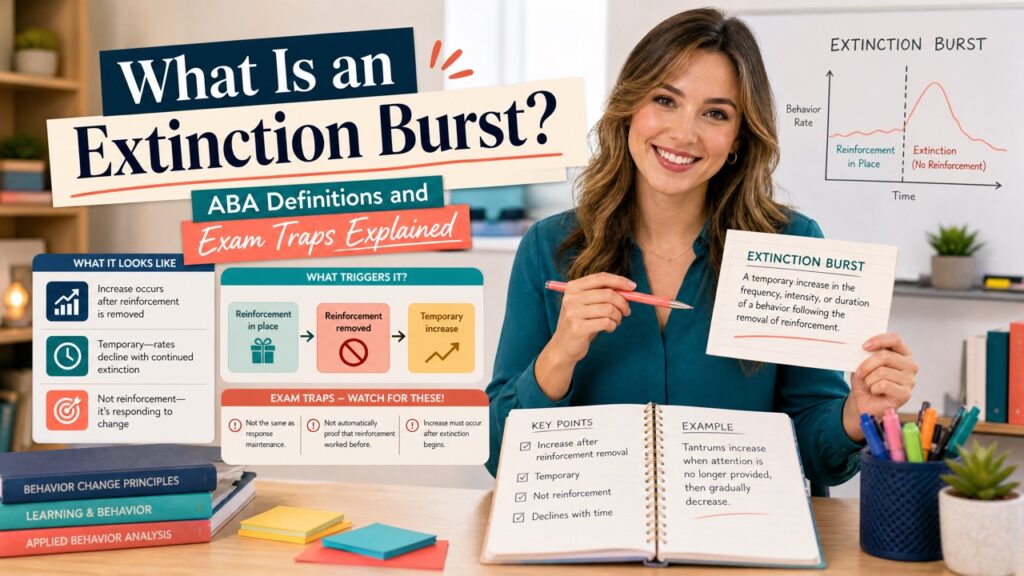
In applied behavior analysis, an extinction burst is a predictable and temporary increase in the frequency, intensity, or duration of a behavior that occurs immediately after reinforcement is withheld. It is a natural side effect of the extinction procedure, not a separate intervention. When a behavior that previously produced reinforcement suddenly no longer does, the learner often responds with a burst of the behavior as if testing whether the change is real.
Table of Contents
- Defining an Extinction Burst
- Classic Examples in ABA Practice
- Why Understanding Extinction Bursts Matters for the BCBA Exam
- Quick Checklist: Identifying an Extinction Burst
- Summary and Key Takeaways
- How to Study extinction burst for BCBA-Style Questions
- Take the Free BCBA Mock Exam
For BCBA exam preparation, it is essential to distinguish the extinction burst from extinction itself. Extinction is the procedure of discontinuing the reinforcement that maintains a behavior. The burst is the short-term reaction to that procedure. Recognizing this difference is critical because exam questions often test whether you can identify which part of the scenario represents the burst versus the ongoing extinction process.
What Exactly Is an Extinction Burst?: Technically, an extinction burst is defined as a temporary increase in the rate or magnitude of the behavior when reinforcement is no longer delivered. It may also include new or more varied topographies of behavior, sometimes called extinction-induced variability. For example, a child who previously asked for a toy politely may start screaming or grabbing after the request is ignored.
This burst is not a sign that extinction is failing. In fact, it is often a sign that the learner has noticed the change in contingency and is increasing effort to re-obtain the reinforcer. Clinically, this means practitioners must persist through the burst to avoid accidentally reinforcing a more intense behavior.
Classic Examples in ABA Practice
To master the concept, it helps to see how extinction bursts appear in real scenarios. These examples follow the ABC format (Antecedent, Behavior, Consequence) and include the hypothesized function of the behavior, which is a common way exam questions are structured.
Example 1: Tantrum in a Classroom: Antecedent: A teacher ignores a student’s request for attention. Behavior: The student begins to whine more loudly, then escalates to a full tantrum with crying and feet stomping. Consequence: The teacher continues to ignore the behavior. The hypothesized function is attention. Why does the burst occur? The student is increasing the intensity of the behavior in an attempt to gain the teacher’s attention, which previously worked.
Example 2: Escape from Task: Antecedent: A student is given a math worksheet. Behavior: The student starts whining, complains, and attempts to leave the desk. Consequence: The teacher does not allow escape and continues to prompt the student to work. The hypothesized function is escape from demands. The burst here is the increased whining and escape attempts, which are more intense than the previous behavior.
Example 3: Access to Preferred Item: Antecedent: A child sees a tablet on a high shelf but cannot reach it. Behavior: The child points to the tablet, then begins crying, and finally reaches and screams. Consequence: The parent does not give access to the tablet. The hypothesized function is tangible access. The burst is the rapid escalation from pointing to screaming when access is denied.
Why Understanding Extinction Bursts Matters for the BCBA Exam
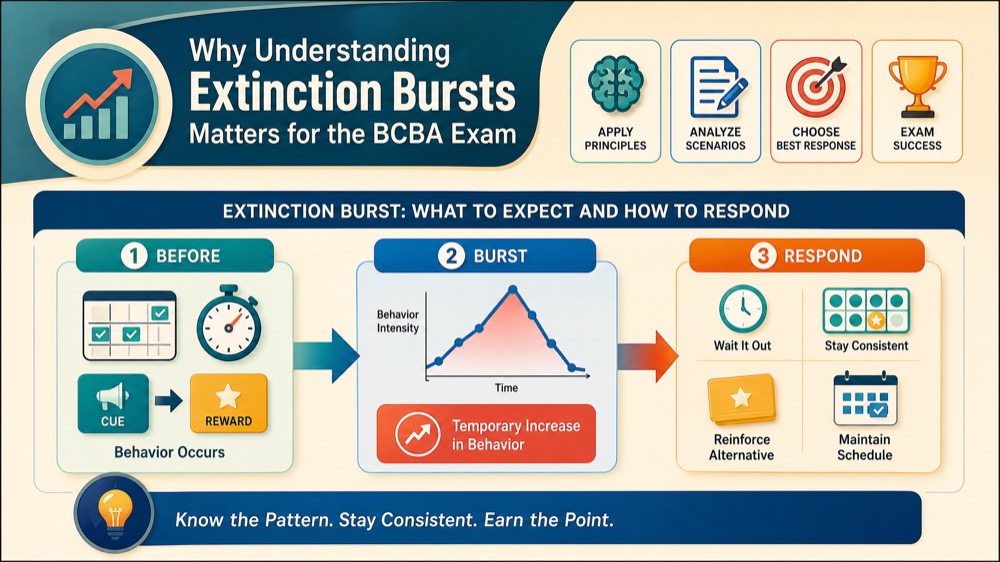
On the BCBA exam, questions about extinction bursts test your ability to apply behavioral principles to clinical scenarios. You need to know not only the definition but also how to respond when a burst occurs. The exam often presents a situation where a practitioner stops reinforcing a behavior and then sees an increase in that behavior—your task is to identify it as an extinction burst and choose the appropriate next step.
Understanding this concept also connects to other principles like reinforcement schedules and procedural integrity. For instance, a behavior on an intermittent schedule of reinforcement is more resistant to extinction, and the burst may be more pronounced. This knowledge helps you make data-based decisions and avoid common clinical errors.
Common Exam Traps and Misconceptions: Many students miss the question because they confuse an extinction burst with spontaneous recovery. Spontaneous recovery is the reappearance of a behavior after extinction has been in place for a while and the behavior has decreased. The burst occurs at the very beginning of extinction, not later.
- Trap 1: Thinking an extinction burst means extinction is not working. In truth, it is a sign the procedure is taking effect.
- Trap 2: Confusing it with a reinforcement effect. The burst is not due to reinforcement but to the sudden removal of reinforcement.
- Trap 3: Believing the burst always includes new behaviors. While extinction-induced variability is possible, it is not always present.
- Trap 4: Failing to persist through the burst and inadvertently reinforcing a more intense behavior. This is a common clinical error.
Using the Term Correctly in Answers: When writing or selecting answers, describe an extinction burst as a temporary increase in behavior when reinforcement is removed. Avoid saying “extinction burst” when you mean the extinction procedure itself. For example, an answer that says “the extinction burst occurred because the teacher stopped giving attention” is correct. An answer that says “the extinction burst is the procedure used to decrease behavior” is incorrect.
Quick Checklist: Identifying an Extinction Burst
Use this checklist when you encounter a scenario on the exam or in practice. It will help you quickly determine if what you are seeing is an extinction burst.
- Has reinforcement for the behavior been discontinued? (Extinction must be in place)
- Is the increase in behavior temporary and occurring shortly after extinction begins?
- Is the increase in frequency, intensity, or duration of the same behavior?
- Are there any new behaviors appearing that were not previously reinforced? (Variability)
- Is the behavior still decreasing over time if extinction is maintained?
- Is the function of the behavior clearly identified? (e.g., attention, escape, tangible)
If you can answer “yes” to most of these, you are likely looking at an extinction burst. Remember that the burst is a signal to maintain extinction integrity, not to change the intervention.
Summary and Key Takeaways
An extinction burst is a temporary increase in behavior that occurs when reinforcement is withheld. It is a normal part of the extinction process and should not be misinterpreted as a failure. Recognizing the burst is important for both clinical practice and the BCBA exam. Key points to remember:
- An extinction burst is a side effect of extinction, not a separate procedure.
- It may involve an increase in frequency, intensity, duration, or variability of behavior.
- It is not the same as spontaneous recovery, which occurs later.
- Persisting through the burst is essential to avoid accidentally reinforcing the behavior.
- Use the ABC format to analyze scenarios and identify the function of the behavior.
To deepen your understanding of related concepts, review our guide on extinction in ABA or explore reinforcement and extinction principles. For a broader perspective, check the BACB website for ethical guidelines on using extinction.
How to Study extinction burst for BCBA-Style Questions
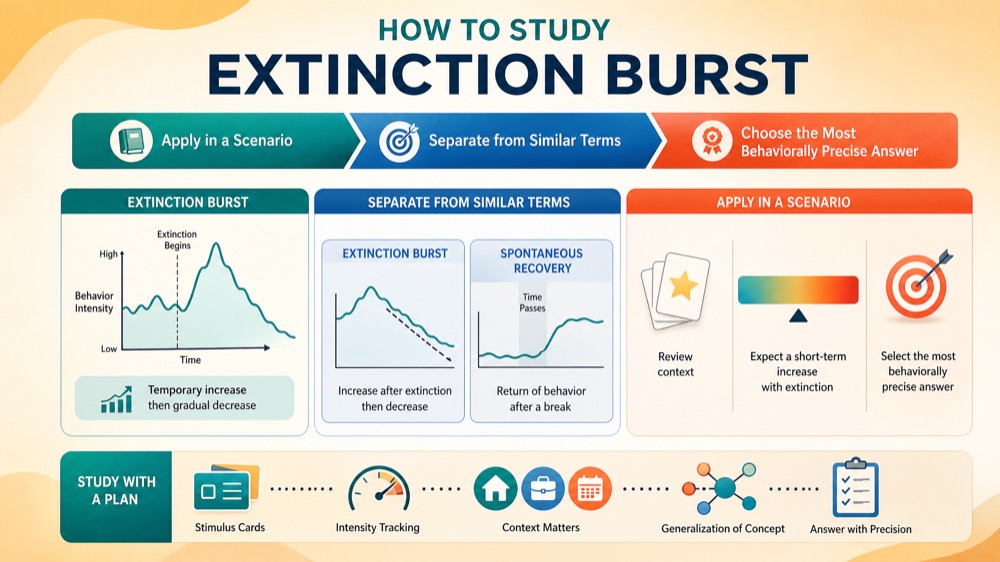
When you review extinction burst, do not stop at the definition. The exam usually tests whether you can apply the concept inside a short scenario, separate it from similar terms, and choose the most behaviorally precise answer. A strong study routine should connect the term to observable behavior, environmental context, measurement, and likely consequences.
- Define the response: identify exactly what the learner or client does, not just the broad skill area.
- Find the context: note the antecedent, setting, materials, people, or condition that makes the concept relevant.
- Check the consequence: ask what changes after the response and whether that change supports the answer choice.
- Compare close terms: write one sentence explaining why the best answer is not a related but different ABA concept.
For practice, turn each example into a quick discrimination exercise. Ask, “What would make this answer wrong?” and then change one detail in the scenario. This builds flexible exam reasoning instead of memorizing a single phrase.
Take the Free BCBA Mock Exam
Ready for more practice? Use the free mock exam to keep testing your accuracy with realistic BCBA-style items. Take the Free BCBA Mock Exam



