
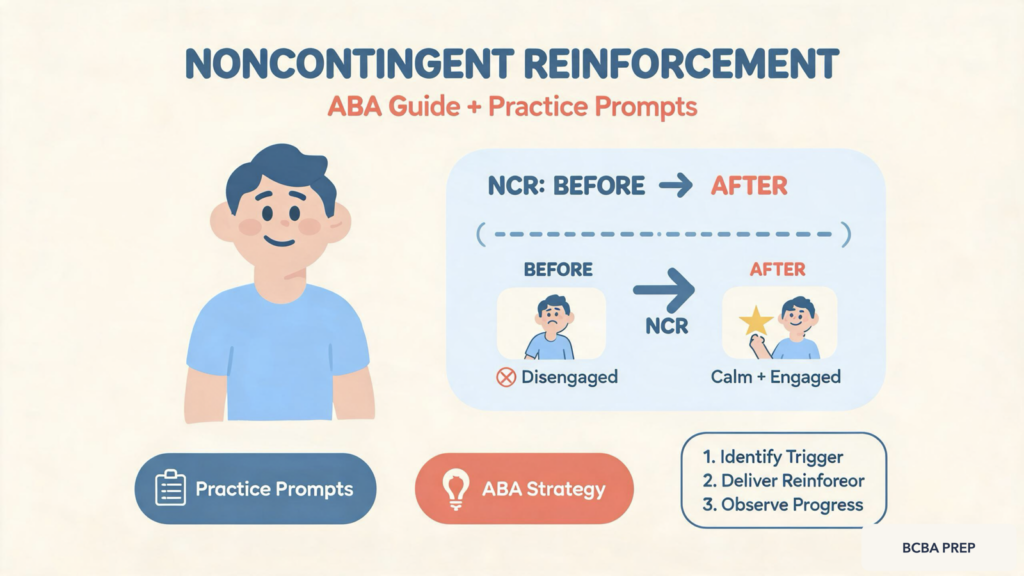
What Is Noncontingent Reinforcement?
Noncontingent reinforcement (NCR) is a procedure in applied behavior analysis in which a reinforcer is delivered on a fixed or variable time schedule, independent of the learner’s behavior. The goal is to reduce problem behavior by eliminating the motivation for it through free access to the reinforcer. This approach is commonly used to decrease behaviors maintained by attention, tangible items, or escape.
Table of Contents
- What Is Noncontingent Reinforcement?
- How Noncontingent Reinforcement Works: 3 Worked ABA Examples
- Exam Relevance: Why Noncontingent Reinforcement Appears on the BCBA Exam
- Quick Review Checklist for Noncontingent Reinforcement
- Summary and Practice Prompts
The key difference between noncontingent and contingent reinforcement is straightforward: in contingent reinforcement, the learner must emit a specific behavior to earn the reinforcer. In NCR, the reinforcer is provided on a time-based schedule, regardless of what the learner is doing. For example, a teacher might give a student attention every 2 minutes regardless of whether they are working or not, which can reduce the student’s need to seek attention through disruptive behavior.
NCR is considered an antecedent intervention because it alters the environment before the behavior occurs. It often includes an extinction component as well, which increases its effectiveness. However, the procedure must be carefully designed based on a functional assessment to correctly identify the reinforcer maintaining the problem behavior.
How Noncontingent Reinforcement Works: 3 Worked ABA Examples
Each example below uses an ABC format (Antecedent, Behavior, Consequence) and identifies the hypothesized function. NCR typically involves a fixed-time (FT) or variable-time (VT) schedule of reinforcement.
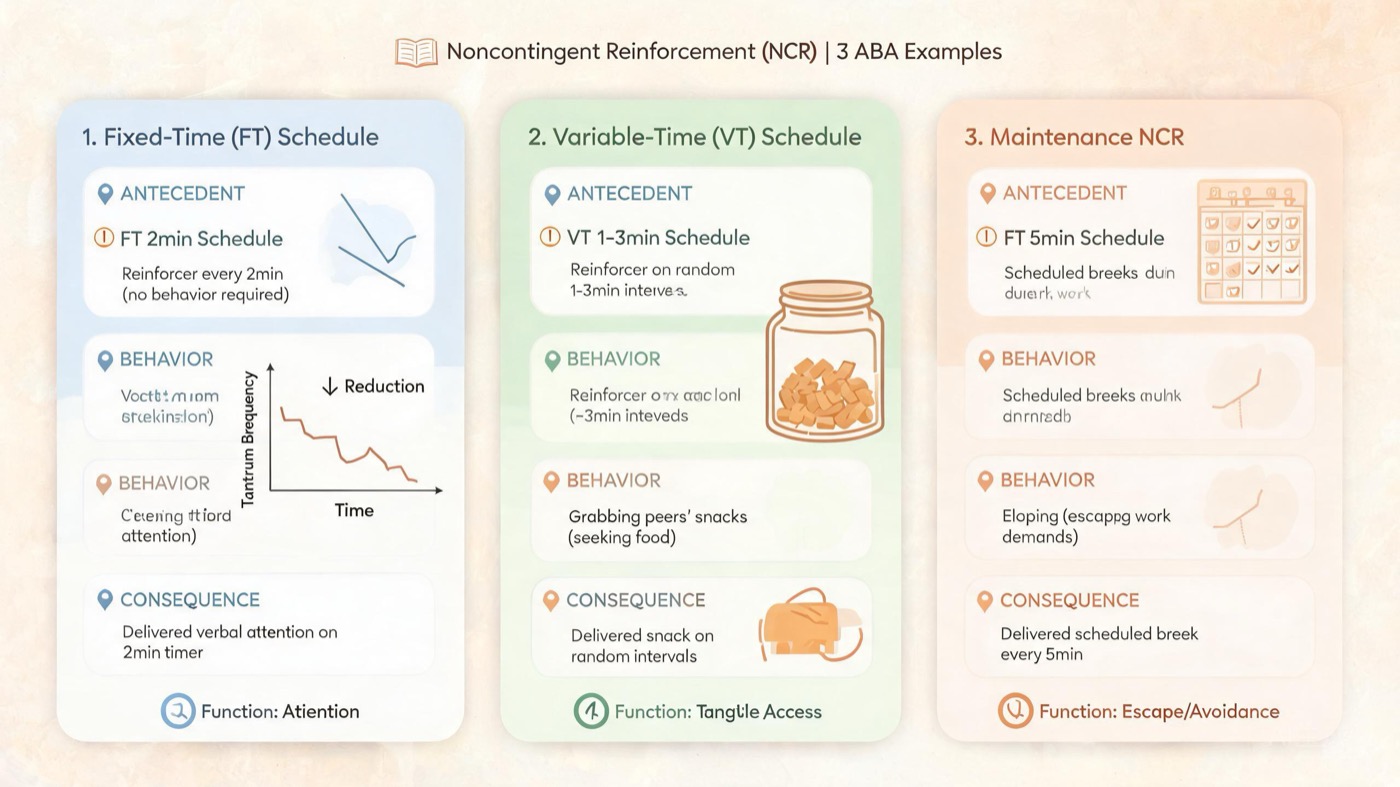
Example 1: Noncontingent Attention for Problem Behavior Maintained by Attention
A child hits peers to gain teacher attention. A functional assessment confirms the behavior is maintained by attention. The NCR procedure: The teacher provides attention (e.g., a brief verbal comment or physical proximity) on an FT 2-minute schedule, regardless of whether the child is engaging in appropriate or inappropriate behavior. The hitting gradually decreases because attention is now freely available and no longer contingent on hitting.
- Antecedent: Teacher is present, but not attending to the child.
- Behavior: Hitting peers (low rates after NCR implemented).
- Consequence: Noncontingent attention every 2 minutes; hitting is ignored (extinction).
- Hypothesized function: Access to attention.
Example 2: Noncontingent Access to Tangibles in a Classroom
A student screams to request a preferred toy. The function is access to tangibles. The teacher implements NCR by providing the toy for 30 seconds every 5 minutes on an FT 5-minute schedule, regardless of the student’s behavior. Screaming decreases as the toy is available regularly without requiring the student to scream.
- Antecedent: Student does not have the toy.
- Behavior: Screaming (reduced over time).
- Consequence: Toy delivered on FT 5 schedule; screaming does not produce toy.
- Hypothesized function: Access to tangibles.
Example 3: Noncontingent Escape from Demands
An individual engages in aggression to escape from task demands. The function is escape. The NCR procedure provides a 1-minute break from demands every 4 minutes (FT 4 schedule) regardless of behavior. During the break, the individual can engage in a preferred activity. Aggression decreases because escape is provided regularly without requiring aggression.
- Antecedent: Task demands are present.
- Behavior: Aggression (decreases).
- Consequence: Break on FT 4 schedule; aggression does not produce break.
- Hypothesized function: Escape from demands.
Exam Relevance: Why Noncontingent Reinforcement Appears on the BCBA Exam
The BCBA exam frequently tests NCR because it is a core intervention within the antecendent-based procedures category. You may see questions asking you to identify whether a described procedure is NCR, to select the appropriate schedule, or to recognize when NCR is contraindicated. Many test takers confuse NCR with extinction or think the reinforcer is being withheld instead of delivered freely.
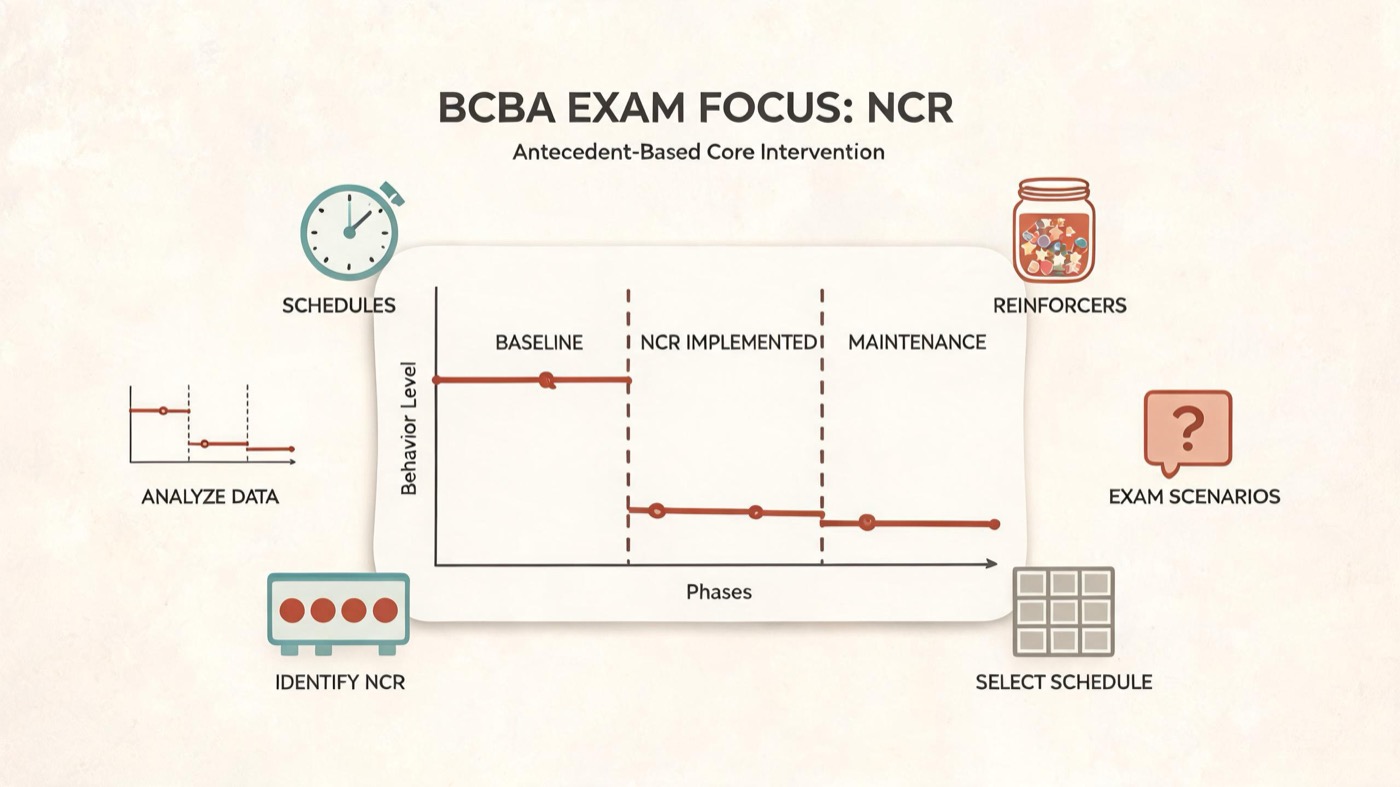
Common Exam Traps to Avoid
- Confusing NCR with extinction: NCR involves delivering the reinforcer; extinction involves withholding it. Both often go together, but they are distinct procedures.
- Misidentifying the reinforcer: If you choose the wrong reinforcer (e.g., delivering attention when the behavior is maintained by escape), NCR will not work and may even make things worse.
- Forgetting to specify the schedule: Exam questions often ask you to identify the schedule (e.g., FT 3 min). Be ready to distinguish between fixed-time (FT) and variable-time (VT) schedules.
- Thinking NCR is punishment: NCR is not punishment because it does not involve removing a stimulus to decrease behavior; it provides access to a reinforcer on a time-based schedule.
Quick Review Checklist for Noncontingent Reinforcement
Use this quick checklist to confirm your understanding for the BCBA exam:
- Identify the function of the problem behavior via functional assessment.
- Select the same reinforcer that maintains the behavior.
- Choose a time-based schedule (FT or VT) initially dense enough to compete with the behavior.
- Deliver the reinforcer on schedule regardless of behavior.
- Consider adding extinction for the problem behavior (if safe and ethical).
- Monitor behavior; thin the schedule gradually as behavior decreases.
- Document changes in behavior and adjust the schedule as needed.
Summary and Practice Prompts
Noncontingent reinforcement is a well-supported intervention that reduces problem behavior by providing free access to the maintaining reinforcer on a time-based schedule. Remember: the reinforcer must match the function, and the schedule must be independent of behavior. For deeper study, review the differential reinforcement guide or automatic reinforcement guide. Also see the BACB for official standards.
Practice Prompt 1
Scenario: A child hits to get teacher attention. The function is attention. How would you design an NCR procedure? State the schedule and the reinforcer. (Hint: Use an FT schedule and deliver attention as the reinforcer.)
Practice Prompt 2
Multiple choice: Which of the following is an example of noncontingent reinforcement? (A) A student receives a sticker every time they raise their hand. (B) A teacher gives a student a break after 3 minutes of on-task behavior. (C) A child receives attention every 4 minutes regardless of behavior. (D) A parent removes a toy after problem behavior. (Hint: The correct answer is the one where the reinforcer is delivered on a time-based schedule independent of behavior.)



