
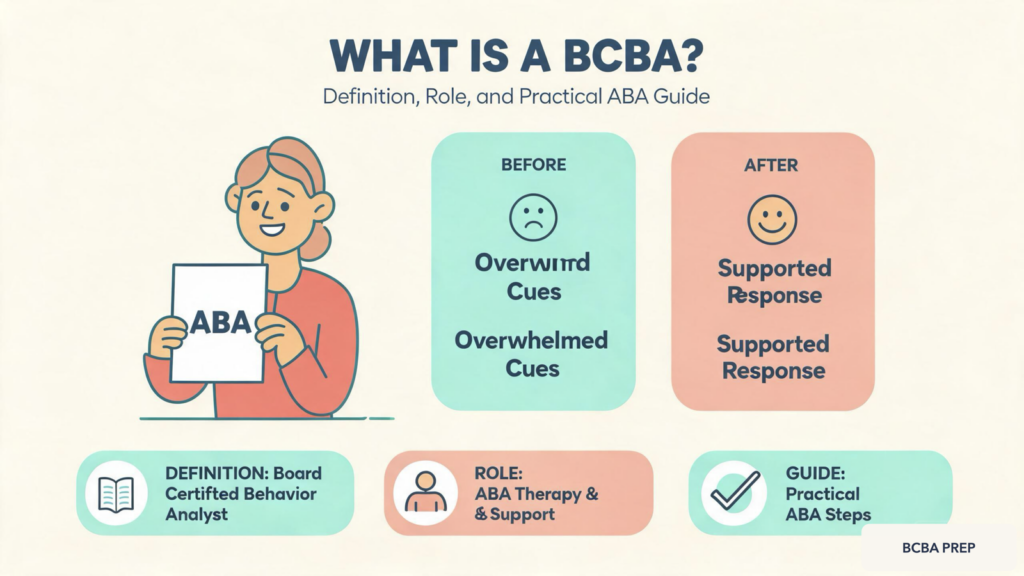
What Does BCBA Stand For?
A Board Certified Behavior Analyst (BCBA) is a graduate-level professional who applies the principles of applied behavior analysis (ABA) to improve socially significant behaviors. The BCBA credential, awarded by the Behavior Analyst Certification Board (BACB), signifies expertise in designing, implementing, and supervising behavior-analytic interventions. This certification is recognized across the United States and internationally, and it serves as a benchmark for competence in the field of ABA.
Table of Contents
- What Does BCBA Stand For?
- BCBA Certification Requirements
- What Does a BCBA Do? Real-World Examples
- Common Exam Traps and How to Avoid Them
- Quick Checklist for BCBA Exam Readiness
- Final Summary
Visit the BACB official site for more details.
Definition and Core Responsibilities
BCBAs conduct functional assessments, develop behavior intervention plans, and train caregivers and staff. They work in settings like schools, clinics, and homes, often with individuals diagnosed with autism spectrum disorder or other developmental disabilities. Their role is distinct from that of a BCBA-D (doctoral-level) or BCaBA (undergraduate-level). The BCBA supervises RBTs and BCaBAs, ensuring that behavior-analytic services are delivered with fidelity and ethical integrity.
BCBA Certification Requirements
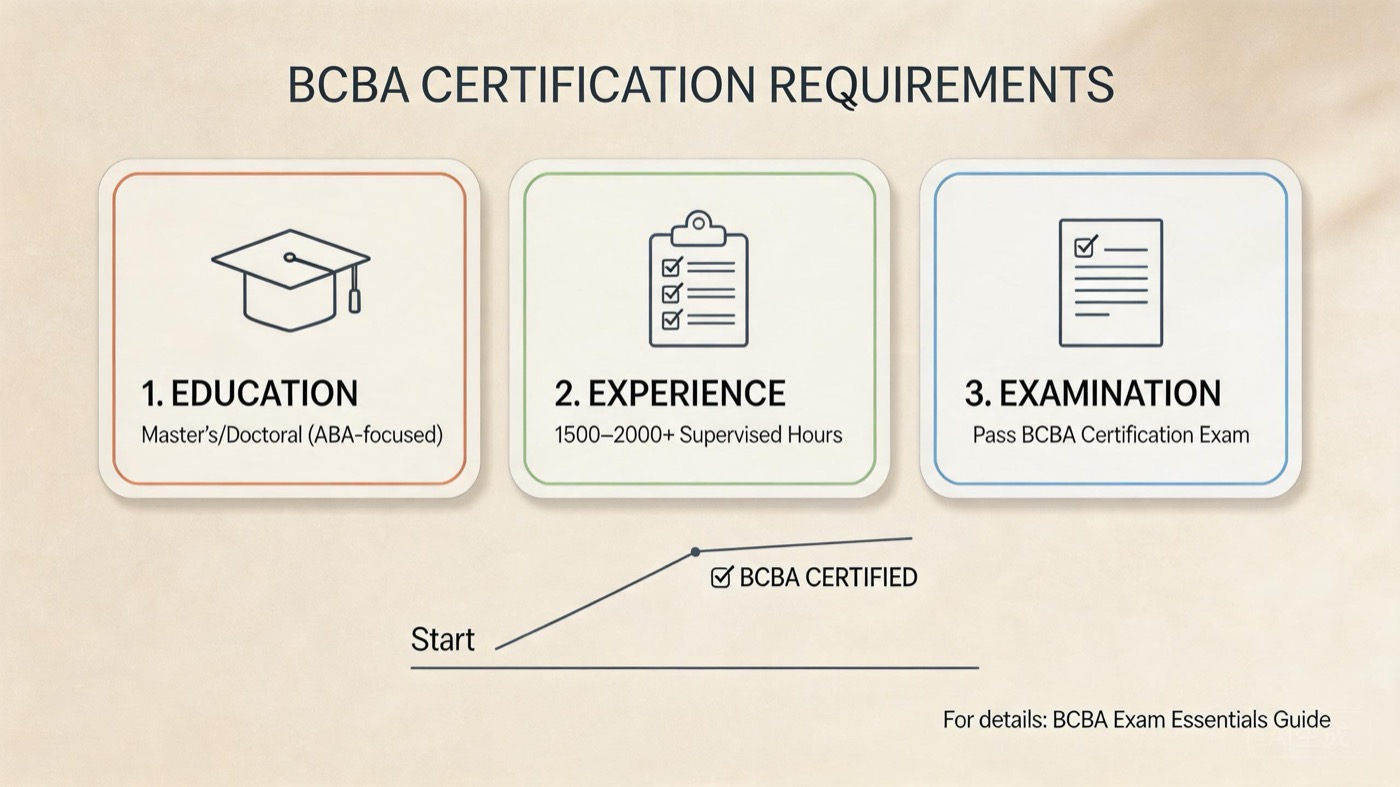
To become a BCBA, you must meet rigorous educational, experiential, and examination standards. Here are the key steps:
- Master’s Degree: Obtain a master’s degree from an accredited institution. Your program must include a verified course sequence covering BACB task list topics.
- Supervised Fieldwork: Complete 1,500 to 2,000 hours of supervised experience, depending on the option (supervised fieldwork, concentrated fieldwork, or practicum).
- BCBA Exam: Pass the computer-based exam administered by the BACB. The exam covers eight content areas, including measurement, assessment, intervention, and ethics.
For more details, check our guide on BCBA exam essentials.
Master’s Degree and Coursework
The BACB requires completion of a verified course sequence that includes topics like ethical and professional conduct, behavior assessment, and behavior-change procedures. Many universities offer ABA-specific master’s programs or post-graduate certificates. It is essential to confirm that the program you choose has its coursework verified by the BACB, as not all ABA-related programs meet the standard. Taking courses that align with the current BACB Task List (5th edition) is critical for exam preparation.
Supervised Fieldwork Hours
Supervised fieldwork must be overseen by a qualified BCBA or BCBA-D. Options include:
- Supervised Fieldwork: 2,000 hours (5% supervision per month)
- Concentrated Supervised Fieldwork: 1,500 hours (10% supervision per month)
- Practicum: Varies by university, typically 1,500–2,000 hours
These hours provide hands-on experience conducting assessments, designing interventions, and collecting data. Supervision must include direct observation of the trainee with clients, and at least 50% of supervision time must be individual. Many trainees opt for concentrated fieldwork to reduce total hours, but it requires a higher supervision frequency.
BCBA Exam: Structure and Content
The exam consists of 185 multiple-choice questions (150 scored) to be completed in 4 hours. Scores range from 0–500, with a passing score of 400. Topics are weighted according to the BACB’s test content outline. Content areas include: measurement, experimental design, behavior assessment, behavior change procedures, client-centered responsibilities, and ethical and professional conduct. The exam is known for its challenging scenarios that require clinical reasoning and application of ABA principles. Many test-takers find the ethics section especially demanding because it presents nuanced situations that require careful consideration of the BACB Ethics Code.
What Does a BCBA Do? Real-World Examples
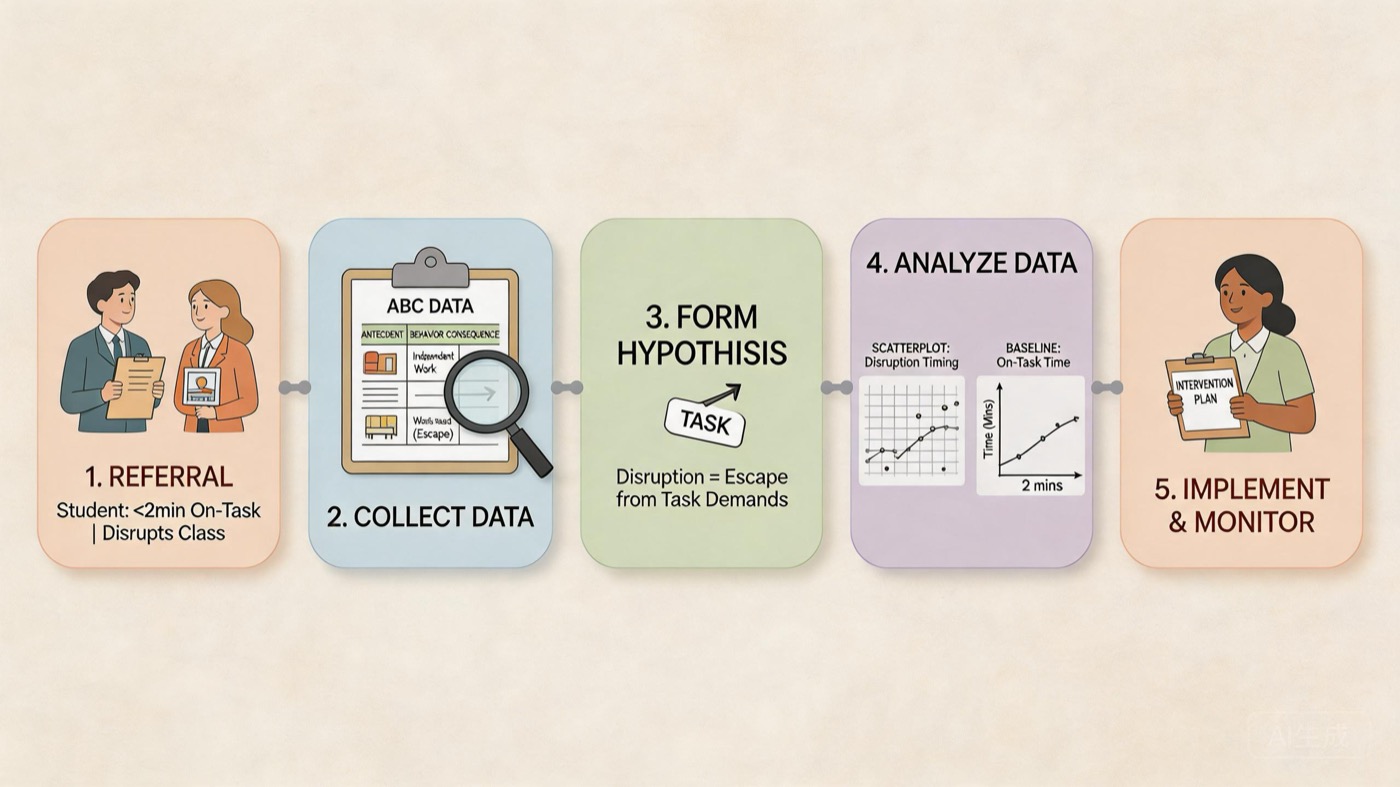
Understanding the day-to-day role of a BCBA can clarify how ABA principles are applied. Below are two common scenarios you might encounter on the exam or in practice.
Example 1: Increasing On-Task Behavior
A teacher reports that a student stays on task for only 2 minutes before disrupting class. ABC data shows the behavior occurs during difficult tasks, and the student often gains peer attention (function: attention). Intervention: Implement a differential reinforcement of alternative behavior (DRA) procedure, providing praise for every 3 minutes of on-task behavior, gradually increasing the requirement. The BCBA also trains the teacher to avoid delivering attention for off-task behavior and to prompt the student to request help appropriately, thereby teaching a replacement behavior.
Example 2: Reducing Aggression
A child hits peers when asked to transition from preferred activities. ABC data indicates that aggression consistently results in escaping the transition demand (function: escape). Intervention: Teach the child to request a break using a functional communication training (FCT) card, and reinforce that request with a brief delay before the transition. Over time, the delay is increased to build tolerance for longer work periods. This intervention is paired with a token economy that provides preferred activities after completing a set of tasks without aggression.
Exam Relevance: Interpreting ABC Data
On the BCBA exam, you will often be presented with ABC data and asked to hypothesize the function of behavior. Practice interpreting data from multiple contexts. Our guide to the four functions of behavior can help sharpen this skill. Additionally, be prepared to identify when data are insufficient or confounded, as exam questions may include distractors that lead to incorrect functional hypotheses if you are not careful.
Common Exam Traps and How to Avoid Them
Many test-takers make similar mistakes. Being aware of them can improve your score.
- Confusing BCBA with Similar Certifications: Know the differences: BCBA is master’s level; BCBA-D is doctoral; BCaBA is undergraduate; RBT is technician level. Each has distinct scope of practice. On the exam, scenarios might ask who is responsible for designing a behavior plan—always the BCBA (or BCBA-D).
- Misidentifying Functions of Behavior: Avoid jumping to conclusions. Base your hypothesis on clear ABC data, not assumptions. Use the four common functions: attention, escape, tangible, automatic. Watch out for questions where the consequence seems obvious but is not actually the maintaining variable—always refer to the data provided.
- Overlooking Ethics: Ethics scenarios appear throughout the exam. Remember to prioritize client dignity, informed consent, and least restrictive procedures. Also, be aware of dual relationships and conflicts of interest; if a scenario involves a BCBA supervising a family member or close friend, that is typically a violation.
- Misreading Measurement Questions: The exam often includes questions about which measurement system to use (e.g., frequency, duration, latency, interresponse time). Read the scenario carefully: if the behavior has a clear beginning and end, duration may be appropriate; if it is discrete, frequency might be best. Know the definitions and when to use each.
Quick Checklist for BCBA Exam Readiness
Use this list to gauge your preparation:
- Review all BACB task list items at least twice
- Complete a verified course sequence or equivalent
- Log and verify all supervised fieldwork hours
- Take at least 3 full-length timed practice exams
- Study ethics and professional conduct cases
- Master interpreting graphs and single-case designs
- Review experimental design concepts: reversal, multiple baseline, alternating treatments, changing criterion
- Practice identifying functions from narrative ABC data without leading prompts
For additional resources, explore our BCBA exam prep guide.
Final Summary
Becoming a BCBA requires dedication to education, supervised experience, and passing a rigorous exam. The credential opens doors to rewarding careers using ABA to enact meaningful behavior change. By understanding the role, certification pathway, and common pitfalls, you are better prepared for the journey ahead. Use the checklist above to track your progress and focus your study efforts. With consistent practice and review, you can confidently approach the exam and succeed.



