
Foundational principles in ABA include the ideas that explain how behavior changes in relation to its environment, how those changes should be measured, and how a behavior analyst selects a socially meaningful next step. The phrase is not one official BACB checklist, so the safest study guide separates behavioral principles, philosophical assumptions, ABA dimensions, and intervention procedures.
Table of Contents
- What Do Foundational Principles in ABA Include?
- What Are the 7 Core Principles to Know?
- How Are Principles Different From Procedures?
- How Do the Principles Guide an ABA Decision?
- How Do You Apply Them on the BCBA Exam?
- What Mistakes Should You Avoid?
- Foundational ABA Principles FAQ
- Sources and Date Check
- Take the Free BCBA Mock Exam
Students often type this keyword when a study question asks for the foundations of applied behavior analysis but does not say whether it wants philosophical assumptions, basic behavioral processes, or the defining dimensions of ABA. Those categories overlap, but they answer different questions. If you memorize one unlabelled list, you can recognize vocabulary and still miss the best answer in a scenario.
A stronger approach is to ask three things: what explains the behavior, what evidence shows that explanation, and what professional decision follows? That sequence keeps “reinforcement” from becoming a catch-all answer and keeps “evidence-based” from becoming a slogan without measurement.
What Do Foundational Principles in ABA Include?
In a study context, foundational principles in ABA include the basic relations and assumptions used to describe, predict, and influence behavior. Common examples include reinforcement, punishment, extinction, stimulus control, motivating operations, respondent conditioning, operant conditioning, and the role of environmental contingencies.
The foundation also includes a way of knowing. Behavior analysis relies on observable definitions, direct or appropriately selected measures, repeated observation, and data-based evaluation. Its applied use adds a responsibility to select goals that matter to the person and the people affected by the service. The current BACB sixth-edition Test Content Outline organizes examination tasks across behaviorism, concepts and principles, measurement, assessment, intervention, ethics, and other domains; it does not publish one page titled “the seven foundational principles.”
So, when an instructor or question stem uses the phrase, identify the category first. Is it asking for a behavioral process, a philosophical assumption, a dimension of ABA, a teaching procedure, or an ethical safeguard? That classification is often the real test.
What Are the 7 Core Principles to Know?
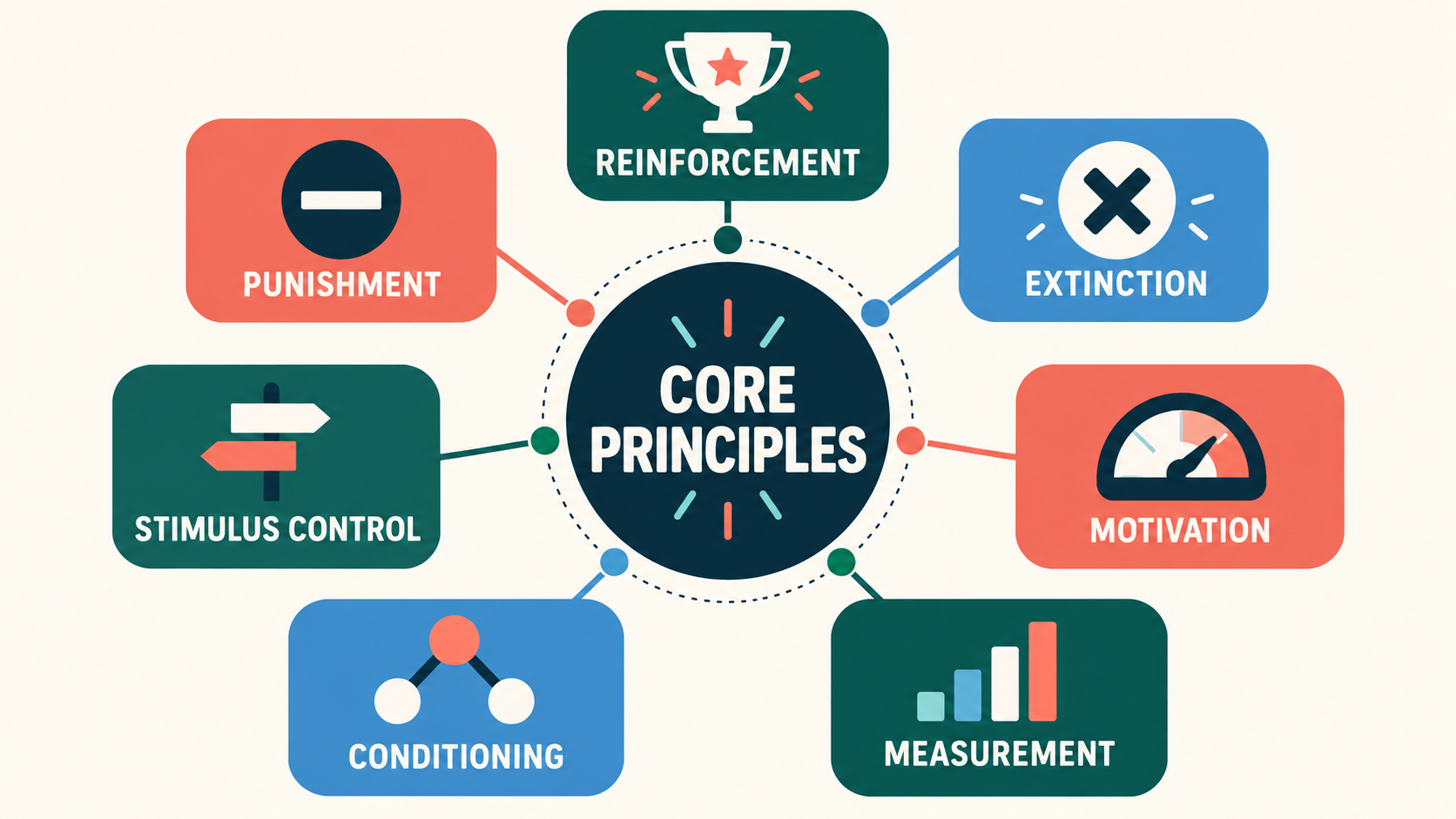
The following seven ideas form a useful study map. They are not a substitute for the complete TCO, but they help you organize the vocabulary that repeatedly appears in BCBA coursework and exam scenarios.
| Core idea | What it means | Exam cue |
|---|---|---|
| Operant behavior | Behavior is selected and maintained by its consequences and context. | Look at what follows the response and whether future responding changes. |
| Reinforcement | A consequence increases the future probability of the behavior it follows. | The defining feature is an increase, not whether the event feels pleasant. |
| Punishment | A consequence decreases the future probability of the behavior it follows. | Check the effect on future behavior before labelling positive or negative. |
| Extinction | A previously effective reinforcer is no longer delivered for the target response. | Identify the historical contingency and consider possible temporary changes in responding. |
| Stimulus control | A stimulus changes the likelihood of behavior because of a history of differential consequences. | Ask which cue signals reinforcement, nonreinforcement, or a different response requirement. |
| Motivating operations | Events alter the value of a consequence and momentarily affect behavior related to it. | Separate value-changing effects from cueing effects. |
| Measurement and function | Behavior must be operationally defined and evaluated in relation to relevant environmental variables. | Do not infer function from a label, impression, or one unverified observation. |
Reinforcement and punishment are defined by their effects on future behavior, not by their appearance. Extinction is defined by a change in the consequence contingency, not simply by ignoring someone. A motivating operation is not the same as a discriminative stimulus. These definition-level distinctions are where many “almost correct” answers fail.
How Are Principles Different From Procedures?
A principle describes a behavioral relation. A procedure is an arranged way to apply or test a principle. A dimension describes what makes applied behavior analysis applied. An ethical requirement sets a professional boundary. The same scenario can contain all four, but the question may ask for only one.
- Principle: reinforcement increases future responding when the consequence is functionally effective.
- Procedure: differential reinforcement, prompting, shaping, chaining, or functional communication training arranges teaching events.
- Dimension: applied, behavioral, analytic, technological, conceptually systematic, effective, and generality describe qualities of ABA work.
- Ethical safeguard: client dignity, informed participation, competence, confidentiality, cultural responsiveness, and risk reduction guide whether and how a service should be delivered.
For example, “provide a break after an appropriate request” is a procedure statement. The principle behind it might be reinforcement if appropriate requests increase. To decide whether it worked, the analyst needs a definition, a measurement plan, and a meaningful goal. Calling the whole sentence “positive reinforcement” skips those steps.
How Do the Principles Guide an ABA Decision?
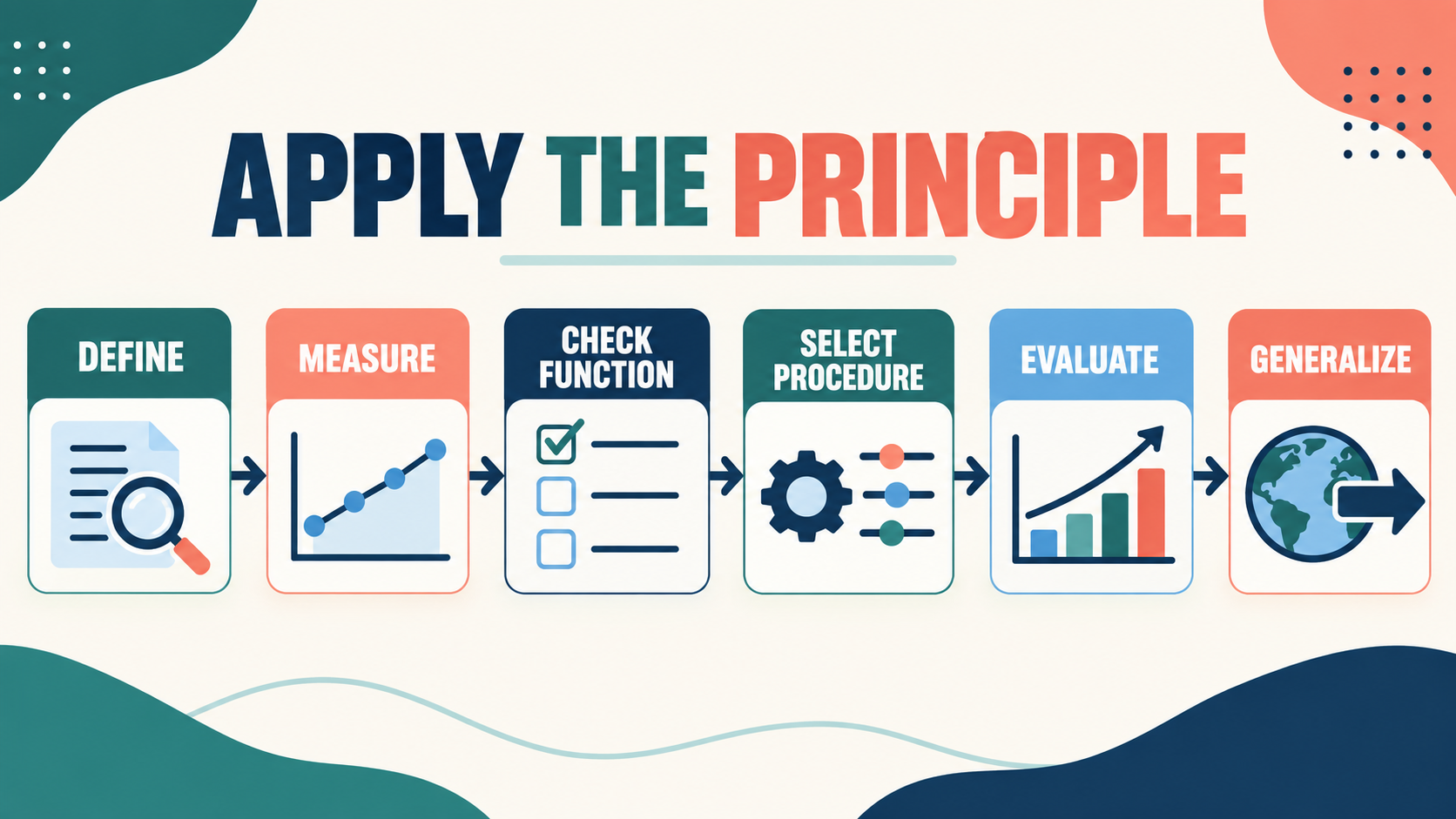
Apply the principles as a decision chain rather than as isolated flashcards. Imagine a learner who rarely initiates a request during a difficult task. A careful analysis might proceed like this:
- Define the response: describe what counts as an independent request, including a time window and examples and nonexamples.
- Measure the starting pattern: record opportunities, independent responses, prompted responses, and relevant contextual variables.
- Check the contingency: determine what consequence follows the request and whether it is actually valuable to this learner in this context.
- Consider motivation and stimulus control: ask whether the task, delay, cue, or consequence changes the likelihood of requesting.
- Choose a procedure: select prompting, shaping, differential reinforcement, or another supervised procedure that fits the assessment and goal.
- Evaluate and generalize: look for independent responding, meaningful participation, maintenance, and use across relevant people or settings.
This sequence prevents an intervention from becoming a reflex. A prompt may produce a correct response without showing independent stimulus control. A reinforcer may be delivered without increasing the target behavior. A lower frequency may reflect a measurement change rather than a meaningful improvement. The principle is a reason to inspect the data, not permission to skip the data.
How Do You Apply Them on the BCBA Exam?
On a BCBA item, first identify the level of the question. If the stem asks what consequence will increase behavior, it is likely testing reinforcement. If it asks why a cue changes responding, examine stimulus control. If it asks which event changes the value of a consequence, examine motivating operations. If it asks whether an intervention is ABA, inspect measurement, analytic logic, conceptual consistency, social significance, and generality. Use this exam checklist:
- Underline the defined behavior and the direction of change.
- Circle the consequence and ask whether future behavior increased or decreased.
- Separate the antecedent cue from the value-changing event.
- Check whether the answer confuses a prompt with reinforcement or a procedure with a principle.
- Prefer the option that is measurable, function-based, individualized, and consistent with the evidence in the stem.
The free BCBA mock exam can give you additional scenario practice with this kind of discrimination. It is an independent study aid, not an official BACB product and not a replacement for the current TCO, handbook, coursework, supervision, or professional judgment.
What Mistakes Should You Avoid?
Foundational language can sound authoritative even when it is being used imprecisely. Watch for these errors:
- Defining reinforcement as “something rewarding” without checking its effect on future behavior.
- Calling every antecedent a motivating operation or every cue a reinforcer.
- Using a procedure name as though it proves that the procedure worked.
- Describing ABA as a universal recipe rather than a data-based, individualized science and professional service.
- Ignoring the client’s goals, assent, dignity, cultural context, or meaningful outcomes while discussing technical accuracy.
- Choosing an answer because it contains more jargon instead of because it matches the question and evidence.
The current BACB Handbook also places professional, legal, and ethical requirements around certification and practice. A foundational study answer should therefore be technically accurate and humanly responsible. When a scenario involves risk, scope of competence, confidentiality, or a person’s meaningful participation, those facts are not decorative details.
Foundational ABA Principles FAQ
What are the most important foundational principles in ABA?: For basic study, start with reinforcement, punishment, extinction, stimulus control, motivating operations, respondent and operant conditioning, and measurement tied to environmental variables. Then learn how those principles are arranged in procedures and evaluated in applied settings.
Are the seven dimensions of ABA the same as the foundational principles?: No. The dimensions describe qualities of applied behavior analysis, while principles describe behavioral relations. They are related but not interchangeable. A question asking whether work is analytic is asking about evidence and experimental logic, not merely whether reinforcement appears somewhere in the plan.
Is positive reinforcement the same as praise?: No. Praise can function as positive reinforcement if it is added after a response and that response increases in the relevant context. The label depends on the observable contingency and effect, not on the word “praise.”
Why do definitions matter so much on the exam?: Definitions prevent category errors. They help you separate an antecedent from a consequence, a motivating operation from a discriminative stimulus, a prompted response from an independent response, and a treatment procedure from the principle that may explain its effect.
Sources and Date Check
This article was reviewed on September 29, 2026 against the BACB sixth-edition Test Content Outline, the current BCBA Handbook, and university and professional educational resources on ABA principles. Terminology, examination content, ethics requirements, and professional guidance can change; verify the live BACB materials when preparing for the exam or making a practice decision.
Take the Free BCBA Mock Exam
If you want a low-pressure way to check your recall, use the free practice resource below. Take the Free BCBA Mock Exam



