

PRT ABA example: a learner chooses between two motivating activities, the practitioner creates a natural opportunity to communicate, reinforces a clear attempt with the requested activity, and gradually helps the skill occur with other people and materials. The point is not simply to give a reward. Pivotal Response Treatment (PRT) arranges teaching around motivation, choice, responsivity to multiple cues, self-initiation, and natural reinforcement.
Table of Contents
- What Is a PRT ABA Example?
- Which Components Should the Example Include?
- What Does a PRT ABA Example Look Like?
- How Do You Audit the PRT Contingency?
- How Is PRT Different From a Generic Reward or DTT?
- How Should the Skill Generalize?
- How Is PRT Tested on the BCBA Exam?
- PRT Example Checklist
- Quick Review Checklist
- Take the Free BCBA Mock Exam
PRT is an ABA-based, naturalistic intervention approach often discussed in relation to autism support. A good example makes the contingency visible: what the learner wants, what response is encouraged, what consequence follows, and how the team measures whether the skill generalizes. A single successful interaction does not prove that PRT is appropriate or effective for every learner. The CDC overview of PRT and ABA teaching styles is a useful public-health starting point, while clinical decisions require individualized assessment.
This article uses a fictional teaching scenario for BCBA study. It is not a diagnosis, treatment prescription, or substitute for training and supervision. For exam context, review the current BCBA Test Content Outline and use current evidence reviews rather than relying on a memorable anecdote. Table of Contents
What Is a PRT ABA Example?
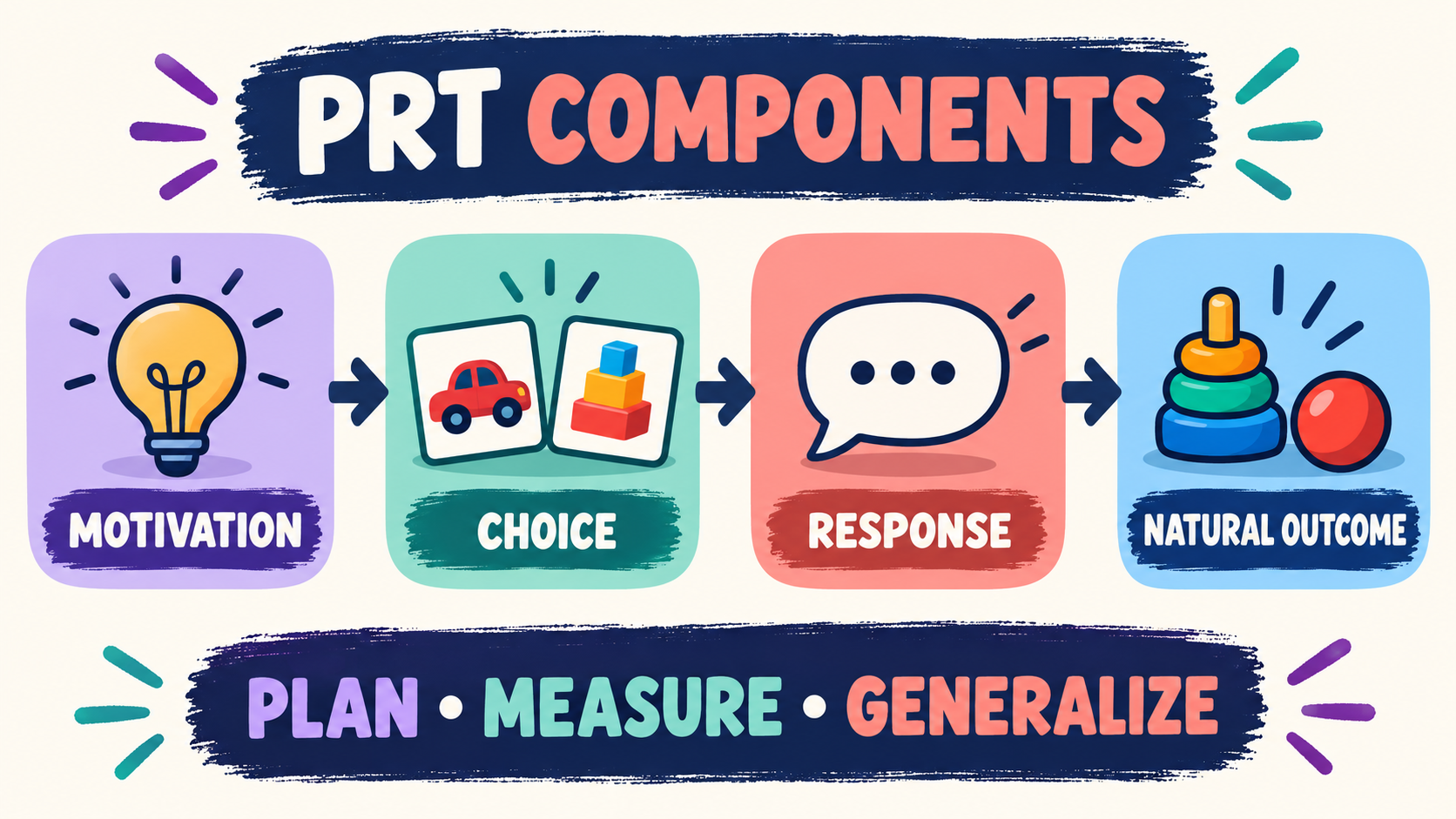
A PRT ABA example is a concrete description of how a pivotal response treatment interaction is arranged and measured. It should include a meaningful motivating operation or choice, a response opportunity, a prompt or model only when needed, a natural consequence, and a plan for checking whether the skill transfers beyond the original activity.
The Centers for Disease Control and Prevention describes PRT as an ABA teaching style that takes place in a natural setting and targets a few pivotal skills that can support learning in other areas. That high-level description is useful, but an exam or training answer should go one step further: identify the learner’s choice, the behavior that changes access to the natural outcome, and the data that will show whether the change matters.
PRT should not be reduced to “let the child play and give praise.” Naturalistic teaching can still be planned, observable, and evaluated. The practitioner arranges the environment, follows the learner’s motivation, creates communication opportunities, reinforces attempts appropriately, and monitors treatment integrity and meaningful outcomes.
Which Components Should the Example Include?
Different training materials may phrase PRT components differently, but a study example is clearer when it addresses these ideas:
- Motivation: the activity or item is valuable to the learner at that moment, and the team respects changes in interest.
- Choice and shared control: the learner has a meaningful way to select materials, actions, topics, or partners rather than merely following an adult-selected script.
- Response opportunities: the practitioner arranges a reason to communicate, initiate, respond, or persist.
- Multiple cues: the learner practices attending to relevant features of the situation instead of responding only to one narrow prompt.
- Natural reinforcement: the consequence is connected to the response. A request for a turn with a toy produces a turn with that toy, not an unrelated token several minutes later.
- Generalization: the team plans for the response to occur with different people, materials, routines, and settings when that is meaningful.
These elements are not a license to improvise without measurement. The practitioner still needs an operational definition, a consistent data system, stakeholder input, and a plan for revising the arrangement when the learner is disengaged or the target is not meaningful.
What Does a PRT ABA Example Look Like?
Imagine a fictional learner who often reaches toward a bubble container but rarely initiates a request for a turn. During a short play routine, the practitioner places two preferred materials within view and asks, “Which one?” The learner touches the bubble card and looks toward the container. The practitioner models a short communication response, waits briefly, and accepts the learner’s clear approximation according to the individualized communication plan. The practitioner immediately provides a brief bubble turn, then pauses so another opportunity can occur.
The interaction includes a natural reason to communicate, a meaningful choice, a response opportunity, and a consequence related to the learner’s request. The practitioner can vary the materials—bubbles, a wind-up toy, or a favorite song—so the learner practices responding to the relevant cue and not only to one memorized phrase.
After several opportunities, the team might invite a caregiver to arrange the same kind of choice during a home routine. Later, the team could check whether the learner initiates with a different partner or requests a turn in a different activity. The data should show the response definition, number of opportunities, level of prompting, independent responses, and generalization conditions.
| Moment | What the practitioner arranges | What to measure |
|---|---|---|
| Choice | Two meaningful activities are visible and available for selection. | Choice response and engagement. |
| Opportunity | The preferred activity pauses at a natural point. | Initiation, request, or response within the defined window. |
| Consequence | The requested activity follows a clear response or approximation. | Independent versus prompted response and latency. |
| Transfer | A new person, material, or routine is introduced gradually. | Generalization and maintenance across planned conditions. |
How Do You Audit the PRT Contingency?
Before calling an interaction a PRT example, ask whether the natural consequence actually depends on the learner’s response. If the learner reaches, requests, or initiates and receives the same outcome regardless of what happens, the contingency may be too weak to teach the target response. If the practitioner delivers an unrelated reward after a fixed number of trials, that may be reinforcement, but it does not by itself demonstrate the naturalistic logic in this example.
- Is the motivation visible? The activity should matter to the learner, and the practitioner should watch for signs that interest has changed.
- Is the response defined? “Communicates better” is too vague. Define the topography, approximation criteria, opportunity window, and prompt level.
- Is the consequence related? A request for the swing should produce a turn on the swing or a clearly connected outcome.
- Is the learner an active participant? The arrangement should allow choice, initiation, and reasonable control rather than turning naturalistic materials into a rigid drill.
- Is there a generalization plan? Identify who, where, and what will change when the skill is used outside the first routine.
These questions also protect against overclaiming. A well-described interaction is evidence that a teaching opportunity was arranged; it is not evidence that the intervention caused a lasting change without a broader measurement and evaluation plan.
How Is PRT Different From a Generic Reward or DTT?
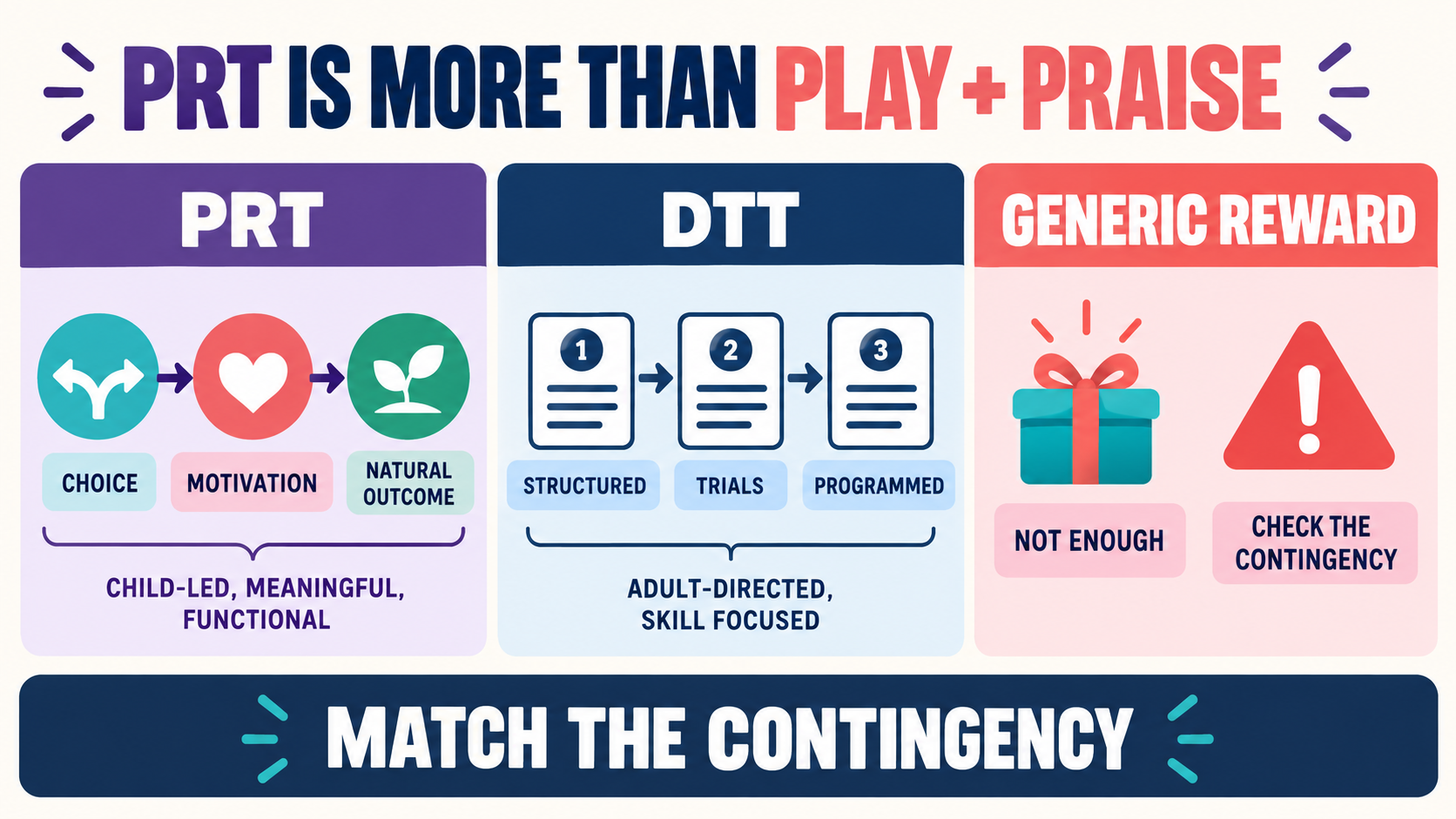
PRT and DTT both draw on ABA principles, and a learner may benefit from more than one teaching format. The key is to identify the teaching arrangement rather than treating the labels as mutually exclusive teams.
| Feature | PRT-style example | What it is not enough to say |
|---|---|---|
| Motivation | The learner’s current interest helps select the opportunity. | “The learner likes rewards.” |
| Control | The learner can choose or initiate within the arranged routine. | “The adult picked a fun toy.” |
| Reinforcement | The natural activity follows the related response. | “Praise happened after the trial.” |
| Teaching format | Natural routine with planned opportunities and data. | “It was play, so it must be PRT.” |
DTT may use clear instructions, repeated learning opportunities, prompts, and programmed consequences in a more structured format. PRT emphasizes pivotal responses and naturalistic teaching features. The correct exam answer depends on the details in the scenario, not on which label sounds more modern.
How Should the Skill Generalize?
Generalization should be planned, measured, and meaningful. In the fictional request example, the team might vary the communication partner, activity, item, room, and time of day. It should not change every variable at once without knowing what the learner is responding to. A gradual plan makes it easier to identify which condition supports success.
Maintenance asks a different question: does the skill continue after teaching conditions or prompts change? A learner may request independently during a bubble routine but not during snack, with a caregiver, or after a break from services. The team can collect data across relevant conditions and adjust the teaching arrangement rather than interpreting one successful trial as generalization.
Evidence reviews of PRT are useful for understanding the research base, but they also remind readers to interpret findings carefully. Study populations, outcomes, intervention fidelity, intensity, and comparison conditions vary. The safest article-level conclusion is that PRT has a defined naturalistic logic and a research literature—not that one example guarantees a specific result.
How Is PRT Tested on the BCBA Exam?
BCBA-style questions may describe a learner selecting an activity, a practitioner following motivation, or a response producing a natural consequence. Use a feature-matching process:
- Find the pivotal target: motivation, self-initiation, self-management, or responding to multiple cues may affect a broader class of skills.
- Look for the natural consequence: the relevant activity or social outcome follows the learner’s response.
- Notice the teaching context: PRT is commonly described in natural routines rather than only adult-selected table drills.
- Reject the label-only answer: “The child received praise” is not enough to identify PRT; the contingency and learner participation matter.
- Check the evidence claim: an example illustrates a procedure, while treatment effectiveness requires data and appropriate evaluation.
If a question asks which feature best distinguishes a PRT-style interaction, prioritize learner motivation, choice or initiation, natural reinforcement, and the plan to use the pivotal response across contexts.
PRT Example Checklist
Before calling a scenario a strong PRT ABA example, confirm that it answers these questions:
- What does the learner currently want or choose?
- What pivotal response or related skill is operationally defined?
- What opportunity does the practitioner arrange?
- What prompt, model, or support is used, and how will it fade?
- What natural consequence follows the response?
- How will independence, fidelity, generalization, and maintenance be measured?
- What would make the team revise the plan or seek additional consultation?
For separate exam practice after reviewing the concept, use the free BCBA mock exam as a study aid. It is not official BACB guidance and does not replace assessment, training, supervision, or individualized decision-making. The short answer is that a PRT ABA example should show more than play plus a reward. It should show a meaningful motivation, learner choice or initiation, a defined response, a related natural consequence, and a plan to measure whether the pivotal skill transfers to the situations that matter.
Quick Review Checklist
Use this final checklist to turn prt aba example into exam-ready reasoning. The goal is not to memorize a label in isolation; it is to identify the relevant evidence and explain why the best answer fits the scenario. Key ideas to review:
- State the central definition or decision point for prt aba example in your own words.
- Identify the detail that makes prt aba example different from its closest related ABA term.
- Separate the observable facts in a scenario from assumptions that are not supported by the facts.
- Write one example and one nonexample so you can recognize the concept in a new setting.
Exam application checks:
- Ask what the question is actually requesting before comparing the answer choices.
- Mark the antecedent, response, consequence, or other evidence that supports the selected answer.
- Look for a distractor that describes a related process but does not answer the specific question.
Final self-check:
- Explain how you would verify the interpretation with clear observations or data.
- Change one detail in the scenario and decide whether your answer should change.
- Give a one-sentence rationale that a supervisor or study partner could evaluate.
Take the Free BCBA Mock Exam
When you are ready to apply the idea, use the free practice resource below for additional feedback. Take the Free BCBA Mock Exam



