
What Are BCBA Prerequisites?
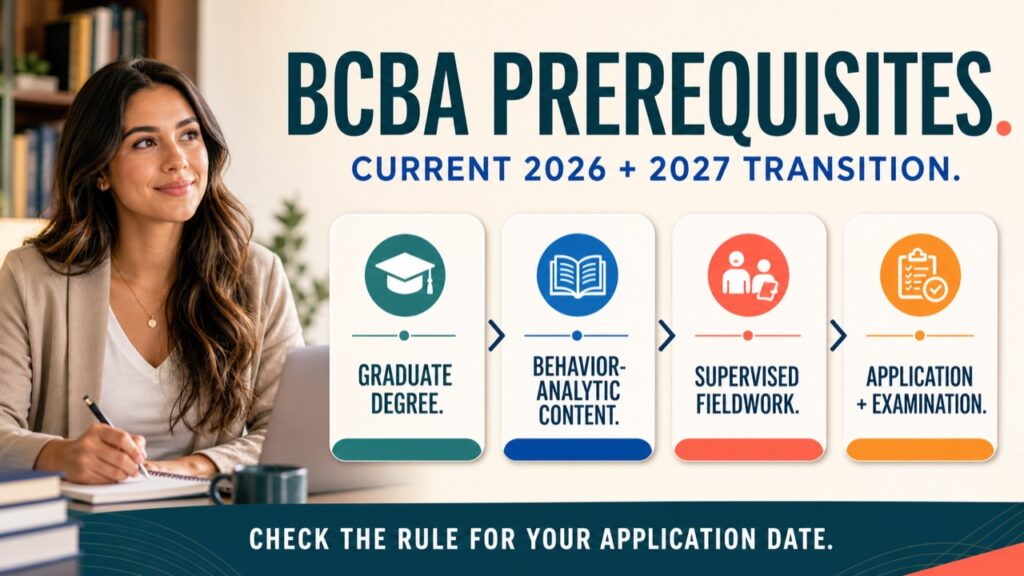
As of July 28, 2026, BCBA prerequisites are the eligibility requirements a candidate must meet before applying for Board Certified Behavior Analyst certification. The BACB describes the BCBA as a graduate-level certification. A candidate must meet one applicable eligibility pathway’s degree and behavior-analytic content requirements, complete supervised fieldwork, submit an application, and pass the BCBA examination. The controlling details depend on the pathway and the requirements in effect when the application is submitted. This guide separates current 2026 requirements from the 2027 transition so candidates can plan without mixing rule sets. Because the handbook is updated periodically, save the version and effective-date evidence used for every major education, fieldwork, and application decision.
Table of Contents
- What Are BCBA Prerequisites?
- Current (2026) vs. 2027 Requirements
- Supervised Fieldwork Requirements
- Common Traps to Avoid
- Application and Examination
- Distinction from Licensure and BCBA-D
- Study Checklist for Prospective Candidates
- Practical Example: Pathway 2 in Action
- Test Your Knowledge with a Free BCBA Mock Exam
Many individuals mistakenly believe that a bachelor’s degree in psychology or RBT certification is required to become a BCBA. In reality, neither is a universal prerequisite. The BCBA is a graduate-level credential, and the acceptable degree and behavior-analytic content depend on the eligibility pathway and effective requirements. For example, you do not need to major in psychology; a master’s degree in education, special education, or a related field may qualify if you complete the required behavior-analytic coursework. Similarly, RBT certification, RBT work experience, and completion of the RBT 40-hour training are not required for BCBA certification. Always refer to the official BACB sources for accurate information.
Current (2026) vs. 2027 Requirements
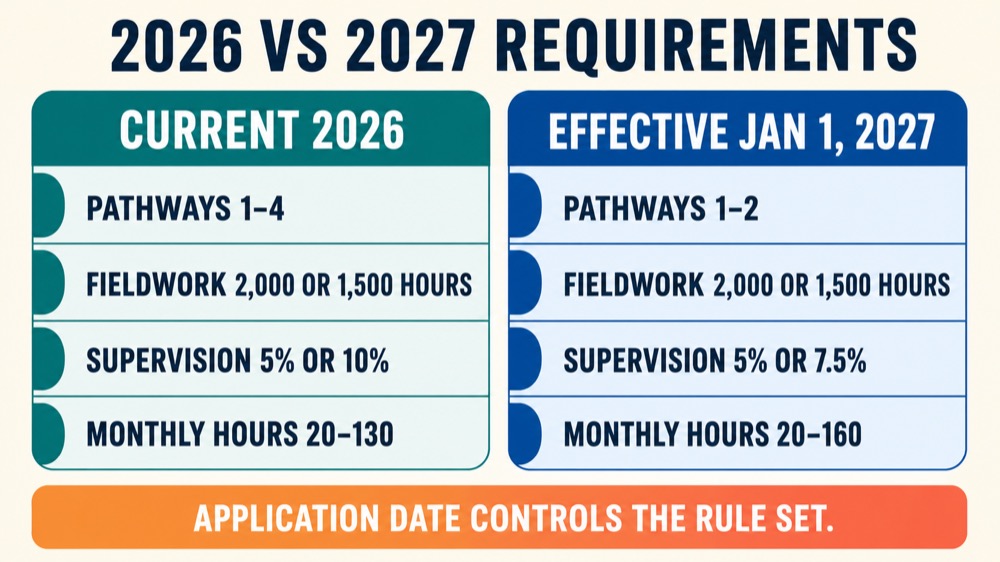
The current 2026 handbook describes four eligibility pathways. For applications under the requirements effective January 1, 2027, Pathways 1 and 2 remain while the faculty teaching/research and postdoctoral pathways are no longer offered. Candidates should read both the current BCBA Handbook and the official 2027 BCBA Requirements, then check the BACB’s upcoming changes page before choosing a program, beginning fieldwork, or applying. The application date—not which document looks newer—determines the applicable eligibility rule set.
- Current Pathways (2026):
- Pathway 1: Eligible graduate degree from an ABAI-accredited, APBA-accredited, or recognized program that includes verified behavior-analytic content.
- Pathway 2: Any graduate degree plus qualifying behavior-analytic coursework from an acceptable institution. The degree need not be in behavior analysis, but the coursework must meet BACB content requirements.
- Pathway 3: Faculty teaching or research in behavior analysis at a qualifying institution. Requires a graduate degree and substantial teaching or research experience.
- Pathway 4: Postdoctoral experience in behavior analysis. Requires a doctoral degree and supervised postdoctoral work.
- 2027 Requirements:
- Pathway 1 (Retained): Eligible graduate degree from an ABAI-accredited, APBA-accredited, or recognized program.
- Pathway 2 (Retained): Any graduate degree plus qualifying behavior-analytic coursework.
- Pathways 3 and 4 are discontinued for applications under the 2027 rules. If you are not yet enrolled, plan on Pathways 1 or 2.
A psychology major is not a universal prerequisite. Pathway 1 requires an eligible master’s or doctoral degree from an APBA-accredited or ABAI-accredited or recognized behavior analysis program under the handbook’s institutional and date criteria. Pathway 2 combines a qualifying graduate degree with qualifying behavior-analytic coursework offered under the current Pathway 2 rules, including the applicable institutional and program-contact requirements. An online delivery format neither automatically qualifies nor disqualifies a program. Candidates should verify the exact degree, coursework, attestations, and effective dates in the handbook rather than relying on a school’s marketing label.
Supervised Fieldwork Requirements
All four current pathways require supervised fieldwork in applied behavior analysis, but the old supervised-independent-fieldwork, practicum, and intensive-practicum categories should not be used for a 2026 plan. Under the current handbook, candidates complete either 2,000 hours of Supervised Fieldwork or 1,500 hours of Concentrated Supervised Fieldwork, or combine the two under the handbook’s multiplier rules. Each supervisory period is one calendar month with 20–130 total fieldwork hours. Supervised Fieldwork requires four supervisor contacts and supervision equal to 5% of monthly hours; Concentrated Supervised Fieldwork requires six contacts and 10%. Both require at least one observation with a client during the month, at least half of supervised hours to be individual, and at least 60% unrestricted activities across total fieldwork. Qualifying coursework must begin before fieldwork, a written contract must be signed before hours accrue, and documentation must follow the applicable handbook. Under the 2027 rules, the total 2,000/1,500 hour options remain, but concentrated supervision changes to 7.5%, monthly hours may reach 160, and cumulative monthly client-observation minutes become 60 or 90 depending on fieldwork type. Candidates must use the rule set in force for their application.
Common Traps to Avoid
- Assuming any online master’s degree automatically meets BACB requirements – only those from ABAI-accredited, APBA-accredited, or recognized programs satisfy Pathway 1.
- Believing that completion of the RBT 40-hour training counts toward BCBA prerequisites – it does not.
- Thinking that a bachelor’s degree in psychology is sufficient – BCBA is a graduate-level certification.
- Confusing BCBA certification with state licensure – they are separate. Certification does not automatically authorize practice in every jurisdiction; check local laws.
- Assuming BCBA-D is a separate certification with expanded privileges – it is a designation for eligible doctoral-level BCBAs, not a distinct certification.
- Neglecting to check the 2027 transition deadlines – if you plan to apply after 2026, your pathway options change.
- Failing to verify the acceptability of your coursework provider – not all universities or programs are recognized by the BACB.
Application and Examination
After completing the applicable degree, behavior-analytic content, and supervised fieldwork requirements, the candidate submits the documentation and fees specified in the current handbook. BACB approval of the application establishes examination eligibility; the candidate then schedules and takes the BCBA examination version in effect for that appointment. Certification is granted only after the BACB verifies the applicable eligibility requirements and a passing examination result. Certification maintenance is a separate stage involving current continuing-education, ethics, self-reporting, and recertification requirements. Practice questions can help identify study gaps, but they do not establish eligibility or substitute for official application guidance.
Distinction from Licensure and BCBA-D
BCBA certification and government licensure answer different questions. BACB certification shows that a person met the BACB’s certification requirements, but a state, province, or other jurisdiction may separately regulate who can practice, use a professional title, or provide particular services. Employer credentialing and payer enrollment can add still other conditions. Candidates should identify the jurisdictions in which they expect to work and verify each relevant board or agency directly; a school or supervisor should not be treated as the final authority for legal eligibility.
BCBA-D is also different from both certification eligibility and licensure. It is a designation available to eligible doctoral-level BCBAs, not a separate certification and not an expansion of BCBA practice privileges. A person with the designation remains responsible for maintaining active BCBA certification and for practicing only within competence and applicable law. Thus, earning a doctorate does not replace the BCBA application sequence, create a new fieldwork shortcut, or resolve jurisdiction-specific licensing, employer, or payer requirements.
Study Checklist for Prospective Candidates
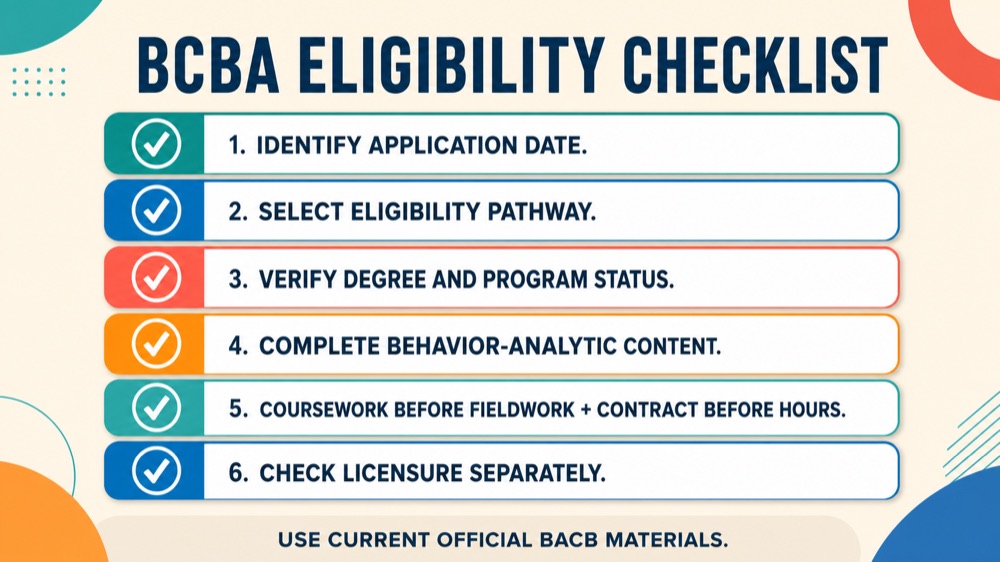
- Choose the eligibility pathway and identify the expected application date before selecting a degree or coursework plan.
- For Pathway 1, verify the program’s APBA or ABAI status and the dates for which that status applies.
- For Pathway 2, confirm the graduate degree, behavior-analytic coursework, institution, and Pathway 2 Program Contact requirements.
- Begin qualifying coursework before accruing fieldwork and sign a compliant supervision contract before counting any hours.
- Use only Supervised Fieldwork, Concentrated Supervised Fieldwork, or a permitted combination; do not plan from obsolete practicum categories.
- Recheck the current handbook, the official 2027 document, and upcoming-change notices before applying.
- Keep certification eligibility separate from jurisdictional licensure, employer rules, and payer enrollment requirements.
- Prepare for the BCBA examination from the content outline in effect for the scheduled appointment and use practice resources only as study support.
Practical Example: Pathway 2 in Action
Consider Maria, who has a master’s degree in education and expects to apply under Pathway 2. She first asks the relevant university contact to confirm that her degree and planned behavior-analytic coursework satisfy the rule set for her intended application date. After qualifying coursework begins, she signs a fieldwork contract with an eligible supervisor and follows the monthly requirements for her selected fieldwork type. She preserves transcripts, attestations, monthly records, and final verification forms. Maria does not assume that the online format, RBT experience, or a psychology background makes her eligible; she rechecks the current BACB materials before applying because later changes could affect her plan.
Test Your Knowledge with a Free BCBA Mock Exam
Use our Free BCBA Mock Exam for broad practice and immediate feedback after you have separated eligibility planning from examination study. Review missed items against the current BACB content outline and authoritative materials rather than treating a score as proof of application readiness. The mock exam supports retrieval practice and gap identification; it does not verify a degree, coursework, supervised fieldwork, licensure, or any other individual prerequisite.



