
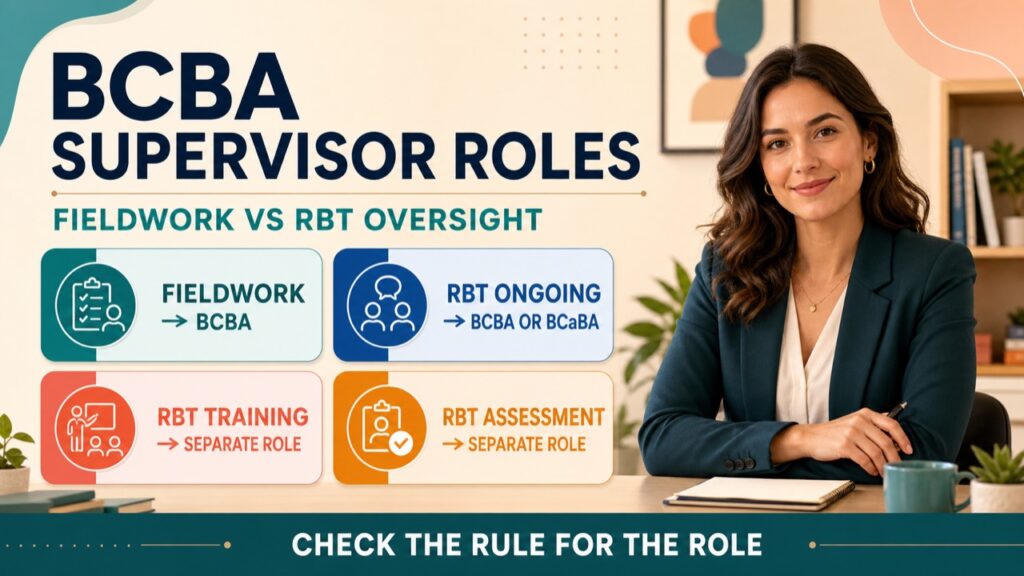
As of July 28, 2026, “BCBA supervisor” is still an imprecise label: the required role depends on who is being supervised and why. A BCBA may serve as a fieldwork supervisor for a BCBA or BCaBA candidate, provide ongoing-service supervision for a certified RBT, supervise a BCaBA, or separately act as an RBT trainer or competency assessor. The BACB’s current Supervision and Training overview treats these as distinct oversight roles, with different qualification and documentation rules. Trainees, employers, and certificants should identify the exact role before applying a rule. This guide compares fieldwork supervision with RBT oversight, explains a defensible selection process, and outlines the supervision contract and ethical safeguards that support competent practice.
Table of Contents
- Fieldwork Supervision vs Ongoing-Service Supervision
- Qualifications for BCBA Supervisors
- Defensible Supervisor Selection Process
- The Written Supervision Contract: Essential Components
- Remote Supervision: No Shortcut to Compliance
- Ethics Code Requirements for Supervision
- Supervisor Selection Checklist
- Keep 2026 Rules Separate from 2027 Changes
- Test Your Supervision Knowledge with Our Free BCBA Mock Exam
Fieldwork Supervision vs Ongoing-Service Supervision
Fieldwork supervision applies when a candidate is accumulating supervised experience toward BCBA or BCaBA certification. Under the current BCBA Handbook, this fieldwork supervisor must be an active BCBA without current disciplinary sanctions and must complete the 8-hour supervision training before signing the fieldwork contract. A BCBA certified for less than one year also needs monthly consultation from a qualified consulting supervisor while supervising fieldwork. Ongoing-service supervision for an RBT is different: the RBT is already certified and must work under a qualified RBT Supervisor and/or RBT Requirements Coordinator. Current RBT rules require supervision for at least 5% of the hours the RBT spends providing behavior-analytic services in each calendar month—not 5% of billable hours. Training an RBT, assessing initial competency, and providing ongoing supervision are separate functions; one person may qualify for more than one function, but the titles are not interchangeable. Fieldwork supervision is restricted to a qualified BCBA, whereas the BACB role matrix permits a qualified BCBA or BCaBA to supervise, train, or assess RBTs after the required supervision training.
Qualifications for BCBA Supervisors
The current BCBA Handbook specifies the certification, training, continuing-education, and consulting-supervisor conditions for fieldwork supervisors. Qualification is not established by an active credential alone. Ethics Code standard 4.02 requires supervisory competence, so the supervisor must be able to teach and evaluate the relevant behavior-analytic work with the actual population, setting, and procedures. The Ethics Code for Behavior Analysts also makes supervisors accountable for their supervisory practices. Use the BACB Certificant Registry to verify certification status, then separately verify any license required by the applicable jurisdiction. For example, strong early-intervention experience does not automatically establish competence to supervise complex adult residential services. A responsible supervisor either demonstrates the needed scope of competence, obtains appropriate training and consultation, or declines that assignment.
Defensible Supervisor Selection Process
A defensible selection process protects the trainee, supervisor, and clients. Follow these steps:
- Identify the role first: Decide whether the arrangement is fieldwork supervision, RBT ongoing supervision, BCaBA supervision, RBT training, or competency assessment.
- Verify credentials and standing: Check the BACB registry for active certification and current sanctions, then verify any separately required professional license.
- Confirm role-specific qualifications: Ask for evidence of the 8-hour supervision training and, for a newly certified fieldwork supervisor, the required consulting-supervisor arrangement.
- Evaluate competence: Review experience with the relevant clients, settings, procedures, cultural variables, risk level, and documentation systems.
- Evaluate capacity: Ethics Code standard 4.03 uses a capacity-based rule. There is no universal BACB maximum of 10 fieldwork trainees; the supervisor must accept only a volume they can supervise effectively.
- Review the teaching and feedback system: The plan should specify observation, behavioral skills training when appropriate, performance measures, timely feedback, documentation, and remediation.
Do not treat payment, an active credential, or a verbal agreement as a guarantee that fieldwork will be accepted. The written contract must be in place before fieldwork begins, and hours cannot be created retroactively. The current fieldwork rules also require observation of the trainee with a client during each supervisory period. Although in-person observation is preferred, a live video observation or an asynchronous recording may be used when requirements are met; an asynchronous recording does not itself become a real-time supervision contact unless the supervisor and trainee discuss it together in real time. Delegated tasks must also match the recipient’s competence and authorized role.
The Written Supervision Contract: Essential Components
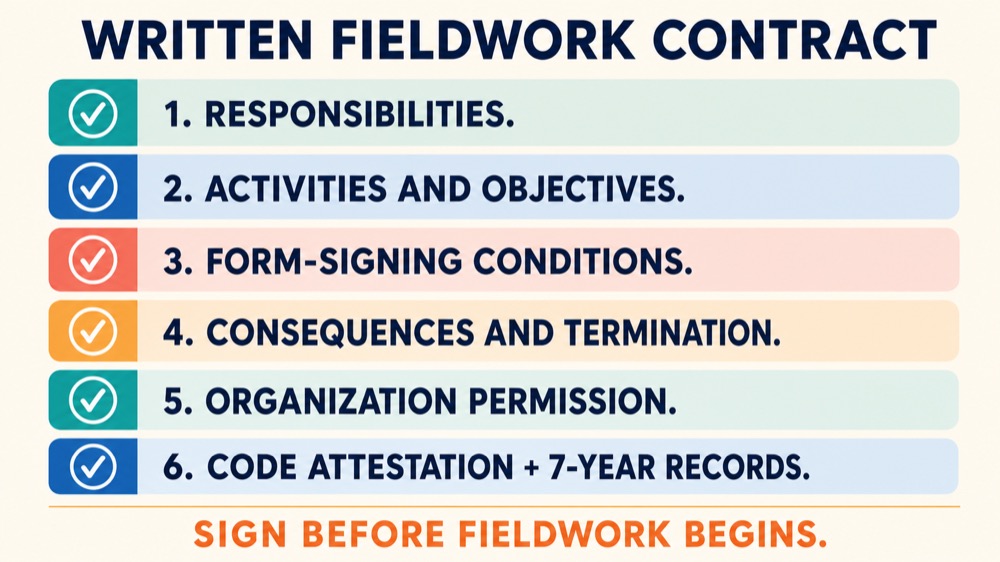
A formal supervision contract is mandatory before fieldwork hours begin. It should specify:
- Responsibilities: State what the supervisor and trainee will do, how required documentation will be completed, and how both parties will comply with applicable BACB requirements.
- Individualized activities and objectives: Describe how the experience will develop the trainee’s behavior-analytic skills rather than merely document service hours.
- Observation, training, and feedback: Define how client observation, competency-based training, performance measurement, timely feedback, and remediation will occur.
- Conditions for signing forms: Specify measurable circumstances under which the supervisor will or will not sign monthly or final verification forms.
- Consequences and termination: Describe what happens when either party does not meet responsibilities and the circumstances for appropriate termination or transition.
- Organization permission: When the trainee works for an organization, document the required permission and access needed for the supervisor to know the client’s programming and observe services.
- Ethics and retention: Include the required Code attestation and a plan for both parties to retain supervision documents for at least seven years.
- Optional business terms: If supervision is paid, fees, cancellations, and a dispute process may be included, but those optional terms should not be mistaken for the BACB’s core fieldwork elements.
Both parties should sign the supervision contract before any fieldwork is accrued and retain a complete copy. The current handbook also restricts certain conflicts: a fieldwork supervisor cannot be related to, subordinate to, or employed by the trainee, although compensation paid specifically for supervision is not treated as employment for that rule. RBT ongoing supervision has its own current handbook requirements and organizational accountability structure; do not copy the fieldwork contract rules into an RBT arrangement without checking which provisions actually apply.
Remote Supervision: No Shortcut to Compliance
Remote supervision changes the medium, not the supervisor’s accountability. Fieldwork must still relate to specific client programming, and the supervisor needs enough knowledge of the organization, client context, data, and trainee performance to provide meaningful direction. Before recording or streaming a session, obtain the permissions required by the client-service setting and protect confidentiality during transmission, storage, review, and deletion. A remote arrangement must also satisfy the observation and real-time-contact rules that apply to the particular role. If the parties are in different locations, check every implicated jurisdiction as well as employer, payer, privacy, and consent requirements; BACB certification by itself does not resolve licensure questions. When remote technology prevents reliable observation or immediate risk management, the supervisor should change the method, add local support, or decline the arrangement.
Ethics Code Requirements for Supervision
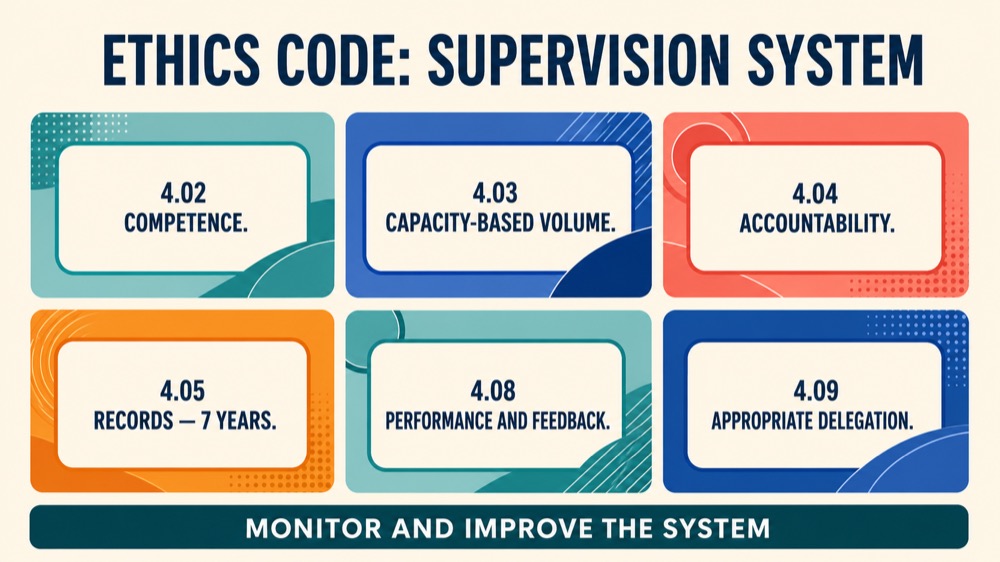
The BACB Ethics Code includes several standards directly relevant to BCBA supervisors for both fieldwork and ongoing-service supervision:
- 4.01–4.02, requirements and competence: Follow the applicable supervisory rules and supervise only within demonstrated competence.
- 4.03, supervisory volume: Accept only the number and intensity of supervisees that available time, resources, risk, and competence allow; this is not a fixed universal headcount.
- 4.04–4.05, accountability and documentation: Remain accountable for supervisory practices and maintain accurate supervision records for at least seven years.
- 4.06 and 4.08, training and feedback: Use evidence-based, reinforcement-focused, individualized training; monitor performance and provide timely, documented feedback.
- 4.09–4.10, delegation and evaluation: Delegate only suitable tasks to competent people and continually evaluate whether the supervision system is producing the intended outcomes.
- 4.11–4.12, continuity and termination: Plan for interruptions and transitions, and end supervision appropriately when services cannot continue safely or effectively.
These standards apply to the supervisor’s behavior, not just the supervisee’s paperwork. For example, a supervisor who signs forms but rarely observes performance cannot repair the problem by adding detailed notes later. A stronger system defines observable competencies, samples performance under relevant conditions, uses data to choose feedback or retraining, and documents what changed. If the supervisor lacks competence for a high-risk procedure or setting, consultation and training may be necessary before accepting the role; in some cases, referral or declining the assignment is the ethical response.
Supervisor Selection Checklist
Before committing to a fieldwork or RBT supervisor, use this checklist:
- ☐ The exact oversight role and the supervisee’s status are identified.
- ☐ Certification status and sanctions were checked in the BACB registry.
- ☐ Applicable licensure was verified separately.
- ☐ The supervisor completed the role-required 8-hour supervision training.
- ☐ A newly certified fieldwork supervisor has the required consulting supervisor.
- ☐ The supervisor’s scope of competence matches the clients, setting, procedures, and risk.
- ☐ Capacity was evaluated using actual workload and resources, not an invented universal trainee cap.
- ☐ The plan includes client observation, competency-based training, performance data, and timely feedback.
- ☐ A compliant fieldwork contract was signed before hours began, when fieldwork is the role.
- ☐ Record retention, organizational permission, privacy, and remote-practice requirements are addressed.
Keep 2026 Rules Separate from 2027 Changes
This guide reflects the requirements available on July 28, 2026. BACB transition materials may give future rules, forms, or hour structures a later effective date, so “newer” does not always mean “currently applicable.” Build a 2026 arrangement from the current handbook and contract requirements, then recheck the BACB’s effective dates before changing documents or submitting an application. Candidates planning across the transition can review our focused explanation of BCBA 2027 concentrated fieldwork changes, but should use the official BACB materials as the controlling source. This separation prevents a common documentation error: mixing a future requirement into current fieldwork while overlooking the rule that applies today.
Test Your Supervision Knowledge with Our Free BCBA Mock Exam
Supervision questions often test whether you can distinguish a role, identify the controlling requirement, and choose an ethical response without importing a rule from another arrangement. Our Free BCBA Mock Exam provides broad practice and immediate feedback that can help you identify concepts needing further study. Use practice results as a study guide, then return to the current BACB handbook and Ethics Code for authoritative requirements. A mock exam supports preparation; it does not replace official policy, jurisdiction-specific legal advice, or individualized supervision planning.



