

Understanding Organizational Behavior Management (OBM)
Organizational behavior management (OBM) is a subdiscipline of applied behavior analysis (ABA) that applies behavior-analytic principles and methods to improve performance and organizational systems. Rather than relying on broad policies, annual appraisals, or trait-based explanations of employee behavior, OBM emphasizes direct measurement and systematic intervention to achieve measurable outcomes. It is not a replacement for all management practices; OBM can complement leadership, human resources, industrial-organizational psychology, operations, and quality-improvement methods. This guide compares their methods, boundaries, and appropriate uses.
Table of Contents
- Understanding Organizational Behavior Management (OBM)
- What is OBM?
- Key Comparisons: OBM vs Traditional Management
- Three Commonly Described Areas of OBM
- Levels of Analysis in OBM
- Common Traps in Comparing OBM vs Traditional Management
- Ethics and Social Validity in OBM
- Practical Example: Improving Customer Service
- From Performance Pinpoint to Data-Based Adjustment
- Evidence, Causation, and Practical Interpretation
- Study Checklist for BCBA Candidates
- Free BCBA Mock Exam Practice
- References
What is OBM?
OBM uses the same principles as clinical ABA—reinforcement, stimulus control, and motivating operations—but targets workplace performance behaviors. Practitioners define performance pinpoints, such as number of units produced or percentage of tasks completed accurately, and measure them directly. OBM is built on the three-term contingency (antecedent-behavior-consequence) and involves modifying environmental variables to support desired behavior. For example, a clear instruction may precede report completion, followed by timely performance feedback. OBM also emphasizes data-based decision making and systems thinking to create sustainable improvements.
- Direct Measurement: OBM uses observable, measurable behaviors rather than subjective ratings. For instance, instead of rating “customer service quality” on a scale, OBM measures “percentage of calls resolved on first contact.”
- Functional Analysis: Before intervening, OBM practitioners analyze antecedents and consequences maintaining current behavior through interviews, observation, and data review.
- Data-Based Decision Making: All interventions are guided by ongoing data collection. If an intervention does not produce improvement, adjustments are made based on the data.
- Systems Thinking: OBM considers the entire work system, including resources, policies, feedback loops, and organizational culture.
Key Comparisons: OBM vs Traditional Management
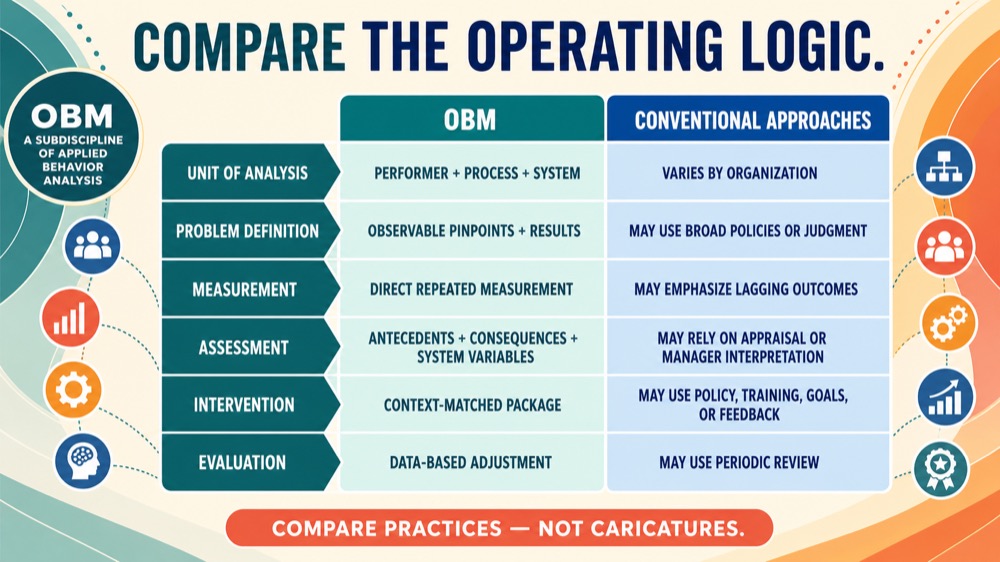
The following table summarizes major differences across several dimensions. These contrasts are generalizations; many traditional managers also use data and evidence-based practices, but OBM systematizes these approaches.
| Dimension | Traditional Management | OBM |
|---|---|---|
| Unit of Analysis | May emphasize roles, teams, leadership judgments, or organization-level outcomes | Individual performer, work process, and total system levels |
| Problem Definition | May begin with manager judgment, policy gaps, appraisal results, or business outcomes | Operationally defined using observable performance pinpoints |
| Measurement | Lagging outcome measures (e.g., annual sales, turnover rate) | Direct, ongoing measurement of target behaviors and results |
| Assessment | May use interviews, appraisals, operational reviews, or established management frameworks | Functional analysis of antecedents, consequences, and system variables |
| Intervention Selection | May use policy, training, coaching, incentives, job design, or process improvement | Context-matched interventions based on data (e.g., task clarification, goal setting, feedback, reinforcement, process redesign) |
| Evaluation | May combine judgment with periodic leading and lagging indicators | Repeated measurement with data-based adjustment |
| Sustainability | Depends on how well practices, resources, accountability, and workflows are maintained | Built into systems through environmental supports and process redesign |
The comparison is about method, not a contest between good and bad managers. A conventional operations team may already use dashboards, coaching, quality systems, and employee participation. An OBM consultant adds a behavior-analytic unit of analysis: the team agrees on an observable performance pinpoint and a valued result, measures a baseline, examines relevant antecedents, consequences, skills, resources, and process constraints, and then selects an intervention matched to that analysis. Repeated measurement shows whether performance changed when the intervention was introduced; it does not by itself prove why the change occurred. Sustainability must be checked after prompts, feedback, or added attention are reduced, and the plan should be revised when benefits do not maintain or when unwanted effects emerge.
Three Commonly Described Areas of OBM
OBM is often organized into three interrelated areas: performance management, behavior-based safety, and behavioral systems analysis. Each area focuses on different levels of the organization but shares the common foundation of behavior analysis.
Performance Management: Performance management targets individual or small-group behavior using pinpointed, observable dimensions of performance. Common tools include task clarification (defining exactly what to do), training (providing skills), goal setting (specific, challenging but achievable targets), performance feedback (information about past performance relative to a goal), and reinforcement (positive consequences for improvement). Feedback alone does not uniformly improve performance; its effectiveness depends on timing, specificity, and context.
Behavior-Based Safety: Behavior-based safety identifies critical safety behaviors, observes them, provides feedback, and reinforces safe practices. It often includes peer observations and data collection on at-risk behaviors. BBS does not replace safety culture or leadership commitment but adds a behavioral focus on observable safety acts.
Behavioral Systems Analysis: Behavioral systems analysis examines how work processes, resources, policies, and feedback loops support or impede performance. It takes a macro-level view, considering the entire system. Interventions may include redesigning workflows, improving communication channels, or aligning incentives across departments.
Levels of Analysis in OBM
Work can be analyzed at three levels: the individual performer, the work process, and the total system. At the individual level, we examine a single person’s behavior and its immediate antecedents and consequences. At the process level, we look at the sequence of steps across people or machines (e.g., order fulfillment from receipt to delivery). At the system level, we consider the organization’s structure, goals, and external environment (e.g., company culture, market pressures). Effective OBM interventions often require addressing all three levels.
Common Traps in Comparing OBM vs Traditional Management
- Reducing OBM to incentive delivery. OBM may involve task clarification, skills training, process redesign, feedback, reinforcement, and environmental supports selected from assessment.
- Treating conventional management as data-free. Many managers use goals and evidence. OBM places particular emphasis on observable pinpoints, repeated direct measurement, and demonstration of change.
- Treating OBM as person-level work only. Behavioral systems analysis examines workflows, interlocking performance, resources, feedback loops, and organization-level contingencies.
- Treating feedback as sufficient by itself. Its effects depend on timing, specificity, available skills, consequences, task difficulty, and the surrounding work system.
- Reusing one package without assessment. Similar performance gaps can reflect different skill, resource, antecedent, consequence, or process variables, so intervention selection remains context dependent.
- Confusing OBM with behavior modification. OBM respects ethical guidelines, prioritizes social validity, and involves employees in the process.
Ethics and Social Validity in OBM
Ethical OBM starts by asking whose goals define success and who bears the costs. Worker well-being, informed participation, transparency, privacy, equity, workload, accessibility, and unintended effects belong in the evaluation alongside productivity or quality. Data collection should be proportionate to the decision, explained to affected people, protected from unnecessary access, and reviewed for differential effects across roles or groups. Social validity is not a one-time satisfaction question: practitioners should assess the acceptability and importance of goals, procedures, and outcomes throughout the project. Employee input can reveal missing resources or system constraints that a manager-level analysis overlooks. If an intervention produces the target number while increasing unsafe shortcuts, concealment, excessive pace, or inequitable burden, the result is not an adequate success.
Practical Example: Improving Customer Service
Consider a hypothetical service team that wants to improve first-contact resolution without increasing rushed or inaccurate responses. The team could define both a result—eligible cases resolved on the first contact—and critical quality safeguards, such as accuracy and appropriate escalation. Baseline data would be examined by case type, shift, and process step. Interviews and observation might indicate unclear authority, slow access to reference materials, a training gap, or consequences that favor short calls over complete solutions. Those findings would lead to different interventions: decision aids and authorization changes for a process barrier, rehearsal and coaching for a skill deficit, or revised goals and feedback when existing consequences favor the wrong result. The team would introduce the selected change, repeatedly graph resolution and quality measures, seek staff feedback, and check maintenance. Any improvement would be described as a measured outcome of this local project, not a guaranteed effect of OBM in every call center.
From Performance Pinpoint to Data-Based Adjustment
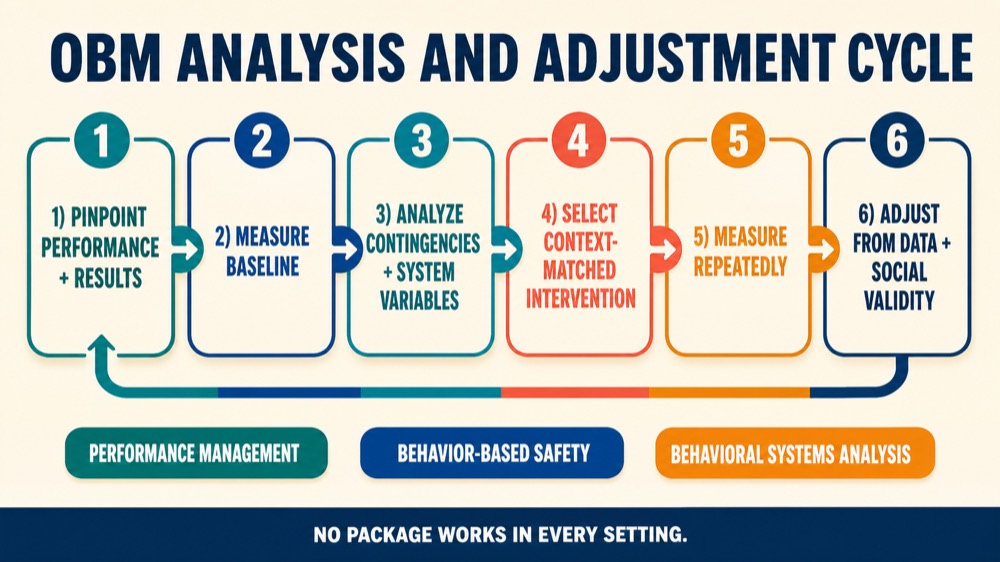
A defensible OBM project follows a sequence instead of jumping from a broad concern to a favorite technique. First, stakeholders define an observable performance pinpoint and the result it is expected to support. They decide how the measure will be collected and check whether it represents the work fairly. Second, they establish a baseline long enough to understand current level, trend, and variability. Third, they analyze skills, task clarity, materials, workflow, antecedents, consequences, and system variables. That analysis narrows plausible barriers but should not be presented as proof of a behavioral function unless the design supports that conclusion.
- Pinpoint: state what performers will do, under what conditions, and how correct performance will be counted.
- Measure: pair direct measurement of performance with relevant results and guardrails.
- Analyze: examine performer, process, and total-system variables before choosing a procedure.
- Intervene: match task clarification, training, goals, performance feedback, reinforcement, environmental supports, or process redesign to the evidence.
- Evaluate: use repeated measurement and an appropriate design to judge whether change coincides with the intervention.
- Adjust and maintain: revise ineffective elements, monitor unintended outcomes, and test whether gains persist.
Evidence, Causation, and Practical Interpretation
Workplace data can support different levels of inference. A graph showing that errors fell after training is useful descriptive evidence, but coincident changes in staffing, workload, equipment, or measurement may offer alternative explanations. Stronger evaluations plan repeated measurement and experimental or quasi-experimental comparisons when feasible. The practical question is not whether a chart looks better; it is whether the design supports a reasonable conclusion, the change matters to stakeholders, quality safeguards remain acceptable, and the effect maintains across relevant people and conditions.
- Do not confuse correlation with an intervention effect. Performance may covary with feedback, incentives, or leadership changes without demonstrating that one variable produced the other.
- Do not evaluate only a lagging business result. Revenue, turnover, and injury rates can matter, but direct performance measures help identify where change occurred.
- Do not ignore system constraints. A person may know the task while lacking time, materials, authority, or a workable process.
- Do not select a package by label. “Training,” “feedback,” or “reinforcement” describes a broad class, not a context-matched implementation.
- Do not declare maintenance too early. Continue measurement after novelty, intensive coaching, or extra attention decreases.
Study Checklist for BCBA Candidates
- Understand OBM as a subdiscipline of ABA focused on workplace behavior and systems.
- Differentiate performance management, behavior-based safety, and behavioral systems analysis.
- Know the typical OBM sequence: pinpoint, measure, analyze, intervene, evaluate, adjust.
- Recognize that OBM is built on direct measurement and functional analysis.
- Distinguish OBM from trait-based management approaches.
- Apply ethical considerations: consent, transparency, social validity.
- Explain how a performance pinpoint differs from a broad label such as motivation, attitude, or culture.
- Ask what evidence would support an intervention effect, maintenance, generalization, social validity, and acceptable unintended outcomes.
Free BCBA Mock Exam Practice
Use our Free BCBA Mock Exam for additional practice applying behavior-analytic concepts and reviewing feedback. Practice can help you notice whether you can distinguish an observable pinpoint from a broad outcome, choose a measure that fits the decision, and evaluate evidence conservatively. The resource is a study aid; this article does not claim that its exact OBM comparison appears in any certification examination.
References
- PMC article on Organizational Behavior Management
- PMC article on OBM in healthcare
- Journal of Organizational Behavior Management
- Tandfonline article on OBM



