
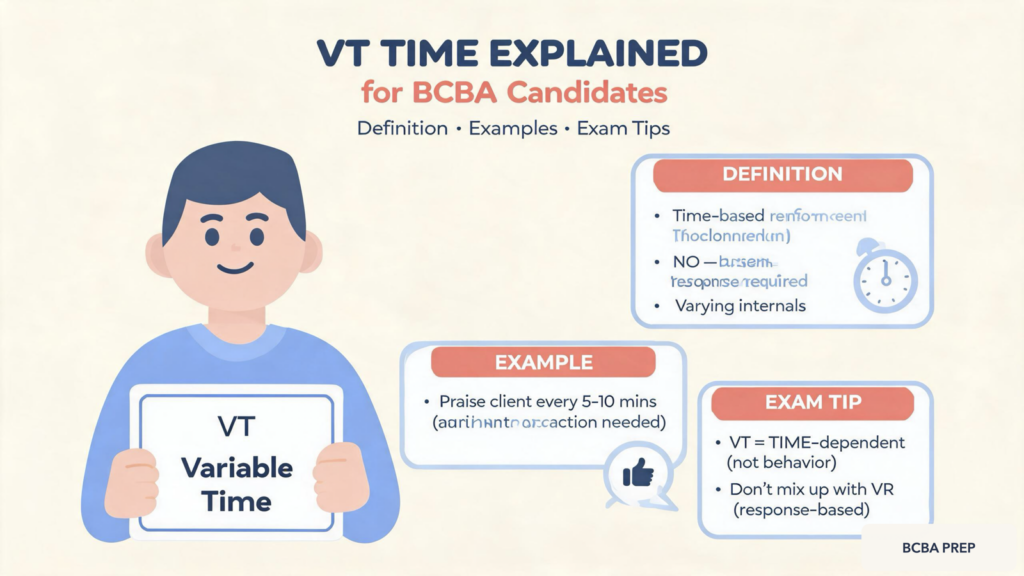
What Is VT Time? Definition in Applied Behavior Analysis
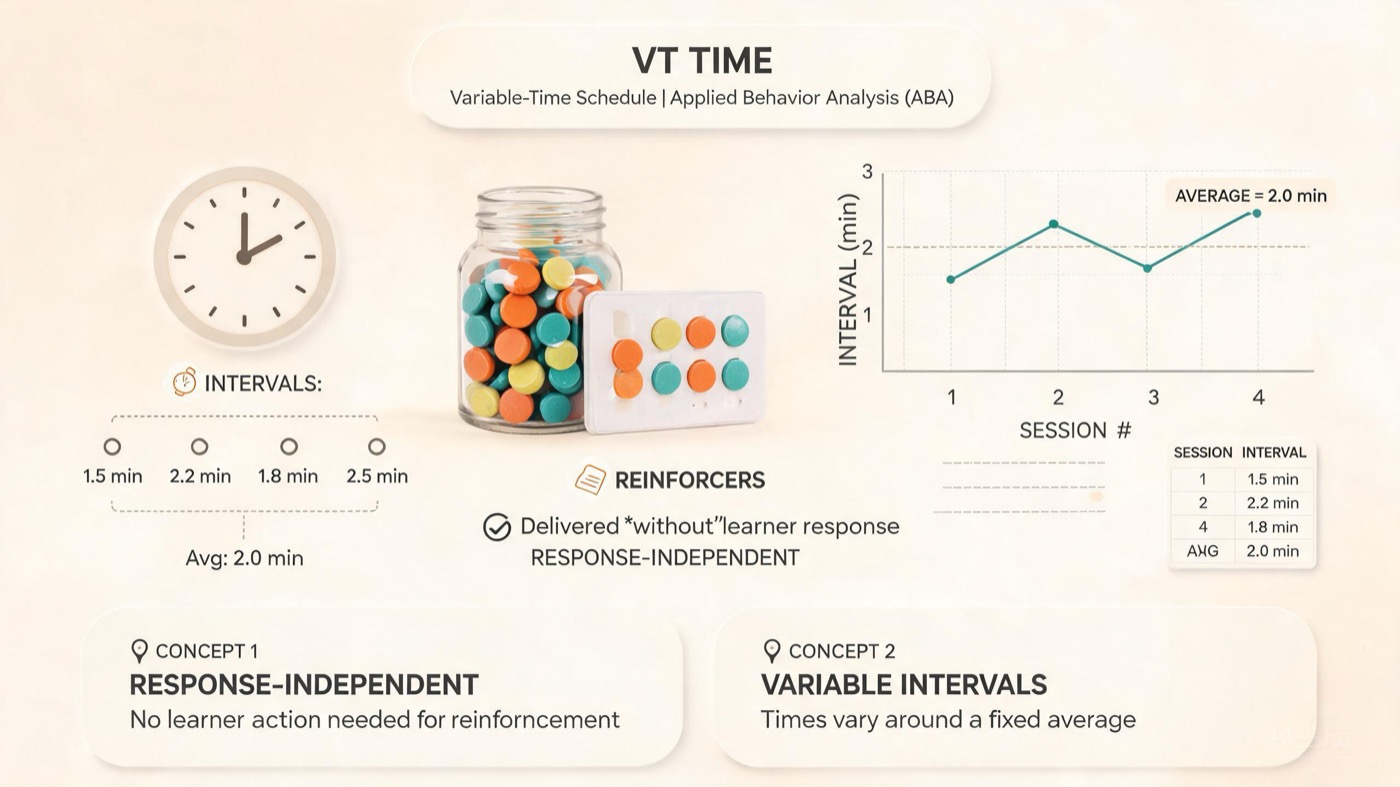
VT time stands for variable-time schedule of reinforcement. In ABA, a variable-time (VT) schedule delivers reinforcement on a time-based, response-independent schedule. The time between reinforcer deliveries varies around an average value. For example, a VT 5-minute schedule means that a reinforcer is delivered approximately every 5 minutes on average, but the exact interval changes unpredictably.
Table of Contents
- What Is VT Time? Definition in Applied Behavior Analysis
- VT Time in Practice: ABC Examples with Hypothesized Functions
- Exam Relevance: How VT Time Appears on the BCBA Test
- VT Time Quick Checklist for Exam Review
- Summary: Mastering VT Time for Your BCBA Exam
VT schedules are commonly used in noncontingent reinforcement (NCR) interventions. Because reinforcement is delivered regardless of behavior, VT can function as an abolishing operation (AO) – reducing the value of the reinforcer and decreasing motivation to engage in problem behavior maintained by that reinforcer.
VT vs. VI: Key Differences for Exam Questions
One of the most common mix-ups on the BCBA exam is confusing VT with variable-interval (VI) schedules. Both involve variable time, but the critical difference is response dependency:
- VT (variable-time): Reinforcer is delivered after a variable amount of time, regardless of what the learner does. No response required.
- VI (variable-interval): A response must occur after the variable interval has elapsed for reinforcement to be delivered. The response is required.
- Practical tip: If the question mentions NCR or that reinforcement is given “freely,” it’s probably VT. If a behavior must be emitted to get the reinforcer, it’s VI.
VT Time in Practice: ABC Examples with Hypothesized Functions
Understanding VT in real-world scenarios helps solidify the concept. Below are two examples using the ABC (Antecedent-Behavior-Consequence) format.
Example 1: Reducing Attention-Maintained Disruption
A student engages in loud vocalizations (behavior) that are maintained by teacher attention. The intervention uses a VT 5-minute schedule where the teacher delivers praise and brief social interaction every 5 minutes on average, regardless of the student’s behavior.
| Antecedent | Behavior | Consequence | Function |
|---|---|---|---|
| Teacher busy with other students | Loud vocalizations | Teacher attention (previously) | Attention (positive reinforcement) |
| VT 5-min: teacher delivers attention every ~5 min | Decrease in vocalizations | Attention delivered on VT schedule (noncontingent) | VT serves as AO, reduces motivation for attention |
In this case, VT time acts as an abolishing operation: the free attention satiates the student’s need for attention, decreasing the value of attention as a reinforcer and thus reducing problem behavior.
Example 2: Increasing Compliance Using Non-Contingent Reinforcement
A child with autism refuses to complete math tasks (behavior) because the task is aversive and the child wants a break (escape function). The intervention introduces a VT 3-minute schedule of edible delivery during math tasks, regardless of compliance.
| Antecedent | Behavior | Consequence | Function |
|---|---|---|---|
| Math worksheet presented | Task refusal (crying, pushing away) | Break from task (previously) | Escape (negative reinforcement) |
| VT 3-min: edible delivered every ~3 min | Increased compliance (sitting, attempting work) | Edible delivered noncontingently | VT adds a competing reinforcer (edible) and may reduce escape motivation |
Here, VT time provides a competing reinforcer that makes the task context more reinforcing. While the function may still be escape, the edible delivery can reduce the aversiveness of the task.
Exam Relevance: How VT Time Appears on the BCBA Test
On the BCBA exam, VT time is tested through questions that ask you to identify the schedule, predict behavior effects, or compare with other schedules. You’ll likely encounter scenarios involving noncontingent reinforcement (NCR) and be asked to distinguish VT from fixed-time (FT) and interval schedules.
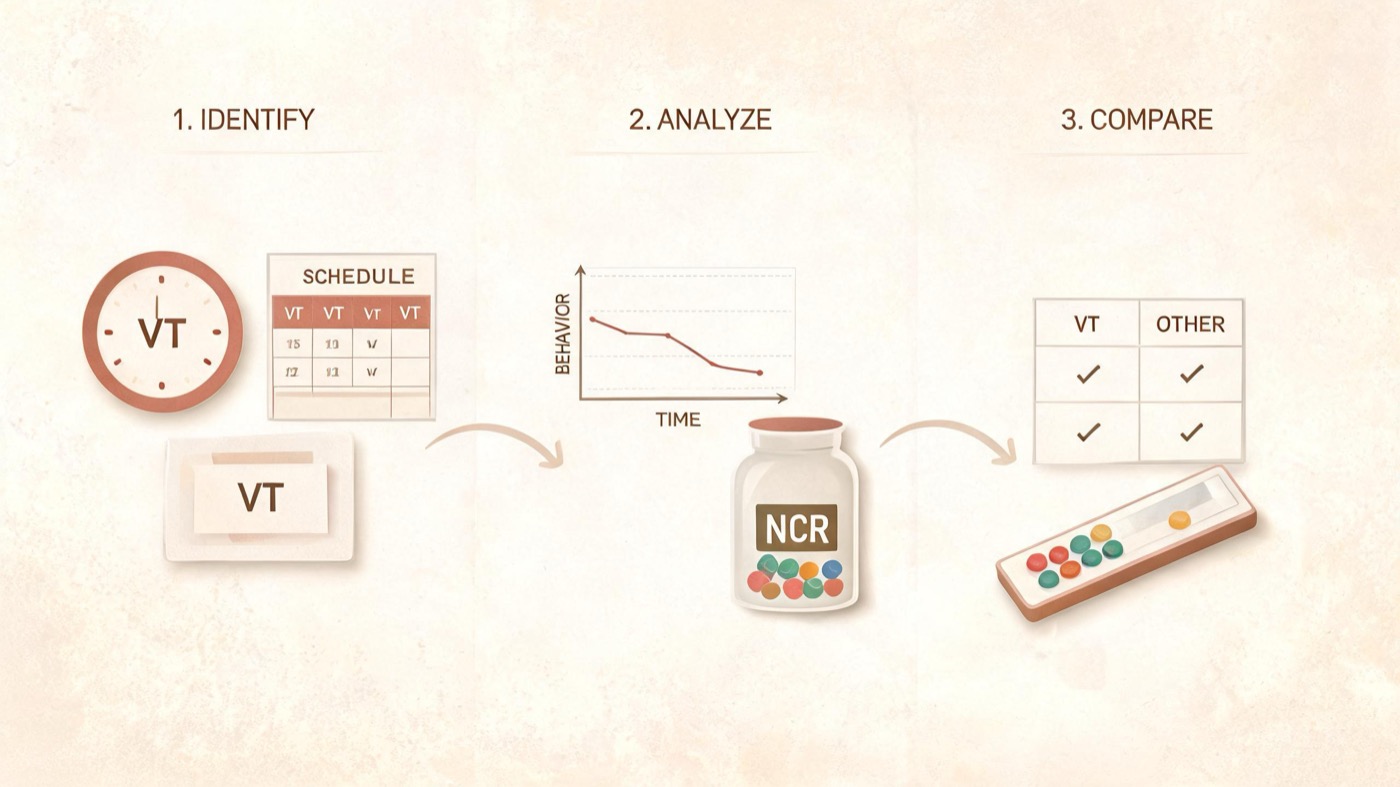
Common Traps to Avoid on the BCBA Exam
- Confusing VT and VI: Remember: VT is response-independent; VI requires a response. If the question says “reinforcement is delivered on a variable-time schedule,” no response is needed.
- Forgetting that VT is time-based: Some distractors describe a response-based schedule (e.g., FR, VR) – don’t be fooled.
- Misidentifying the maintaining variable in NCR: VT is a procedure, not a function. The schedule itself doesn’t tell you what the reinforcer is; you need to look at the consequence delivered.
- Assuming VT always decreases behavior: VT is often used to reduce problem behavior, but it can also increase appropriate behavior if the reinforcer matches a competing function.
Practice Prompt: VT Question Walkthrough
During a 30-minute observation, a therapist delivers a preferred toy to a child every 2-4 minutes regardless of behavior. Which schedule is being used?
- A) Variable-interval 3-minute
- B) Variable-time 3-minute
- C) Fixed-time 3-minute
- D) Noncontingent reinforcement (NCR)
Correct answer: B) Variable-time 3-minute. The schedule is time-based (variable) and response-independent. Option A is wrong because VI requires a response. Option C is wrong because FT would be fixed intervals (e.g., exactly every 3 min). Option D is too broad; NCR can use any time-based schedule. The specific schedule described is VT 3-minute.
VT Time Quick Checklist for Exam Review
- Define VT: Variable-time = reinforcer delivered after variable time, response not required.
- Contrast with VI: VI requires a response; VT does not.
- Contrast with FT: FT uses fixed (constant) time between deliveries; VT uses variable.
- Connect to NCR: VT is a common schedule for noncontingent reinforcement procedures.
- Identify function: VT often serves as an AO (abolishing operation) by satiating the reinforcer.
- Predict effects: VT can decrease problem behavior (especially attention-maintained) or increase compliance when paired with competing reinforcers.
- Watch for traps: Don’t confuse response-independent with response-based; VT does not require a target behavior.
Summary: Mastering VT Time for Your BCBA Exam
VT time is a fundamental schedule in ABA, especially within noncontingent reinforcement interventions. Key takeaways: VT is time-based and response-independent; it differs from VI (which requires a response) and FT (fixed time). VT can function as an abolishing operation to decrease problem behavior or as a competing reinforcer to increase appropriate behavior. On the exam, focus on identifying the schedule from a description and understanding its behavioral effects. For more resources on schedules of reinforcement, check out our guide on compound vs. simple schedules and practice with free BCBA mock exam questions here. Also review the BACB task list for official content outlines.
Complete BCBA Exam Prep
Turn this topic into exam-day practice
Practice concepts in context with five full-length 6th Edition mock exams, two bonus practice exams, a 6th Edition study guide, and key-term flashcards—all in one $120 USD package.
Get the $120 All-in-One Prep Pack
Review everything included on the product page before ordering. No pass guarantee is implied.



