
What Is an Example Stimulus in ABA?
In applied behavior analysis, a stimulus is any environmental change that can affect behavior. An example stimulus is a specific instance of such a change, like a teacher’s instruction or a peer’s smile. Unlike general talk about ‘stimuli,’ behavior analysts define stimuli by their observable and measurable impact on behavior.
Table of Contents
- What Is an Example Stimulus in ABA?
- Why Understanding Example Stimuli Matters for the BCBA Exam
- Worked Examples: ABC Analysis and Hypothesized Function
- Exam Tips: Common Traps and How to Avoid Them
- Quick Checklist for Identifying Example Stimuli on the Exam
- Summary: Mastering Example Stimulus for the BCBA Exam
A Technical Definition from Behavior Analysis
Technically, an example stimulus is a particular antecedent or consequence that alters the probability of a behavior. It differs from a ‘stimulus class’ (a group of stimuli that share a function) and from a ‘discriminative stimulus’ (SD), which signals reinforcement availability. For the BCBA exam, you need to identify the specific stimulus in an ABC contingency. A common mistake is to label an entire situation as the stimulus rather than isolating the precise environmental change. For instance, if a student throws a pencil after the teacher says “do page 5,” the example stimulus is the teacher’s instruction, not the overall classroom context. This precision is key to running accurate functional analyses.
Furthermore, example stimuli can be either antecedent (occurring before the behavior) or consequent (occurring after). In the example above, the teacher’s instruction is an antecedent stimulus. The consequent stimulus might be the teacher’s reaction, such as saying “don’t do that.” Both types are critical in the three-term contingency (ABC). Understanding this distinction helps you build effective behavior intervention plans that target the right variables.
Why Understanding Example Stimuli Matters for the BCBA Exam
Mastering example stimulus identification is crucial because exam questions often present a scenario and ask you to pinpoint the antecedent or consequence. Many students confuse stimuli with motivating operations (MOs) or fail to discriminate between conditioned and unconditioned stimuli. For example, an MO like “being in a hot room” alters the value of a cool breeze, but the hot room itself is not typically an example stimulus—rather, the behavior “opening a window” might be reinforced by the cool breeze, and the specific trigger (e.g., a window within reach) is the antecedent stimulus. Practicing with stimulus control examples can sharpen your skills.
Additionally, the exam often tests your ability to identify stimulus classes—groups of stimuli that evoke the same response. For instance, a child trained to say “hello” when seeing their mother may also say “hello” to other adults with similar features. This concept, known as generalization, relies on example stimuli that belong to a class. Being able to distinguish a single example stimulus from a class is a high-level skill that appears in questions about discrimination training.
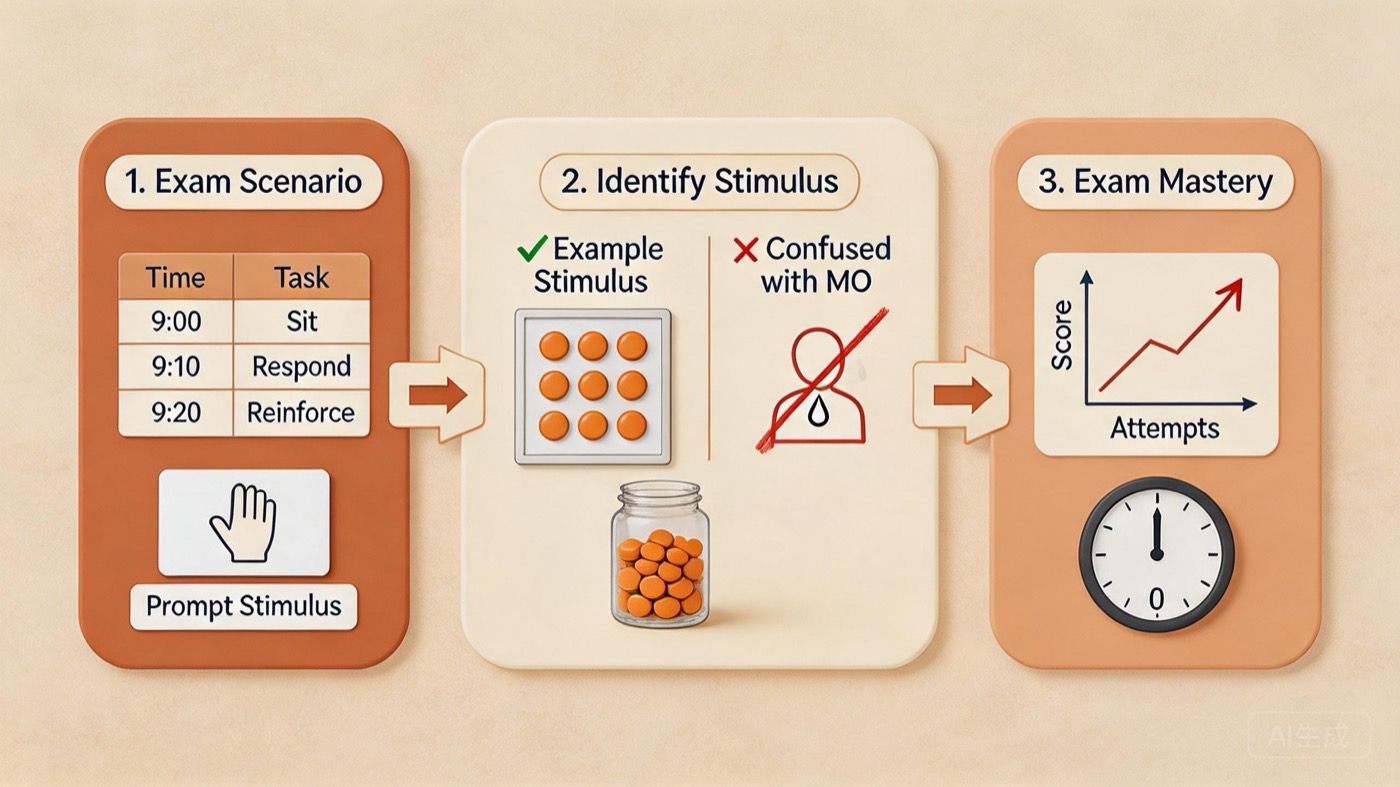
Worked Examples: ABC Analysis and Hypothesized Function
Below are three realistic scenarios showing how to identify the example stimulus and hypothesize the function using ABC analysis.
Example 1: Requesting a Break During Task
- Antecedent stimulus: Difficult worksheet presented.
- Behavior: Learner says ‘break, please.’
- Consequence: Worksheet removed, break provided.
- Hypothesized function: Negative reinforcement (escape from task).
Example 2: Peer Attention During Group Activity
- Antecedent stimulus: Peer enters the room.
- Behavior: Learner calls out peer’s name loudly.
- Consequence: Peer turns and talks to learner.
- Hypothesized function: Social positive reinforcement (attention).
Example 3: Access to Preferred Toy
- Antecedent stimulus: Toy visible on a high shelf.
- Behavior: Learner points at the toy.
- Consequence: Caregiver retrieves and hands toy.
- Hypothesized function: Tangible positive reinforcement (access to item).
Notice that in each case, the example stimulus is the specific environmental event that precedes or follows the behavior. This clarity is essential for functional assessment. A fourth example can help solidify the concept: a student starts humming when the teacher leaves the room. Here, the antecedent stimulus is the teacher’s departure, and the behavior might be maintained by automatic reinforcement (sensory stimulation). Without identifying the example stimulus correctly, you might incorrectly hypothesize escape as the function.
Exam Tips: Common Traps and How to Avoid Them
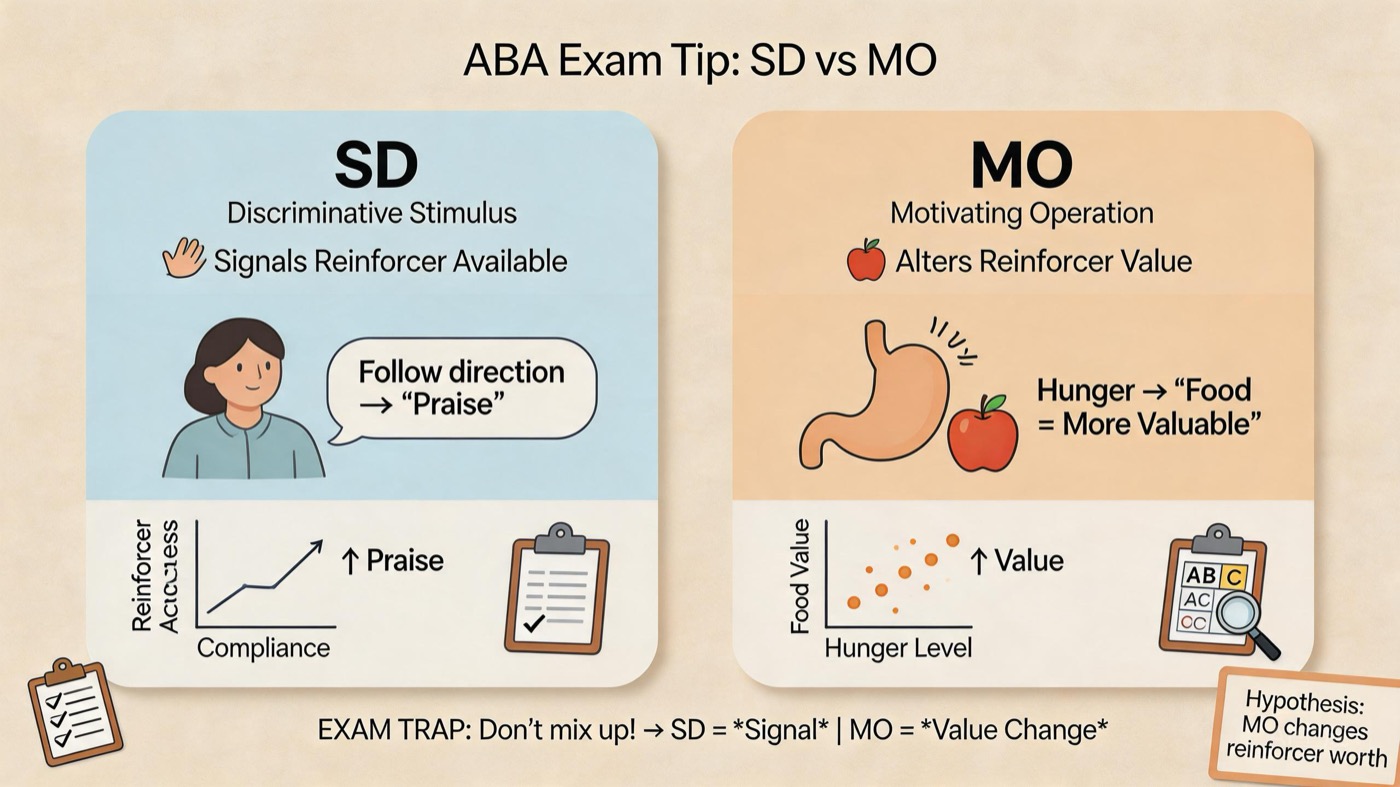
Trap: Confusing Discriminative Stimulus with Motivating Operation
An SD signals that a reinforcer is available; an MO alters the current value of that reinforcer. For example, a teacher’s instruction (SD) indicates that compliance will lead to praise, whereas hunger (MO) makes food more valuable. Practice with our SD vs MO guide to avoid this mix-up. A trick: if removing the stimulus eliminates the behavior, it’s likely an SD; if the behavior persists but becomes less motivated, it’s more about MO.
Trap: Overlooking Conditioned vs. Unconditioned Stimuli
Unconditioned stimuli (e.g., food, pain) do not require learning to affect behavior. Conditioned stimuli (e.g., tokens, praise) acquire their function through pairing. Exam questions may test your ability to classify a novel stimulus. Remember, a stimulus that elicits a respondent behavior (e.g., a loud noise causing a startle) is unconditioned, while one that only works after training (e.g., a stop sign for a driver) is conditioned.
Trap: Forgetting Stimulus Generalization Gradients
Sometimes the exam gives you a scenario where a behavior occurs to similar but not identical stimuli. For example, a child who says “ball” to a soccer ball might also say “ball” to a basketball. The original example stimulus (soccer ball) is part of a class. The BCBA must identify which specific stimulus was used in training versus generalization. A common error is to call the new stimulus an example stimulus when it is actually a generalized stimulus. Differentiating these terms is vital.
Quick Checklist for Identifying Example Stimuli on the Exam
- Identify the behavior first, then look at immediate antecedents and consequences.
- Ask: Is this stimulus an SD (signals availability) or an MO (alters value)?
- Determine if the stimulus is conditioned or unconditioned based on learning history.
- Check if the stimulus is part of a stimulus class with similar functions.
- Practice with ABC charts from your supervision hours.
- Recognize that a single stimulus can have multiple components; focus on the aspect that directly influences the behavior.
Summary: Mastering Example Stimulus for the BCBA Exam
Understanding the example stimulus is foundational for functional analysis and intervention design. Remember to distinguish stimuli from other concepts, use ABC analysis consistently, and watch for common traps. For more practice, explore our free BCBA mock exam questions. Additional resources from the BACB can deepen your knowledge. By mastering example stimuli, you’ll be better prepared to analyze behavior and design effective interventions.



