
Introduction: What Is Definition Bigger in ABA?
In Applied Behavior Analysis (ABA), the term definition bigger refers to the practice of writing operational definitions that are broad enough to capture all relevant instances of a behavior while remaining precise and measurable. This balance is critical for reliable data collection and effective intervention. For BCBA candidates, mastering definition bigger is essential because exam questions often test your ability to distinguish between overly narrow and appropriately broad definitions. A well-written definition ensures that different observers can agree on whether a behavior occurred, which is a cornerstone of ABA science.
Table of Contents
- Introduction: What Is Definition Bigger in ABA?
- Breaking Down the Concept: Definition Bigger vs. Related Terms
- ABA Examples with ABC Analysis
- Exam Relevance: How ‘Definition Bigger’ Appears on the BCBA Test
- Quick Checklist: Is Your Definition ‘Bigger’ Enough?
- Summary: Putting It All Together
The purpose of operational definitions is to make behavior observable and measurable. Without a clear definition, data may be inconsistent, leading to flawed conclusions. Definition bigger helps avoid two common pitfalls: definitions that are so narrow they miss important instances, and definitions that are so vague they include irrelevant behavior. The goal is a definition that is both inclusive and exclusive—capturing every instance of the target behavior while excluding non-target behaviors.
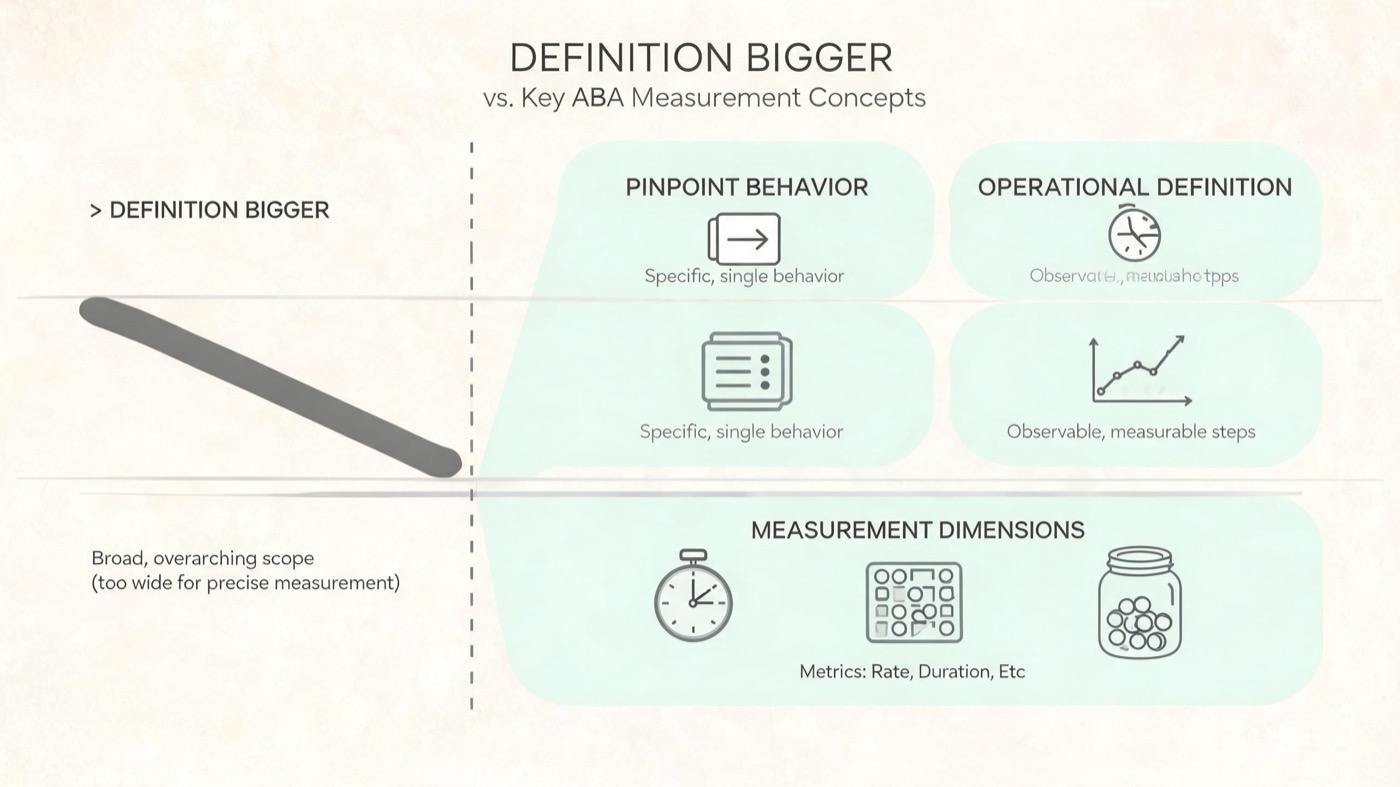
Breaking Down the Concept: Definition Bigger vs. Related Terms
It is easy to confuse definition bigger with other measurement concepts like pinpoint behavior, operational definition, and measurement dimensions. Here is how they differ:
- Pinpoint behavior: A highly specific behavior selected for intervention (e.g., ‘hitting with an open hand’). Definition bigger asks: are we capturing all forms of aggression, or just one?
- Operational definition: The written description that makes behavior measurable. Definition bigger is a quality of that definition.
- Measurement dimensions: Frequency, duration, latency, etc. A definition that is ‘bigger’ ensures the behavior can be measured along the relevant dimension.
Common Misunderstandings on the Exam
Exam traps often arise from conflating breadth with precision. A common mistake is selecting a definition that is broad but not measurable (e.g., ‘aggression’ without specifying topographies). Another trap is choosing a definition that is too narrow, excluding valid instances. For example, defining ‘throwing’ only as ‘propelling an object with force’ may miss dropping items. Always ask: Does this definition capture all instances of the behavior I intend to measure?
ABA Examples with ABC Analysis
Let us apply definition bigger to three typical scenarios using the ABC (Antecedent-Behavior-Consequence) format. Each example includes a hypothesized function.
Example 1: Aggression in a Classroom Setting
- Antecedent: Another student approaches the learner’s desk.
- Behavior: Hitting, kicking, or pushing (operationally defined as ‘any instance of making contact with another person using a body part or object with force’). This definition is ‘bigger’ because it includes multiple topographies.
- Consequence: Teacher redirects attention to the learner and removes the peer.
- Hypothesized function: Attention (positive reinforcement).
Example 2: Self-Injurious Behavior in a Clinic
- Antecedent: Therapist presents a difficult task.
- Behavior: Head banging against a hard surface, defined as ‘any forceful contact between the head and a surface (wall, floor, table) resulting in an audible sound or visible mark.’ This definition is big enough to include all types of surfaces.
- Consequence: Therapist removes the task for 30 seconds.
- Hypothesized function: Escape (negative reinforcement).
Example 3: Vocal Stereotypy During Downtime
- Antecedent: Learner is alone with no demands or preferred activities.
- Behavior: Humming, singing, or making non-contextual vocal sounds (defined as ‘any audible vocalization that is not directed at another person and is not a response to a question’). This definition captures all forms of vocal stereotypy.
- Consequence: Sensory stimulation (no immediate external consequence).
- Hypothesized function: Automatic (sensory) reinforcement.
These examples show how a definition bigger approach ensures that the behavior is captured reliably across settings and observers. A narrow definition might miss variations, compromising data integrity.
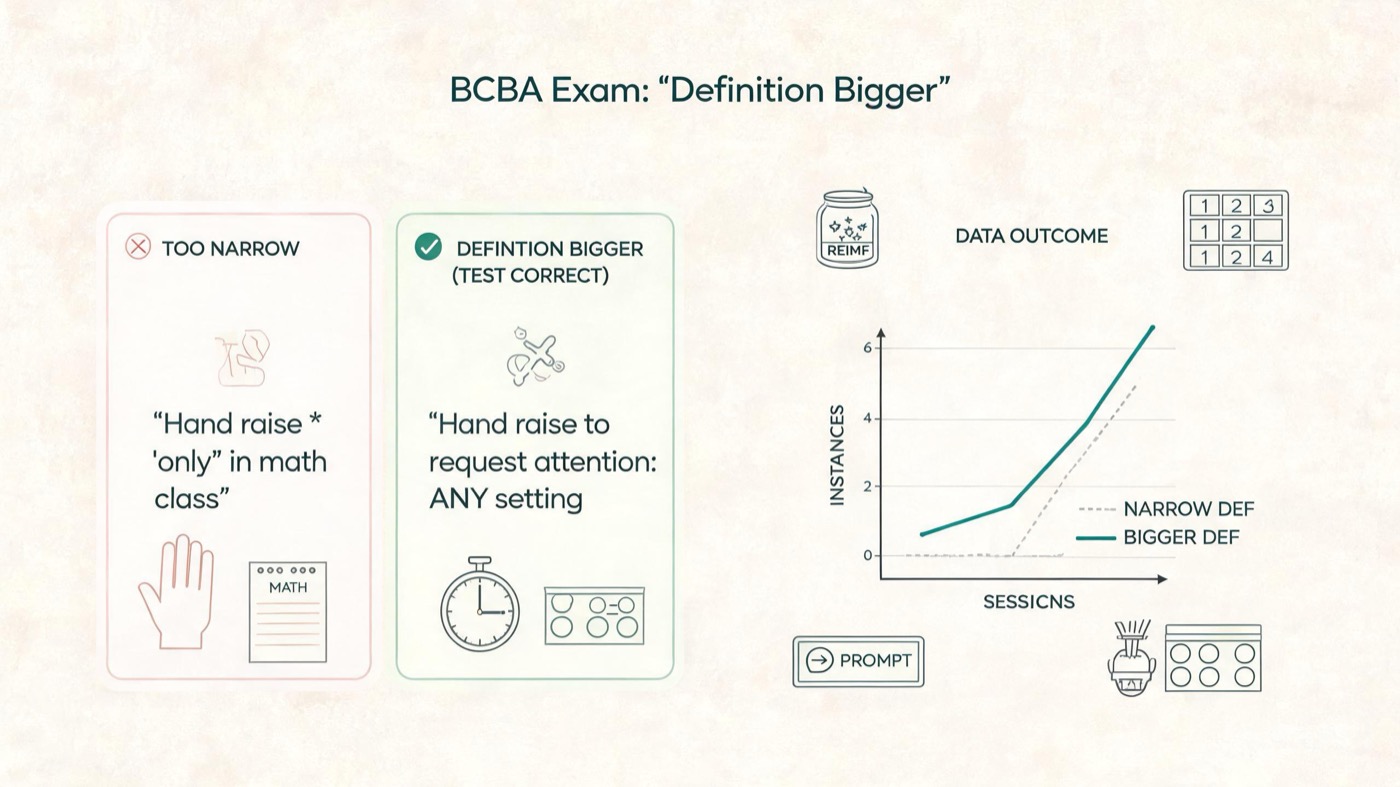
Exam Relevance: How ‘Definition Bigger’ Appears on the BCBA Test
On the BCBA exam, you will encounter questions that require you to evaluate or select operational definitions. The concept of definition bigger often appears in scenarios asking you to identify the most appropriate definition or to critique a given definition. Key exam topics include the BACB Task List items related to measurement and data collection (e.g., A-1, A-2 in the 5th edition). You may be asked to choose between a narrow and a broad definition, or to identify the missing component of a definition.
Common Exam Traps to Avoid
- Overly broad definitions: Including behaviors that are not the target (e.g., defining ‘on-task behavior’ as ‘paying attention’). Instead, specify observable actions like ‘eyes on the worksheet, pencil moving.’
- Underly narrow definitions: Excluding valid topographies (e.g., defining ‘aggression’ only as ‘hitting’ when pushing, kicking, or grabbing also occur).
- Mixing function into definition: Defining behavior by its intent (‘attempts to escape’) rather than its form. Stay topographical.
- Not including boundaries: For example, defining ‘tantrum’ without specifying duration or intensity thresholds.
Practice Prompts for Self-Testing
- Which definition is ‘bigger’? (a) ‘Hitting: any forceful contact of hand with another’s body’ vs. (b) ‘Aggression: any instance of hitting, kicking, pushing, or biting.’ Answer: (b) is bigger and more measurable.
- Identify the missing component: ‘Elopement: leaving the classroom without permission.’ Is this definition too narrow? It may miss leaving the therapy room or leaving during recess. A broader definition would include ‘any instance of moving more than 3 feet away from an adult without consent.’
- Rewrite this definition to be ‘bigger’: ‘Self-stimulatory behavior: flapping hands.’ Improved: ‘Self-stimulatory behavior: any repetitive movement of the hands, fingers, arms, or torso that does not serve a functional purpose (e.g., hand flapping, rocking, spinning).’
Quick Checklist: Is Your Definition ‘Bigger’ Enough?
Use this checklist to evaluate any operational definition you write or encounter. Each item ensures the definition meets BCBA standards for reliability and validity.
Checklist Items
- Observable: Can you see or hear the behavior? (e.g., ‘crying’ is observable; ‘feeling sad’ is not.)
- Measurable: Can you count, time, or record the behavior? (e.g., frequency, duration, intensity.)
- Inclusive boundaries: Does it capture all relevant topographies? (e.g., includes hitting, kicking, pushing for aggression.)
- Exclusive boundaries: Does it exclude non-target behaviors? (e.g., excludes accidental contact for aggression.)
- Reliable: Would two independent observers agree? (Use interobserver agreement data to test.)
- Context-appropriate: Does it fit the setting and function? (e.g., a classroom definition may differ from a clinic definition.)
For more on constructing operational definitions, see our guide on data collection in ABA.
Summary: Putting It All Together
Definition bigger is a crucial concept in ABA that ensures operational definitions are both comprehensive and precise. By balancing breadth with specificity, you enable reliable measurement and effective behavior change. We covered the definition, distinguished it from related terms, provided three ABC examples with hypothesized functions, highlighted exam traps, and offered a practical checklist. Remember, a definition that is ‘bigger’ is not necessarily long—it is clear, inclusive, and testable. As you prepare for the BCBA exam, practice evaluating definitions for inclusion and exclusion criteria. For additional exam strategies, check out our BCBA exam prep guide or relevant BACB resources. Keep refining your definitions, and you will master this foundational skill.



