
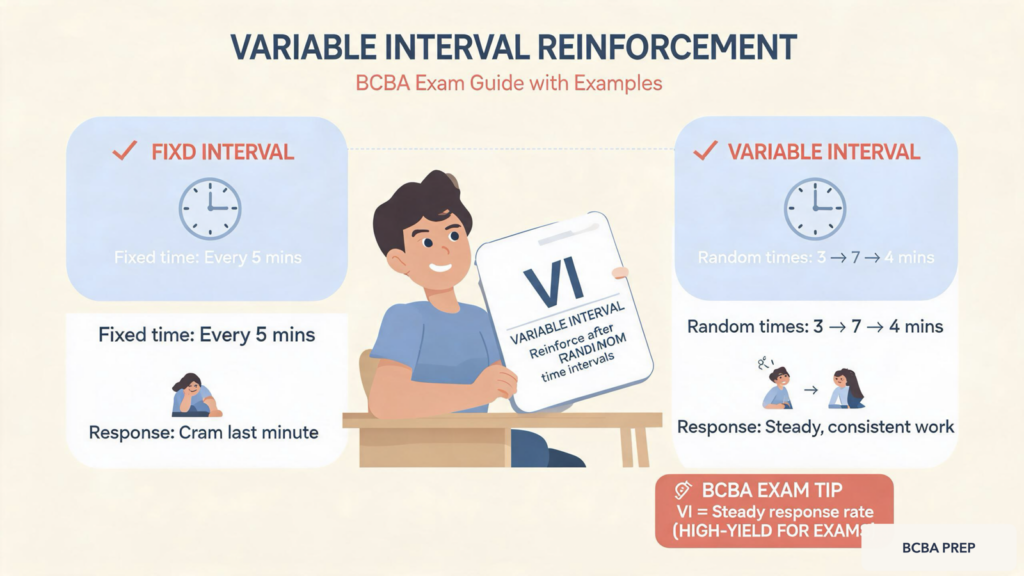
What Is Variable Interval Reinforcement?
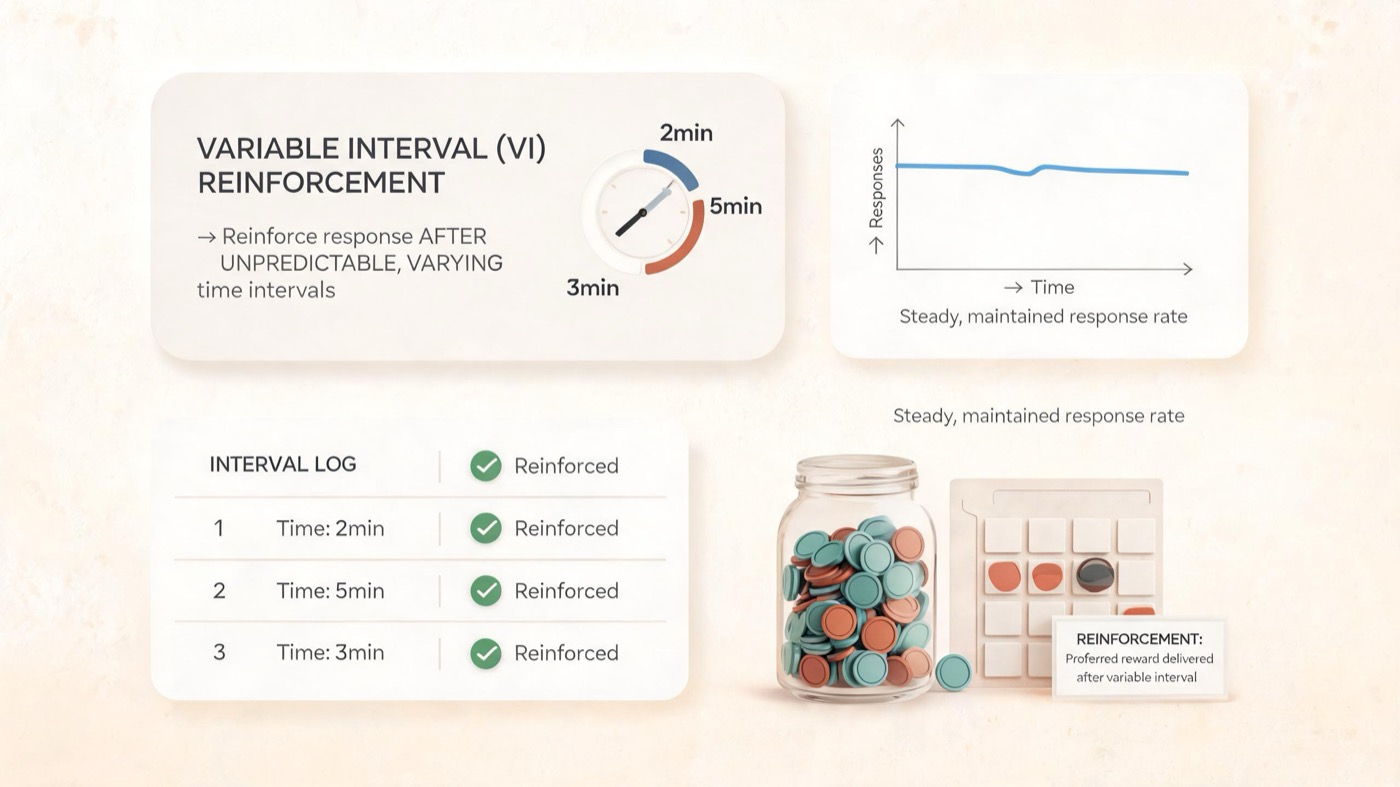
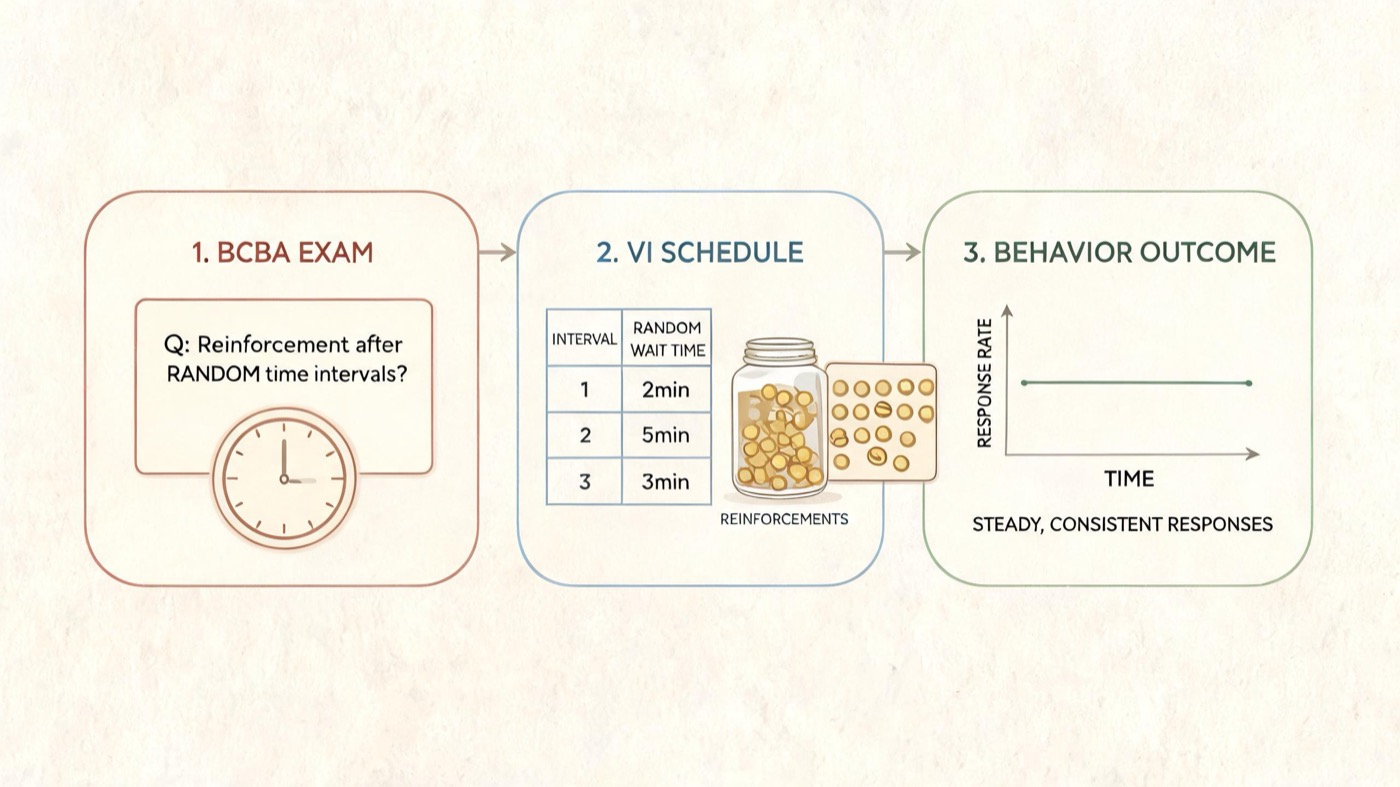
Variable interval reinforcement is a schedule of reinforcement where a response is reinforced after an unpredictable amount of time has passed. The key feature is that the interval between opportunities for reinforcement varies around an average. This schedule is time-based, meaning the first correct response after the variable interval ends produces reinforcement.
Practice this concept
Table of Contents
- What Is Variable Interval Reinforcement?
- Variable Interval Reinforcement Examples in ABA Therapy
- Why Variable Interval Reinforcement Matters for the BCBA Exam
- Quick Study Checklist for Variable Interval Reinforcement
- Final Summary
Key Components of a Variable Interval Schedule
To fully understand variable interval (VI) schedules, focus on these components:
- Time-based criterion: Reinforcement is delivered after a variable amount of time, not after a set number of responses.
- Average interval: The schedule is described by its average length (e.g., VI 5 minutes means intervals average 5 minutes, but can range from a few seconds to many minutes).
- First response after interval: Only the first response after the interval elapses produces reinforcement; responses before that go unreinforced.
- Steady, moderate response rate: Because the next reinforcement opportunity is unpredictable, learners tend to respond at a steady, moderate pace without the pauses seen in fixed interval schedules.
Variable Interval vs. Variable Ratio: A Common Distinction
A frequent source of confusion on the BCBA exam is differentiating variable interval from variable ratio (VR). Remember: VI is time-based; VR is response-based. In a VR schedule, reinforcement is delivered after a variable number of responses (e.g., VR 10 means on average every 10th response is reinforced). VR schedules produce high, steady response rates because the faster you respond, the sooner you get reinforcement. In contrast, VI schedules produce steady, moderate rates because responding quickly does not hasten reinforcement – you simply have to wait for the next interval to end. Recognizing this distinction is essential for correctly identifying schedules in exam scenarios.
Variable Interval Reinforcement Examples in ABA Therapy
Applying variable interval reinforcement in real ABA settings helps clarify how it works. Below are three examples using the ABC (Antecedent-Behavior-Consequence) format.
Example 1: Checking Email for Work Praise
- Antecedent: Work email notification sound. The employee knows that praise from a supervisor sometimes follows.
- Behavior: Checking email.
- Consequence: Receiving a praising email from the supervisor after a variable amount of time (average every 10 minutes).
- Function: Social positive reinforcement (attention).
This scenario often appears on the exam because it highlights the steady checking behavior typical of a VI schedule.
Example 2: Student Raising Hand in Class
- Antecedent: Teacher asks a question to the class.
- Behavior: Student raises hand.
- Consequence: Teacher calls on the student after variable intervals (average every 5 minutes).
- Function: Attention from the teacher.
Notice that the student raises their hand at a steady rate because they never know exactly when they will be called on.
Example 3: Client Requesting Breaks
- Antecedent: Task demand presented (e.g., worksheets).
- Behavior: Client requests a break.
- Consequence: Break granted after a variable interval (average every 8 minutes).
- Function: Escape from task demands.
This example demonstrates how variable interval schedules can maintain escape-maintained behavior. The client learns that requesting a break eventually works, but not every time, leading to persistent requesting.
Why Variable Interval Reinforcement Matters for the BCBA Exam
The BCBA exam regularly tests your ability to identify and distinguish among schedules of reinforcement. Variable interval questions can appear in scenario-based items, definition-based items, and even in questions about behavioral effects. Mastering this concept helps you avoid common traps and secure easy points.
Common Exam Traps to Avoid
Be aware of these frequent pitfalls:
- Confusing VI with VR: Remember time vs. responses. If the scenario mentions time passing, it’s likely interval; if it mentions number of responses, it’s ratio.
- Forgetting steady rates: VI produces a steady, moderate response rate – not high and not low. If a scenario describes rapid responding, it’s probably VR.
- Misidentifying the schedule when time is constant: If the time interval is fixed, it’s fixed interval (FI), not VI. Look for words like ‘unpredictable’ or ‘variable.’
- Overlooking post-reinforcement pause: In VI, there is typically little to no post-reinforcement pause because the next interval has already started. This contrasts with FI, where a pause is common.
How to Answer Scenario-Based Questions
When you encounter a scenario on the exam, use these steps:
- Identify the controlling variable: Is the reinforcer delivered based on time or number of responses? If time, proceed to step 2.
- Determine if time is variable or fixed: Look for keywords like ‘unpredictable,’ ‘random,’ ‘on average.’ If variable, it’s VI.
- Look at response pattern: VI produces consistent, steady responding without pauses or bursts. If the pattern matches, you’re likely correct.
- Check for function: VI can maintain any function (attention, escape, tangible, sensory) as long as the delivery is time-based and variable.
Quick Study Checklist for Variable Interval Reinforcement
Use this checklist to reinforce your knowledge before the exam:
- [ ] Define variable interval schedule in your own words (time-based, average interval, first response after interval).
- [ ] Differentiate VI from VR (time vs. responses) and from FI (variable vs. fixed).
- [ ] Describe the typical response pattern: steady, moderate rate, minimal post-reinforcement pause.
- [ ] Identify the average interval specification (e.g., VI 5 min).
- [ ] Generate at least two ABA examples using the ABC format.
- [ ] Explain the behavioral function maintained (often attention or escape).
- [ ] Predict what happens if the schedule is thinned (e.g., VI 2 min to VI 10 min).
- [ ] Recognize common exam traps (confusing with VR, forgetting steady rates).
- [ ] Practice with at least 5 scenario-based questions from a reliable source like BCBA mock exams.
Final Summary
Variable interval reinforcement is a time-based schedule that produces steady, moderate responding. It is defined by an average interval that varies unpredictably. On the BCBA exam, you must be able to distinguish VI from other schedules, especially VR and FI. Use the examples and checklist above to solidify your understanding. For more in-depth review on schedules of reinforcement, check out this guide on compound vs. simple schedules. Additionally, the BACB’s official website provides the task list and resources to guide your study. By mastering this concept, you’ll be better prepared to tackle schedule-related questions and boost your exam score.
Complete BCBA Exam Prep
Turn this topic into exam-day practice
Practice concepts in context with five full-length 6th Edition mock exams, two bonus practice exams, a 6th Edition study guide, and key-term flashcards—all in one $120 USD package.
Get the $120 All-in-One Prep Pack
Review everything included on the product page before ordering. No pass guarantee is implied.



