
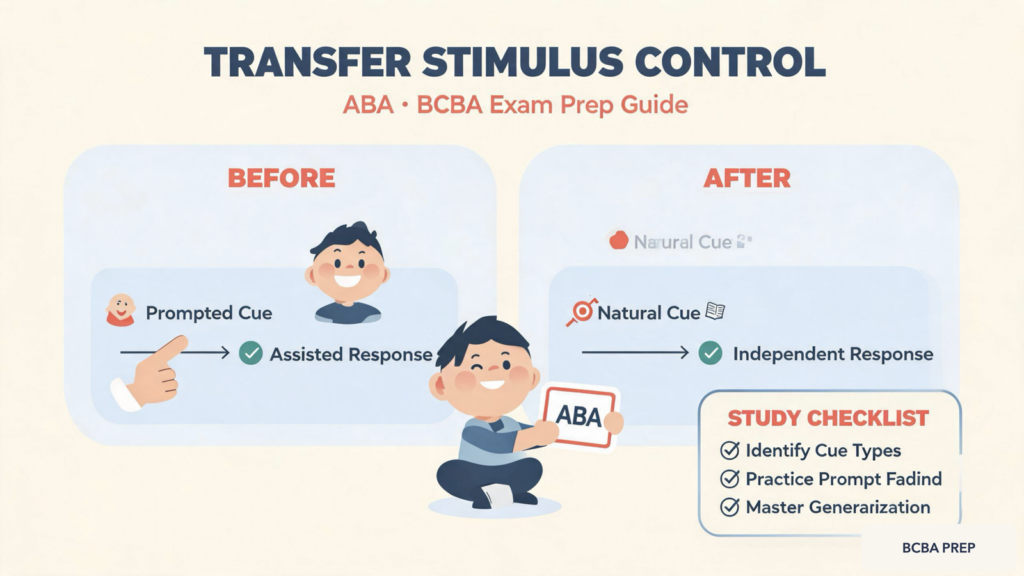
In ABA, transfer stimulus control is a fundamental process where control over a behavior shifts from a prompt to a natural discriminative stimulus. This ensures that the learned behavior occurs independently in the appropriate context. For BCBA candidates, understanding this concept is critical for designing effective interventions. This guide covers the definition, key procedures, practical examples, common exam traps, and a quick review checklist.
Table of Contents
- What Is Transfer of Stimulus Control?
- Procedures for Transferring Stimulus Control
- ABA Examples with ABC Analysis
- Exam Relevance and Common Traps
- Quick Checklist: Transfer of Stimulus Control
- Summary: Key Takeaways
What Is Transfer of Stimulus Control?
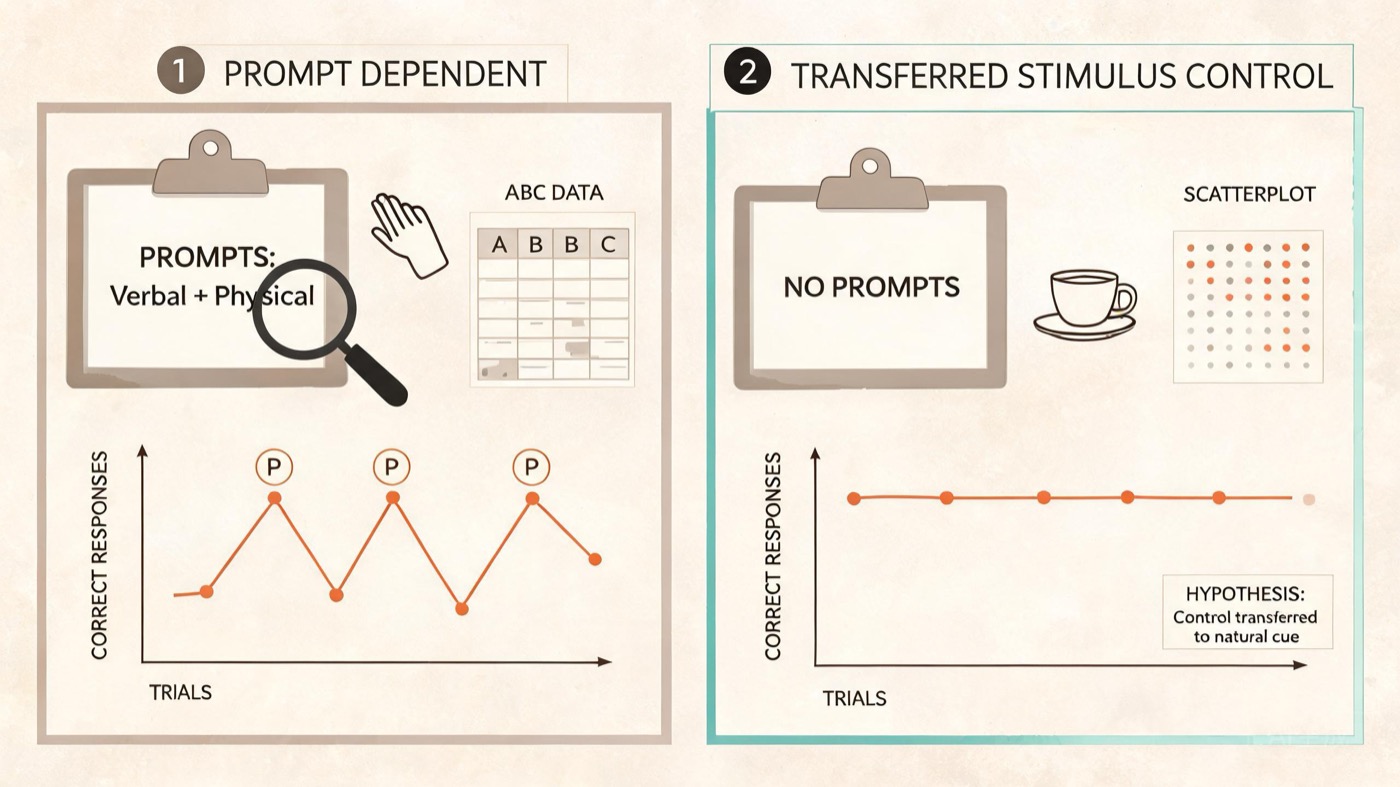
When you teach a new skill, you often use prompts to help the learner respond correctly. The goal is to eventually remove those prompts so the behavior is under natural stimulus control. Transfer of stimulus control is the process of moving from prompt-controlled responding to natural discriminative stimulus (SD) control.
Practice this concept
Use the related stimulus control questions to practice transfer and fading decisions.
Without this transfer, the learner may become prompt-dependent and fail to perform the skill in real-world settings. The BCBA task list emphasizes that practitioners must select and implement transfer procedures systematically.
Key Terminology
- Stimulus control: When a behavior is more likely to occur in the presence of a specific antecedent stimulus.
- Prompt: An extra antecedent stimulus used to evoke a correct response.
- Discriminative stimulus (SD): The natural cue that signals reinforcement is available.
- Transfer procedures: Systematic methods to eliminate prompts while maintaining the behavior under SD control.
Procedures for Transferring Stimulus Control
Several evidence-based procedures exist to transfer stimulus control. Each method shapes the transition from prompt to natural cue in a slightly different way. The choice depends on the learner, the skill, and the context.
Prompt Fading
Prompt fading involves gradually removing the prompt across trials. For example, teaching a child to request a ball: start by modeling the word ‘ball’, then whisper, then use a partial verbal prompt (‘ba…’), and finally provide no prompt. The child learns to say ‘ball’ in the presence of the ball alone.
Prompt Delay
In prompt delay, you insert a brief delay between the natural SD and the prompt. Two common types:
- Constant delay: A fixed delay (e.g., 2 seconds) is used from the start.
- Progressive delay: The delay increases gradually (e.g., 0s, 2s, 4s).
For example, teaching a student to raise their hand: the teacher says ‘If you have a question, raise your hand.’ Then waits 3 seconds before prompting (e.g., modeling hand raise). Over time, the student raises their hand before the prompt.
Stimulus Fading
Stimulus fading involves gradually changing an irrelevant stimulus dimension (e.g., color, size) to transfer control to the relevant SD. For teaching color discrimination: start with a red card (target) and a green card (distractor) where the red card is much larger. Slowly reduce the size difference until only color matters. The learner responds to red regardless of size.
ABA Examples with ABC Analysis
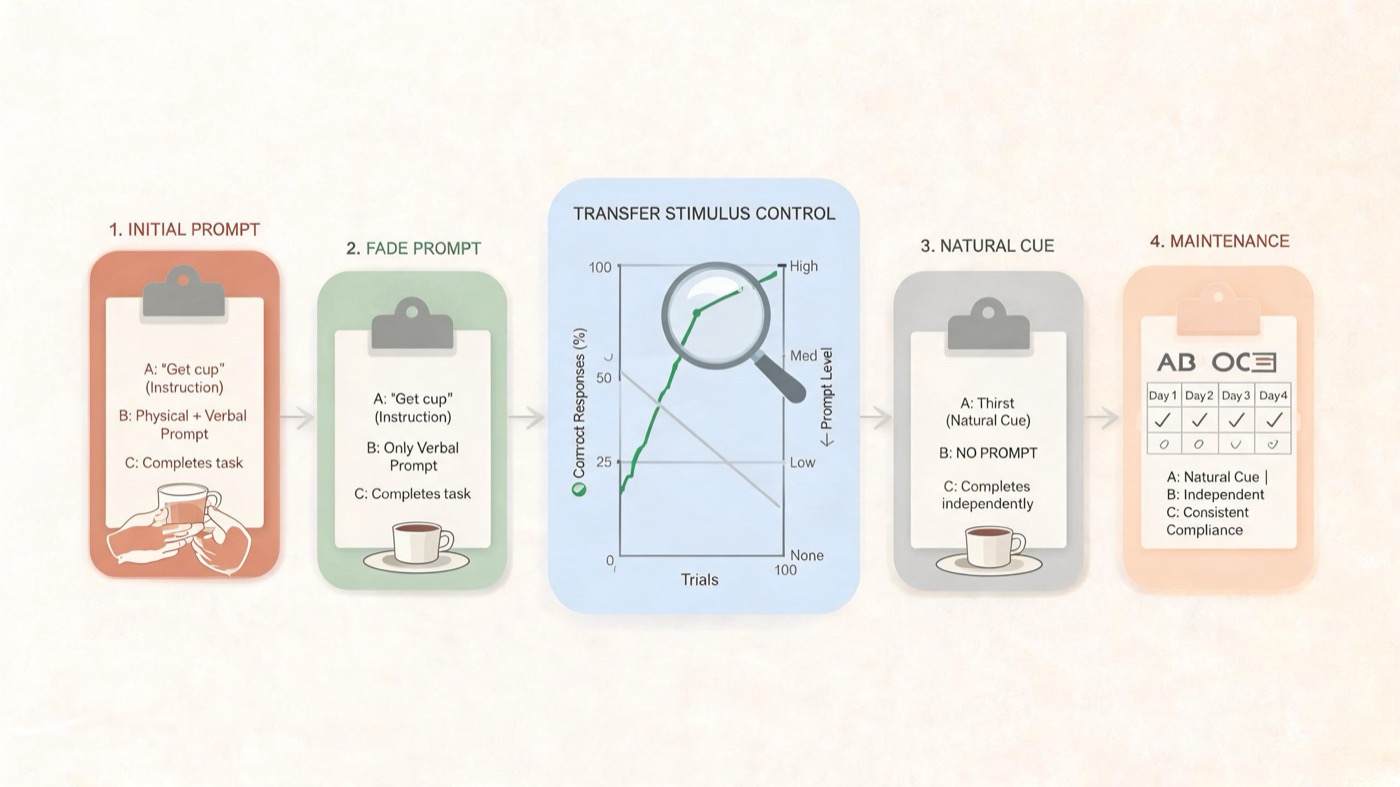
Applied examples help solidify your understanding of transfer stimulus control. Below are three scenarios with ABC analysis illustrating how control shifts from prompt to natural cue.
Example 1: Teaching a Child to Greet
- Antecedent: Peer approaches (natural SD) + verbal prompt ‘Say hi’.
- Behavior: Child says ‘hi’.
- Consequence: Peer smiles (social reinforcement).
- Transfer: Fade the prompt (whisper, then no prompt). Eventually, peer approach alone evokes ‘hi’.
Example 2: Teaching a Student to Read Sight Words
- Antecedent: Flashcard with word ‘cat’ + teacher points to word.
- Behavior: Student says ‘cat’.
- Consequence: Teacher says ‘Great!’ (praise).
- Transfer: Use prompt fading (remove pointing) so the word card alone becomes the SD.
Example 3: Teaching a Client to Wash Hands
- Antecedent: Sink area + physical guidance (hand-over-hand).
- Behavior: Client washes hands.
- Consequence: Timer sounds (escape from guidance).
- Transfer: Reduce guidance gradually (e.g., light touch, shadow, then no guidance). Sink alone becomes the SD.
Exam Relevance and Common Traps
On the BCBA exam, transfer of stimulus control appears in scenario-based questions. You must identify the procedure being used or its purpose. Avoid these common mistakes.
How It Appears on the Exam
Questions may describe a teaching session and ask what procedure the therapist is using (e.g., prompt fading vs. time delay). Remember: the goal is always to move control from prompt to natural stimulus. For more on stimulus control, see our stimulus control ABA guide.
Trap 1: Confusing Transfer with Generalization
Transfer is within the same stimulus class (e.g., prompt to SD). Generalization is across different stimuli (e.g., responding to various examples of a concept).
Trap 2: Forgetting the Prompt is Removed
In transfer, the prompt no longer evokes the behavior. If the prompt remains, control has not transferred.
Trap 3: Misidentifying the Procedure
Progressive delay vs. constant delay, stimulus fading vs. shaping—know the differences. Shaping involves behavior, not stimuli.
Quick Checklist: Transfer of Stimulus Control
- Identify the natural SD for the target behavior.
- Choose a prompt type (verbal, model, physical, etc.) that matches the learner.
- Select a transfer procedure: prompt fading, prompt delay, or stimulus fading.
- Collect data to ensure the behavior occurs under SD control without prompts.
- Monitor for prompt dependency and adjust accordingly.
Summary: Key Takeaways
Transfer stimulus control is an essential ABA procedure for building independent skills. It moves behavioral control from prompts to natural discriminative stimuli using methods like prompt fading, prompt delay, and stimulus fading. The BCBA exam expects you to distinguish these procedures and apply them to real-world scenarios. For additional practice, check out our BCBA mock exam 6th edition. For authoritative guidelines, refer to the BACB website.



