
A variable duration schedule reinforces behavior after it continues for a changing amount of time. Learn the recognition rule, see how it differs from variable interval and variable ratio schedules, and use a simple comparison framework for BCBA exam questions.
Table of Contents
- What Is a Variable Duration Schedule?
- What Does “Duration” Control in This Schedule?
- How Is Variable Duration Different From Variable Interval?
- How Do You Distinguish Variable Duration From Similar Schedules?
- What Is a Variable Duration Schedule Example?
- How Does the Average Duration Organize the Schedule?
- What Measurement Details Matter for a Duration Schedule?
- What Common Mistakes Appear in Variable Duration Questions?
- How Should a BCBA Apply the Concept Responsibly?
- How Can You Remember Variable Duration for the BCBA Exam?
- What Is the Bottom Line?
- Quick Review Checklist
- Take the Free BCBA Mock Exam
When a question asks about a variable duration schedule, the key is to identify what must vary and what the learner must do before reinforcement is available. The requirement is based on the duration of an ongoing response. The behavior must continue for a duration that changes from opportunity to opportunity, usually around an average value. The schedule is not defined by the amount of time since the last reinforcer, and it is not defined by how many responses have occurred.
This distinction matters because schedule names can sound alike while controlling different dimensions of behavior. Variable interval (VI) schedules vary the time until a reinforcer becomes available; variable ratio (VR) schedules vary the number of responses; variable time (VT) schedules deliver a stimulus or event after varying time intervals without requiring a particular response. A variable-duration schedule instead asks whether the response has continued long enough on that opportunity.
The examples below are designed for BCBA study and conceptual discrimination. The BACB task-list materials provide the professional exam framework, while the exact contingency, measurement system, and clinical decision must always be interpreted in context. This page is educational guidance, not a universal treatment protocol.
What Is a Variable Duration Schedule?
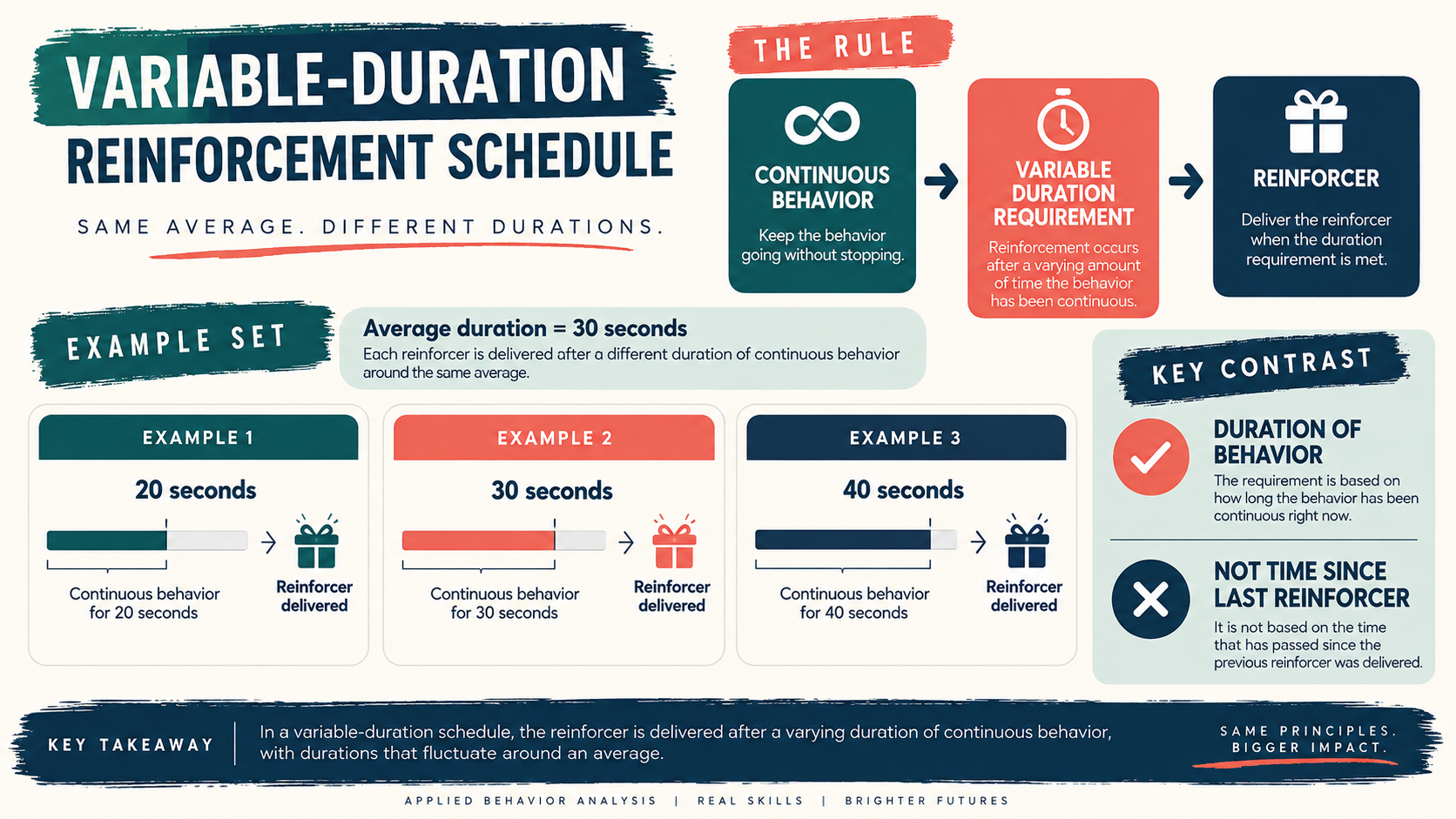
A variable duration schedule is a reinforcement arrangement in which reinforcement follows the continued performance of a response after a changing duration requirement has been met. The response has to remain in progress. The duration requirement might be shorter on one opportunity and longer on the next, while the schedule is organized around an average or expected duration.
Imagine that a learner is practicing sustained engagement with a task. On different opportunities, the criterion might be 20 seconds, 50 seconds, 35 seconds, and 75 seconds before the programmed reinforcer is delivered. The relevant question is not simply whether the learner touched the task or whether 50 seconds passed since the last reinforcer. The question is whether the defined response continued for the current duration requirement. For a study question, reduce the schedule to three parts:
- Response dimension: the behavior must continue, rather than merely occur once.
- Requirement: the duration needed for reinforcement changes across opportunities.
- Consequence: reinforcement follows completion of the current duration requirement, assuming the programmed contingency is otherwise met.
What Does “Duration” Control in This Schedule?
Duration is the amount of time a response is occurring during a defined episode. A duration-based contingency therefore needs a response with a reasonably clear onset and offset. “Staying seated,” “engaging with the assigned material,” or “remaining in a designated area” might be described in duration terms, but the operational definition must state what counts as the response and when the episode ends.
This is different from recording how long a session lasts or how much time has elapsed on a wall clock. If the response stops before the current criterion is met, the duration requirement has not been completed. If a new episode begins, the observer must know whether the schedule resets, pauses, or follows another programmed rule. Those details cannot be inferred from the phrase “variable duration” alone.
How Is Variable Duration Different From Variable Interval?
The easiest way to separate variable duration from variable interval is to ask what the learner is doing while the requirement is being met. In a variable duration schedule, the response must continue for the required duration. In a variable interval schedule, a changing amount of time passes before reinforcement becomes available, and the next eligible response can produce reinforcement after availability.
Suppose the requirement is an average of 60 seconds. If the schedule is variable duration, the learner may need to maintain the target response for the current sampled duration. If the schedule is variable interval, the learner may only need to emit the relevant response after the interval has elapsed. The same clock time could appear in both examples, but the controlling dimension is different.
Use the wording of the question carefully. Phrases such as “continues for,” “maintains,” “holds,” or “engages for a changing amount of time” point toward duration. Phrases such as “after an unpredictable amount of time has passed” or “the first response after the interval” point toward interval. Do not select VI merely because the example contains seconds.
How Do You Distinguish Variable Duration From Similar Schedules?
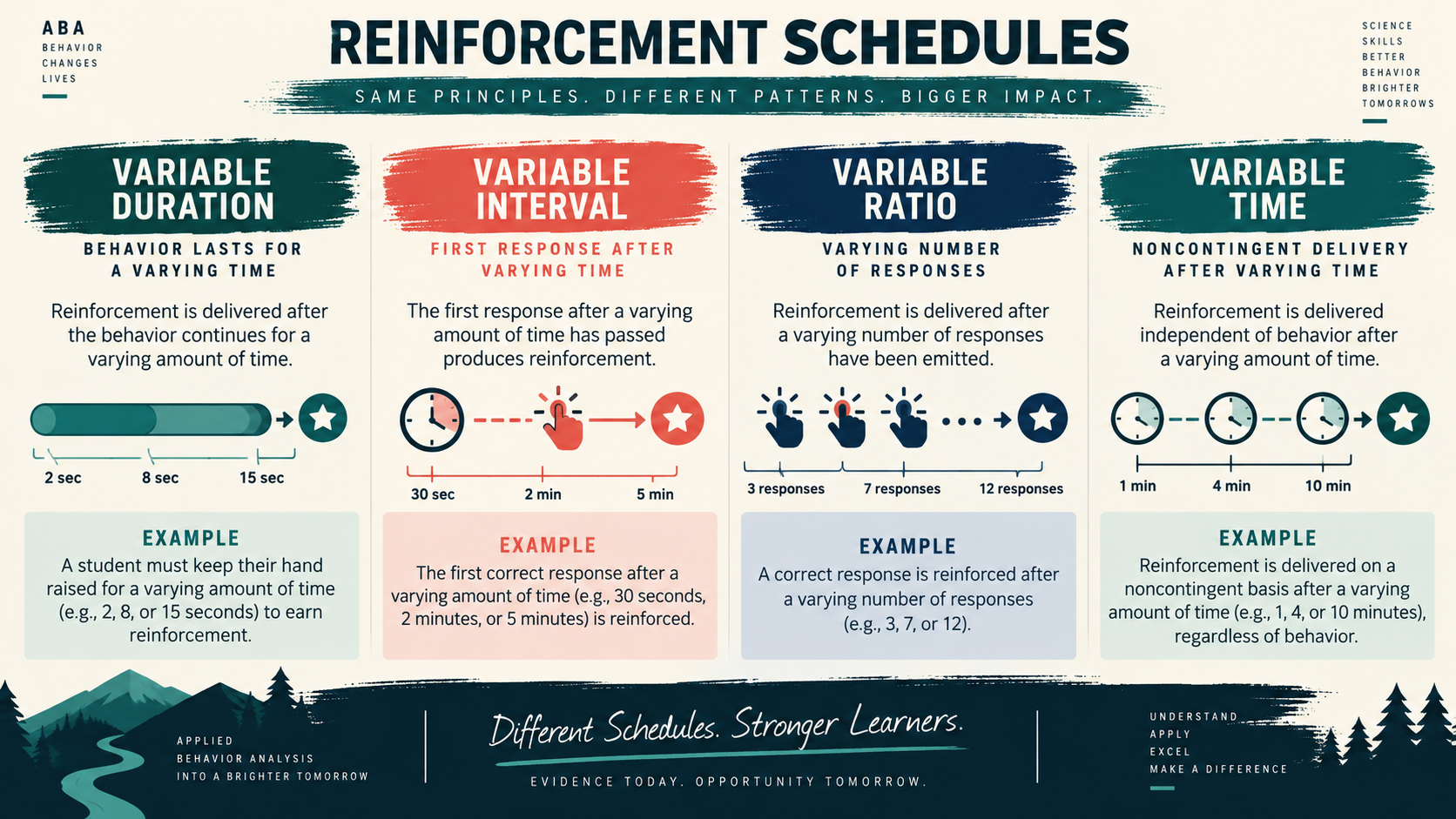
Compare the schedule names by identifying the event that makes reinforcement available. The word variable tells you that the requirement changes; the second word tells you the response or time dimension that changes. A ratio schedule counts responses. An interval schedule counts time before a response can be reinforced. A duration schedule measures how long the response continues. A time schedule delivers according to time rather than requiring the target response.
| Schedule | What varies? | What must happen? | Exam recognition cue |
|---|---|---|---|
| Variable duration (VD) | The duration requirement for an ongoing response | The defined response continues until the current duration is met | “Maintain,” “sustain,” or “continue for” a changing time |
| Variable interval (VI) | The time until reinforcement becomes available | An eligible response occurs after the interval has elapsed | “First response after” a changing amount of time |
| Variable ratio (VR) | The number of responses required | The learner emits the required count of responses | “After an average of” a changing number of responses |
| Variable time (VT) | The time between scheduled events | The time passes; a particular target response is not required for delivery | “Delivered noncontingently” at changing time intervals |
What Is a Variable Duration Schedule Example?
Consider an instructional activity in which the target response is continuous task engagement. The team defines engagement as manipulating the assigned materials or orienting to the task materials while remaining in the instructional area, with clear rules for brief pauses. A duration sequence might require 30 seconds on one opportunity, 60 seconds on another, 45 seconds on the next, and 90 seconds later. Reinforcement follows when the current criterion is met.
This example becomes a true variable-duration arrangement only if the variation is part of the programmed contingency and the response must continue for the criterion. If the learner receives a reinforcer simply because 60 seconds passed, the example may be time-based instead. If the learner receives reinforcement after the first correct response following 60 seconds, it is closer to an interval contingency. If the requirement is ten task responses regardless of how long they take, it is response-count based.
Do not overread the example. The numbers do not tell you whether a schedule is clinically appropriate, whether the reinforcer is effective, or whether the learner can access the task. They only help identify the defining relation between the response, the changing duration, and the consequence.
How Does the Average Duration Organize the Schedule?
Variable schedules are often described by an average requirement. An average helps communicate the general density of reinforcement across opportunities, but it does not mean that every opportunity will use the same number. A schedule with an average duration of 60 seconds may include shorter and longer criteria, depending on how the sequence is generated and what limits are specified.
For exam purposes, focus on the relation rather than trying to calculate a sequence that the question does not provide. Ask whether the learner must maintain the response until the sampled duration is complete. If yes, the duration dimension is doing the work. If the question only states that reinforcement becomes available after changing time intervals, look for interval terminology instead.
What Measurement Details Matter for a Duration Schedule?
Measurement begins with an operational definition. Specify the response, onset, offset, qualifying context, and treatment of interruptions. If the target is “on-task behavior,” define whether looking away for two seconds ends the episode, whether a teacher prompt counts as engagement, and how transitions are handled. The answer should be observable and usable by the people collecting data.
- Record the duration requirement: document the programmed criterion for each opportunity instead of assuming that all opportunities were equivalent.
- Record actual response duration: distinguish the time the response occurred from the time reinforcement was delayed for another reason.
- Track interruptions: note whether the schedule resets, pauses, or ends when the response stops.
- Track prompts and context: an increase in duration with intensive prompting may not represent independent performance.
- Review the consequence: check whether reinforcement was delivered as programmed and whether it remained valuable.
What Common Mistakes Appear in Variable Duration Questions?
- Choosing interval because seconds are mentioned: time units alone do not identify an interval schedule. Ask whether the response must continue.
- Choosing ratio because the learner responds repeatedly: repeated responding is not the same as a programmed response count.
- Calling every changing delay variable duration: the behavior must be the event whose duration meets the requirement.
- Ignoring the word “noncontingent”: if delivery occurs independently of the target response, consider a time-based schedule.
- Confusing duration measurement with duration schedule: recording how long behavior occurs does not automatically mean reinforcement is arranged on a duration schedule.
- Assuming a variable schedule is automatically better: schedule selection still requires assessment, clear goals, competent implementation, and review.
How Should a BCBA Apply the Concept Responsibly?
A schedule label is not a complete intervention plan. Before using a duration-based contingency, a qualified professional would consider the learner’s skills, communication, preferences, assent or consent processes as applicable, access to breaks, safety, and the function of the behavior. A requirement that is too long, unclear, or disconnected from the learner’s priorities may create frustration or produce misleading data.
The BACB ethics resources emphasize responsible, competent, and individualized practice. That context matters for exam questions that ask for the best next step. The strongest answer usually defines the response, gathers relevant data, considers social significance, and avoids presenting a schedule name as a shortcut around assessment or professional judgment.
Also separate study examples from clinical decisions. A simple diagram may show the contingency clearly, but a real plan may need assent, caregiver collaboration, communication supports, generalization planning, and safeguards against reducing appropriate refusal or self-advocacy.
How Can You Remember Variable Duration for the BCBA Exam?
Use the phrase “the response stays on.” If reinforcement depends on the response staying in progress for a changing amount of time, think variable duration. If the first response after a changing time becomes eligible, think variable interval. If a changing number of responses is required, think variable ratio. If the event is delivered after time passes without requiring the response, think variable time.
Then check the entire contingency. Ask what starts the opportunity, what ends it, whether a response is required, what changes from one opportunity to the next, and what event produces reinforcement. This five-question check is more reliable than memorizing isolated labels because it forces you to identify the functional relation described in the stem.
What Is the Bottom Line?
A variable duration schedule makes reinforcement contingent on a defined response continuing for a changing duration. The duration requirement is the central feature. It is not the same as a variable interval, which varies the time until reinforcement is available; a variable ratio, which varies the response count; or a variable-time schedule, which delivers independently of a target response.
For review, practice translating each schedule name into a plain-language rule: what varies, what the learner must do, and what produces reinforcement. When you are ready to test your understanding of schedules, measurement, and related BCBA concepts, you can use the free BCBA mock exam. Practice questions can sharpen discrimination, but they do not replace supervision, assessment, or an individualized professional plan.
For targeted review, use our variable duration schedule practice questions to apply the concept in exam-style scenarios.
Quick Review Checklist
Use this final checklist to turn variable duration schedule into exam-ready reasoning. The goal is not to memorize a label in isolation; it is to identify the relevant evidence and explain why the best answer fits the scenario. Key ideas to review:
- State the central definition or decision point for variable duration schedule in your own words.
- Identify the detail that makes variable duration schedule different from its closest related ABA term.
- Separate the observable facts in a scenario from assumptions that are not supported by the facts.
- Write one example and one nonexample so you can recognize the concept in a new setting.
Exam application checks:
- Ask what the question is actually requesting before comparing the answer choices.
- Mark the antecedent, response, consequence, or other evidence that supports the selected answer.
- Look for a distractor that describes a related process but does not answer the specific question.
Final self-check:
- Explain how you would verify the interpretation with clear observations or data.
- Change one detail in the scenario and decide whether your answer should change.
- Give a one-sentence rationale that a supervisor or study partner could evaluate.
Take the Free BCBA Mock Exam
When you are ready to apply the idea, use the free practice resource below for additional feedback. Take the Free BCBA Mock Exam



