

Reinforcement is powerful, but a good procedure can still produce unwanted effects. This side effects of reinforcement ABA guide explains how to recognize satiation, ratio strain, incidental reinforcement, schedule problems, and response substitution before they compromise a behavior plan.
Table of Contents
- What Counts as a Side Effect of Reinforcement?
- Which Reinforcement Side Effects Should You Know?
- How Are Reinforcement and Extinction Side Effects Different?
- How Do You Monitor Side Effects of Reinforcement ABA?
- How Can a BCBA Reduce Unwanted Reinforcement Effects?
- What Does Client-Centered Monitoring Look Like?
- What Are Common BCBA Exam Traps?
- How Would You Answer a Side-Effects Scenario?
- What Is the Bottom Line?
- Quick Review Checklist
- Take the Free BCBA Mock Exam
Side effects of reinforcement in ABA are changes that occur because of the way a reinforcer, schedule, or contingency is arranged, even when the target behavior improves. A reinforcer can increase one response while reducing motivation for another, create dependence on an artificial reward, or strengthen a response that the team did not intend to teach. These effects do not automatically mean reinforcement is wrong. They mean the analyst must monitor the whole response-and-environment system rather than only the primary outcome.
The BCBA Test Content Outline expects behavior analysts to plan, implement, and evaluate behavior-change procedures. That responsibility includes anticipating possible unwanted effects and making data-based adjustments. The BACB Ethics Code also makes client welfare, dignity, and individualized decision making part of the implementation context.
What Counts as a Side Effect of Reinforcement?
A side effect is an important change outside the narrow target of the intervention. Suppose a learner earns a token for completing work. Completion may increase, while spontaneous communication decreases because the learner waits for the token board, or the learner begins asking only for tokens instead of contacting natural social reinforcement. Those changes are clinically relevant even if the completion graph looks excellent.
Reinforcement side effects are not the same as proof that the procedure caused every change. Sleep, illness, schedule changes, medication, staff turnover, and task difficulty can affect behavior. The analyst should define what will be monitored, collect data across relevant phases, and consider competing explanations before labeling a pattern a side effect.
Which Reinforcement Side Effects Should You Know?
Common patterns include satiation, ratio strain, accidental or incidental reinforcement, overselectivity, prompt dependence, response substitution, and changes in reinforcer value. A schedule can also create bursts of responding when the contingency changes or can make a learner persist with a response that is no longer efficient.
Satiation occurs when repeated access reduces the current value of a reinforcer. If a snack is delivered too frequently, the learner may stop responding for it. Ratio strain occurs when the response requirement becomes too demanding for the current reinforcement history, producing pauses, errors, or abandonment. Incidental reinforcement occurs when an unintended response contacts the consequence. For example, if a learner pushes materials away and staff immediately reduce a demand while reinforcing task completion elsewhere, the push may still be strengthened by escape.
How Are Reinforcement and Extinction Side Effects Different?
Exam questions often place reinforcement and extinction in the same scenario, but they are not the same procedure. Reinforcement increases a response by arranging a consequence contingent on that response. Extinction is the discontinuation of a consequence that previously reinforced a response. An extinction burst, response variability, or aggression can follow a change in reinforcement availability, but the question is asking about the contingency that changed.
| Pattern | What may be happening | What to measure |
|---|---|---|
| Satiation | Repeated access reduces reinforcer value | Response rate, consumption, preference shifts, latency |
| Ratio strain | Requirement is too large for the current history | Pauses, errors, break requests, task completion |
| Incidental reinforcement | An unintended response contacts the consequence | All response topographies and staff-contingency fidelity |
| Prompt dependence | Reinforcement remains tied to a prompt | Independent responses, prompt level, generalization |
How Do You Monitor Side Effects of Reinforcement ABA?
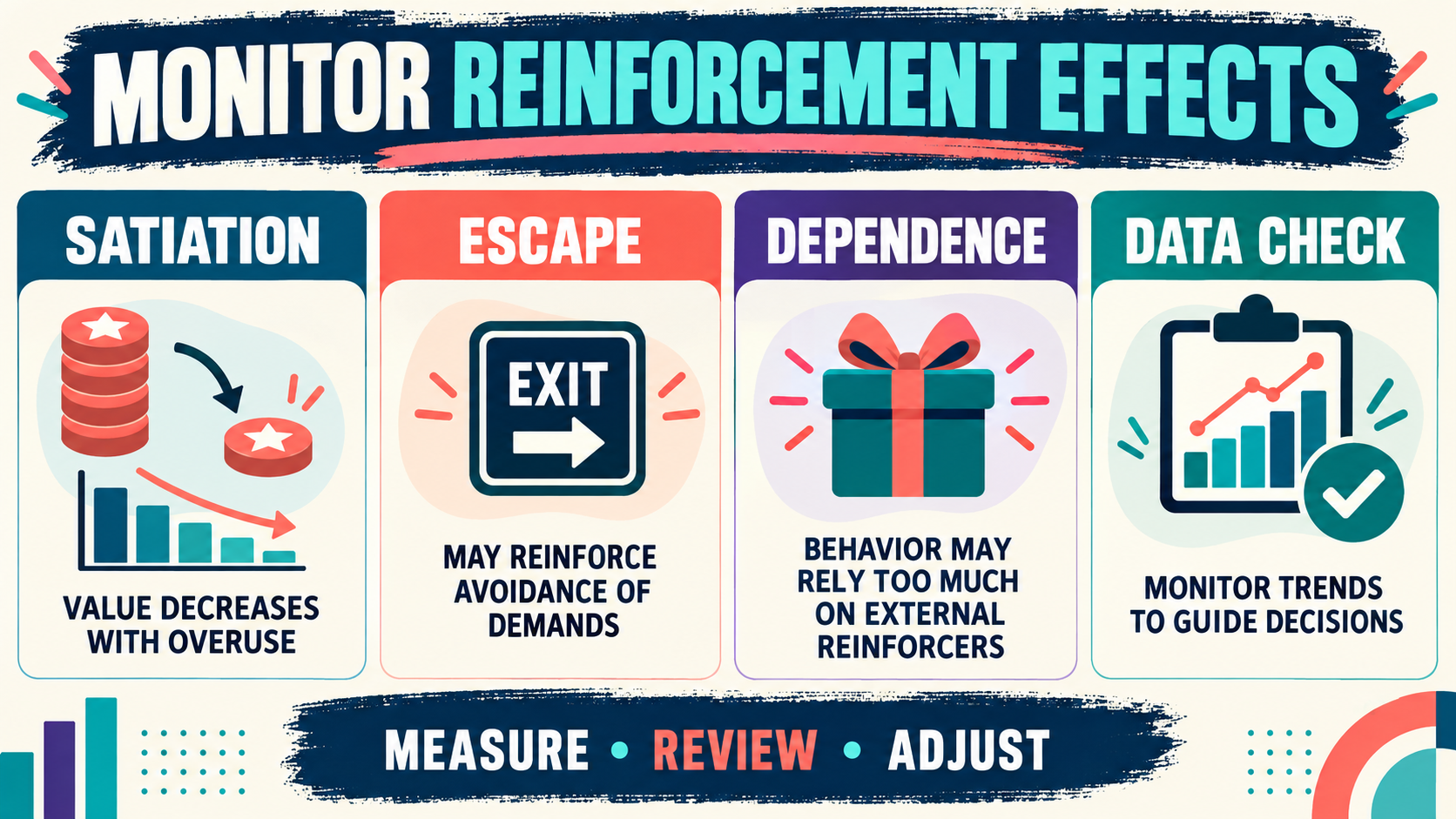
Start with a measurement plan that names the target response and the possible collateral responses. If the goal is increasing independent task completion, also track prompt level, break requests, errors, refusal, aggression, latency, and whether the learner uses the skill with different people. Do not collect every possible behavior without purpose; select measures that could change the clinical decision.
Graph the primary and collateral measures on compatible timelines. A simple session note such as “the learner seemed tired” is not enough to identify satiation or ratio strain. Record the reinforcer, schedule, response requirement, prompt, consequence, and relevant setting events. When a side effect appears, ask whether it covaries with the contingency change and whether it occurs across observers or settings.
How Can a BCBA Reduce Unwanted Reinforcement Effects?
Adjust one meaningful parameter at a time when possible. A team might rotate effective reinforcers, thin a schedule gradually, reduce the response requirement, increase choice, or use a naturally occurring consequence. Pairing an artificial reinforcer with descriptive praise and functional activity can help the learner contact a broader reinforcement system, but pairing is not a promise that the artificial reinforcer will disappear automatically.
Use differential reinforcement carefully. Reinforcing a replacement response should not accidentally make the old response more efficient. If a learner hits to obtain a break and also receives a break after a prompted request, the team should verify that the break is delivered according to the plan and that the prompted request is systematically transferred to independent communication. Safety procedures and caregiver training must be explicit when escalation is possible.
What Does Client-Centered Monitoring Look Like?
Ask whether the intervention is acceptable, usable, and meaningful to the learner and caregivers. A response can improve while the procedure increases distress, restricts choice, or makes participation unnecessarily effortful. Preference checks, assent or assent-withdrawal signals when applicable, accessible communication, and observation of quality-of-life indicators belong in the review.
Individualization does not mean abandoning measurement. It means selecting outcomes that reflect the person’s goals and context. If a token board improves table work but makes community participation harder, the team should not declare success from the table-work graph alone.
What Are Common BCBA Exam Traps?
- Calling any decrease in responding satiation: verify access history and compare the value of alternative reinforcers.
- Confusing extinction burst with reinforcement: identify whether a previously effective consequence was withheld.
- Ignoring collateral data: a target increase does not erase new aggression, refusal, or prompt dependence.
- Changing several variables at once: the team may not know which adjustment produced the result.
- Assuming an artificial reinforcer is automatically unethical: evaluate consent, dignity, proportionality, choice, and effectiveness in context.
- Reinforcing an unintended response: inspect what staff do immediately after every response that may produce access or escape.
How Would You Answer a Side-Effects Scenario?
First, name the contingency and the measured response. Next, identify the unwanted pattern without assuming a cause. Then choose the smallest safe evaluation that can test the likely explanation. If the scenario says a fixed-ratio requirement was raised and responding becomes slow with long pauses, ratio strain is a better answer than satiation unless the reinforcer-access history also changed. If access was delivered regardless of behavior and aggression rose, examine whether the arrangement produced incidental reinforcement.
What Is the Bottom Line?
Side effects of reinforcement in ABA are signals to widen the analysis. Monitor the target, collateral responses, reinforcer value, effort, prompts, and the learner’s experience. Use data to adjust the contingency, teach efficient alternatives, and protect meaningful access. For more practice distinguishing reinforcement, extinction, and behavior-change decisions, try the free BCBA mock exam. It is a study resource, not a substitute for supervision, assessment, or individualized clinical judgment.
For targeted review, use our side effects of reinforcement ABA practice questions to apply the concept in exam-style scenarios.
Quick Review Checklist
Use this final checklist to turn side effects of reinforcement ABA into exam-ready reasoning. The goal is not to memorize a label in isolation; it is to identify the relevant evidence and explain why the best answer fits the scenario. Key ideas to review:
- State the central definition or decision point for side effects of reinforcement ABA in your own words.
- Identify the detail that makes side effects of reinforcement ABA different from its closest related ABA term.
- Separate the observable facts in a scenario from assumptions that are not supported by the facts.
- Write one example and one nonexample so you can recognize the concept in a new setting.
Exam application checks:
- Ask what the question is actually requesting before comparing the answer choices.
- Mark the antecedent, response, consequence, or other evidence that supports the selected answer.
- Look for a distractor that describes a related process but does not answer the specific question.
Final self-check:
- Explain how you would verify the interpretation with clear observations or data.
- Change one detail in the scenario and decide whether your answer should change.
- Give a one-sentence rationale that a supervisor or study partner could evaluate.
Take the Free BCBA Mock Exam
When you are ready to apply the idea, use the free practice resource below for additional feedback. Take the Free BCBA Mock Exam



