

A social validity questionnaire in ABA gathers feedback about whether goals matter, procedures are acceptable and feasible, and outcomes make a useful difference in daily life. A strong questionnaire invites direct consumer voice, uses accessible response formats, separates the three domains, and turns feedback into a documented decision rather than a decorative score.
Table of Contents
- What Should a Social Validity Questionnaire ABA Include?
- Why Are Goals, Procedures, and Outcomes Separate?
- Who Should Complete the Questionnaire?
- How Should You Write the Questions?
- Which Response Scale Fits?
- What Does a Practical Questionnaire Layout Look Like?
- When Should You Collect Social-Validity Feedback?
- How Do You Include Direct Consumer Voice?
- How Should You Interpret Ratings and Comments?
- What Should Happen After the Questionnaire?
- What Are the Limits of a Social Validity Questionnaire?
- What Common Questionnaire Mistakes Should You Avoid?
- How Is Social Validity Tested on the BCBA Exam?
- What Is the Bottom Line?
- Take the Free BCBA Mock Exam
When someone searches for a social validity questionnaire ABA teams can use, they may be looking for sample questions, a rating scale, a printable form, or a way to interpret responses. Those are related but different tasks. The questionnaire should fit the learner, intervention, respondents, and decision being made; there is no single form that is automatically valid for every case.
Social validity is also broader than satisfaction. It asks whether the goals are socially important, the procedures are acceptable and practical, and the outcomes are meaningful. The BACB ethics resources provide the professional context for dignity, welfare, competence, and informed participation. A questionnaire supports that work; it does not replace assent, direct observation, outcome data, or clinical judgment.
What Should a Social Validity Questionnaire ABA Include?
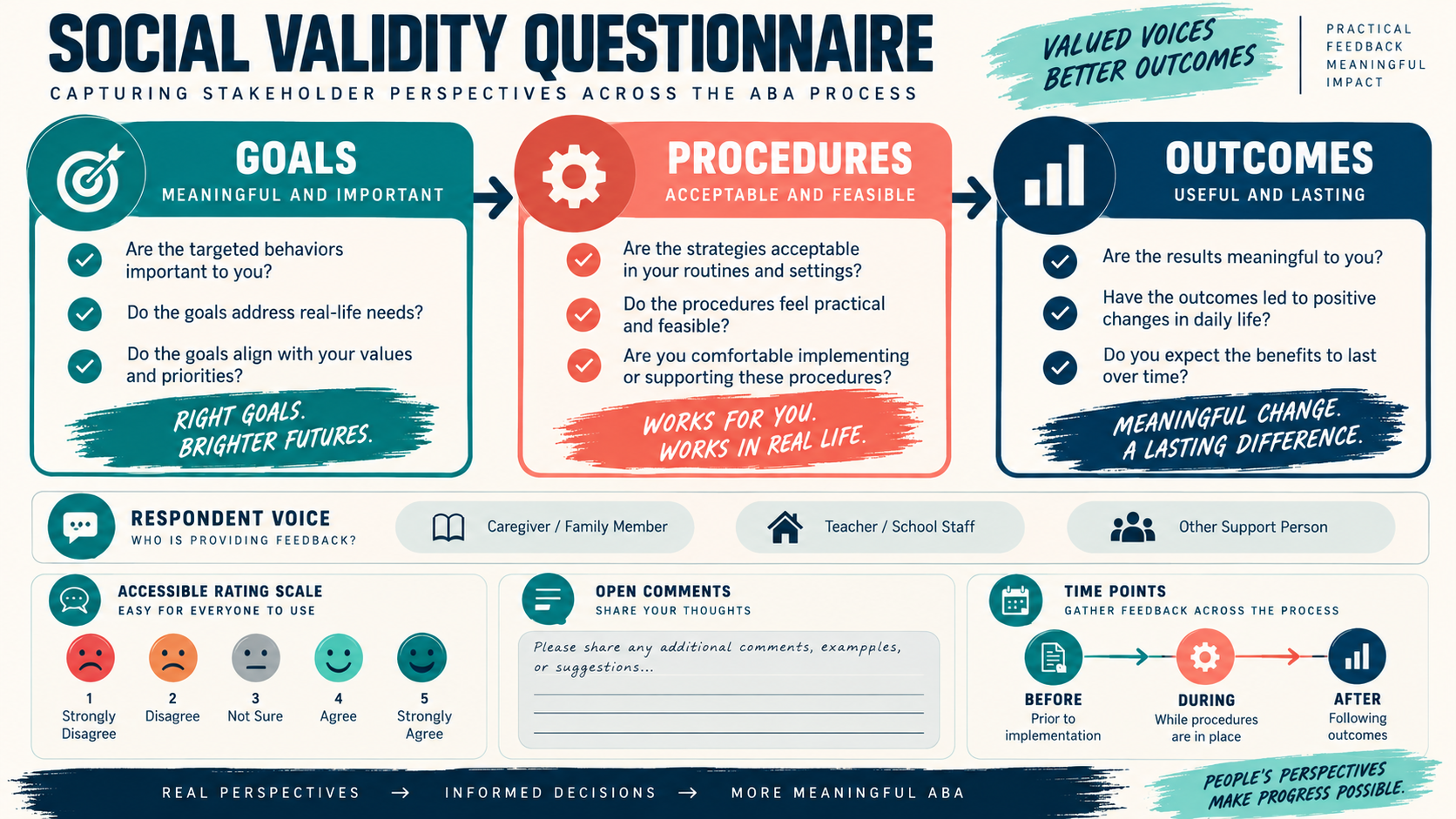
Organize the questionnaire around three domains: goals, procedures, and outcomes. Ask whether the target matters to the person and the people affected by it, whether the intervention is acceptable and feasible, and whether the change is useful, durable, and noticeable in real life. Keep the domains separate so a positive outcome does not hide an unacceptable procedure or an unimportant goal.
Include a short explanation of the purpose, who should respond, how the information will be used, and how privacy will be handled. Use language the respondent can understand. A questionnaire that is technically polished but inaccessible to the direct consumer may measure the convenience of the service team rather than the social validity of the intervention.
Why Are Goals, Procedures, and Outcomes Separate?
A goal can be measurable and still not matter to the learner. A procedure can produce change and still be too burdensome, intrusive, or difficult to use in the natural setting. An outcome can look good in session and fail to improve communication, participation, autonomy, safety, or another meaningful priority.
Separating the domains helps the team locate the concern. If respondents value the goal but dislike the procedure, the next step may be to review burden, choice, prompting, or reinforcement. If the procedure is acceptable but the outcome is not useful, the team may need to reconsider the target, generalization, or measurement. If ratings differ, the disagreement is information rather than a nuisance to average away.
Who Should Complete the Questionnaire?
Invite the person receiving services whenever possible and provide accessible ways to respond. Depending on the case, relevant respondents may include caregivers, family members, teachers, support staff, supervisors, or other people affected by the goals and procedures. Do not assume that the adult who authorized services speaks for every person involved.
Document who responded and what perspective they represent. A caregiver may comment on routines at home, a teacher may comment on classroom feasibility, and the learner may describe comfort, priorities, or communication access that others cannot infer. More respondents do not automatically make a questionnaire better; the important question is whether the people with relevant experience had a meaningful opportunity to be heard.
How Should You Write the Questions?
Use one idea per item. Avoid asking whether a procedure was “effective and acceptable” in the same statement because a respondent may agree with one part and reject the other. Define the time frame and context. “The plan helped” is less useful than “During the last two weeks, the new communication option helped the learner participate in the routine.”
- Goals: Is this outcome important to the person? Does it support a real-life priority, access, communication, safety, or independence?
- Procedures: Is the plan understandable, feasible, respectful, and acceptable to use in the actual setting?
- Outcomes: Has the change improved daily life, and does it appear likely to maintain or generalize?
- Open feedback: What should be kept, changed, stopped, or measured differently?
Use neutral wording. The questionnaire should not pressure respondents to praise the program or imply that disagreement is noncompliance. Explain that honest feedback can lead to a revision of goals, procedures, supports, or measurement.
Which Response Scale Fits?
A Likert-type scale can make patterns easier to summarize, such as strongly disagree through strongly agree or not acceptable through very acceptable. A smaller scale may be easier for some respondents; a visual scale, yes/no-plus-comment format, interview, or AAC-supported choice may be more accessible. The scale is a tool, not a sign that the construct has been measured perfectly.
Label the endpoints clearly and define what a middle response means. “Neutral” might mean unsure, mixed, or not applicable. Consider adding “not enough information” or “not applicable” so respondents are not forced to choose a number that misrepresents their view. Keep the number of items manageable enough that fatigue does not shape the answers.
What Does a Practical Questionnaire Layout Look Like?
The table below is a design map, not a validated instrument. Adapt the language, response format, and number of items to the person and the decision. Do not present sample items as though they establish treatment effectiveness or replace professional review.
| Domain | Question focus | Useful follow-up |
|---|---|---|
| Goals | Does the target matter to the person and support a meaningful priority? | What would make this goal more useful, relevant, or respectful? |
| Procedures | Are the teaching and behavior-change steps acceptable, understandable, and feasible? | Which step is difficult, intrusive, burdensome, or unclear? |
| Outcomes | Has the change improved participation, communication, safety, autonomy, or daily life? | Where does the change generalize, and what still needs support? |
| Open comments | What did the scale miss? | What should the team continue, revise, or ask about next? |
When Should You Collect Social-Validity Feedback?
Collect feedback before, during, and after an intervention when the decision warrants it. Before implementation, ask whether the goals are important and whether the proposed procedures are understandable and acceptable. During implementation, ask about burden, feasibility, communication access, and unexpected effects. After a period of use, ask whether the outcomes matter and whether they hold up in daily routines.
A one-time questionnaire can miss change over time. A procedure may feel acceptable in theory but become impractical after repeated use. An outcome may look promising in a clinic and be less useful at home or school. Timing should match the risk, length, and context of the intervention.
How Do You Include Direct Consumer Voice?
Ask the person who receives the intervention in a form they can use. That may mean plain language, visual choices, an interview, an AAC response, a supported conversation, or another communication method selected with appropriate professional input. Do not assume a lack of spoken language means a lack of preference, assent, or feedback.
Make the response process as independent as reasonably possible and explain how feedback will affect decisions. If a person declines, communicates distress, or gives a different view from a caregiver, document and investigate that information rather than treating it as a barrier to the questionnaire.
How Should You Interpret Ratings and Comments?
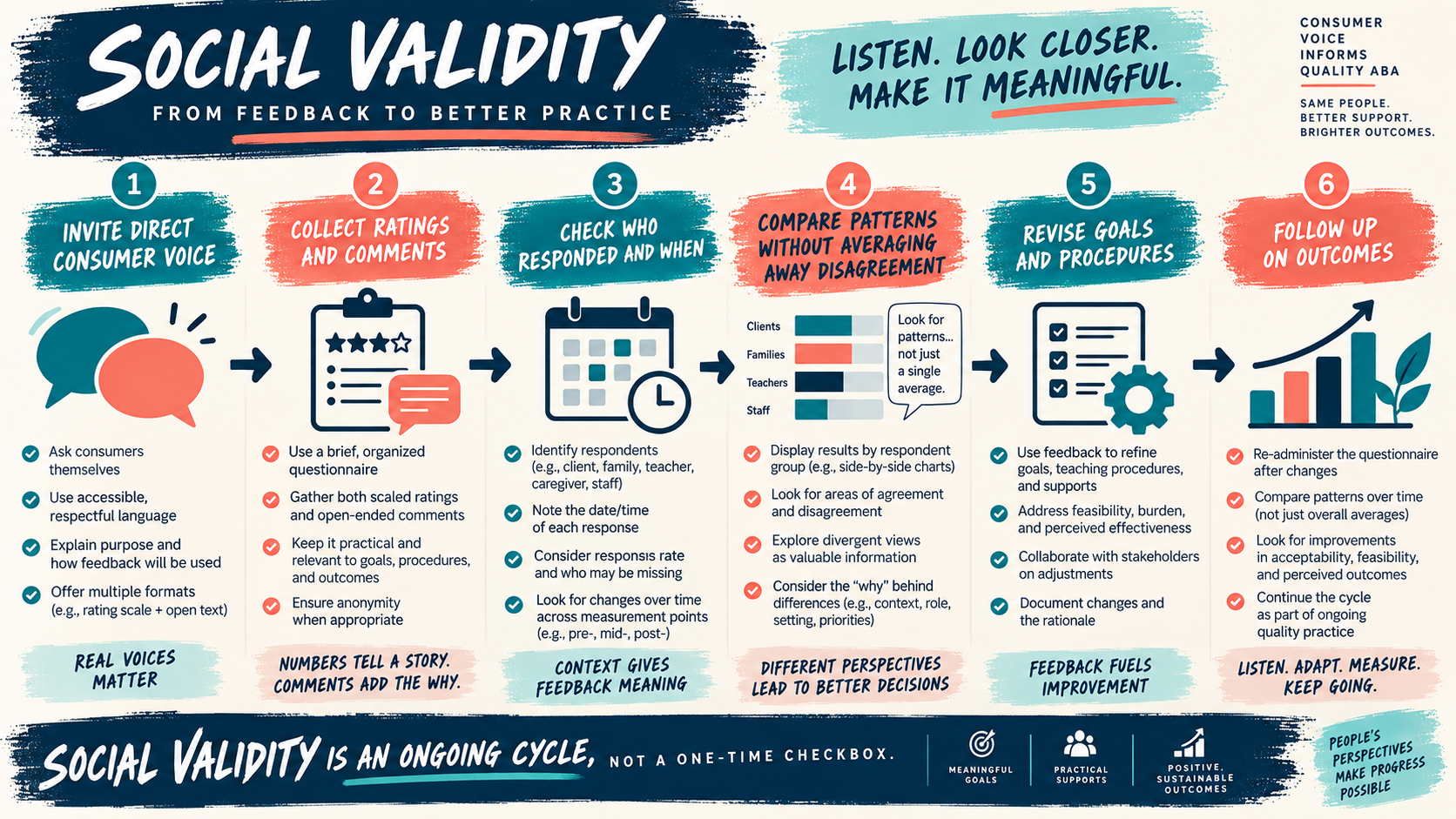
Begin with response context: who answered, when, after which experience, and with what information. Summarize patterns by respondent group and domain rather than reporting only one combined score. Look for agreement, disagreement, missing responses, “not applicable” selections, and comments that identify barriers or benefits.
A high average can hide a direct consumer’s negative experience if most responses came from staff. A low average can reflect an implementation problem rather than rejection of the goal. Open comments often explain why a rating was selected. Treat the questionnaire as a prompt for conversation and decision-making, not a vote that mechanically approves or rejects a plan.
What Should Happen After the Questionnaire?
Connect feedback to an action rule. If a goal is not meaningful, review goal selection. If a procedure is burdensome or unacceptable, examine task demands, prompts, reinforcement, choice, communication, and alternatives. If outcomes are not useful, check generalization, maintenance, measurement, and whether the wrong outcome was selected.
- Record the feedback: preserve the date, respondents, items, comments, and context.
- Discuss discrepancies: ask what different ratings reveal about settings, roles, access, or priorities.
- Make a documented change: revise the goal, procedure, support, measurement, or follow-up plan when warranted.
- Recheck later: a change should be evaluated for acceptability and usefulness, not assumed to solve the concern.
What Are the Limits of a Social Validity Questionnaire?
A questionnaire is subjective by design. It captures perspectives, not a direct measure of behavior and not a causal test of intervention effects. Response bias, social pressure, inaccessible wording, low response rates, and missing direct-consumer input can weaken the conclusion. A questionnaire can also be too generic to detect the experience that matters most.
Use it alongside behavioral data, treatment-integrity information, direct observation, and relevant clinical or educational context. A respondent’s concern should not be dismissed because the graph improved, and a positive rating should not hide a dangerous or ineffective outcome. Social validity adds a necessary dimension to data-based decision-making; it does not replace other dimensions.
What Common Questionnaire Mistakes Should You Avoid?
- Using only adult convenience: ask whether the goal matters to the person, not only whether it is easy to deliver.
- Combining goals, procedures, and outcomes: separate the questions so the source of concern is visible.
- Forcing every answer into a number: offer accessible response options, “not applicable,” and open comments.
- Collecting feedback only at discharge: early and ongoing feedback can reveal burden before it becomes a larger problem.
- Reporting one average: preserve respondent identity, setting, timing, and disagreement in the analysis.
- Failing to act: asking for feedback without a review or response process undermines trust.
How Is Social Validity Tested on the BCBA Exam?
Exam questions may ask which measure addresses social validity. Look for questions about the social importance of goals, acceptability of procedures, or value of outcomes from consumers or stakeholders. Do not confuse social validity with treatment integrity, interobserver agreement, or statistical significance. Each answers a different question.
If a stem includes disagreement between a caregiver and the learner, the strongest answer usually seeks accessible direct input, clarifies the goals and procedures, and considers dignity, assent, safety, and meaningful outcomes. The right response is not automatically to choose the majority rating or the easiest procedure to implement.
What Is the Bottom Line?
A social validity questionnaire in ABA should ask separately whether goals matter, procedures are acceptable and feasible, and outcomes make a meaningful difference. Include direct consumer voice, use accessible rating and comment formats, collect feedback at useful time points, preserve disagreement, and connect results to a documented decision. The questionnaire is a feedback system—not a rubber stamp and not a replacement for behavioral data or professional judgment.
For a structured practice session on ethics, assessment, social significance, and data-based decisions, try the free BCBA mock exam. Use practice questions to review distinctions; they do not replace supervision, current professional standards, or individualized care.
For targeted review, use our social validity questionnaire ABA practice questions to apply the concept in exam-style scenarios.
Take the Free BCBA Mock Exam
When you are ready to apply the idea, use the free practice resource below for additional feedback. Take the Free BCBA Mock Exam



