

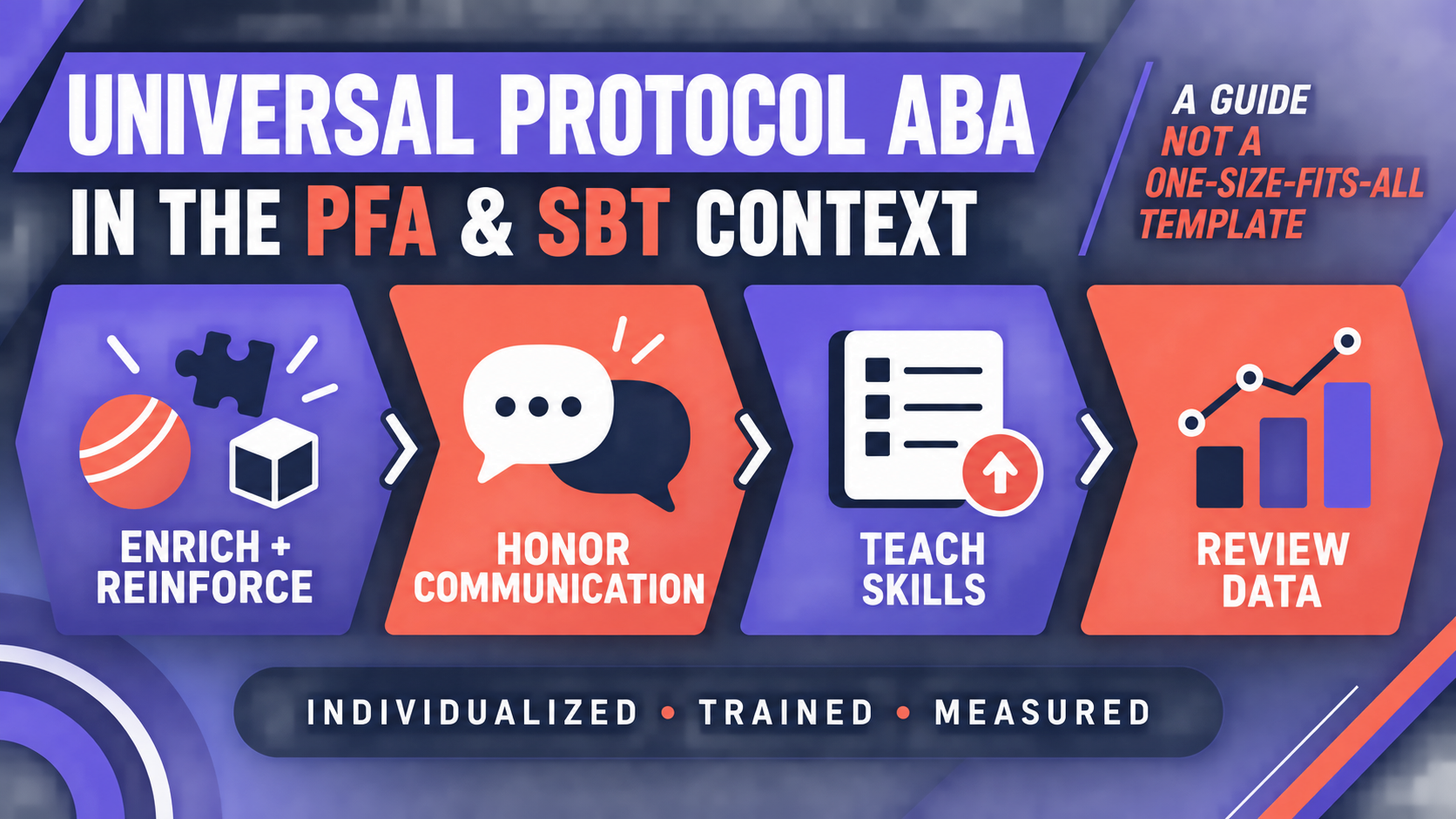
Universal Protocol ABA usually refers to the Universal Protocol, sometimes called UniPro, in the practical functional assessment (PFA) and skill-based treatment (SBT) conversation. In that context, it is a guide for what a team does outside intensive SBT teaching sessions: enrich the environment, respond consistently to communication, reinforce appropriate behavior, and reduce the conditions that can set the stage for escalation.
Table of Contents
- Universal Protocol ABA: What Is It?
- Where Does It Fit With PFA and SBT?
- What Components Are Commonly Discussed?
- How Is It Different From an SBT Plan, BIP, or Crisis Plan?
- What Do Evidence and Ethics Require?
- What Are Common BCBA Exam Traps?
- Practice Assessment and Intervention Questions
- Take the Free BCBA Mock Exam
- References
The word “universal” can be misleading. It does not mean that every ABA client should receive the same script, that BACB requires one named protocol, or that a team can download a template and implement it without training. The protocol still has to be individualized, compatible with the learner’s assessment and communication system, feasible in the setting, and monitored for safety and outcomes.
This article is a BCBA exam and terminology guide, not a clinical protocol. A qualified BCBA and the relevant care team must determine whether a PFA/SBT approach is appropriate, how it is individualized, and how risk is managed for a specific person. Table of Contents
Universal Protocol ABA: What Is It?
Universal Protocol is best understood as a context-specific treatment-support package, not as a stand-alone diagnosis or a generic ABA curriculum. Public descriptions of UniPro connect it to the time when a learner is not in an intensive SBT session. The guide can help a team provide reinforcement and environmental enrichment, honor functional communication, and respond to early problem behavior in a consistent way while the learner practices safer, more effective skills.
Some descriptions use terms such as R1 and R2 for levels of problem behavior or response patterns. Those labels are not universal BACB terminology, and their operational definitions must come from the training or plan being used. A BCBA should never assume that a label has the same meaning across providers. Define the behavior, the communication response, the consequence, and the safety threshold in observable terms.
The core idea is prevention through predictable, humane interaction and skill building. The team arranges conditions in which the learner can communicate, access reinforcement, tolerate changes, and participate without relying on coercion or crisis. That does not remove the need for functional assessment. It makes the assessment and the individualized teaching plan more important.
Where Does It Fit With PFA and SBT?
PFA and SBT are related but not interchangeable labels. Practical functional assessment is an assessment process used to understand the contingencies associated with severe problem behavior and appropriate communication. Skill-based treatment then teaches communication, tolerance, and other adaptive skills through a programmed progression. Universal Protocol may describe the everyday support surrounding that work rather than the full assessment and teaching sequence. Think of the relationship as a system:
- Assessment: identify relevant variables and prioritize safety, assent, communication, and meaningful outcomes.
- Skill-based teaching: teach functionally relevant communication and tolerance skills with a planned progression.
- Universal Protocol support: apply individualized reinforcement, enrichment, communication responses, and prevention practices across the rest of the day.
- Measurement: monitor both learner outcomes and whether the team is implementing the agreed plan accurately.
Universal Protocol is therefore not a shortcut around PFA or SBT. Nor is it proof that a learner is ready for every demand, delay, or setting. The BCBA must define how the support changes when risk increases, when communication is unavailable, or when the learner indicates a need for a break or different arrangement.
What Components Are Commonly Discussed?
Exact components vary by training and individualized plan, but public descriptions and related research commonly discuss several themes:
- Enrichment and reinforcement: arrange meaningful activities and reinforcement so the environment is not organized only around demands and correction.
- Respectful communication: respond to appropriate requests and functional communication in the way the plan specifies, including AAC or other modalities.
- Early prevention: notice precursors or changes in engagement and respond before a situation becomes dangerous, without reinforcing unsafe behavior through an unplanned pattern.
- Teaching adaptive skills: build communication, tolerance, cooperation, and self-management skills through an individualized progression.
- Consistent team behavior: train the adults who interact with the learner so the plan is not dependent on one expert being present.
- Data review: use objective data to evaluate whether the approach is improving safety, participation, communication, and quality of life.
These themes are not permission to use a universal response to every learner. For example, “reinforce a precursor” requires a precise operational definition, a safety analysis, and a plan for what happens if risk escalates. A blog summary cannot establish those details for a particular case.
How Is It Different From an SBT Plan, BIP, or Crisis Plan?
Exam questions often test whether you can distinguish a named approach from the document or process that controls implementation.
| Term | Main question | What it does not replace |
|---|---|---|
| Universal Protocol | How should everyday interactions support communication, reinforcement, enrichment, and prevention in this context? | Individual assessment, training, data review, or emergency procedures. |
| SBT plan | How will specific communication, tolerance, and adaptive skills be taught and advanced? | The entire day’s support or a medical/safety response plan. |
| BIP | What function-based prevention, teaching, and consequence procedures address defined target behavior? | A named community package or the emergency chain of command. |
| Crisis or emergency plan | What trained, authorized actions protect people when immediate risk or a medical/environmental emergency occurs? | Routine teaching, functional assessment, or long-term prevention programming. |
What Do Evidence and Ethics Require?
Research on related skill-based and Universal Protocol treatment packages is promising but should be read carefully. A 2024 study evaluated generality of a skill-based approach across challenging situations and caregiver implementation. A later teacher-training study examined implementation of a Universal Protocol treatment package using behavior skills training. Those studies support studying training, generality, and implementation; they do not turn the package into a BACB requirement or prove that one version fits every learner and setting. The current BACB Ethics Code provides the guardrails that matter regardless of the named approach:
- Use assessment and intervention decisions that fit the client, context, resources, and risks.
- Prioritize client welfare, informed consent or assent processes as applicable, dignity, and communication access.
- Minimize harm and do not introduce restrictive or risky procedures simply because a training label sounds comprehensive.
- Work within competence, obtain training and consultation, and document data, decisions, and changes.
- Review outcomes and revise or discontinue an ineffective or unsafe plan.
Before implementation, the team should be able to answer: what behavior and communication are defined, what reinforcement is available, what the learner can decline, what staff do when risk increases, how fidelity is measured, and who reviews the data. If those answers are missing, the problem is not solved by calling the plan “universal.”
What Are Common BCBA Exam Traps?
- “Universal” means one protocol for everyone. The relevant plan still requires assessment, individualization, training, and review.
- “Universal Protocol” is a BACB standard. It is a named approach in a PFA/SBT conversation, not a BACB certification requirement.
- It replaces functional assessment. A daily support guide does not establish function or eliminate the need for assessment.
- It is the same as a crisis plan. Prevention and everyday support are different from emergency actions for immediate danger.
- A promising study proves universal effectiveness. Check the population, setting, design, training, and outcomes before generalizing.
- Adult consistency is enough. The learner’s communication, assent, dignity, safety, and meaningful outcomes remain central.
Practice Assessment and Intervention Questions
When a BCBA practice question mentions Universal Protocol, identify the context first. Ask whether the scenario is testing PFA, SBT, prevention, treatment integrity, ethics, or crisis response. The best answer usually respects the learner’s communication and safety, follows the individualized plan, and uses data and supervision rather than a slogan or one-size-fits-all script. Our free BCBA mock exam can help you practice these assessment, intervention, measurement, and ethics decisions under time pressure. Try the Free BCBA Mock Exam
Take the Free BCBA Mock Exam
If you want a low-pressure way to check your recall, use the free practice resource below. Take the Free BCBA Mock Exam
References
- BACB BCBA Test Content Outline, 6th Edition
- BACB Ethics Code for Behavior Analysts
- PFA and SBT Community: Universal Protocols
- Journal of Applied Behavior Analysis study on universal behavioral readiness
- Study of teacher implementation of a Universal Protocol treatment package



