
Free BACB CEUs can be legitimate, but “free” is not the rule that makes a continuing-education activity count. The decisive checks are whether the provider is authorized through the BACB’s ACE program, whether the specific event offers the right type and number of CEUs, whether you complete the required participation steps, and whether you receive documentation you can keep and report.
Table of Contents
- Are Free BACB CEUs Actually Possible?
- What Does “Free” Mean on a CEU Page?
- How Do You Verify a Free CEU Before Taking It?
- Does the 2027 BCBA Change Affect Free CEUs?
- How Can You Build a Free or Low-Cost CEU Plan?
- What Mistakes Make a Free CEU Unusable?
- Quick Review Checklist
- Take the Free BCBA Mock Exam
- References
That distinction matters because a page may advertise free access to a video, free registration for a webinar, or a free learning library without promising a BACB CEU certificate. Another offer may waive the course fee but charge for the credit. Both can be useful, but they are not the same outcome. Treat the word free as a price question first, then verify the credential question separately.
This is an educational planning guide, not a guarantee that a particular provider or event will remain available. Offers, schedules, provider status, and course terms change. Check the current BACB registry and the provider’s current event page before you rely on a free activity for recertification. Table of Contents
Are Free BACB CEUs Actually Possible?
Yes. The BACB’s ACE Provider Handbook allows ACE events to be offered free of charge, either publicly or to an in-house audience. That means a no-cost event can be a valid learning opportunity when the authorized provider and the event meet the applicable requirements. The BACB does not set the price of an ACE event, so a paid event is not automatically more valid than a free one.
The important qualification is that provider authorization is not the same as BACB endorsement of every course. The ACE Provider Verification Registry is the better starting point than a badge, logo, search snippet, or marketing sentence on a third-party page. A provider may be authorized to offer learning CE, while a particular page may be outdated, may offer only general education, or may have a different product for RBT professional development.
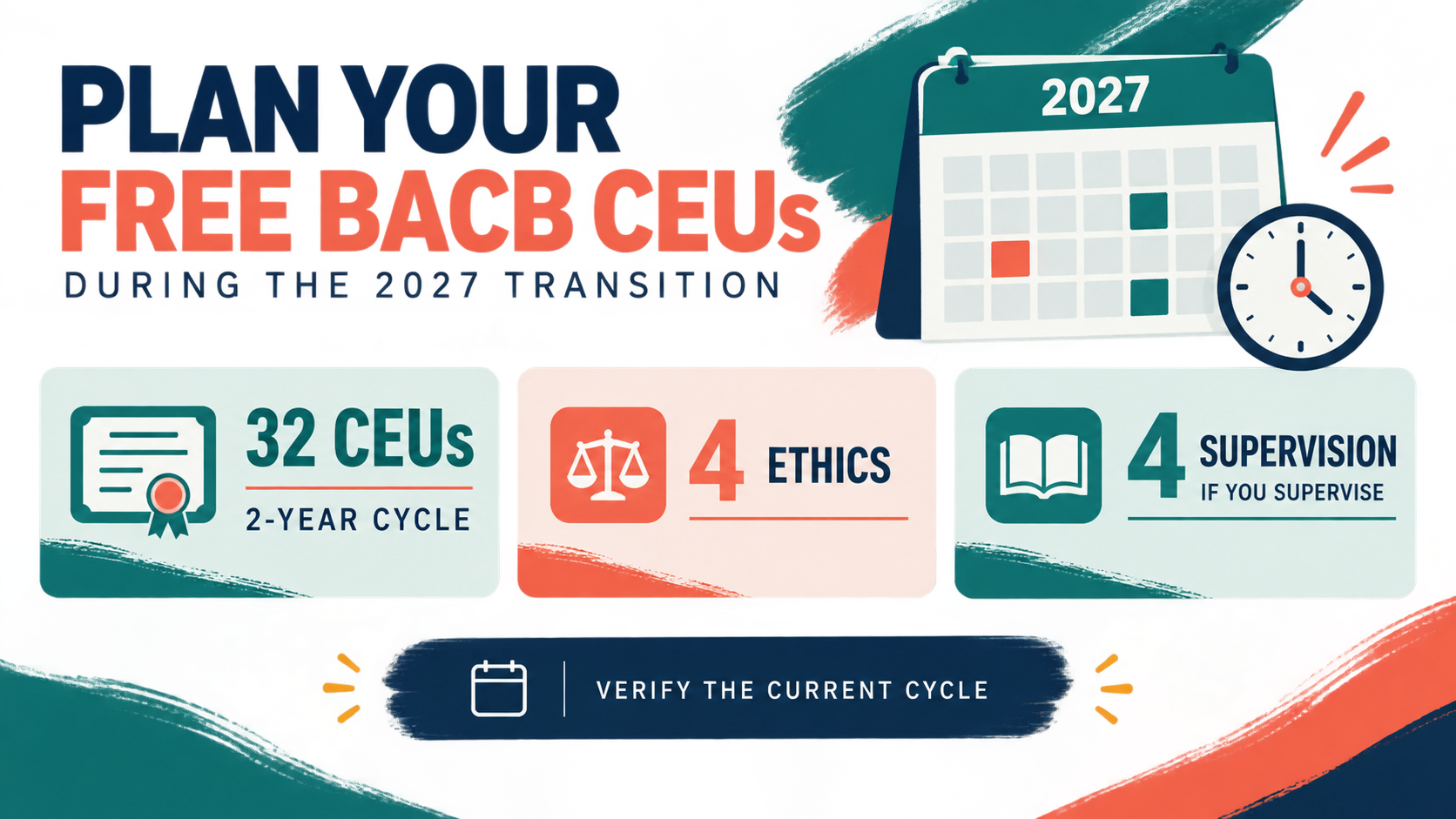
For the current 2027 BCBA maintenance requirements, the BACB states that a BCBA needs 32 CEUs in each two-year recertification cycle, including 4 ethics CEUs and 4 supervision CEUs for supervisors. A free course can help fill a cycle, but it still has to fit the category and cycle you need. “No cost” does not turn a general learning event into an ethics or supervision event.
What Does “Free” Mean on a CEU Page?
Before you enroll, translate the offer into a specific question: free for what? The table below separates common claims that look similar in search results but create different planning consequences.
| Offer language | What may actually be free | What you still verify |
|---|---|---|
| Free webinar | Registration and attendance | Whether the event awards BACB Learning CEUs and how participation is measured |
| Free to watch | Video, podcast, or reading access | Whether a quiz, attendance step, or paid certificate is required for credit |
| Free account | Access to a catalog or trial | Which individual course is CEU-bearing, its category, and the terms after the trial |
| Free CEU | The provider says the credit and certificate have no fee | ACE status, CEU type, completion evidence, and the current cycle |
A second trap is confusing BACB CEUs with another credential’s professional-development hours. A free autism webinar can be valuable professional learning and still not be a BCBA Learning CE event. Read the credential label, not only the topic label.
How Do You Verify a Free CEU Before Taking It?
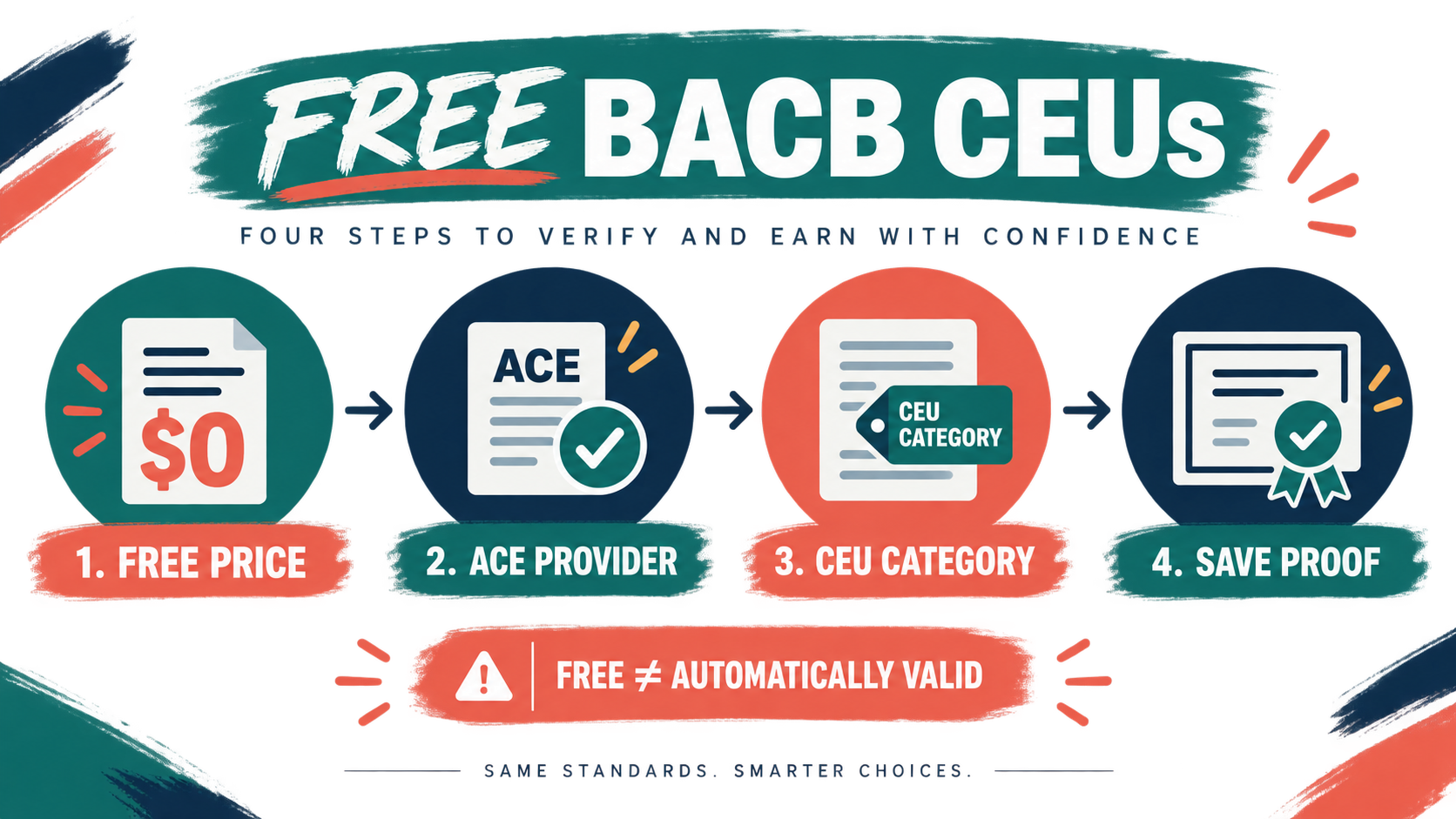
Use this four-step check before you spend time watching a course. The goal is to catch a problem before the renewal deadline, when a missing certificate or incorrect category is difficult to repair.
- Check the provider: search the organization or individual in the BACB ACE Provider Verification Registry. Do not treat an ACE logo, a search result, or a provider’s own claim as the final check.
- Check the event: confirm that the specific listing names the event, instructor or presenter information, learning objectives, modality, publication or event date, and the number of Learning CEUs.
- Check the category: if you need ethics or supervision CEUs, the event must be identified and structured for that category. A brief mention of ethics in a general lecture does not make the lecture an ethics CEU.
- Check participation and proof: asynchronous learning may require active responding or knowledge questions. Save the certificate or completion record and verify that it contains the information needed for reporting.
The 2026 ACE Provider Handbook says participant documentation should include items such as the participant’s name and certification number, completion date, ACE provider name and number, event title, instructor, modality, number of Learning CEUs, and applicable ethics or supervision CEUs. If a “free” offer cannot explain what proof you will receive, it is not ready for your CEU tracker.
For self-paced material, do not assume that time logged in equals participation. The current handbook describes active measures such as knowledge questions and states that login time alone is not enough. You do not need to memorize the provider handbook for a shopping decision, but you should recognize when a page offers only content access rather than a documented CE event.
Does the 2027 BCBA Change Affect Free CEUs?
The 2027 change makes accurate planning more important; it does not create a special category of “free 2027 CEUs.” The BACB’s upcoming-changes page lists January 1, 2027, as the effective date for revised BCBA eligibility and maintenance requirements. The published requirements still organize maintenance around the two-year cycle and category obligations, so the offer must be evaluated against the rules that apply to your own credential and cycle.
There is also a separate change to ACE Provider requirements that took effect in 2026. That matters because a free event page may remain visible after its provider, event format, or documentation process changes. Use the current BACB registry and the current event page rather than relying on an old “free CEU” list, cached social post, or screenshot.
A useful planning question is: “Would I still know the provider, category, completion date, and certificate location six months from now?” If the answer is no, the activity may be too fragile to anchor a recertification plan. Free is helpful, but traceability is what protects the cycle.
How Can You Build a Free or Low-Cost CEU Plan?
Start with the categories that are hardest to replace, then fill the general-learning balance. This avoids collecting a large number of convenient general CEUs and discovering later that an ethics or supervision requirement is still missing.
- Write down the cycle end date: use the date in your BACB account or current handbook, not the date shown on a blog post.
- Mark the required categories: list ethics and, if you supervise, supervision before you count general learning credits.
- Reserve a documentation folder: name files with the date, provider, event title, category, and CEU amount.
- Use a source ladder: start with the official registry, then the provider’s current course page, then the certificate after completion.
- Keep a backup option: if a free webinar has limited seats or a one-time schedule, identify a paid or low-cost alternative before your deadline.
For example, suppose a supervisor needs 4 ethics CEUs and 4 supervision CEUs under the current 2027 requirements, but finds a free 2-CEU general webinar first. That webinar may be useful, but it does not solve either required category unless the event is specifically designated that way. The correct next step is to verify category-specific options, not to collect more general credits simply because they are free.
What Mistakes Make a Free CEU Unusable?
- Counting a free video as a CEU: education access and documented BACB credit are different products.
- Checking only the provider’s marketing page: confirm authorization in the BACB registry.
- Ignoring the category: general learning cannot automatically substitute for ethics or supervision.
- Missing the active-response step: a self-paced event may require a quiz or another participation measure.
- Saving only a screenshot: keep the official completion documentation and the event details needed for reporting.
- Trusting an old list: free offers, schedules, prices, and provider status can change before the cycle ends.
- Assuming “BACB approved” means endorsed: ACE authorization does not mean the BACB endorses the content or guarantees a course’s fit for your needs.
In short, the best free BACB CEUs are not simply the ones with a zero-dollar price. They are the ones you can verify, complete, categorize, document, and report within the correct cycle. If a course passes those checks, free can be a smart budget decision. If it fails one of them, the time may still be educational, but it should not be counted until the issue is resolved.
CEU tracking and BCBA exam preparation are separate tasks. If you are studying for the examination, our free BCBA mock exam can help you practice scenario-based questions; it is not a CEU event and does not replace BACB documentation. Try the Free BCBA Mock Exam
Quick Review Checklist
Use this final checklist to turn free bacb ceus into exam-ready reasoning. The goal is not to memorize a label in isolation; it is to identify the relevant evidence and explain why the best answer fits the scenario. Key ideas to review:
- State the central definition or decision point for free bacb ceus in your own words.
- Identify the detail that makes free bacb ceus different from its closest related ABA term.
- Separate the observable facts in a scenario from assumptions that are not supported by the facts.
- Write one example and one nonexample so you can recognize the concept in a new setting.
Exam application checks:
- Ask what the question is actually requesting before comparing the answer choices.
- Mark the antecedent, response, consequence, or other evidence that supports the selected answer.
- Look for a distractor that describes a related process but does not answer the specific question.
Final self-check:
- Explain how you would verify the interpretation with clear observations or data.
- Change one detail in the scenario and decide whether your answer should change.
- Give a one-sentence rationale that a supervisor or study partner could evaluate.
Take the Free BCBA Mock Exam
If you want a low-pressure way to check your recall, use the free practice resource below. Take the Free BCBA Mock Exam
References
- BACB Authorized Continuing Education Providers
- BACB ACE Provider Verification Registry
- BACB ACE Provider Handbook 2026
- BACB 2027 BCBA Requirements
- BACB Recent and Upcoming Changes
- The ABA Index: Free BCBA CEUs and verification notes



