

A fidelity checklist ABA teams use should make treatment integrity observable. It turns the steps of an assessment or intervention protocol into items that an observer can score consistently. The purpose is not to create paperwork for its own sake. It is to learn whether the procedure was implemented as designed, whether staff need coaching, and whether a change in client behavior can reasonably be interpreted alongside the intervention.
Table of Contents
- Fidelity Checklist ABA: What Does It Measure?
- How Do You Build a Checklist From a Protocol?
- How Should Fidelity Be Observed and Scored?
- How Is Fidelity Different From IOA and Outcome Data?
- How Should a BCBA Interpret the Score?
- What Should Happen After an Integrity Error?
- What Are Common BCBA Exam Traps?
- Practice Measurement and Supervision Questions
- Take the Free BCBA Mock Exam
- References
Procedural fidelity is also called treatment integrity or implementation integrity. The terms can vary by source, but the practical question is similar: did the person implementing the plan complete the relevant components in the way the plan specified? A good checklist is derived from the actual protocol, not copied from a generic form that may omit the steps that matter in this case. This guide is for BCBA exam preparation and general professional education. It is not an official BACB form or a substitute for an individualized protocol, supervision, training, employer policy, or clinical judgment. Table of Contents
Fidelity Checklist ABA: What Does It Measure?
A fidelity checklist measures the degree to which an interventionist, caregiver, or other implementer followed the observable components of a prescribed procedure. If a reinforcement plan says to deliver a reinforcer after a defined response, the checklist might score whether the response was identified, the timing was correct, the reinforcer was delivered, and the consequence matched the plan. The items should be observable enough that two trained observers can make the same judgment.
The checklist does not measure every important outcome. It does not tell you by itself whether the intervention is socially valid, whether the target behavior changed, or whether the selected treatment is appropriate. It answers a narrower question about implementation. That narrow answer is valuable because a poor outcome may reflect an ineffective intervention, low fidelity, an inaccurate assessment, changing conditions, or several variables at once.
Research and practice guides commonly emphasize direct procedural-fidelity checks because treatment drift can continue when nobody observes the relevant steps. A checklist is most useful when it leads to a decision: maintain the plan, clarify a step, provide feedback, retrain, modify the protocol, or investigate another variable.
How Do You Build a Checklist From a Protocol?
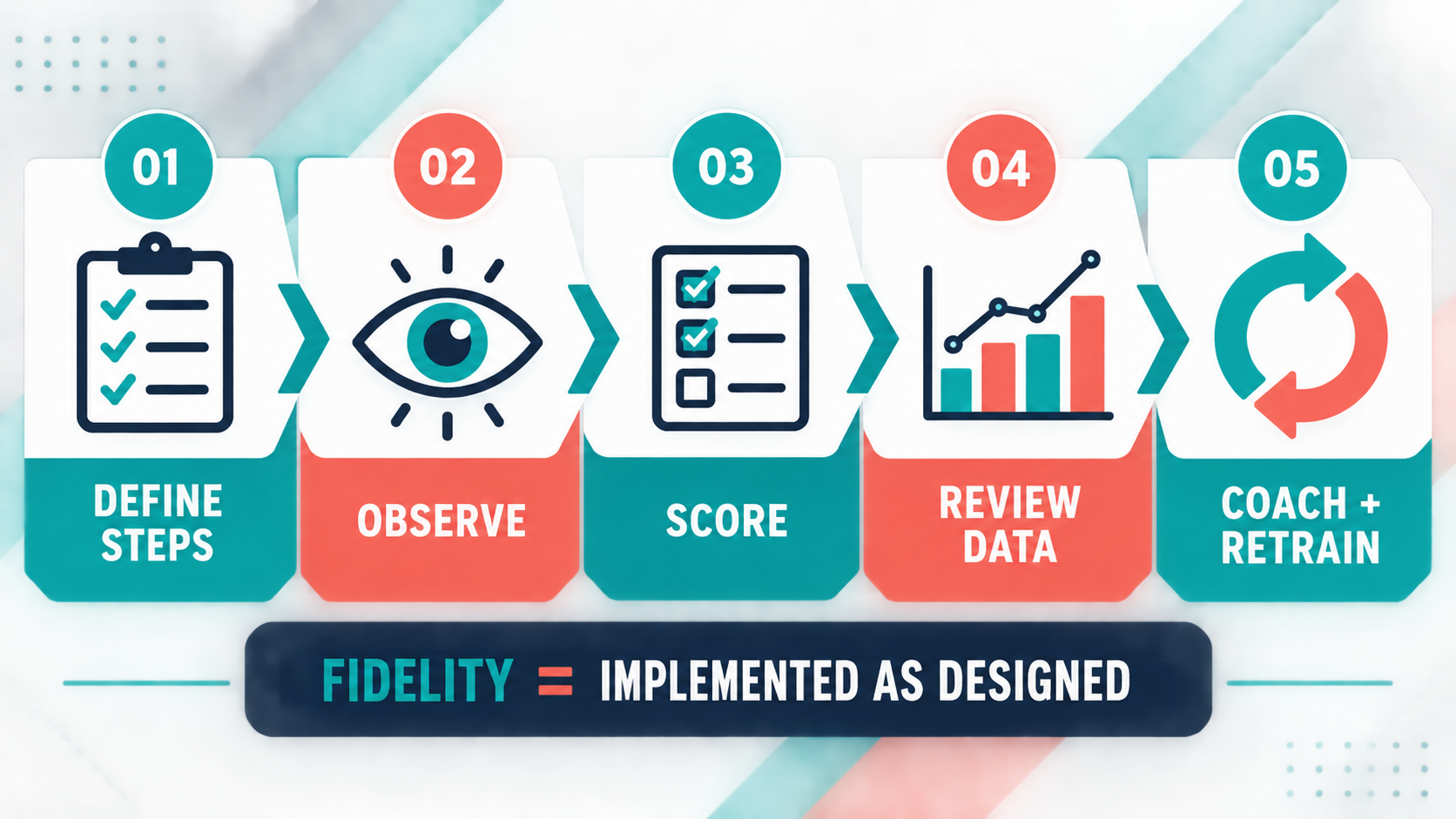
Start with the written assessment or intervention plan. Do not begin by browsing for a generic “ABA fidelity form.” Use the plan to identify the components that are necessary for treatment exposure and that can be observed within the setting.
- Define the procedure: name the intervention, target context, implementer, and version of the plan being checked.
- Task analyze the steps: break the procedure into observable actions in the order they occur.
- Remove vague wording: replace “uses reinforcement correctly” with the specific action, timing, or decision the observer can see.
- Identify essential components: distinguish steps that are critical to the intervention from optional style or preference items.
- Choose a scoring rule: define what counts as correct, incorrect, not observed, or not applicable before collecting data.
- Plan the observation: decide who observes, when, how often, and how feedback will be delivered.
For a caregiver or school-based plan, include enough context to make the items usable without turning the checklist into a second treatment manual. If a step cannot be scored from observation, rewrite it or specify what evidence counts. If an item depends on a medical or safety decision outside the observer’s competence, the plan needs qualified instruction and escalation—not a checkbox that creates false confidence.
How Should Fidelity Be Observed and Scored?
Direct observation is often the clearest method, but the method should fit the procedure. A checklist may be completed during a session, from a video when permitted, or through a permanent product when the product validly shows the step occurred. A permanent product is not automatically a better measure; it may miss timing, prompting, or interaction quality that matters to the intervention. A common item-level calculation is: Fidelity percentage = correctly implemented components ÷ observed applicable components × 100.
For example, if 8 applicable checklist items were observed and 7 were implemented correctly, the session score would be 87.5%. That number is useful only when the items are clearly defined and the observer records why an item was marked not applicable or not observed. A high percentage based on trivial items can be less informative than a lower percentage caused by one essential component.
Plan for observer training. Review examples, practice scoring, compare disagreements, and clarify the operational definition before using the data for supervision or treatment decisions. If two observers disagree frequently, the problem may be the checklist definition, observer training, or the procedure itself. That is a measurement issue to solve, not a reason to silently average incompatible judgments.
How Is Fidelity Different From IOA and Outcome Data?
BCBA exam questions may place several measurement terms together. Keep the questions separate:
- Treatment integrity: whether the intervention was implemented as prescribed.
- Interobserver agreement (IOA): how closely two observers agree when measuring behavior or implementation.
- Outcome data: what happened to the learner’s target behavior or skill.
- Social validity: whether goals, procedures, and outcomes are meaningful and acceptable to stakeholders.
You can have high IOA about a low-fidelity implementation. You can also have high treatment fidelity with an intervention that does not improve the target behavior. Strong analysis may require more than one measure: fidelity to understand exposure, outcome data to evaluate change, and IOA to support confidence in the data-collection system.
How Should a BCBA Interpret the Score?
Do not treat one universal percentage as a pass/fail rule unless the protocol, organization, or study has justified that criterion. Interpret the score in relation to the essential components, the pattern across sessions, the implementer’s training, and the client’s outcome. A declining score may indicate drift or a confusing step. A stable low score may indicate that the procedure is too complex, resources are missing, or the plan is not feasible in the setting. Look for patterns rather than only a total:
- Which step is missed most often?
- Does the error occur before, during, or after the target response?
- Is the step misunderstood, unavailable, or incompatible with the routine?
- Does fidelity change across people, settings, times, or target conditions?
- Did implementation change when the plan or training materials changed?
These questions make the checklist a feedback system. They also help a BCBA avoid changing an intervention solely because the learner did not improve when the intervention was never implemented as intended.
What Should Happen After an Integrity Error?
Respond proportionally and promptly. First determine whether the error created risk or affected the client’s immediate access to an effective intervention. Then provide clear feedback, model the correct step, allow practice, and recheck performance. Behavioral skills training or another appropriate training process may be needed when explanation alone does not produce accurate implementation.
Document the error and the response according to the setting’s procedures. If the step is repeatedly missed, examine whether the protocol is understandable, feasible, culturally responsive, and supported by the environment. A checklist should not be used to blame a caregiver or technician for a plan that was never taught, is missing resources, or conflicts with the actual routine. Fidelity data are most useful when they improve the system and protect client welfare.
What Are Common BCBA Exam Traps?
- Measuring outcomes only: behavior change data cannot show whether the intervention was implemented as written.
- Calling IOA fidelity: agreement between observers and implementation accuracy answer different questions.
- Using vague checklist items: “implements plan well” cannot be scored reliably.
- Scoring every item as applicable: record not observed or not applicable when the protocol supports that distinction.
- Waiting until the end of treatment: periodic checks can detect drift while coaching can still improve implementation.
- Changing the intervention after one low score: first determine whether the problem is training, feasibility, measurement, or the intervention itself.
Practice Measurement and Supervision Questions
When a BCBA practice question mentions a fidelity checklist, ask what is being measured, how each item is defined, and what decision the data should support. The best answer usually protects the distinction between implementation and outcome, uses observable components, and provides feedback or retraining before drawing a conclusion about treatment effectiveness. Our free BCBA mock exam can help you practice these measurement, intervention, and supervision distinctions under time pressure. Try the Free BCBA Mock Exam For targeted review, use our fidelity checklist aba practice questions to apply the concept in exam-style scenarios.
Take the Free BCBA Mock Exam
If you want a low-pressure way to check your recall, use the free practice resource below. Take the Free BCBA Mock Exam
References
- BACB BCBA Test Content Outline, 6th Edition
- A Practitioner’s Guide to Measuring Procedural Fidelity
- Treatment Integrity Reporting in Behavior Analysis in Practice
- Treatment Integrity of School-Based Behavior Analytic Interventions



