
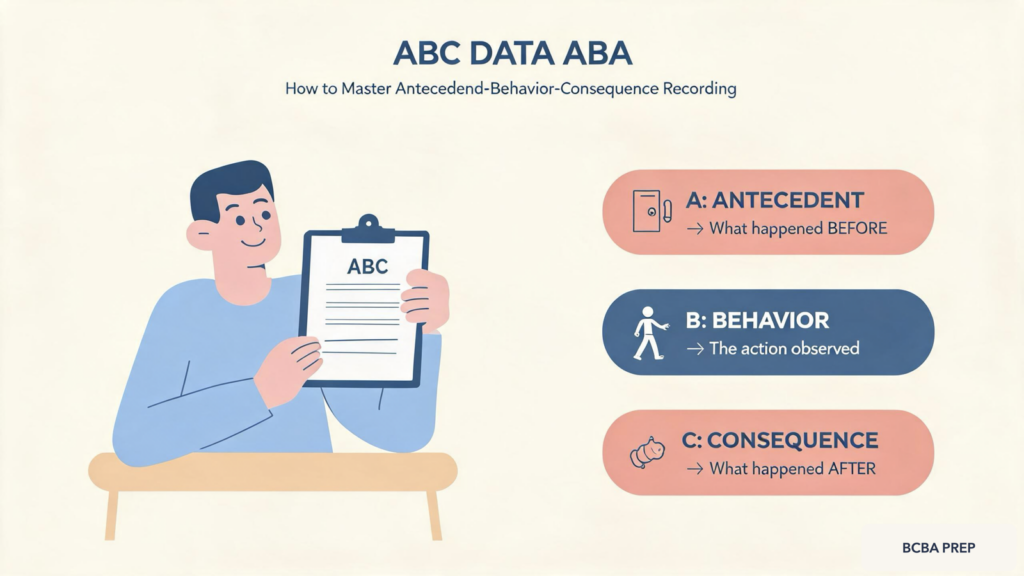
What Is ABC Data in ABA?
ABC data is a direct observation method used to record events surrounding a behavior. The acronym stands for Antecedent, Behavior, Consequence. In applied behavior analysis, ABC data helps practitioners understand how environmental factors influence behavior. This method is foundational for functional behavior assessments (FBAs) and is heavily tested on the BCBA exam.
Table of Contents
- What Is ABC Data in ABA?
- Why ABC Data Matters for the BCBA Exam
- Step-by-Step: How to Collect ABC Data
- Worked Examples: ABC Data in Action
- Common Exam Traps with ABC Data
- Quick Checklist for ABC Data on the Exam
- Summary & Next Steps
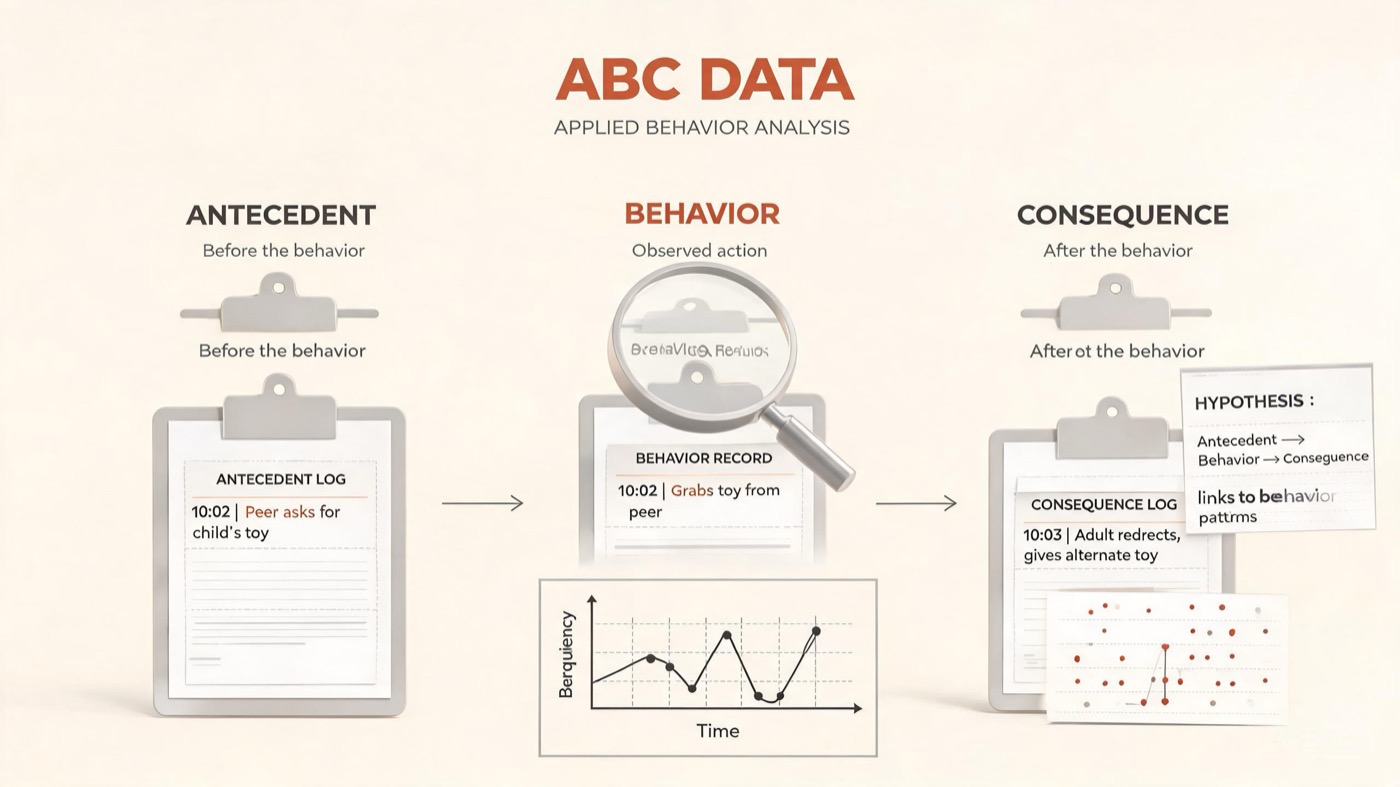
Breaking Down Antecedent, Behavior, Consequence
An antecedent is what happens immediately before a behavior. It can be an instruction, a peer interaction, a change in routine, or an environmental cue. The behavior must be observable and measurable, such as hitting, eloping, or shouting. The consequence is what follows the behavior and affects its future occurrence. Consequences can be reinforcing or punishing, but in ABC data, you record exactly what happened without judgment.
- Antecedent: teacher says ‘time to clean up’
- Behavior: student throws toy on floor
- Consequence: teacher tells student to sit out
ABC data is not just for problem behaviors. It can be used to analyze skill acquisition or any observable action. The key is objectivity: record only what you see and hear, not what you think the person feels.
Why ABC Data Matters for the BCBA Exam
The BCBA exam frequently includes questions on measurement, functional assessment, and function identification. ABC data is central to all these areas. You will need to interpret ABC data to hypothesize the function of a behavior, such as escape, attention, tangible, or automatic reinforcement.
Connection to Functional Behavior Assessment (FBA)
ABC data is a cornerstone of the descriptive assessment phase of an FBA. Unlike experimental functional analysis, ABC data is collected in natural settings. Exam questions often present an ABC narrative and ask you to identify the likely function. For example, if every time a peer laughs after a joke, the behavior increases, the function might be attention.
Differentiating ABC Data from Other Recording Methods
Other recording methods, like frequency or duration, only measure the behavior itself. ABC data provides context, making it more useful for function-based interventions. On the exam, you may be asked to choose the best method for a given situation. If the goal is to identify why a behavior occurs, ABC data is preferred. For more on measurement, see our data collection guide.
Step-by-Step: How to Collect ABC Data
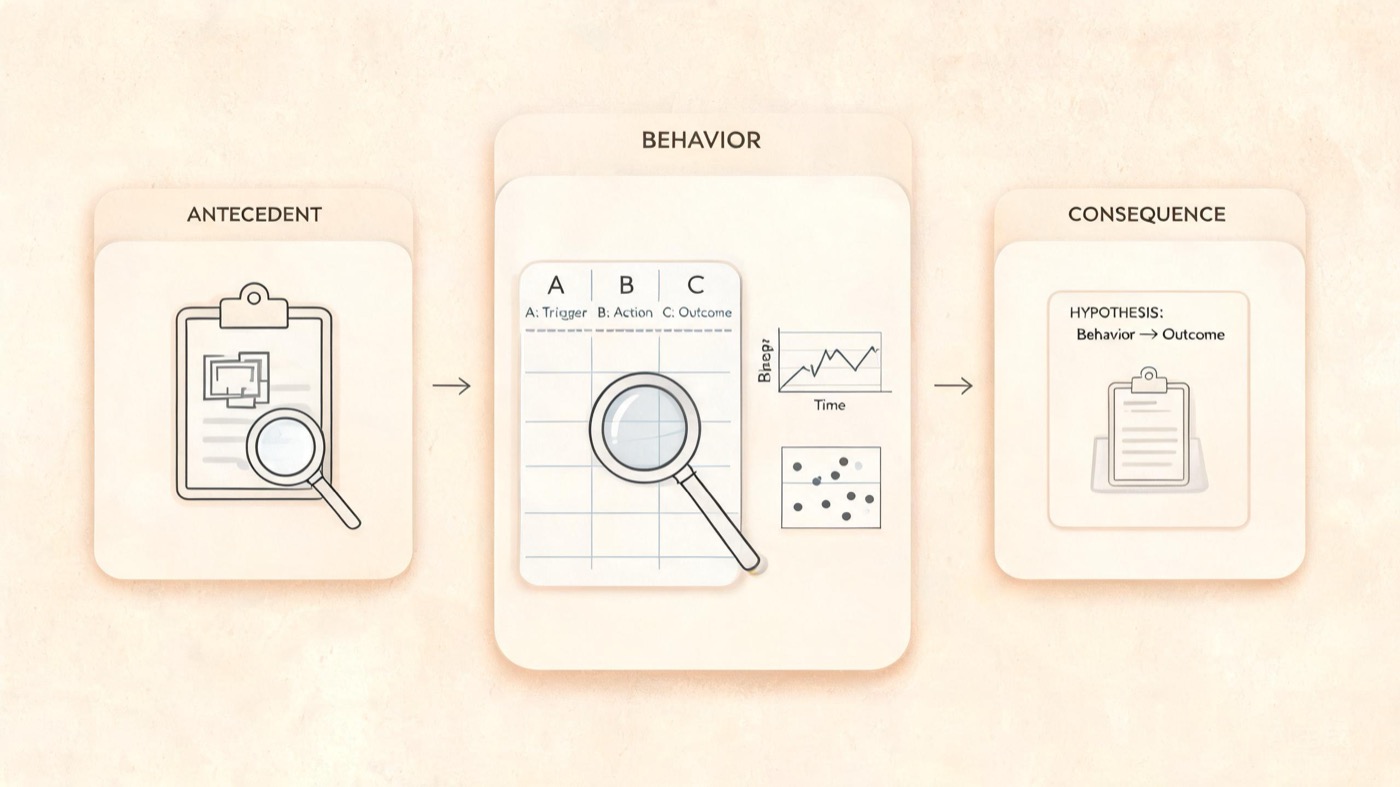
Collecting high-quality ABC data requires practice and objectivity. Follow these steps to ensure your data is useful for analysis.
Recording Antecedents Objectively
Describe the environment, people, and events immediately before the behavior. Include details like time of day, activity, instructions given, and who is present. Avoid inferences such as ‘student was frustrated.’ Instead, record: ‘teacher asked student to open math book. Student looked at floor for 10 seconds.’
Describing Behaviors in Observable Terms
Use operational definitions. Instead of ‘aggression,’ write ‘hits another person with an open palm.’ Include intensity, duration, and topography if relevant. Remember, the behavior must be something you can count or time.
Noting Consequences Accurately
Record exactly what happens after the behavior. Did a staff member provide attention? Did the task end? Did the client gain access to a preferred item? Even if the consequence seems accidental, record it. The consequence may be maintaining the behavior.
Worked Examples: ABC Data in Action
These realistic examples show how to analyze ABC data to hypothesize behavior function.
Example 1: Escape from Task
Antecedent: teacher hands student a worksheet. Behavior: student crumples paper and throws it. Consequence: teacher removes worksheet and sends student to break area. Hypothesized function: escape from task (negative reinforcement).
Example 2: Attention from Peers
Antecedent: peer group is talking during lunch. Behavior: student tells a loud joke. Consequence: peers laugh and look at student. Hypothesized function: attention from peers (positive reinforcement).
Example 3: Access to Tangible
Antecedent: student sees tablet on shelf. Behavior: student screams and cries. Consequence: parent gives tablet to stop crying. Hypothesized function: access to tangible item.
Example 4: Automatic Reinforcement
Antecedent: student alone in room with no activities. Behavior: rocks back and forth. Consequence: no social reaction; rocking continues. Hypothesized function: automatic/sensory stimulation.
Common Exam Traps with ABC Data
Even experienced test-takers make mistakes with ABC data questions. Watch out for these pitfalls.
Confusing Consequence with Punishment
A consequence is simply what follows a behavior. It is not automatically punishment. Punishment is defined by a decrease in future behavior. For example, if a teacher reprimands a student and the behavior increases, the reprimand is reinforcing, not punishing. Always look at the effect on behavior.
Inferring Function Without Enough Data
One ABC episode does not confirm a function. Patterns across multiple observations are needed. Exam questions may give you a single incident and ask for a ‘hypothesized function,’ not a confirmed one. Read carefully: words like ‘likely’ or ‘hypothesized’ indicate you should choose the most probable function based on limited data.
Ignoring Setting Events or Motivating Operations
Setting events (e.g., lack of sleep, illness) and motivating operations (e.g., food deprivation) can alter the value of consequences. For instance, a child who didn’t eat breakfast may find food more reinforcing. Exam questions may include these as antecedents. Learn more about the four functions of behavior to strengthen your analysis.
Quick Checklist for ABC Data on the Exam
Use this checklist to review before test day.
- Define each term: antecedent, behavior, consequence in your own words.
- Practice writing an operational definition for a common behavior.
- Review examples of each function (escape, attention, tangible, automatic).
- Identify the function from ABC narratives without overthinking.
- Remember that consequences can be reinforcing even if they seem negative.
- Consider motivating operations when antecedents are ambiguous.
- Try sample questions from reliable sources, such as the BACB’s official website.
Summary & Next Steps
ABC data is a fundamental skill for any behavior analyst. It bridges the gap between observation and function-based intervention. On the BCBA exam, expect multiple questions on ABC data interpretation and its role in FBA. Master the ability to identify antecedents, describe behaviors objectively, and analyze consequences for patterns. For more exam-focused resources, explore our BCBA exam prep guide. Practice with mock data sets and review the BACB’s 6th Edition Task List to reinforce your understanding. Good luck with your studies!
Complete BCBA Exam Prep
Turn this topic into exam-day practice
Practice concepts in context with five full-length 6th Edition mock exams, two bonus practice exams, a 6th Edition study guide, and key-term flashcards—all in one $120 USD package.
Get the $120 All-in-One Prep Pack
Review everything included on the product page before ordering. No pass guarantee is implied.



