
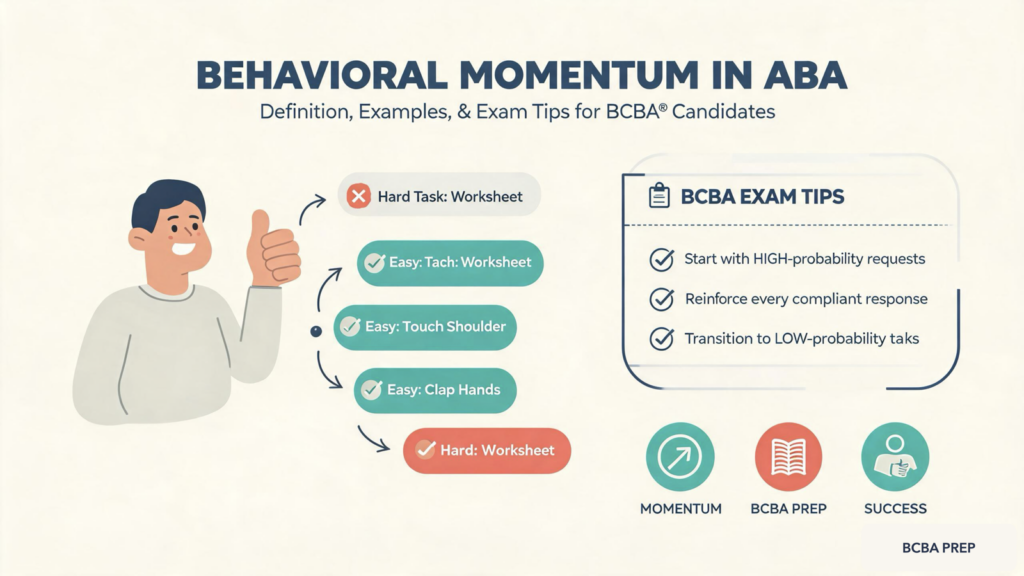
Introduction: What Is Behavioral Momentum?
Imagine asking a learner to complete three easy tasks they usually do quickly, then immediately presenting a harder task. You have just used behavioral momentum. This is a powerful antecedent intervention that increases compliance by building a history of reinforcement before a more demanding request. For BCBA® candidates, understanding this concept is essential for designing effective interventions and answering exam questions accurately.
Table of Contents
- Introduction: What Is Behavioral Momentum?
- Behavioral Momentum Definition and Core Components
- ABA Examples with ABC Analysis
- Behavioral Momentum on the BCBA Exam: Common Traps and Tips
- Quick Checklist for Behavioral Momentum Interventions
- Summary and Integration with Other ABA Concepts
- References
Behavioral momentum is not a new technique; it has been studied since the 1980s and remains a cornerstone of effective behavior intervention plans. By leveraging the natural tendency to continue following instructions after a series of easy successes, practitioners can reduce escape-motivated behavior and increase cooperation. Let’s break down its definition and key components.
Behavioral Momentum Definition and Core Components
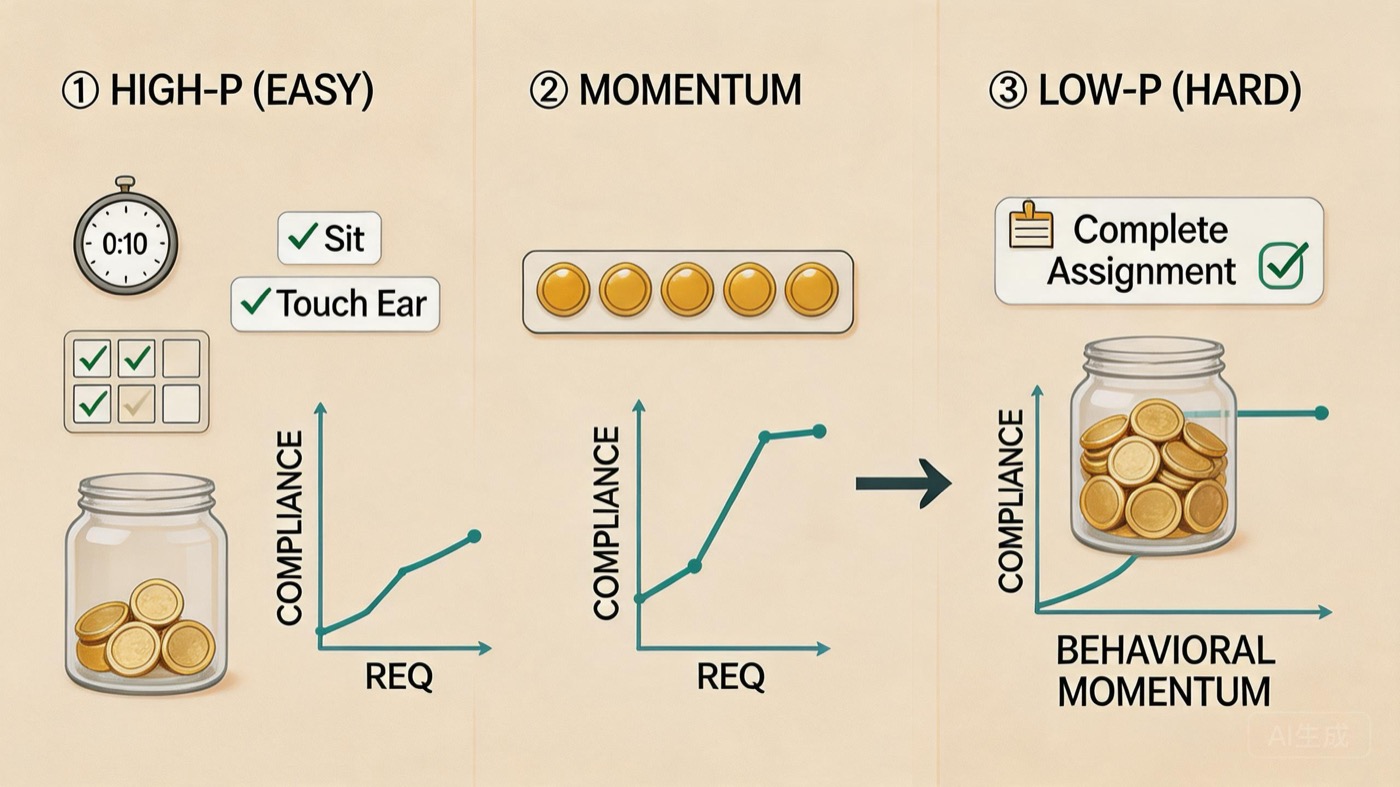
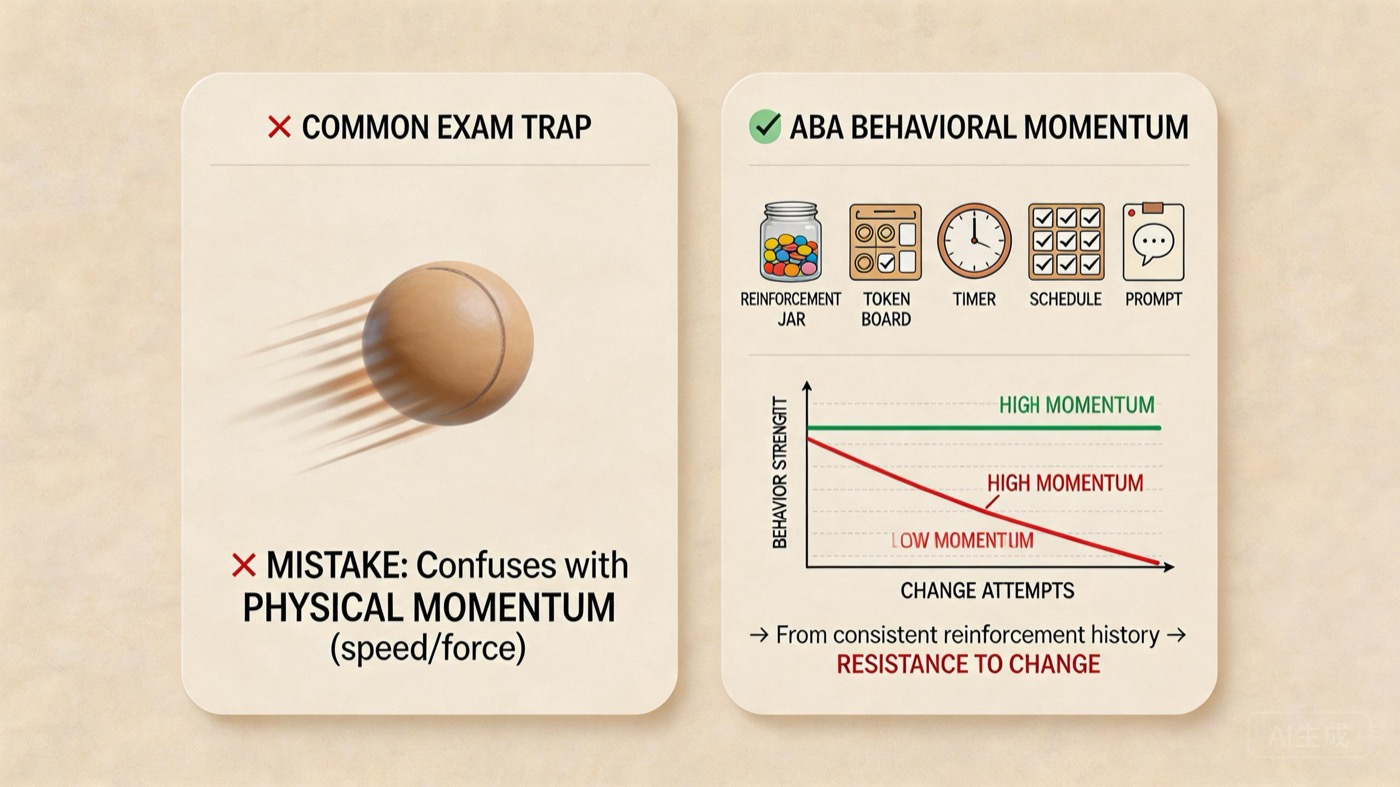
Behavioral momentum refers to the phenomenon where a high rate of reinforcement for a series of easy (high-probability) requests leads to increased compliance with a subsequent difficult (low-probability) request. The term comes from a physics analogy: mass (rate of reinforcement) times velocity (baseline response rate) predicts resistance to change.
The Law of Behavioral Momentum
The law of behavioral momentum states that the resistance to change of an operant behavior is proportional to the rate of reinforcement in that context. In other words, higher reinforcement rates create greater momentum, making the behavior more persistent even when challenged by a low-p request. This principle was formalized by Nevin, Mandell, and Atak (1983) and has been widely replicated. On the BCBA exam, you may be asked to identify which intervention relies on a history of reinforcement to increase persistence.
High-Probability Request Sequence
The high-probability (high-p) request sequence is the specific procedure used to build behavioral momentum. Follow these steps:
- Identify a low-p request (the target behavior).
- Select 3–5 high-p requests (tasks the learner completes with at least 80% compliance).
- Deliver the high-p requests quickly, one after another, and reinforce each compliance immediately.
- Within 5–10 seconds of the last high-p response, present the low-p request.
- Reinforce compliance with the low-p request.
It is critical that the high-p requests are truly high-probability—tasks the learner already does often. If you choose tasks that are not mastered, the procedure may backfire and decrease overall compliance. Also, ensure reinforcement is delivered consistently; even a single missed reinforcement can reduce momentum. Consider using a rich schedule of praise, tokens, or brief access to preferred items after each high-p response.
ABA Examples with ABC Analysis
Here are three practical examples illustrating how behavioral momentum works in everyday ABA practice.
Example 1: Transitioning from Play to Academic Task
Antecedent: Child is playing with blocks (high-p). Therapist says, ‘Hand me the red block’ (high-p), then ‘Give me the blue block’ (high-p), then ‘Touch your nose’ (high-p). Immediately after, ‘Complete this math worksheet’ (low-p). Behavior: Child completes the worksheet. Consequence: Praise and a sticker. Function: Escape from demands overridden by momentum.
Notice how the therapist used three simple motor tasks (handing over objects, touching nose) that the child typically does with 100% compliance. Each compliance was reinforced with brief praise. The momentum carried over to the math worksheet, which the child had previously refused.
Example 2: Increasing Compliance with Hygiene Routines
Antecedent: Teenage boy is watching TV. Parent says, ‘Turn off the TV’ (high-p), ‘Stand up’ (high-p), ‘Walk to the bathroom’ (high-p), then ‘Brush your teeth’ (low-p). Behavior: Brushes teeth. Consequence: Access to preferred video. Function: Access to tangibles maintained by momentum.
In this example, the parent embedded the low-p request (brushing teeth) within a chain of high-p requests. The parent reinforced each high-p response with minimal praise (e.g., ‘Good, you turned it off’) and then delivered a powerful reinforcer (extra video time) after teeth brushing. This approach works well when escape from demands is not the primary function; here, access to tangibles was used.
Example 3: Reducing Elopement During Transitions
Antecedent: In a classroom, teacher says, ‘Clap your hands’ (high-p), ‘Stand up’ (high-p), ‘Push in your chair’ (high-p), then ‘Walk to the carpet’ (low-p). Behavior: Child walks to carpet without eloping. Consequence: Teacher praise. Function: Escape from non-preferred environment reduced.
Here, the child had a history of eloping when asked to go to the carpet. By first engaging in three high-p, fun motor actions (clapping, standing, pushing chair), the teacher built momentum. The low-p request (‘Walk to the carpet’) was delivered in a calm, instructive tone. The child complied, and the teacher provided enthusiastic praise, further strengthening the behavior.
Behavioral Momentum on the BCBA Exam: Common Traps and Tips
Exam questions often test your ability to apply behavioral momentum correctly. Watch out for these common pitfalls.
Trap: Mistaking Momentum for Physical Concept
Some candidates confuse behavioral momentum with a physical force. Remember, in ABA it is about resistance to change due to reinforcement history, not speed or inertia. If a question mentions ‘increasing the rate of behavior’ or ‘keeping behavior going,’ that is not behavioral momentum—it may be behavioral persistence under different conditions.
Trap: Forgetting to Reinforce High-p Requests
A common error is delivering high-p requests without reinforcing each one. Momentum relies on consistent reinforcement for every high-p response; without it, the procedure loses its effect. On the exam, if a vignette describes a practitioner giving three easy instructions but only reinforcing the last one, that is NOT behavioral momentum.
Trap: Overgeneralizing to All Populations
Behavioral momentum may not be effective when the low-p request is maintained by automatic reinforcement or when the learner has a strong history of escape for that specific task. Assess function before applying. Also, note that momentum works best when the high-p requests are functionally unrelated to the low-p request; if they are all in the same response class, satiation may occur.
Quick Checklist for Behavioral Momentum Interventions
Use this checklist during your exam review or when designing interventions:
- Identify the low-p task and its function.
- Select 3–5 high-p tasks from the learner’s current repertoire.
- Deliver high-p requests sequentially with immediate reinforcement.
- Present the low-p request within seconds.
- Reinforce compliance with the low-p request.
- Track compliance rate and latency to respond to the low-p task before and after intervention.
In practice, also collect data on the integrity of the high-p sequence: did the practitioner deliver all high-p requests? Were reinforcers delivered? Did the low-p request follow within the time window? Fidelity is crucial for success.
Summary and Integration with Other ABA Concepts
Behavioral momentum is a practical antecedent strategy that leverages rate of reinforcement to increase compliance. It connects to motivating operations (e.g., altering the value of escape) and resistance to extinction. When studying, compare it to noncontingent reinforcement and differential reinforcement to see how each affects behavior differently. For example, noncontingent reinforcement delivers reinforcers on a fixed schedule regardless of behavior, while momentum is contingent on compliance with high-p requests. Both can reduce escape-maintained behavior, but through different mechanisms. For more review, see our guide on antecedent intervention strategies or the differential reinforcement guide. For authoritative references, consult the BACB Task List (6th ed.) and peer-reviewed journals on behavioral momentum.
References
Complete BCBA Exam Prep
Turn this topic into exam-day practice
Practice concepts in context with five full-length 6th Edition mock exams, two bonus practice exams, a 6th Edition study guide, and key-term flashcards—all in one $120 USD package.
Get the $120 All-in-One Prep Pack
Review everything included on the product page before ordering. No pass guarantee is implied.



