
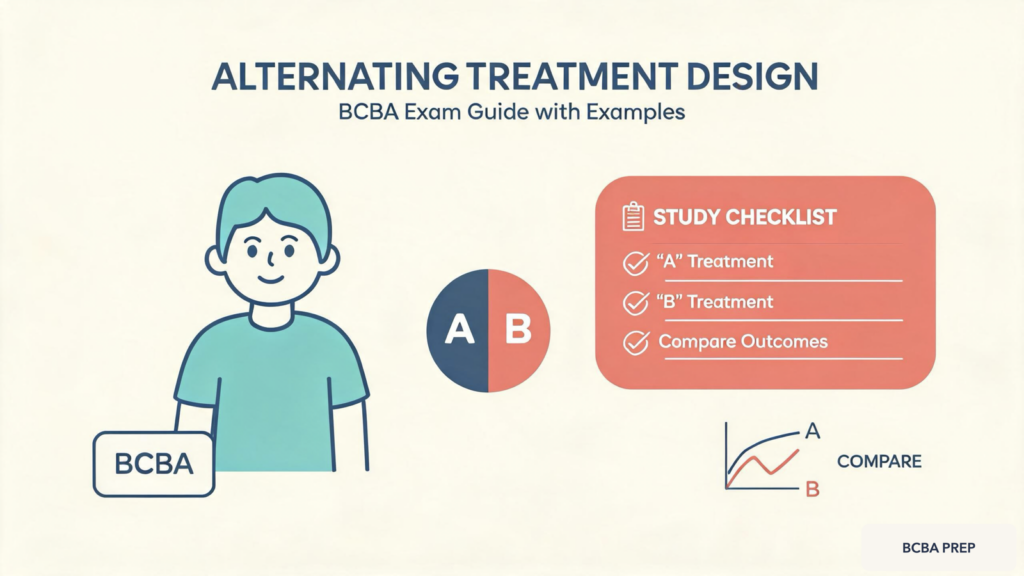
What is Alternating Treatment Design in ABA?
Alternating treatment design (ATD) is a single-subject experimental design used to compare the effects of two or more interventions on a target behavior. Unlike reversal designs, ATD does not require a baseline phase; instead, treatments are alternated rapidly across sessions or even within sessions. This makes it a powerful tool when you need to quickly identify the most effective intervention.
Practice this concept
After reviewing alternating treatments, practice with BCBA experimental design questions.
Table of Contents
- What is Alternating Treatment Design in ABA?
- Real-World ABA Examples of Alternating Treatment Design
- Alternating Treatment Design on the BCBA Exam
- Quick Checklist for Alternating Treatment Design
- Final Summary
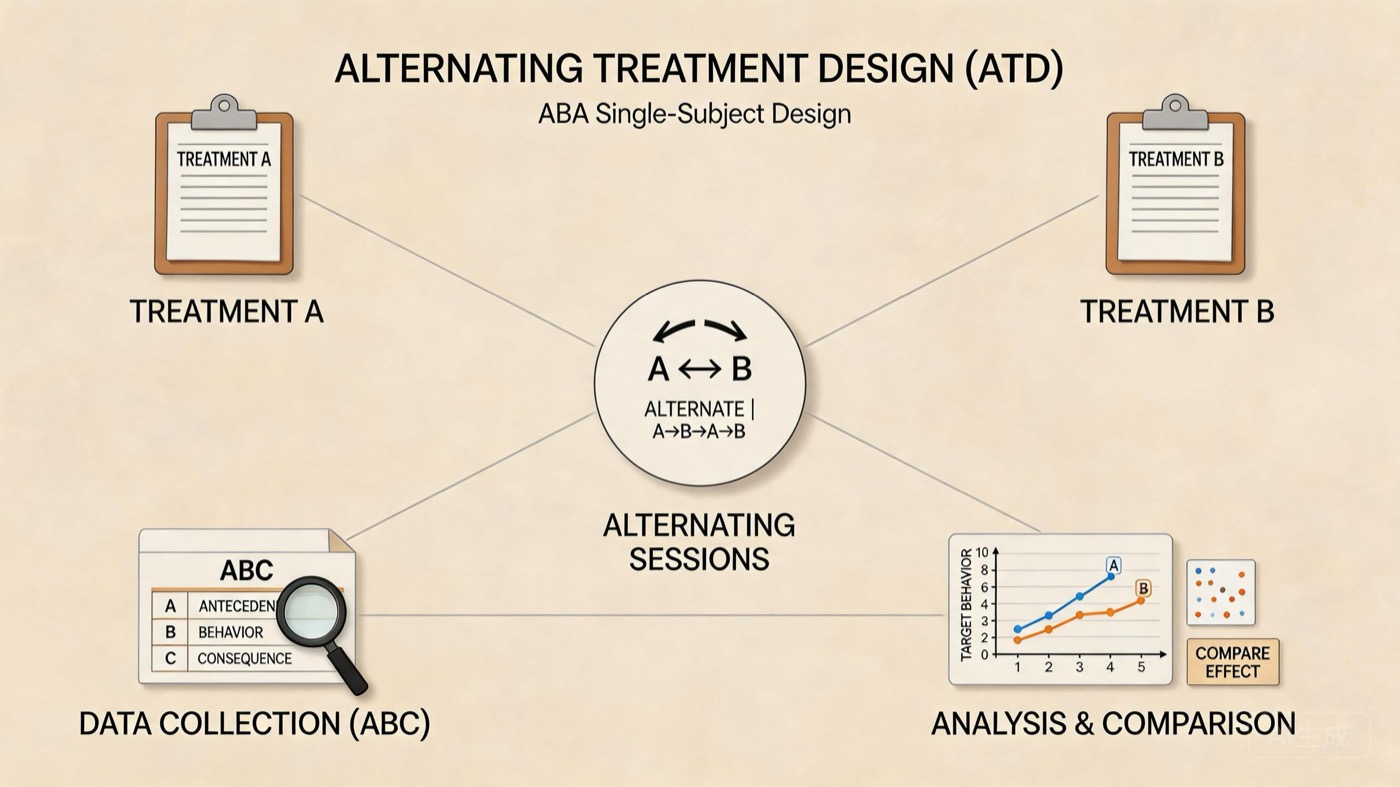
Core Features of Alternating Treatment Design
- Rapid alternation of two or more conditions (e.g., every session or every few trials).
- No baseline required, though a baseline can be included for comparison.
- Counterbalancing to control for order effects and sequence effects.
- Visual analysis of separated data paths to determine which treatment is more effective.
- Minimal carryover effects are assumed; interventions should be distinct and rapidly alternating.
When to Use Alternating Treatment Design
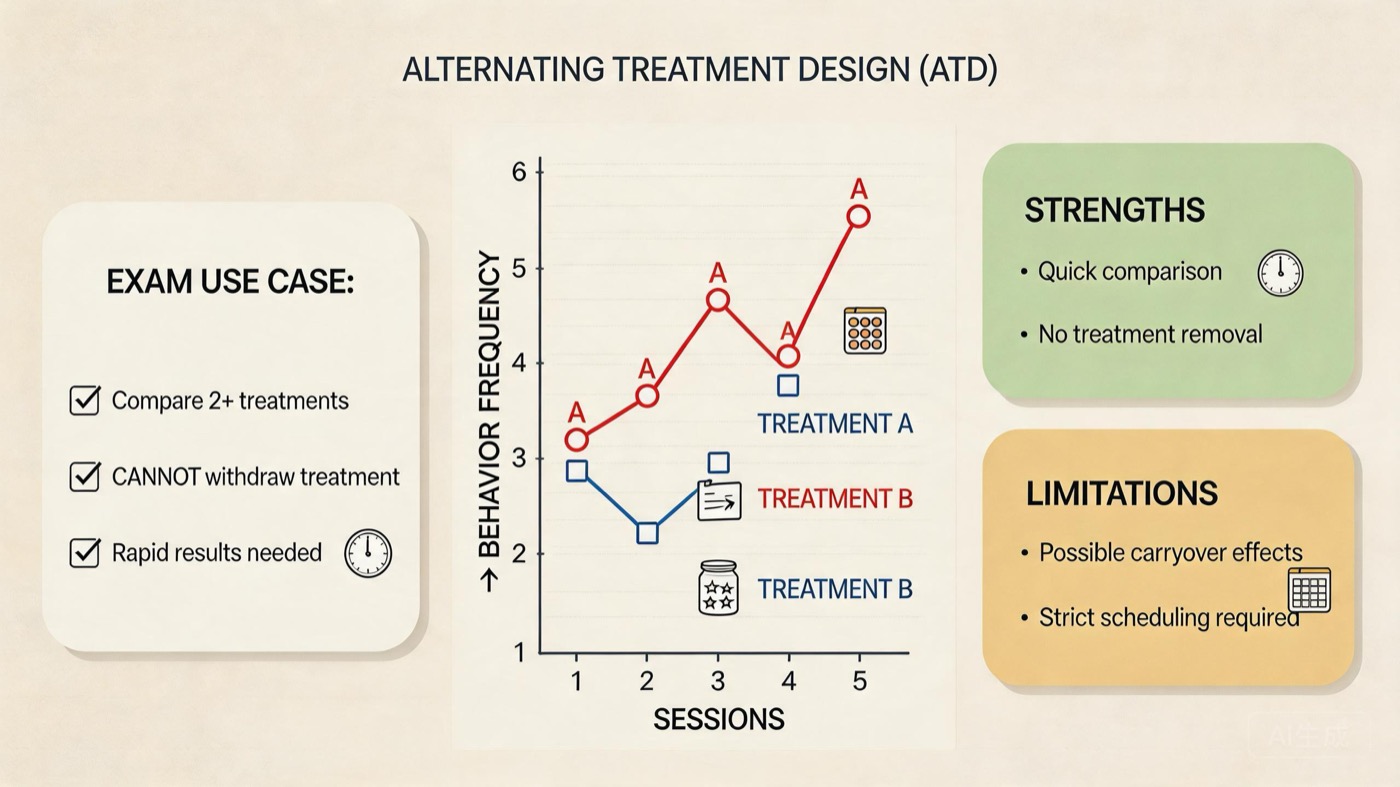
ATD is particularly useful when you cannot withdraw an effective treatment (e.g., for severe problem behavior) or when you need to compare interventions quickly. It is a type of multielement design, but not all multielement designs are ATDs; ATD specifically involves rapid alternation and often includes a baseline. Compared to reversal design (ABAB), ATD does not require returning to baseline, which can be unethical if the behavior is dangerous.
Real-World ABA Examples of Alternating Treatment Design
Example 1: Reducing Aggression with Two Interventions
A child with autism engages in aggression (hitting) when asked to complete a task. The hypothesized function is escape from demands. The BCBA compares two interventions: DRA + escape extinction (reinforcing compliance while blocking escape) and NCR (providing frequent breaks). Sessions alternate randomly. The graph shows that DRA + escape extinction leads to a faster reduction in aggression, with less overlap in data paths, indicating it is the superior treatment.
Example 2: Increasing Communication in a Child with Autism
A child with limited vocal language reaches for preferred items. The function is access to tangibles. The BCBA compares PECS (Picture Exchange Communication System) and vocal mand training. Sessions are alternated. Data show that PECS produces a higher rate of independent requests initially, but vocal mands increase gradually. Some overlapping data may occur, but the trend suggests vocal training is catching up. This helps the team decide to start with PECS and fade to vocal training.
Alternating Treatment Design on the BCBA Exam
On the BCBA exam, you need to identify when to use ATD and recognize its strengths and limitations. Questions often present scenarios and ask which design would be appropriate.
Common Exam Traps to Avoid
- Confusing ATD with multielement design: ATD is a subtype of multielement design; not all multielement designs alternate rapidly or compare treatments.
- Thinking a baseline is required: ATD can be used without baseline, though baseline adds to interpretability.
- Misinterpreting unstable data paths: Some overlap is expected; look for consistent separation in data paths over time.
- Ignoring sequence effects: Always counterbalance the order of treatments to prevent a sequence effect from biasing results.
- Assuming ATD is only for two treatments: It can compare three or more conditions, but visual analysis becomes complex.
Practice Prompts
Question 1: A BCBA wants to compare two treatments quickly and cannot withdraw the treatment. Which design should they use? Answer: Alternating treatment design.
Question 2: What is a limitation of alternating treatment design? Answer: Multiple treatment interference—the treatments may influence each other, making it hard to isolate the effect of a single treatment.
Quick Checklist for Alternating Treatment Design
Use this checklist to review key points before your exam:
- Confirm the design compares two or more treatments.
- Ensure rapid alternation (e.g., session-by-session or trial-by-trial).
- Check that counterbalancing is used to avoid sequence effects.
- Look for separated data paths on the graph to decide effectiveness.
- Remember: No baseline is required, but a brief baseline can strengthen internal validity.
- Consider the risk of multiple treatment interference and how to mitigate it (e.g., using a different therapist for each treatment).
For more study resources, check out our BCBA Exam Prep 2025 guide. Also review the BACB’s official website for the latest task list.
Final Summary
Alternating treatment design is a versatile and efficient single-subject design for comparing interventions. It is especially valuable when rapid results are needed or when withdrawal is not possible. On the BCBA exam, remember its core features, common pitfalls, and practical applications. With this guide, you’ll be ready to tackle any ATD question that comes your way.
Next step for BCBA exam prep
Turn this topic into exam-day practice
Use this topic as a focused review, then test it in exam-style conditions with a free mock before deciding whether five full-length mocks are the right next step.
Start the Free BCBA Mock Exam
Continue with Five Full-Length Mocks — $99
Review the included materials and access details before ordering. No pass guarantee is implied.



