
What Is a Supervisee in ABA?
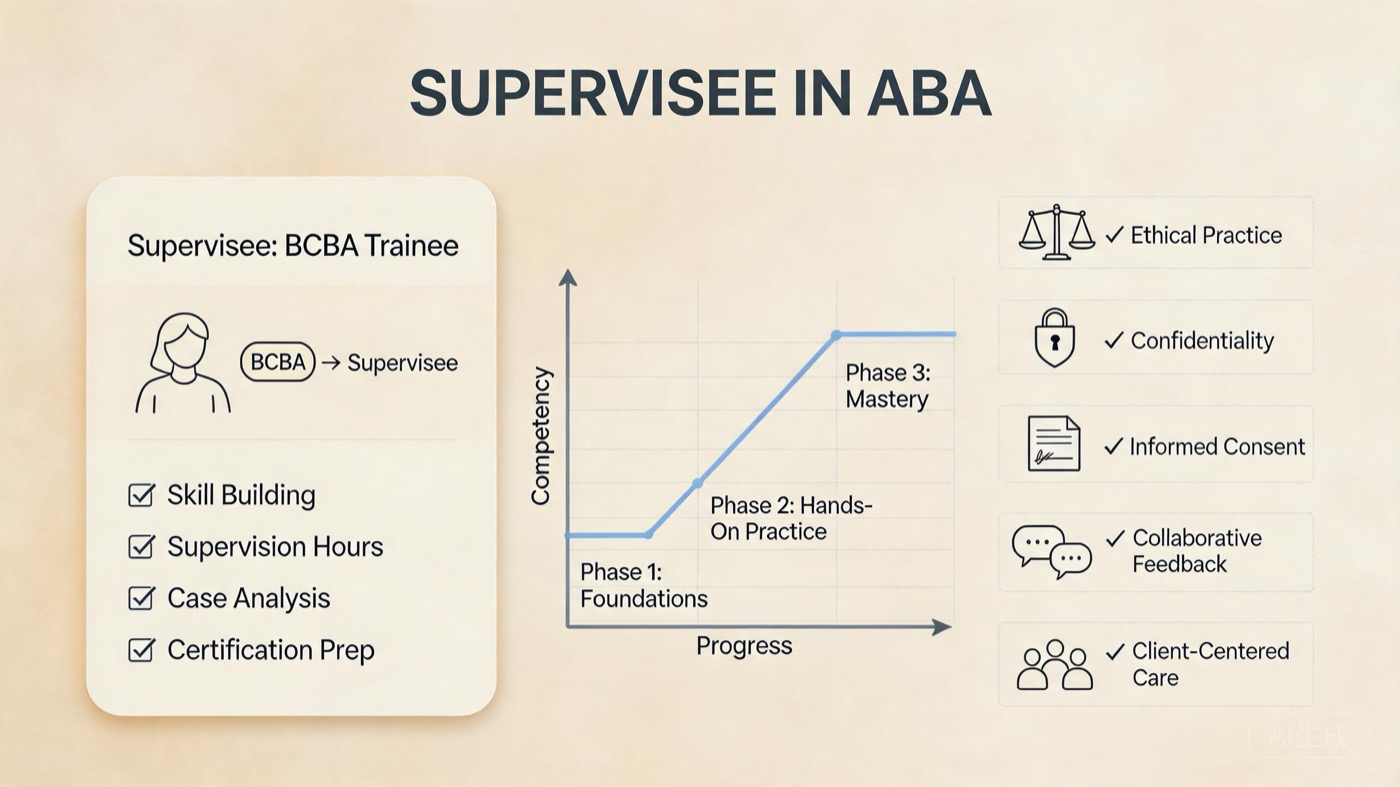
In ABA supervision, a supervisee in ABA is the individual receiving structured guidance from a BCBA or BCBA-D to develop professional competencies. The supervisee actively works toward certification while gaining hands-on experience under supervision. This role is critical because the quality of supervision directly impacts the supervisee’s skill acquisition and ethical practice.
Table of Contents
- What Is a Supervisee in ABA?
- Supervisee Responsibilities: What BCBA Candidates Must Do
- ABA Examples of Effective Supervisee Behavior
- Exam Relevance: How Supervision Appears on the BCBA Exam
- Final Summary
- References
Supervisee vs. Supervisor: Key Differences
The supervisee is the learner, while the supervisor is the certified professional responsible for oversight and evaluation. Think of it as a student-teacher relationship. The BACB requires a minimum number of supervised fieldwork hours and specific supervisor qualifications. For example, a supervisee must complete at least 2,000 hours of supervised fieldwork (or 1,500 hours in a concentrated track) under a BCBA. Understanding these distinctions is vital for exam questions that test accountability and role boundaries.
Why the Supervisee’s Role Matters for Exam Success
The BACB Task List includes supervision content such as ethical responsibilities and performance monitoring. Exam questions often test your understanding of supervision scenarios, so knowing the supervisee role helps avoid common mistakes. Moreover, the task list asks you to identify appropriate supervisee behaviors in ethical dilemmas, such as when to seek additional supervision or how to handle a conflict of interest. Mastering this content can improve your score on the supervision-related portion of the exam.
Supervisee Responsibilities: What BCBA Candidates Must Do
Effective supervision is a two-way street. As a supervisee, you must take ownership of your growth. Here are key responsibilities that go beyond simply showing up:
Preparing for Each Supervision Session
- Bring data on client behaviors and intervention outcomes.
- Prepare questions about challenging cases or procedures.
- Review progress reports and note areas needing feedback.
- Collect artifacts like treatment integrity checklists or parent training materials.
Preparation also includes re-reading relevant parts of the BACB Ethics Code or task list to frame your questions. For instance, if you are struggling with a behavior reduction procedure, review the ethical considerations for least restrictive procedures before your session.
Actively Engaging During Supervision
- Take notes on feedback and action items.
- Ask for clarification when instructions are unclear.
- Demonstrate skills by role-playing or conducting live sessions.
- Implement feedback before the next meeting.
Active engagement also means being receptive to constructive criticism. Remember, the goal is to become a competent BCBA. Embrace feedback as a learning opportunity, not a personal attack.
Documenting Supervision Hours Correctly
Common errors include mismatched dates, missing signatures, or incorrect forms. Always use the BACB fieldwork template and track monthly totals. Accurate documentation is critical for certification eligibility. A simple mistake, such as logging hours from a non-qualifying experience, can delay your application. Double-check that your supervisor is BACB certified at the time of supervision and that the supervision type (individual vs. group) meets BACB requirements.
ABA Examples of Effective Supervisee Behavior
Here are three practical examples that illustrate how supervisees can apply ABA principles to improve their own performance:
Example 1: Reducing Prompt Dependency
Antecedent: The supervisee asks for help before attempting a task. Behavior: The supervisor implements least-to-most prompting. Consequence: Immediate correct response. Hypothesized function: Escape from demand. The supervisee works on independent problem-solving before requesting assistance.
Example 2: Increasing Data Collection Accuracy
Antecedent: The supervisee records data inconsistently. Behavior: The supervisor models correct recording and checks interobserver agreement. Consequence: Higher accuracy on subsequent sessions. Hypothesized function: Lack of skill. The supervisee practices with sample videos to improve reliability.
Example 3: Improving Parent Training Delivery
Antecedent: Parent confusion about the behavior plan. Behavior: The supervisee role-plays with the supervisor before the parent meeting. Consequence: Parent comprehension increases. Hypothesized function: Avoidance of negative evaluation. The supervisee uses BST (Behavioral Skills Training) to prepare.
Example 4: Increasing Self-Monitoring
Antecedent: The supervisee receives vague feedback from the supervisor. Behavior: The supervisee creates a self-monitoring checklist to track implementation integrity. Consequence: Clearer progress and supervisor approval. Hypothesized function: Control over own learning. This proactive approach demonstrates initiative, a trait valued by supervisors and exam scenario writers.
Exam Relevance: How Supervision Appears on the BCBA Exam
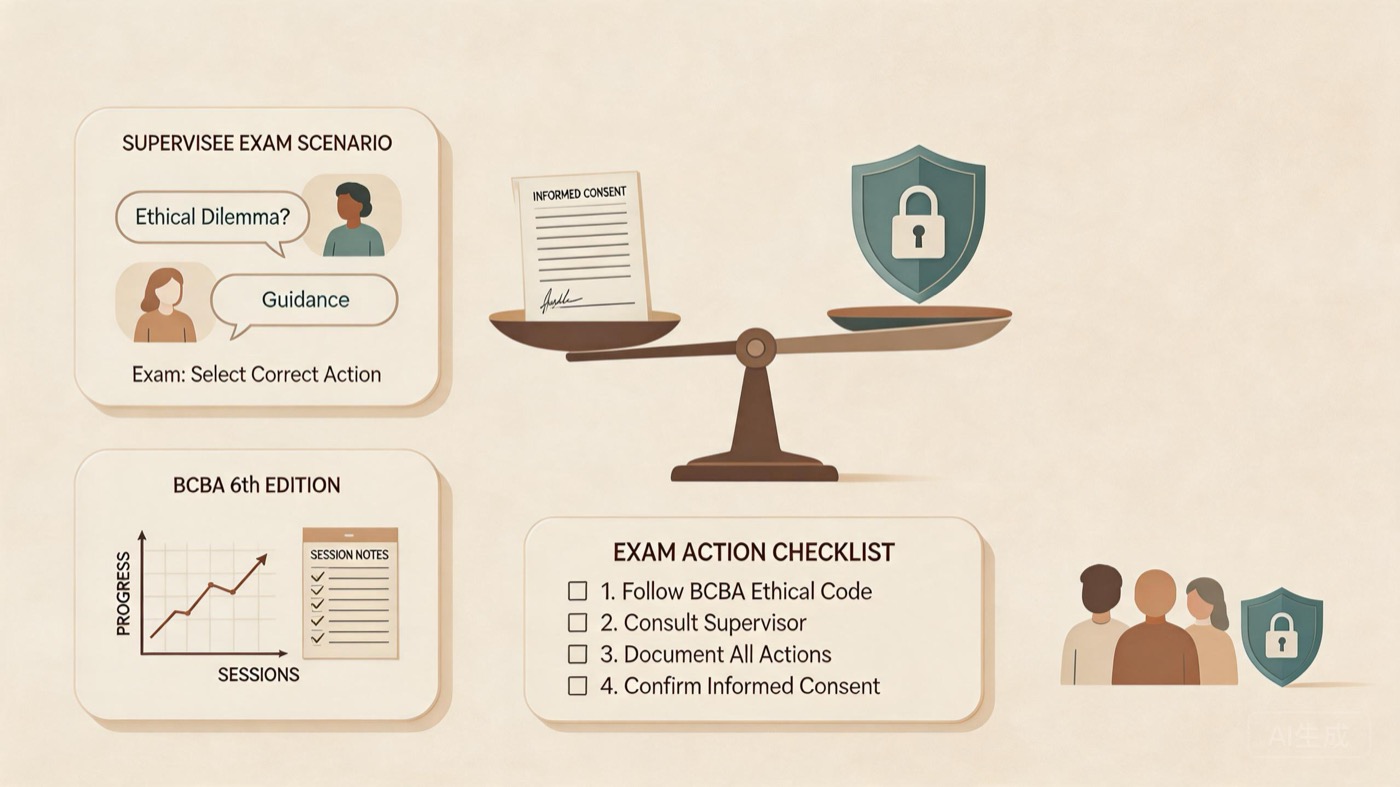
BCBA exam questions often assess your understanding of supervision ethics and responsibilities. You might be asked to identify the correct action for a supervisee in a dilemma. For more details on exam structure, visit our BCBA 6th Edition Exam Blueprint Guide.
Exam items may present a scenario where a supervisee notices a supervisor engaging in unethical behavior. The correct answer typically involves reporting to the BACB or seeking guidance from another supervisor, not ignoring the issue. Similarly, questions about documentation might ask what to do if a supervisor forgot to sign a form: the supervisee should request the signature promptly, not backdate or falsify records.
Common Exam Traps to Avoid
- Trap 1: Confusing supervisee and supervisor responsibilities. Know who is accountable for what.
- Trap 2: Applying ethical guidelines incorrectly. Always reference the BACB Ethics Code for supervision standards.
- Trap 3: Miscalculating supervision hours. Double-check month-by-month totals and supervisor ratios.
- Trap 4: Assuming all supervision hours are equal. Remember that group supervision has a cap of 50% of total hours, and individual supervision must be at least 20% of total hours in the concentrated track.
Quick Review Checklist for Supervisees
- Prepare data before each meeting
- Follow ethical guidelines from the BACB
- Document hours accurately and verify signatures
- Seek feedback and implement it
- Self-monitor progress toward fieldwork goals
- Communicate openly with your supervisor about challenges
Final Summary
Understanding the supervisee role in ABA is essential for BCBA candidates. By preparing thoroughly, engaging actively, and documenting correctly, you set yourself up for fieldwork success. Remember, the BACB Ethics Code and Task List are your guides. Use the resources available, including our BCBA mock exams, to practice applying these concepts. For additional exam prep strategies, check out BCBA Exam Prep 2025. Good luck on your journey to becoming a BCBA!



