
The Assessment of Functional Living Skills, often called AFLS, is a criterion-referenced framework for identifying practical skills that support participation and independence across home, school, work, and community contexts. The assessment of functional living skills is not just a checklist of chores. In ABA and related educational planning, functional-living assessment asks which everyday responses a learner can perform, under what conditions, with what support, and how consistently the skill transfers to real routines. The result should help a qualified team choose meaningful goals rather than turn a score into a label.
Table of Contents
- What Is the Assessment of Functional Living Skills?
- Which Domains Does AFLS Cover?
- How Is AFLS Different From a General Adaptive Test?
- How Should a Team Use the Initial Scan?
- How Do Interview, Observation, and Test Trials Work Together?
- How Should Scores Become Functional Goals?
- What Does Prompting Have to Do With Functional-Living Assessment?
- How Should Generalization and Maintenance Be Checked?
- What Are Common Mistakes With AFLS Interpretation?
- How Is the Assessment of Functional Living Skills Tested on the BCBA Exam?
- What Is the Bottom Line?
- Quick Review Checklist
- Take the Free BCBA Mock Exam
AFLS is a proprietary assessment and teaching system associated with James W. Partington and Michael M. Mueller. This article explains the concept, domains, decision logic, and study distinctions without reproducing copyrighted protocol items or pretending that a short online summary can replace the guide, training, direct observation, or professional judgment. The BACB certification task-list page identifies the current BCBA test-content framework. For exam study, connect functional-living assessment to assessment, measurement, skill acquisition, generalization, maintenance, and ethical, socially meaningful practice.
What Is the Assessment of Functional Living Skills?
The Assessment of Functional Living Skills is a criterion-referenced assessment, skills-tracking system, and teaching companion focused on practical adaptive behaviors. “Criterion-referenced” means that performance is compared with a defined skill criterion rather than ranked only against a norm group. A team uses the result to identify skills that are present, emerging, absent, or uncertain and then decides which areas deserve direct verification and instruction.
The exact score is meaningful only in the context of the protocol, the assessment conditions, the learner’s opportunities, and the scoring rules. A person may perform a task independently in a familiar kitchen but need support in an unfamiliar kitchen. Another learner may know the steps but not initiate them when materials are stored differently. Functional living skills are contextual, so a score should be a starting point for better questions.
Which Domains Does AFLS Cover?
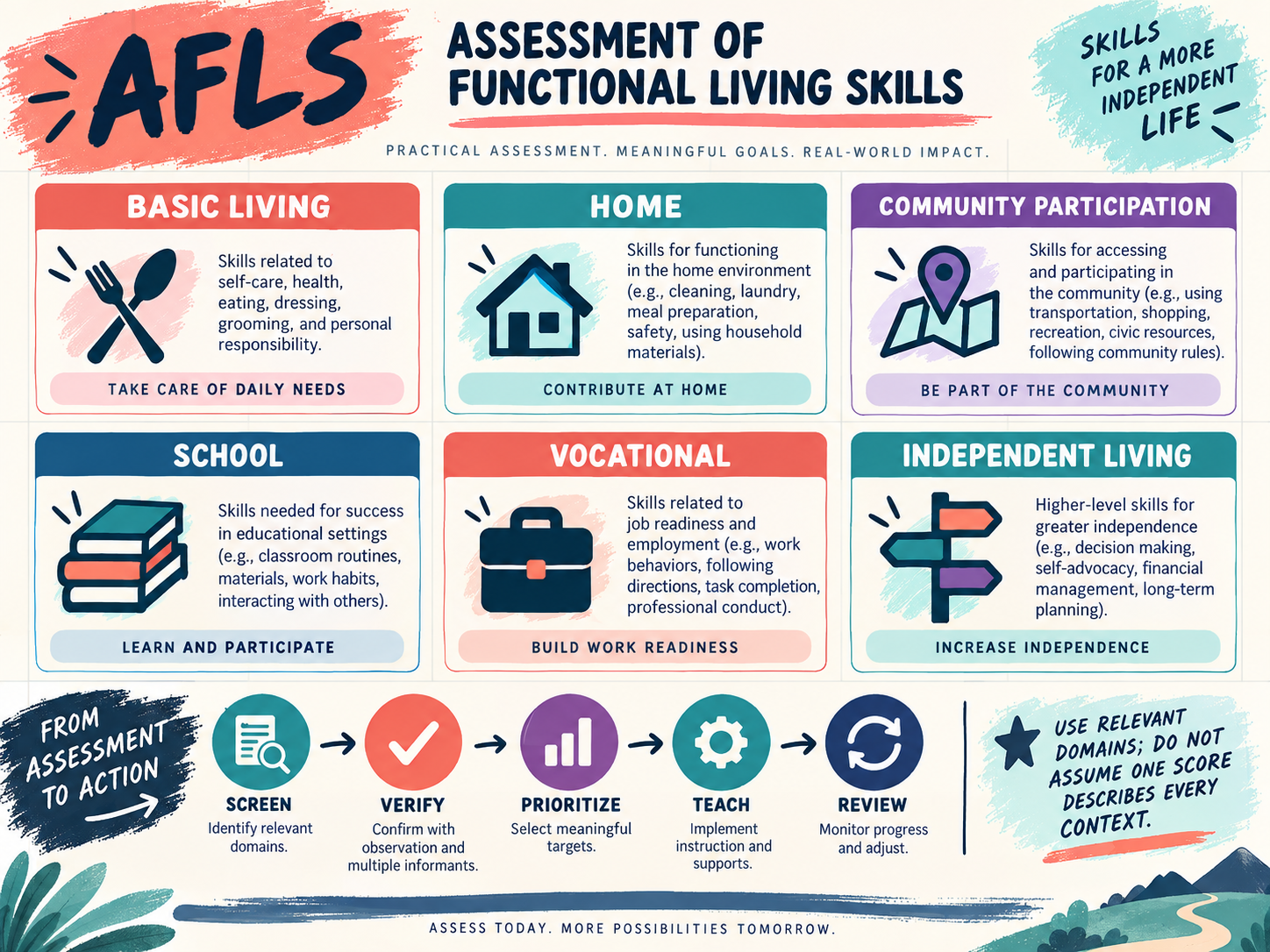
AFLS is commonly organized into modules that address daily living and participation across different contexts. Public descriptions typically identify Basic Living Skills, Home Skills, Community Participation Skills, School Skills, Vocational Skills, and Independent Living Skills. The relevant module or task area should be selected based on the learner’s goals, age, environment, communication, safety needs, and future participation—not because every available section must be completed.
Basic living may include personal care and routines. Home skills may involve cleaning, meals, clothing, laundry, and household participation. Community participation can include navigating places, shopping, transportation, safety, and social expectations. School and vocational areas address participation in those settings, while independent-living areas may involve planning, money, time, problem solving, and self-management. The domain labels organize decisions; they do not replace a person-centered conversation about what matters to the learner.
How Is AFLS Different From a General Adaptive Test?
A broad adaptive-behavior test may compare performance with a normative sample and produce standardized scores. A functional-living assessment is often used to identify specific skills that can be observed, taught, and tracked in everyday contexts. The two approaches can answer different questions and may complement one another.
Do not infer that a criterion-referenced score is a diagnosis, an IQ estimate, or a complete measure of quality of life. Nor should a low score be interpreted as proof that the learner cannot perform the skill in any setting. The team must ask how the skill was assessed, which prompts or materials were used, and whether the opportunity resembled the routine in which the skill is needed.
How Should a Team Use the Initial Scan?
An initial scan helps the team identify likely strengths and gaps efficiently. Public protocol guidance describes a process that can include scanning and scoring known skills, leaving uncertain items for further determination, and marking which skills can be checked through observation versus a more formal assessment. The scan is not the end of assessment. It is a triage step that tells the team where uncertainty or importance justifies deeper review.
Start with relevant informants who know the learner in the target routine. A caregiver may know whether the learner prepares a snack at home; a teacher may know how the learner manages materials at school; a job coach may know which workplace steps are independent. Informant knowledge is valuable, but it is still a report. When the decision matters, confirm the skill through observation or a planned test opportunity.
How Do Interview, Observation, and Test Trials Work Together?
Interview can quickly identify what others have seen, the learner’s preferences, safety concerns, and routines that deserve attention. Observation shows what happens under natural conditions. A structured test trial can answer a narrower question when the skill has not occurred recently or the natural opportunity is rare. The team should record which method supported each conclusion.
| Information source | Strength | Limitation to check | Useful next step |
|---|---|---|---|
| Interview or report | Efficient access to history, priorities, and routine information | Recall, expectations, or different definitions of independence | Observe the skill in the relevant context |
| Natural observation | Shows performance with typical materials, people, and consequences | The opportunity may not occur, or conditions may vary | Define the opportunity and repeat across relevant routines |
| Test trial | Creates a planned opportunity to resolve a specific uncertainty | May not represent natural motivation or generalization | Check the skill again in the everyday routine |
| Prompt-level data | Shows the support needed, not only whether the task was completed | Different observers may code prompts differently | Define prompt codes and track fading separately |
How Should Scores Become Functional Goals?
Choose goals by combining assessment information with the learner’s values, family priorities, safety, access, and opportunities. A gap is not automatically a treatment target. Ask whether the skill improves communication, autonomy, participation, health, safety, relationships, or access to preferred activities. Ask the learner how they want support delivered and whether an adaptation or assistive technology can accomplish the same outcome.
Translate the selected skill into an observable goal. Instead of “improve independent living,” define the response and conditions: “Given the usual kitchen materials and a visual checklist, the learner will prepare a cold snack by completing the defined steps with no more than a gestural prompt in 4 of 5 opportunities across two weeks.” The exact criterion should be individualized, not copied from an online example.
What Does Prompting Have to Do With Functional-Living Assessment?
A learner may complete a task after verbal, model, gestural, or physical assistance. That information is important, but prompted completion should not be reported as unprompted independence. Record the prompt level and define whether the goal measures independent initiation, completion with an acceptable support, or a gradual reduction in assistance.
Prompt fading must protect access and dignity. The aim is not to remove every useful support or force a person to perform a task without an accommodation. The aim is to teach the response under conditions that make participation meaningful and safe. A visual schedule, adapted utensil, communication device, or environmental arrangement may be a legitimate support rather than a failure of independence.
How Should Generalization and Maintenance Be Checked?
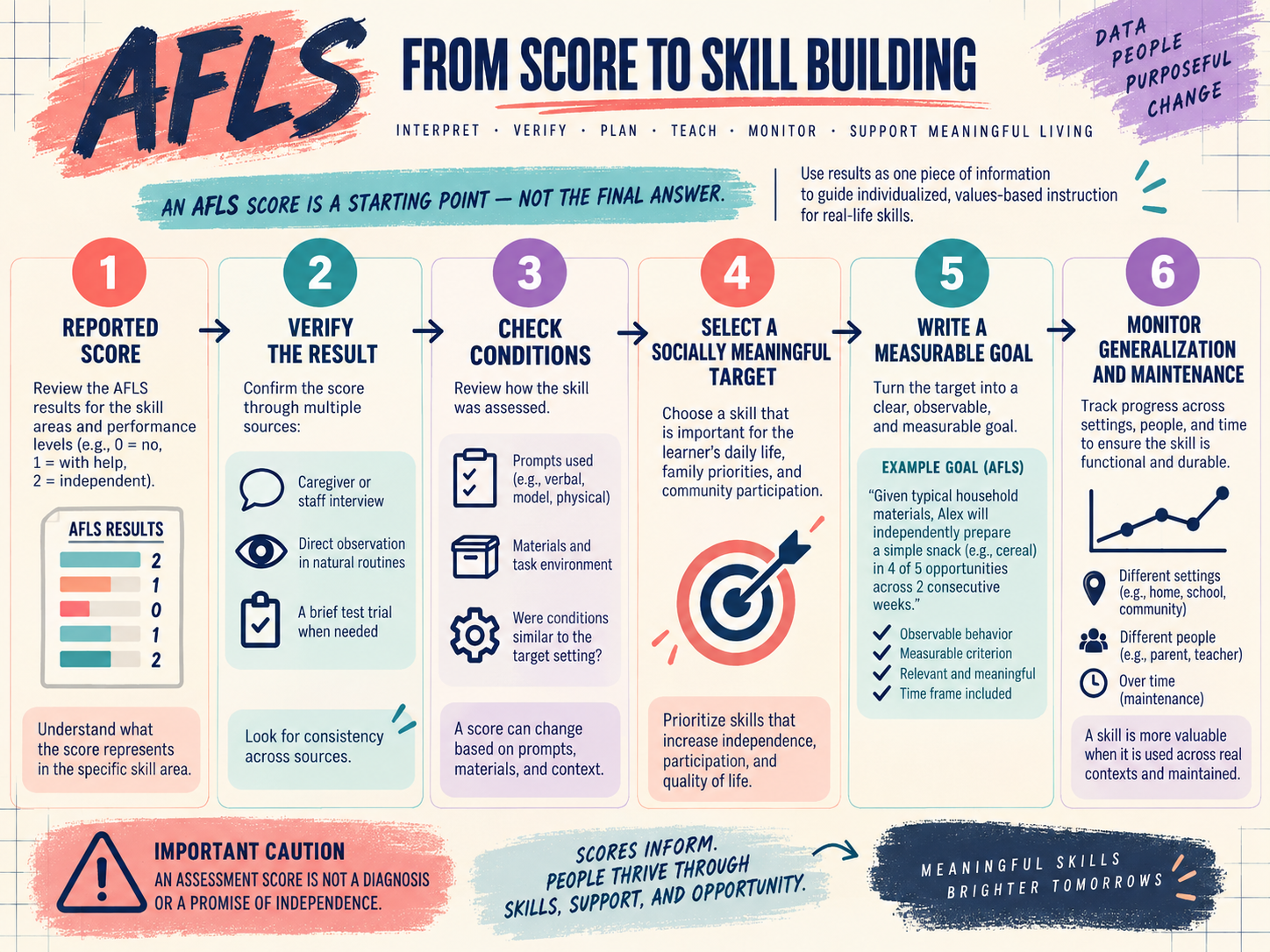
Functional skills matter because they occur in the world, not only in an assessment session. Check whether the learner can use the skill with relevant people, materials, settings, routines, and natural consequences. A learner who completes laundry steps with one staff member may need teaching to use the skill at home or in a supported apartment. A learner who can follow a visual recipe may need practice when the brand or package changes.
Maintenance data should be collected after the skill meets the current teaching criterion and at a schedule that fits the goal. Review whether the skill remains useful and whether the support plan is still respectful. If performance changes, investigate the environment, opportunity, motivation, task difficulty, and access to communication before assuming the learner has lost the skill.
What Are Common Mistakes With AFLS Interpretation?
- Scoring every domain automatically: select relevant areas instead of creating an unnecessary burden.
- Treating a reported score as direct proof: verify important or uncertain items in the target context.
- Ignoring prompts and materials: record what support made the performance possible.
- Writing goals from deficits alone: include strengths, preferences, access, safety, and meaningful participation.
- Teaching only in a clinic arrangement: plan generalization and maintenance from the beginning.
- Reproducing proprietary protocol content: use the authorized guide and training; explain the concept without copying items.
- Calling a score a diagnosis: an assessment result informs programming and does not define the whole person.
How Is the Assessment of Functional Living Skills Tested on the BCBA Exam?
For an exam question, identify what the assessment is designed to measure and what the answer claims. Functional-living assessment focuses on practical adaptive skills and can inform skill-acquisition goals. A score does not automatically establish a diagnosis, a causal function, or generalized independence. If the question describes interview information, look for an option that verifies the skill through observation when that uncertainty affects the decision.
Also distinguish assessment from intervention. Selecting a target after reviewing functional skills is not the same as teaching the target. A complete answer may include operational definitions, prompt-level data, natural-context opportunities, reinforcement, generalization, maintenance, and socially meaningful outcomes.
What Is the Bottom Line?
The assessment of functional living skills helps a team move from a broad question—“What does this learner need for daily life?”—to specific, observable, teachable priorities. Use relevant domains, verify uncertain performance, preserve prompt and context information, choose goals with the learner and stakeholders, and monitor whether skills transfer to real life.
For a structured review of assessment, measurement, and skill-acquisition concepts, try the free BCBA mock exam. Practice can help you distinguish a functional-living assessment from a diagnosis or a generic norm-referenced score; it does not replace authorized materials, supervision, or individualized planning.
For targeted review, use our the assessment of functional living skills practice questions to apply the concept in exam-style scenarios.
Quick Review Checklist
Use this final checklist to turn the assessment of functional living skills into exam-ready reasoning. The goal is not to memorize a label in isolation; it is to identify the relevant evidence and explain why the best answer fits the scenario. Key ideas to review:
- State the central definition or decision point for the assessment of functional living skills in your own words.
- Identify the detail that makes the assessment of functional living skills different from its closest related ABA term.
- Separate the observable facts in a scenario from assumptions that are not supported by the facts.
- Write one example and one nonexample so you can recognize the concept in a new setting.
Exam application checks:
- Ask what the question is actually requesting before comparing the answer choices.
- Mark the antecedent, response, consequence, or other evidence that supports the selected answer.
- Look for a distractor that describes a related process but does not answer the specific question.
Final self-check:
- Explain how you would verify the interpretation with clear observations or data.
- Change one detail in the scenario and decide whether your answer should change.
- Give a one-sentence rationale that a supervisor or study partner could evaluate.
Take the Free BCBA Mock Exam
When you are ready to apply the idea, use the free practice resource below for additional feedback. Take the Free BCBA Mock Exam



