
A sample functional behavior assessment report should show how a referral question became an observable definition, a data plan, a pattern summary, a cautious functional hypothesis, and measurable next steps—without exposing identifying client information.
Table of Contents
- What Is a Sample Functional Behavior Assessment Report?
- What Should the Referral Question Say?
- How Should the Target Behavior Be Defined?
- What Information Belongs in the Background Section?
- Which Assessment Methods Should the Report Identify?
- How Should an ABC Summary Be Written?
- What Is the Difference Between a Pattern and a Functional Hypothesis?
- How Should Recommendations Connect to the Assessment?
- What Should the Progress-Monitoring Section Include?
- How Do You Protect Privacy in a Sample Report?
- How Is a Sample FBA Report Tested on the BCBA Exam?
- What Is the Bottom Line?
- Quick Review Checklist
- Take the Free BCBA Mock Exam
A sample functional behavior assessment report is useful when it teaches the reasoning behind the sections, not when it is copied as a blank form and treated as a clinical answer. A strong report connects the question that prompted the assessment to direct and indirect evidence. It describes behavior in observable terms, identifies relevant context, summarizes patterns, states the limits of the evidence, and explains what will be monitored next.
Examples found online often contain names, dates, school details, or case-specific recommendations. Those examples may help a student recognize the shape of a report, but they should not be copied into a real record or used as a substitute for an individualized assessment. This guide uses a fictional case and intentionally leaves out identifying details. The BACB task-list materials provide exam context for assessment, measurement, intervention, and data-based decisions. The BACB Ethics Code also makes privacy, competence, informed participation, and responsible documentation central professional concerns.
What Is a Sample Functional Behavior Assessment Report?
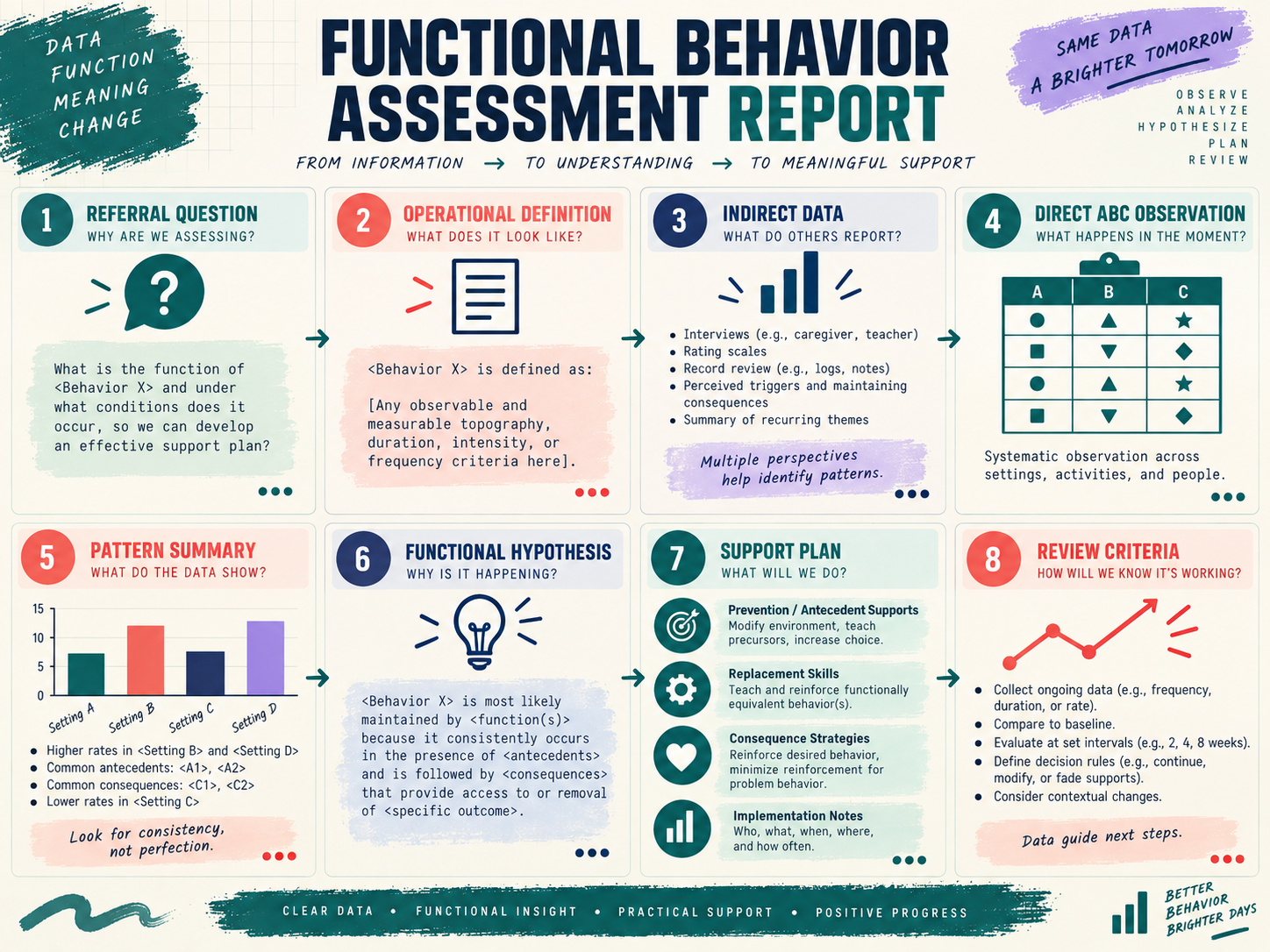
A functional behavior assessment report is a structured record of how a behavior analyst investigated a socially significant behavior and the environmental variables that may influence it. The report is not just a narrative about what a person did. It should show the measurement system, the sources of information, the observed pattern, the hypothesis supported by that pattern, and the decisions that follow.
“Functional” means that the assessment asks about relations between behavior and consequences or other environmental events. It does not mean that every report contains a formal experimental functional analysis. Many reports combine interviews, record review, direct observation, ABC data, scatterplots, rating scales, or other descriptive methods. If the evidence is descriptive, the report should say that the result is a hypothesis rather than a demonstrated causal relation.
What Should the Referral Question Say?
Begin with the decision the assessment is meant to inform. “Understand the behavior” is too broad to guide data collection. A more useful referral question might be: “Under what classroom conditions is Jordan most likely to leave the instructional area, and what response could staff teach and reinforce to make requesting a break more efficient?” In a real report, the name would be handled according to the site’s privacy procedures; “Jordan” is only a fictional placeholder here.
The question should identify the behavior of concern, the relevant settings or routines, and the practical decision. It may also include safety, communication, participation, or quality-of-life concerns. A precise question prevents the report from collecting every possible detail while missing the events that matter.
How Should the Target Behavior Be Defined?
An operational definition describes what an observer can see or hear and gives a clear boundary for when an episode begins and ends. “Noncompliance” is a label, not a complete definition. A stronger example might be: “Within five seconds after an instructional demand, the learner pushes materials more than six inches away, turns their torso away from the work area, or walks more than three feet from the assigned seat. The episode begins with the first qualifying action and ends after 30 consecutive seconds without one.”
The definition should distinguish the target from similar events. It should state the topography, countable unit, context, and measurement dimension. If more than one behavior is included, explain whether they are separate targets or one response class. Avoid adding an interpretation such as “to escape” inside the definition; the likely function belongs in the hypothesis section.
What Information Belongs in the Background Section?
Include only background that is relevant to the assessment question and necessary for the reader to understand the context. Useful information may include the settings observed, communication supports, routine changes, prior strategies, stakeholder concerns, and the dates or duration of the assessment period. Do not include a long personal history simply because a template has a space for it.
Record the source of each report. A caregiver interview, teacher interview, direct observation, permanent product, or record review answers a different kind of question. If a stakeholder reports that the behavior “always happens during math,” direct observation can test whether the pattern occurs during math, whether the demand is the relevant event, and what typically follows.
Which Assessment Methods Should the Report Identify?
List the method, who completed it, when it occurred, and what it was designed to measure. A short report might include an interview, direct ABC observations during several routines, a review of prior data, and a simple frequency or duration measure. The method should match the behavior. Duration is not a substitute for frequency when the question concerns how often discrete episodes occur, and a rating scale is not a direct observation.
| Section | What it contributes | Question for the reviewer |
|---|---|---|
| Operational definition | Observable boundaries and measurement unit | Could two trained observers identify the same event? |
| Indirect information | Stakeholder reports, history, and perceived patterns | Which claims still require direct observation? |
| Direct observation | Antecedent, behavior, consequence, and context data | Does the observed pattern repeat across relevant conditions? |
| Hypothesis | A testable summary of a possible maintaining relation | Does the hypothesis fit the data without claiming more than it shows? |
| Plan and review | Prevention, teaching, reinforcement, safety, and monitoring | What data will tell the team to continue, modify, or stop? |
How Should an ABC Summary Be Written?
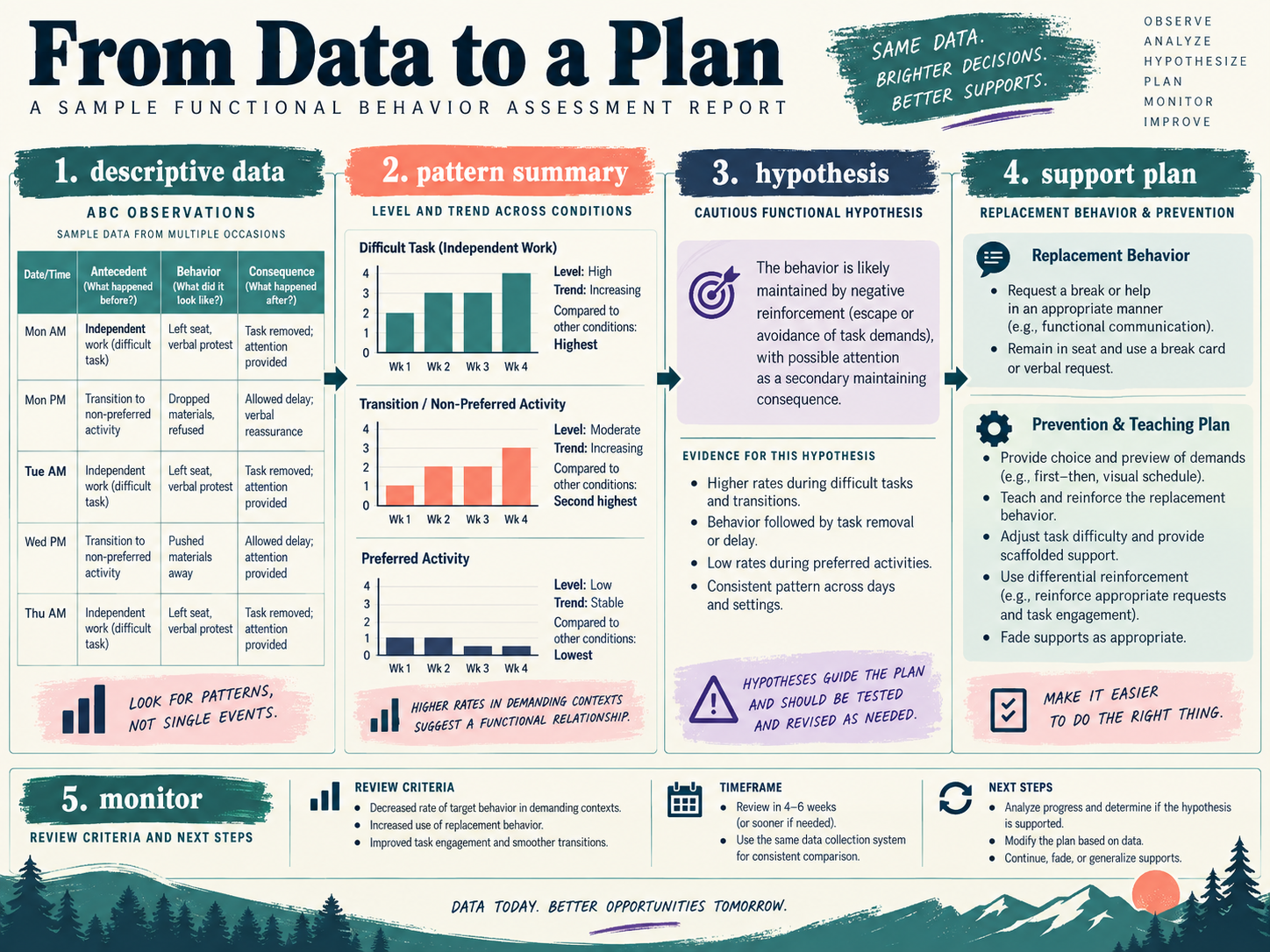
Summarize patterns rather than copying a pile of anecdotes. A useful ABC summary says what preceded the target, what the target looked like, and what reliably followed it. It may also note setting events, task difficulty, communication opportunities, staff responses, and whether the outcome changed the next event.
For a fictional example, direct observations might show that leaving the instructional area occurred 9 times across 12 demanding tasks, most often after multi-step written directions. Staff frequently removed the worksheet and offered a break within 20 seconds. The report could say that the pattern is consistent with an escape-related hypothesis, while noting that the observation did not establish causality and did not test alternative consequences experimentally.
What Is the Difference Between a Pattern and a Functional Hypothesis?
A pattern is a repeated description in the collected data. A functional hypothesis is a concise, testable statement about the relation that may maintain the behavior. The report should not turn a stakeholder’s guess into a conclusion without checking whether direct data support it.
A careful hypothesis includes the setting event or antecedent, the target response, and the likely consequence. For example: “When a difficult written task is presented and a break is not immediately available, the learner is likely to leave the instructional area; staff then remove the task and provide a break, which may reinforce leaving.” The words “may” or “is hypothesized to” preserve the distinction between descriptive evidence and causal demonstration.
How Should Recommendations Connect to the Assessment?
Recommendations should follow from the hypothesis and the learner’s needs. If escape is hypothesized, a plan might teach an efficient break request, arrange an achievable starting response, use choice or task modification, reinforce the replacement response, and define how staff will respond to the target behavior safely. If attention is hypothesized, the plan should not simply say “give more attention”; it should define what appropriate attention-seeking response will be taught and reinforced.
Every recommendation needs an implementation description and a measurement rule. State who will do what, in which routine, how often, and what counts as success. Include generalization, maintenance, dignity, assent, and safety considerations. Avoid recommending punishment, restraint, or restrictive procedures as a casual default. Higher-risk procedures require proper competence, authorization, safeguards, and ongoing review.
What Should the Progress-Monitoring Section Include?
Specify the dependent measures and the decision rules. If the target is leaving, frequency per opportunity or latency to return may be relevant; if the target is prolonged crying, duration may be more informative. Add data on the replacement response and the conditions that create opportunities to use it. A plan that only counts reduction of the target may miss whether the learner gained a functional alternative.
Use a baseline or pre-intervention summary that is comparable to later data. Note important changes in staff, schedule, medication, communication supports, environment, or opportunity density. A lower rate during a week with fewer demands does not automatically show an intervention effect.
How Do You Protect Privacy in a Sample Report?
Use fictional names and invented data in study examples. In real documentation, follow the organization’s privacy and record-retention procedures. Remove unnecessary names, addresses, dates of birth, school identifiers, photographs, and other details from teaching samples. Do not upload an identifiable report to a public template library, paste client data into an unapproved tool, or reuse a real report as a classroom example without appropriate authorization and de-identification.
How Is a Sample FBA Report Tested on the BCBA Exam?
Exam questions often ask you to identify the strongest operational definition, match a dimension to a behavior, distinguish indirect from direct assessment, or select the statement that is a hypothesis rather than a demonstrated function. Look for data quality and scope. A questionnaire can suggest a pattern but does not replace direct observation. A descriptive ABC pattern can support a hypothesis but does not automatically prove causality. A treatment recommendation should be linked to the assessment and monitored with data.
What Is the Bottom Line?
A useful sample functional behavior assessment report demonstrates a chain of reasoning: a focused referral question, an observable definition, appropriate assessment methods, a transparent data summary, a cautious hypothesis, individualized supports, and clear review criteria. The sample should teach structure and professional judgment, not provide a copy-and-paste clinical answer.
For a structured review of assessment, measurement, and other BCBA exam concepts, try the free BCBA mock exam. Practice can help you recognize strong report components; it does not replace supervision, consent, or an individualized assessment.
For targeted review, use our sample functional behavior assessment report practice questions to apply the concept in exam-style scenarios.
Quick Review Checklist
Use this final checklist to turn sample functional behavior assessment report into exam-ready reasoning. The goal is not to memorize a label in isolation; it is to identify the relevant evidence and explain why the best answer fits the scenario. Key ideas to review:
- State the central definition or decision point for sample functional behavior assessment report in your own words.
- Identify the detail that makes sample functional behavior assessment report different from its closest related ABA term.
- Separate the observable facts in a scenario from assumptions that are not supported by the facts.
- Write one example and one nonexample so you can recognize the concept in a new setting.
Exam application checks:
- Ask what the question is actually requesting before comparing the answer choices.
- Mark the antecedent, response, consequence, or other evidence that supports the selected answer.
- Look for a distractor that describes a related process but does not answer the specific question.
Final self-check:
- Explain how you would verify the interpretation with clear observations or data.
- Change one detail in the scenario and decide whether your answer should change.
- Give a one-sentence rationale that a supervisor or study partner could evaluate.
Take the Free BCBA Mock Exam
When you are ready to apply the idea, use the free practice resource below for additional feedback. Take the Free BCBA Mock Exam



