
If the task list BACB feels like a giant checklist you’re “supposed” to know, you’re not alone. I remember the moment I first tried to study it straight through—my notes were perfect, and my practice scores were… not. The turning point was treating the task list BACB not as a reading assignment, but as a skills map: what you must do, what you must discriminate, and what the exam will try to trick you into confusing.
This guide shows you how to use the task list BACB (now aligned to the 6th Edition Test Content Outline) to build a study plan, spot high-yield topics, and choose practice resources that actually move your score.
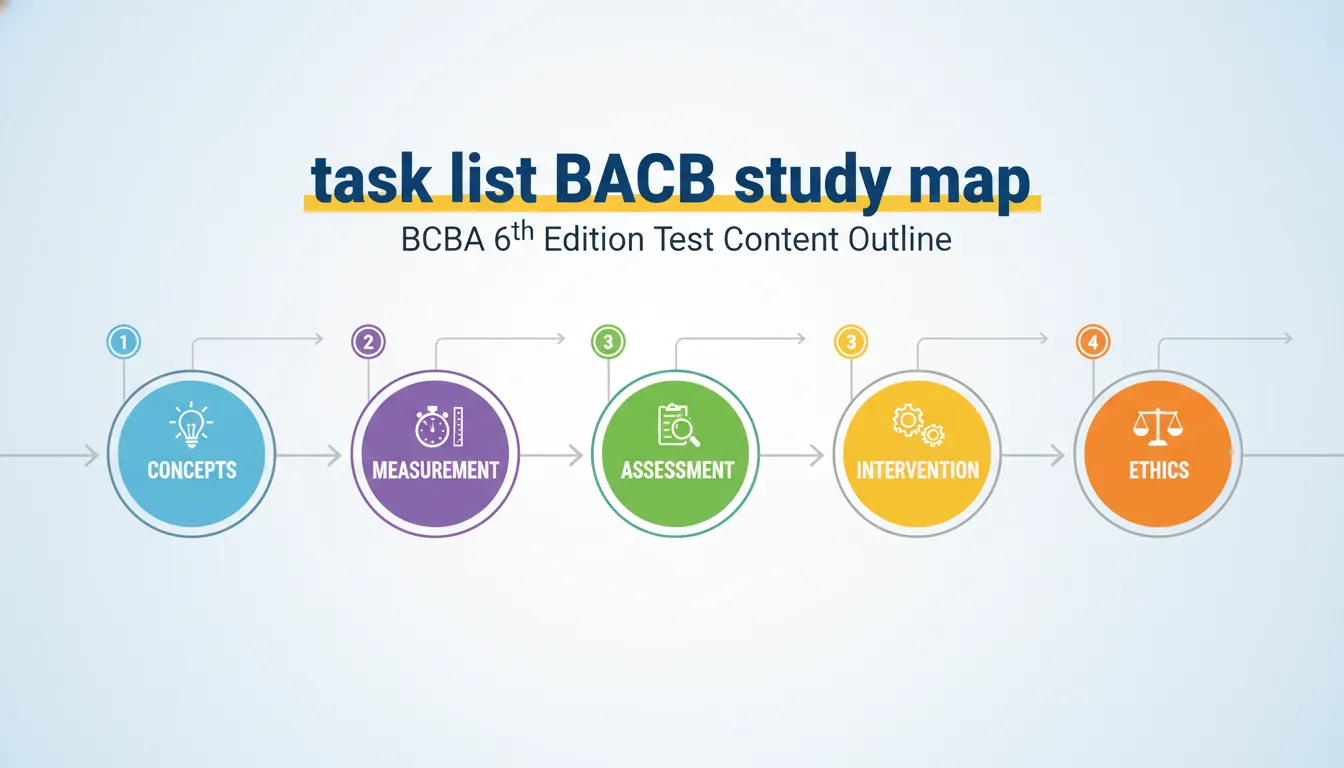
What “Task List BACB” Means Today (and Why Candidates Still Say It)
The BACB used to publish a “Task List” that many of us organized our entire studying around (especially in the 5th Edition era). In the 6th Edition update, the BACB moved to a Test Content Outline (TCO) format. Candidates still search task list BACB because it’s shorthand for “the official list of what’s tested.”
Here’s the practical takeaway:
- The exam is built from the 6th Edition BCBA Test Content Outline, not the 5th Edition Task List.
- Your study plan should still feel “task-list driven,” but it must be TCO-aligned so you’re practicing the right skills.
- You should use the official outline as your blueprint, then attach examples, decision rules, and mini-cases to each line item.
Authoritative sources worth bookmarking:
- BCBA 6th Edition Test Content Outline (BACB PDF)
- BACB Test Content Outlines hub
- BCBA 5th Edition Task List (legacy reference)
5th vs 6th Edition: What Actually Changed (Without the Noise)
Most candidates waste time hunting for a perfect “conversion chart.” You don’t need a 40-page crosswalk—you need to know what changes your studying.
Key shifts you’ll feel:
- Reorganization and clarity: content is grouped more cleanly so concepts build in order.
- More application pressure: definitions alone won’t save you; the exam asks what you’d do next.
- Ethics and professional practice remain central, but often show up embedded in scenarios, not as isolated “ethics questions.”
| What candidates call it | Official BACB document name | How exam uses it | Best way to study it | Common mistake |
|---|---|---|---|---|
| “5th Ed Task List” | BCBA/BCaBA Task List (5th Edition) | Legacy blueprint reference; concepts still appear but not organized the same way as 6th Ed | Use for spot-checking foundational topics; map older tasks to current outline areas | Treating it as the current blueprint and overfocusing on outdated structure |
| “6th Ed Outline” | BCBA Test Content Outline (6th Edition) | Current exam blueprint; drives item distribution and content domains | Build a study plan by domain and subdomain; verify coverage against the outline | Skimming domain titles without learning what each subdomain actually includes |
| “List of terms to memorize” | (Not a separate document; often conflated with 5th Ed Task List) | Exam emphasizes applied decision-making and scenario-based discrimination | Practice discrimination & application (vignettes, mixed sets, error analysis) | Memorize definitions instead of practicing discrimination & application |
| “Study guide in order” | BCBA Test Content Outline (6th Edition) | Domains represent what is tested, not necessarily the order you’d do it in practice | Study by workflow (assessment→intervention→evaluation) while ensuring all outline bullets are covered | Study by section order and miss how steps connect across domains |
| “Checklist for readiness” | BCBA Test Content Outline (6th Edition) | Ensures breadth: items sample across domains; weak areas show up quickly | Convert each bullet into measurable objectives; track performance with timed mixed practice | Only “checking off” bullets without demonstrating fluency under exam-like conditions |
The 6th Edition TCO as Your Study Workflow (Not a PDF to Highlight)
A high-scoring approach is to study the task list BACB content in the same order you’d work a case. That reduces mental load and improves recall under time pressure.
Use this workflow:
- Concepts & principles: stimulus control, motivating operations, reinforcement/punishment effects, respondent vs operant patterns.
- Measurement & data display: select measures, detect artifacts, interpret trends/variability.
- Experimental logic: what demonstrates control, what doesn’t, and why.
- Assessment → intervention selection: FBA logic, function-based treatment, skills acquisition vs reduction.
- Implementation, integrity, generalization: treatment integrity, maintenance plans, caregiver training.
- Ethics & professional issues: consent, scope, documentation, supervision, avoiding conflicts.
If you’ve ever felt like you “know the terms” but miss questions, it’s often because your studying skipped Steps 2–5 (the doing part).
High-Yield Areas Where the Exam Loves Confusions
The BCBA exam often tests discriminations—two answers look right, but one is “more behavior-analytic” or matches the scenario constraints.
From what I’ve seen when reviewing missed-question patterns, these are repeat offenders:
- Stimulus control vs motivating operations: antecedent effects are not interchangeable.
- Negative reinforcement vs punishment: removal can strengthen or weaken behavior depending on the contingency.
- Extinction vs punishment: procedure definition matters more than outcome.
- Function-based intervention vs “topography-based” intervention: pretty plans fail if they don’t match function.
- Ethics embedded in clinical choices: “best treatment” may be unethical given competence, consent, or risk.
To sharpen these quickly, anchor each topic to:
- a clean definition
- a non-example
- a “what changes in the contingency?” explanation
For deep practice on common exam confusions, these focused guides help:
- automatic reinforcement bcba exam guide
- functional behavior assessment fba
- behavior skills training bst bcba exam
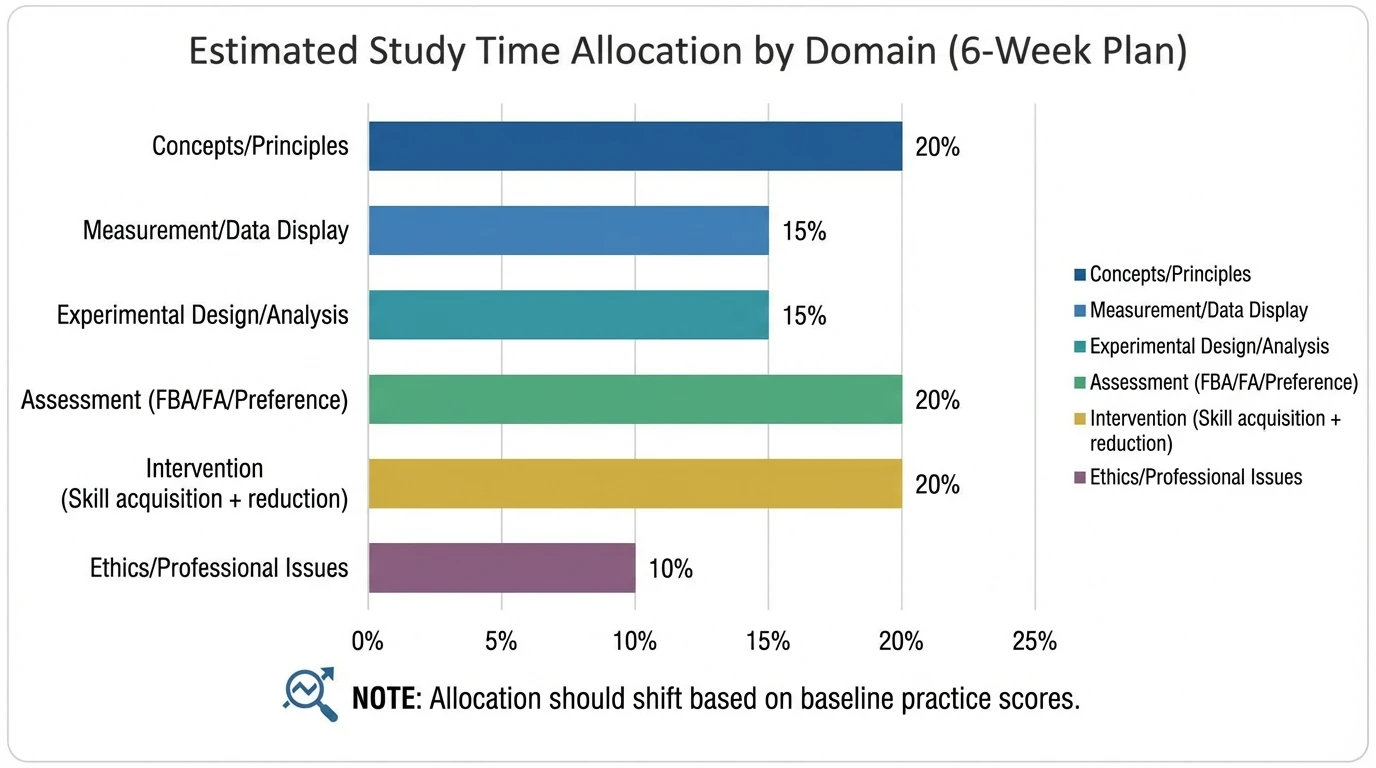
A Simple “Task List BACB” Study Plan You Can Finish While Working Full-Time
This plan assumes ~60–90 minutes/day plus a longer weekend session. It’s built around the task list BACB idea: every study block ends with application.
Weeks 1–2: Build discrimination first (not memorization)
- Read a concept, then write:
- one example
- one non-example
- one boundary rule (how it differs from a close cousin)
- Do short sets of exam-style questions immediately after each mini-topic.
Weeks 3–4: Assessment → intervention linking
- Practice FBA logic until it’s automatic:
- Given ABC patterns, what function is most likely?
- What data are missing?
- What’s the least intrusive next step?
- Then practice selecting:
- function-based reduction procedures
- skills to teach as replacements
- measurement and mastery criteria
Weeks 5–6: Full exam reps + error log
- Take full-length mock exams under realistic timing.
- Track errors by why you missed it:
- definition gap
- discrimination gap
- math/graph/data interpretation gap
- ethics constraint missed
- read-too-fast error
A good rule: if you can’t explain why the wrong answers are wrong, you don’t own the task yet.
Complete 6th Edition BCBA® Task List Study Guide | BCBA® Exam Task List Sixth Edition Review | A-D
How to Use Practice Exams to “Learn the Task List” Faster
Practice questions work only if they are:
- aligned to the 6th Edition outline
- written in exam-style language
- paired with explanations that teach the principle (not just the letter choice)
I’ve found the fastest gains come from unlimited attempts plus an error log that forces you to restudy the exact discrimination you missed. That’s why BCBA Mock Exam focuses on realistic, BACB-style wording and commonly confusing topics—so you spend time where the exam actually separates passing from retaking.
If you want a structured place to start, use:
- bcba practice exam study materials for full-length and targeted practice sets
- timed blocks to train pacing and reading accuracy
- explanation review to turn misses into repeatable rules
Common “Task List BACB” Mistakes (and the Fix)
Candidates don’t fail because they didn’t study enough—they fail because they studied in a way that doesn’t match the test.
- Mistake: highlighting the outline like a textbook
- Fix: turn each line into “If X, then Y” decision rules and mini-cases.
- Mistake: memorizing definitions without non-examples
- Fix: pair every definition with a contrast (MO vs SD, extinction vs punishment).
- Mistake: ignoring data interpretation
- Fix: do graph questions weekly; explain trend/variability and design logic out loud.
- Mistake: doing only untimed practice
- Fix: add timed sets early to train stamina and reduce careless errors.
- Mistake: treating ethics as a separate unit
- Fix: ask on every scenario, “What’s the ethical constraint here?”

Recommended Resources (Trusted, Official, and Exam-Useful)
To stay aligned and avoid outdated checklists, prioritize:
- Official BACB outline documents and updates
- Scenario-based practice questions with explanations
- Targeted review for high-confusion concepts (MO/SD, reinforcement/punishment, function-based treatment, ethics)
Start with the official outline here: BACB Test Content Outlines. Then make your practice do the heavy lifting.
Conclusion: Make the Task List Work for You (Not Against You)
The task list BACB can feel like a wall of requirements—until you treat it like a job aid that tells you exactly what to practice. When I stopped “covering content” and started drilling discriminations, my scores climbed faster and felt more stable under timed conditions. You don’t need more hours; you need a tighter loop between outline → practice → feedback.
FAQ: Task List BACB (BCBA Exam) Questions People Also Ask
1) Is the BCBA exam based on the task list BACB or the 6th Edition Test Content Outline?
It’s based on the 6th Edition BCBA Test Content Outline, which replaced the older “Task List” format. Many people still search “task list BACB” out of habit.
2) Can I still use 5th Edition Task List study guides?
Use them only as supplemental concept review, and verify everything against the 6th Edition outline so you don’t miss reorganized or reframed content.
3) What are the most important topics on the task list BACB for passing?
High-yield areas are usually conceptual discriminations, assessment-to-intervention logic, data interpretation, and ethics embedded in scenarios.
4) How do I turn the task list BACB into a weekly study plan?
Assign each outline area to a week, then end every session with exam-style questions and an error log categorized by domain.
5) Why do I know definitions but still miss questions?
Because the exam rewards application and discrimination (choosing between close answer choices), not recall alone.
6) What’s the best way to study ethics for the BCBA exam?
Practice ethics inside case scenarios: scope, consent, documentation, supervision, and risk-benefit decisions—then justify why alternatives are inappropriate.
7) How many practice exams should I take?
Enough to identify stable weak domains and fix them—most candidates benefit from multiple timed attempts plus deep review of explanations, not just more questions.
Next step for BCBA exam prep
Build a focused BCBA exam practice plan
If you are actively planning your exam preparation, use five full-length practice exams to find timing and domain gaps. Choose the all-in-one system when you also want the study guide and flashcards.
Start Five Full-Length Mocks — $99
Get the $120 All-in-One Study System
Use the option that matches your current preparation stage. No pass guarantee is implied.



