

What Is a Criterion Based Test in ABA?
A criterion based test in Applied Behavior Analysis (ABA) is a type of assessment that measures a learner’s performance against a predetermined mastery criterion. Unlike norm-referenced tests, which compare a learner to a peer group, criterion-referenced assessments evaluate whether the learner can perform a specific skill to a defined standard. This approach is central to ABA interventions because it focuses on individual progress and skill mastery.
Table of Contents
- What Is a Criterion Based Test in ABA?
- Why Criterion Based Tests Matter for BCBA Exam Success
- Applied Examples of Criterion Based Tests in ABA
- Quick Checklist for Criterion Based Test Questions
- Summary: Criterion Based Tests and Your BCBA Exam
Definition and Core Features
A criterion based test uses a fixed performance standard, often called a mastery criterion, to determine when a skill is acquired. Common examples include “80% accuracy across three consecutive sessions” or “100% independent responses on two consecutive days.” The key features are:
- Fixed standard – The criterion is set before instruction and does not change based on others’ performance.
- Individualized – Each learner is assessed against their own progress, not against a norm group.
- Decision-making tool – The results guide treatment changes, such as moving to maintenance, increasing difficulty, or modifying instruction.
Criterion vs. Norm-Referenced Tests
It is essential for BCBA candidates to distinguish criterion-referenced tests from norm-referenced tests. The table below summarizes the differences:
- Purpose – Criterion-referenced measures mastery of specific skills; norm-referenced ranks individuals against a sample.
- Interpretation – Criterion: “Did the learner meet the standard?” Norm-referenced: “How does the learner compare to peers?”
- ABA example – Criterion: A child mands for 10 different items across 3 therapists. Norm-referenced: A standardized communication assessment percentile.
This contrast appears frequently on the BCBA exam, where you must select the appropriate assessment type for a given scenario.
Why Criterion Based Tests Matter for BCBA Exam Success
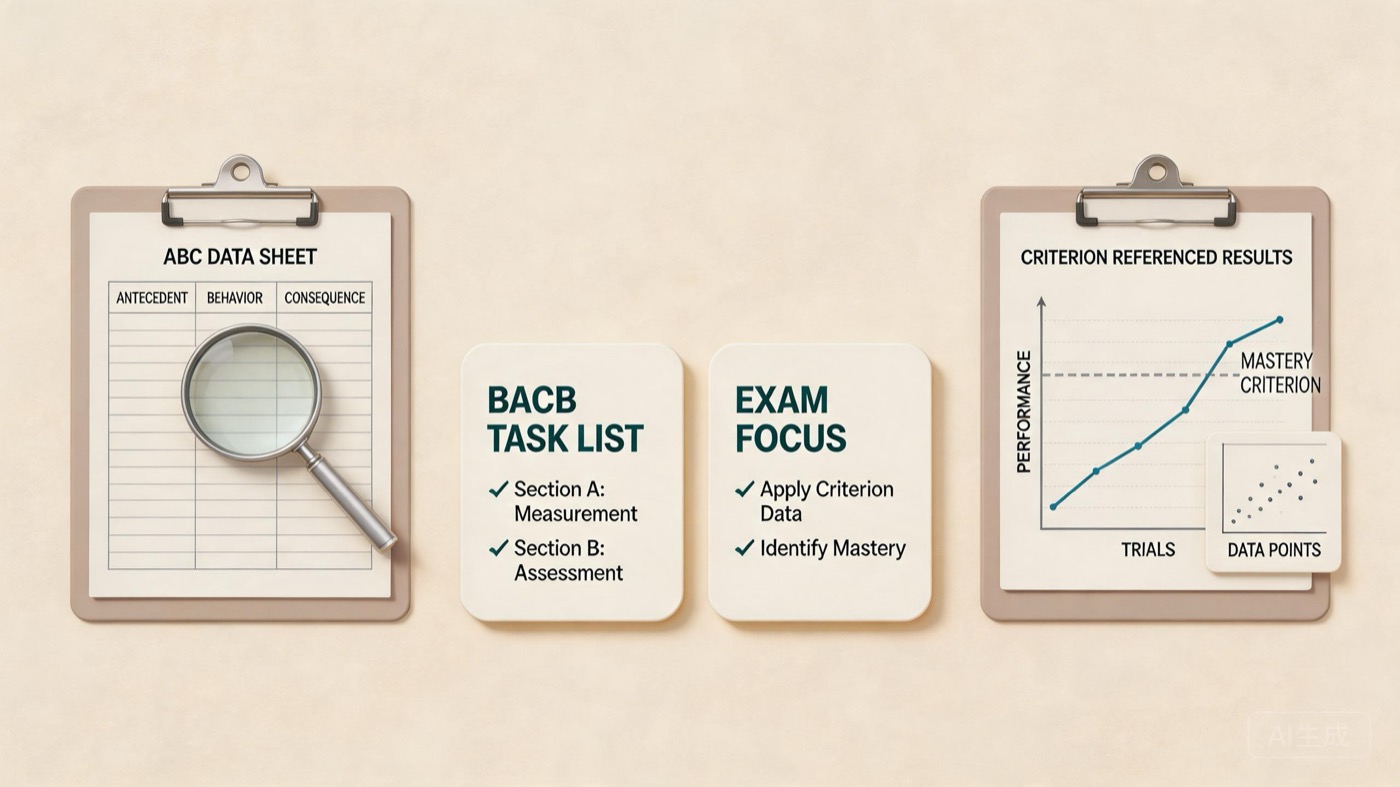
The BCBA exam tests your ability to apply measurement and assessment concepts. Criterion-referenced assessments are embedded in the BACB Task List under areas like “measurement” (Section A) and “assessment” (Section B). Understanding how to read and apply mastery criteria directly impacts your score.
Common Exam Questions on Criterion-Based Assessment
Typical questions ask you to identify the correct criterion from a scenario or evaluate whether data meet a given standard. For example:
- “A client has mastered a target when they perform the response independently in 4 out of 5 trials across two consecutive sessions. Which type of assessment is this?”
- “Given the following data, has the learner met the mastery criterion of 80% correct over three sessions?”
These items require careful reading and a solid grasp of measurement concepts. Review your BCBA exam prep guide for more practice.
Avoiding Traps: False Alternatives
Common mistakes include confusing criterion-referenced with norm-referenced tests or assuming mastery requires 100% accuracy. The BACB does not define a universal criterion; it is always context-specific. Also, watch for questions that describe a norm-referenced purpose but list a criterion-referenced term. Always match the assessment type to the decision being made.
- Trap 1 – Believing all mastery criteria are 100%. In fact, many use 80% or 90% depending on the skill.
- Trap 2 – Selecting “norm-referenced” when the scenario describes fixed standards. Look for words like “mastery” or “criterion.”
- Trap 3 – Misinterpreting consecutive sessions: Some criteria require consecutive sessions, others non-consecutive. Pay attention to wording.
Applied Examples of Criterion Based Tests in ABA
To master this concept, examine real-world examples. Each includes an ABC (Antecedent-Behavior-Consequence) format and hypothesized function.
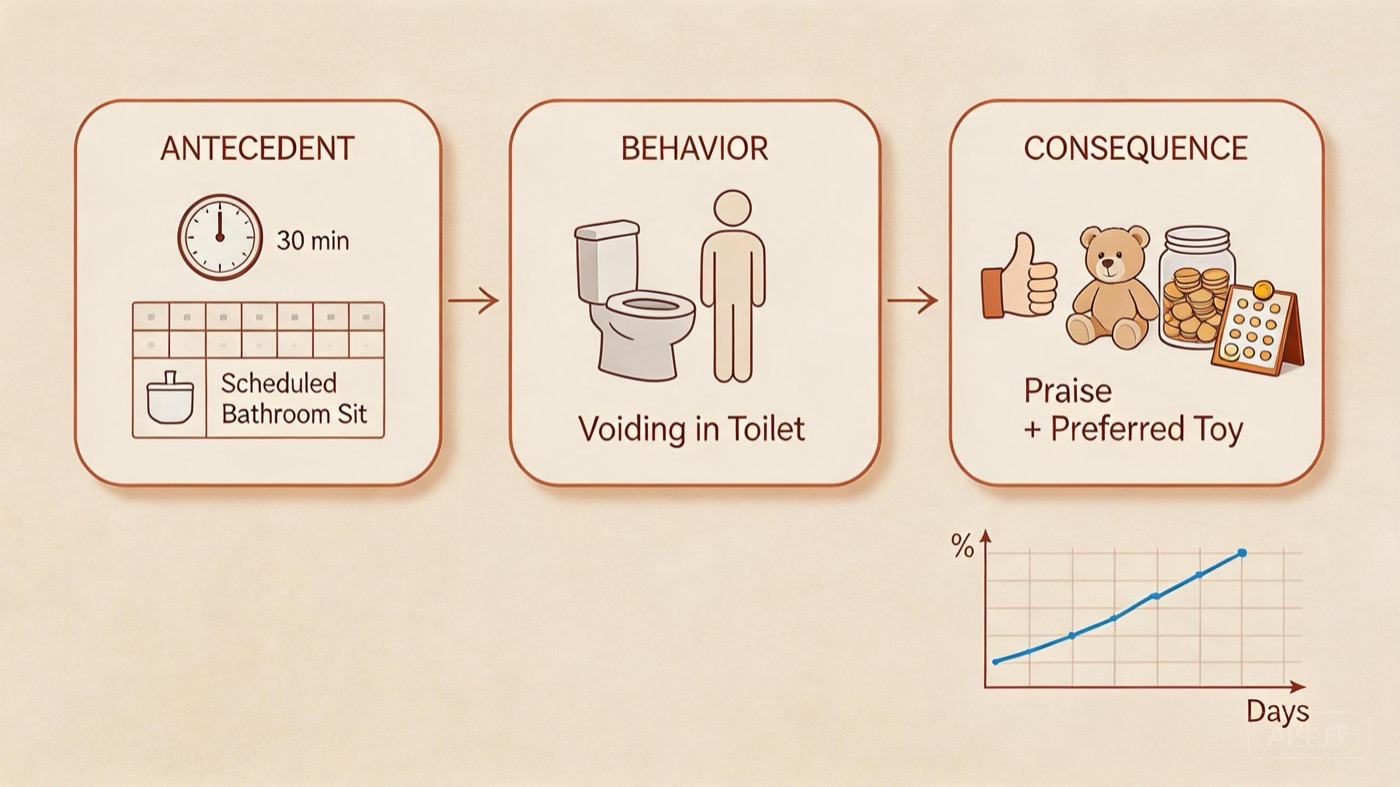
Example 1: Toilet Training Mastery Criterion
Antecedent: Scheduled bathroom sit every 30 minutes. Behavior: Voiding in toilet. Consequence: Praise and access to preferred toy. Criterion: 4 consecutive days with no accidents. Hypothesized function: Access to tangible/attention. This criterion ensures the skill is generalized before reducing prompts.
Example 2: Mand Training for a Child with Autism
Antecedent: Missing preferred item (e.g., iPad). Behavior: Vocal request “iPad”. Consequence: Item delivered. Criterion: 3 out of 5 trials across 2 different therapists. Hypothesized function: Access to item. Using multiple therapists ensures the mand is not under restricted stimulus control.
Example 3: Reducing Aggression Using DRA
Antecedent: Denied access to snack. Behavior: Hitting. Consequence: Escape from demand. Intervention: Differential Reinforcement of Alternative behavior (DRA) – request break. Criterion: 5 consecutive minutes without hitting. Hypothesized function: Escape. The criterion is time-based and emphasizes duration without target behavior.
Example 4: Intraverbal Fill-Ins
Antecedent: Teacher says “Ready, set…” Behavior: Child says “go.” Consequence: Praise and token. Criterion: 8 out of 10 trials correct across two consecutive sessions. Hypothesized function: Access to conditioned reinforcement (praise). This example shows a common percentage-based criterion used in verbal behavior programming.
Quick Checklist for Criterion Based Test Questions
When you encounter a criterion-based question on the exam, use this checklist to avoid errors:
- Identify the performance dimension (e.g., accuracy, frequency, duration).
- Check if the criterion specifies consecutive sessions or cumulative.
- Look for the number of trials or opportunities (e.g., 4 out of 5).
- Determine if the criterion is independent response or includes prompts.
- Match the criterion to the decision rule: mastery, maintenance, or phase change.
- Eliminate options that describe norm-referenced comparisons.
- Double-check 100% vs. lower thresholds – not all mastery is perfect.
- Consider the social validity of the criterion (e.g., is it meaningful for the learner?).
Summary: Criterion Based Tests and Your BCBA Exam
Mastering the criterion based test is crucial for BCBA candidates. Remember that it centers on fixed, individualized mastery standards, not comparisons to others. The exam will test your ability to interpret, apply, and distinguish such assessments. Use the examples and checklist above to reinforce your understanding. For additional practice, try free BCBA mock exam questions that include criterion-referenced scenarios. You can also consult the BACB website for official guidelines on assessment practices.



