
What Are ABA Principles?
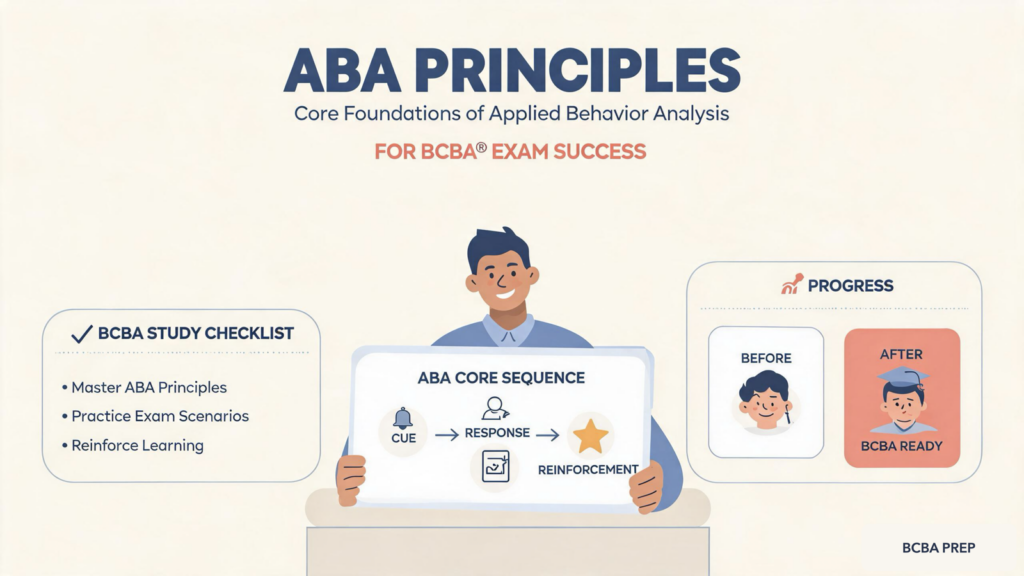
ABA principles form the backbone of applied behavior analysis, guiding how behavior change is conceptualized, measured, and implemented. These principles are not just theoretical concepts; they are practical tools used daily by BCBAs. At their core, ABA principles are grounded in the science of behavior, emphasizing that behavior is learned and influenced by environmental events.
Table of Contents
- What Are ABA Principles?
- Why Understanding ABA Principles Is Critical for the BCBA Exam
- Key ABA Principles with Worked Examples
- How to Apply ABA Principles in Real-World Settings
- Quick Checklist: Mastering ABA Principles for the Exam
- Summary: Your ABA Principles Study Blueprint
One essential framework for understanding ABA principles is the seven dimensions of ABA, introduced by Baer, Wolf, and Risley (1968). These dimensions ensure that interventions are meaningful and effective. They are:
- Applied – focuses on socially significant behaviors
- Behavioral – targets observable and measurable behavior
- Analytic – demonstrates experimental control over the behavior
- Technological – procedures are described clearly and replicably
- Conceptually Systematic – grounded in behavioral principles
- Effective – produces practical, meaningful outcomes
- Generality – behavior change lasts and transfers across settings
Memorizing the acronym ABATCEG (Applied, Behavioral, Analytic, Technological, Conceptually Systematic, Effective, Generality) is a common strategy. These dimensions differentiate ABA from generic behaviorism or other approaches that lack scientific rigor.
Why Understanding ABA Principles Is Critical for the BCBA Exam
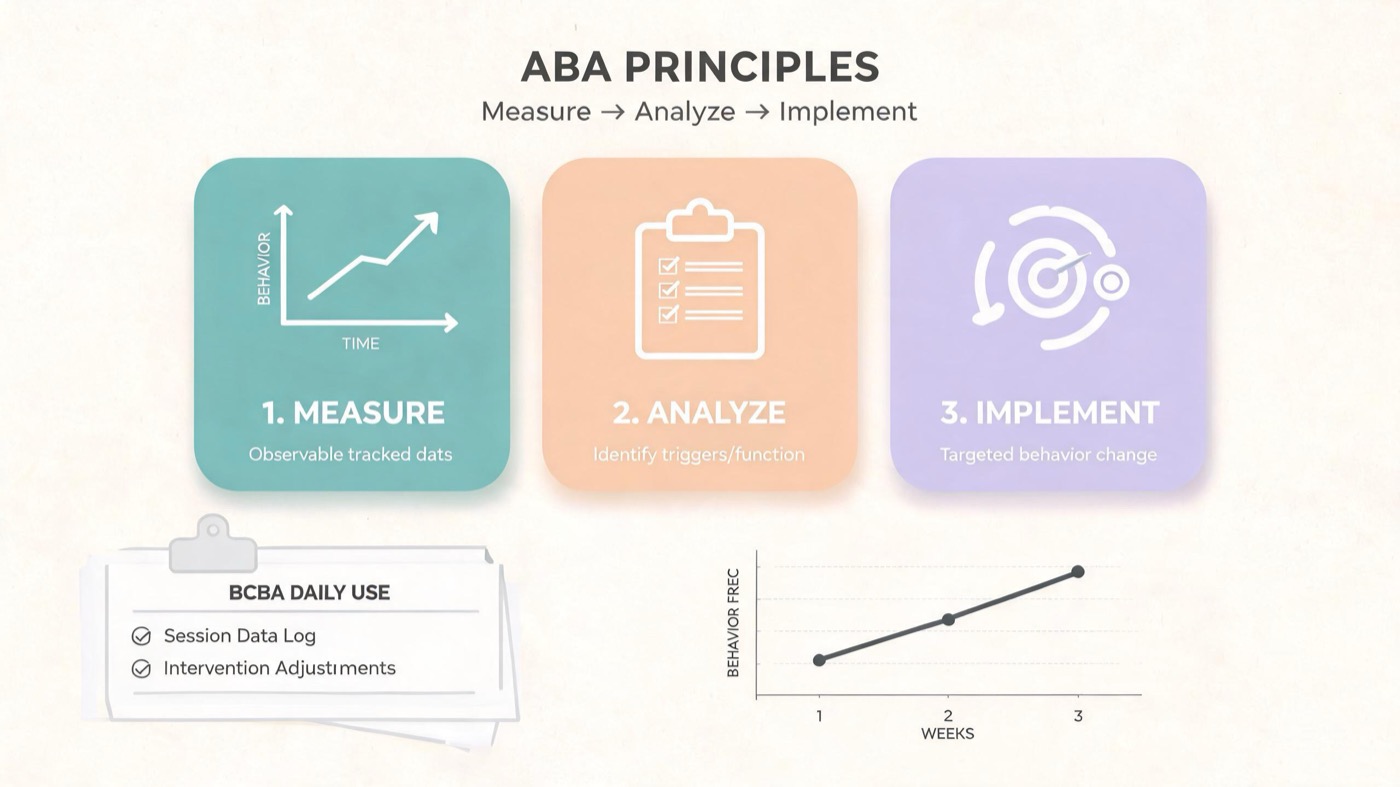
The BCBA exam heavily tests your ability to apply ABA principles in scenario-based questions. You may be asked to identify which dimension of ABA is violated in a given scenario, or to recognize the principle behind an intervention (e.g., positive reinforcement, extinction).
Exam Relevance
Expect questions that present a case and ask: “Which dimension of ABA is most reflected in this intervention?” or “What principle is being applied here?” The exam also tests your ability to distinguish between principles like negative reinforcement and punishment. Mastering these principles is not optional; it is essential for a passing score.
Common Exam Traps
- Confusing dimensions – e.g., thinking “effective” means the same as “applied”
- Overgeneralizing – applying a principle without considering the function of behavior
- Mixing up principles – e.g., confusing extinction with ignoring (extinction can be used without ignoring)
- Misidentifying reinforcement vs. punishment – remember: reinforcement increases behavior, punishment decreases it
One common trap is assuming that any removal of a stimulus is punishment. However, if the behavior increases, it is negative reinforcement. Pay careful attention to the behavior change.
Key ABA Principles with Worked Examples
Understanding principles through concrete examples solidifies your knowledge. Below are three classic examples using the ABC (Antecedent-Behavior-Consequence) framework and hypothesized functions.
Example 1: Positive Reinforcement
- Antecedent: Parent says “time for bed”
- Behavior: Child cries and protests
- Consequence: Parent reads an extra story
- Effect: Crying increases over time
- Hypothesized Function: Attention (parent provides attention by reading)
Example 2: Negative Reinforcement
- Antecedent: Teacher gives a difficult math worksheet
- Behavior: Student whines and complains
- Consequence: Teacher removes the worksheet
- Effect: Whining increases in future
- Hypothesized Function: Escape from demands
Example 3: Extinction
- Antecedent: Child sees a candy at the store
- Behavior: Child says “please” repeatedly
- Consequence: Parent previously bought candy (now ignores)
- Effect: Saying “please” gradually stops
- Hypothesized Function: Access to tangibles (extinguished)
Notice that extinction involves withholding the reinforcer that previously maintained the behavior. In this case, the parent no longer provides candy, so the behavior decreases.
How to Apply ABA Principles in Real-World Settings
Applying ABA principles across different settings is a key skill for the BCBA exam and professional practice. Here are examples in three common environments.
Applied in the Classroom
A teacher uses a token economy to increase on-task behavior. Students earn tokens for staying seated and completing work. Tokens are exchanged for preferred activities. This applies the principle of positive reinforcement and the dimension of effectiveness.
Applied in Home Settings
A parent uses differential reinforcement of alternative behavior (DRA) to increase compliance. When the child follows an instruction, the parent provides praise and a small reward. Noncompliance is ignored (extinction). This combines multiple principles: positive reinforcement and extinction.
Applied in Clinical Settings
A BCBA implements discrete trial teaching (DTT) to teach a new skill. Trials are structured with clear antecedents, prompts, and consequences. This reflects the dimensions of technological and conceptually systematic. DTT is grounded in principles of reinforcement and stimulus control.

Quick Checklist: Mastering ABA Principles for the Exam
Use this checklist to review key concepts before the exam. Each item targets a common area of difficulty.
Memorize the 7 Dimensions
- Use the acronym ABATCEG to recall each dimension
- Associate each dimension with a real-world example
- Practice identifying which dimension is missing in a flawed intervention
Practice ABC Analysis
- For each scenario, identify the antecedent, behavior, and consequence
- Determine whether the consequence is reinforcement or punishment
- Hypothesize the function (attention, escape, access, automatic)
Avoid Common Misconceptions
- Reinforcement ≠ reward – reinforcement is defined by its effect on behavior, not by whether it is pleasant
- Extinction ≠ ignoring – extinction requires withholding the specific reinforcer, which may not be attention
- Negative reinforcement is not punishment – negative reinforcement increases behavior by removing something aversive
Additional Exam Traps
- Be careful with automatic reinforcement – it is not socially mediated
- Remember that positive punishment involves adding something aversive, not removing something pleasant
- When asked about “generality,” ensure the behavior change lasts over time and appears in different settings
For more practice, check out our free BCBA mock exam questions to apply these principles.
Summary: Your ABA Principles Study Blueprint
Mastering ABA principles is a non-negotiable step for BCBA exam success. Start by memorizing the seven dimensions and their definitions. Then, practice breaking down scenarios using the ABC framework and identifying the principle at work. Be aware of common exam traps, such as confusing negative reinforcement with punishment. Finally, use the quick checklist to reinforce your knowledge before test day.
For a deeper dive, review the 7 dimensions of ABA exam guide and take our BCBA practice exam to test your understanding. The BACB also provides official resources on their website for further study. With consistent practice, you can confidently apply these principles and ace the exam.



