

What Are Effective Study Notes for the BCBA Exam?
Effective study notes for the BCBA exam go beyond simply copying definitions. They organize key ABA concepts in a way that boosts retention and helps you apply them to real-world scenarios. Study notes aba should include definitions, examples, and connections to the BCBA task list. When you craft notes with a clear structure, you create a mental framework that makes recalling information during the exam easier. The goal is to transform passive reading into active learning. Many students fail because they treat notes as a reference rather than a study tool. By actively engaging with your notes—through self-quizzing and spaced repetition—you strengthen neural pathways and improve long-term recall.
Table of Contents
- What Are Effective Study Notes for the BCBA Exam?
- How to Structure Your ABA Study Notes for Maximum Retention
- ABA Worked Examples for Your Study Notes
- Common Exam Traps When Studying with ABA Notes
- Quick Checklist for Your ABA Study Notes
- Summary: Study Notes ABA – Your Roadmap to BCBA Success
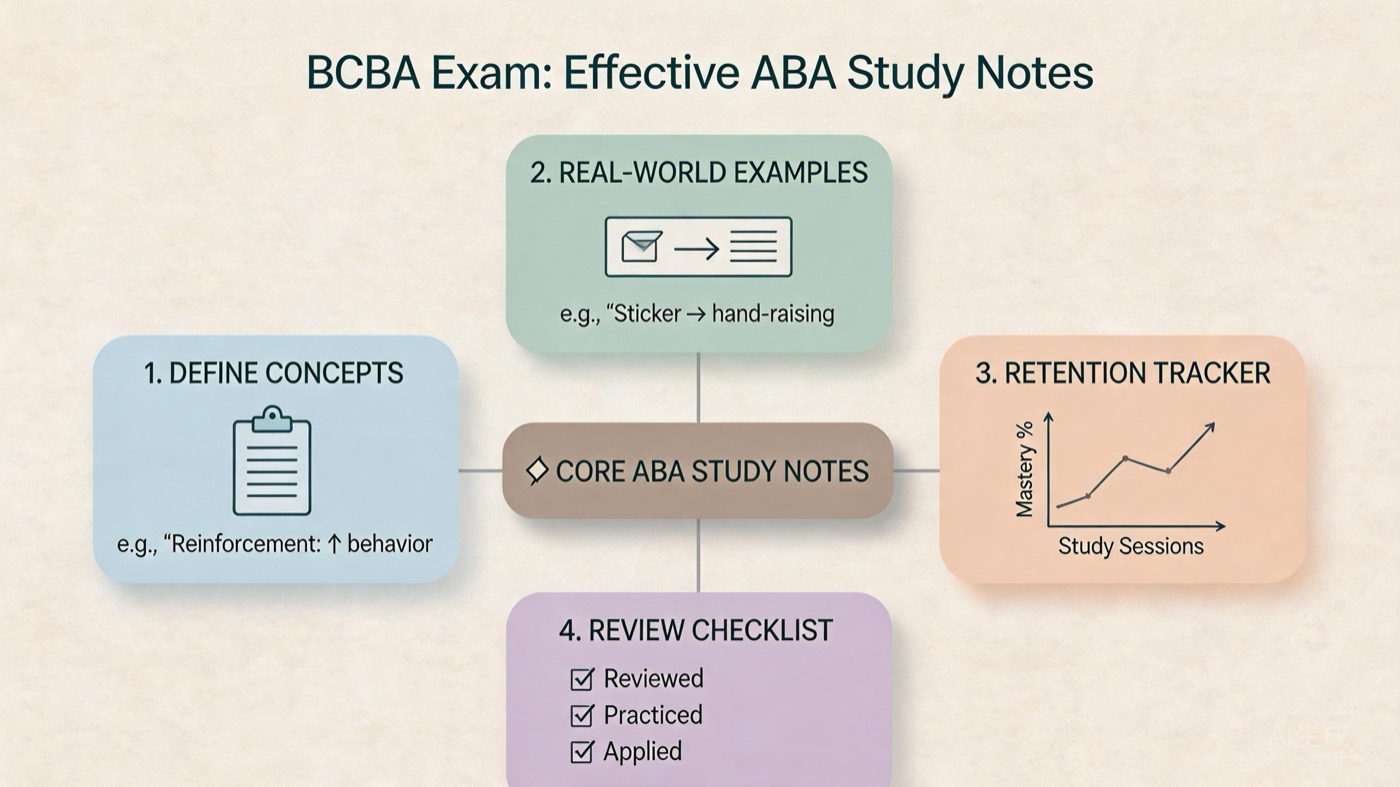
Key Elements of ABA-Focused Study Notes
To build effective notes, include these core components:
- Term and definition: Write the behavior-analytic term (e.g., reinforcement) and a concise definition.
- Everyday example: Provide a concrete scenario from applied settings that illustrates the concept.
- Exam tip: Note common variations or tricky details tested on the BCBA exam.
- Function or effect: For behavior principles, state the effect on behavior (increase or decrease) and function.
How to Structure Your ABA Study Notes for Maximum Retention
A consistent structure helps you quickly find and review information. Use a template that breaks each concept into digestible parts. This method aligns with the BACB task list and mirrors how exam questions are framed. For example, when studying differential reinforcement, your note could include definitions of DRA, DRO, DRI, and DRL, each with a brief scenario. This structural consistency allows your brain to create a mental map, making it easier to retrieve the correct term during the exam.
Template for ABA Study Notes
For each term, create a note card or document with these sections:
- Definition: One-sentence explanation in your own words.
- ABA Example: A specific, measurable scenario (e.g., ‘John completes a math problem, teacher gives praise, John’s problem-solving increases’).
- Function: Indicate the maintaining function (escape, attention, tangible, automatic).
- Exam Tip: Highlight common errors, such as confusing negative reinforcement with punishment.
Reviewing notes in this format trains your brain to recognize the pattern, which is critical for scenario-based BCBA questions. To deepen retention, try covering the term and recalling the entire note from memory before checking.
ABA Worked Examples for Your Study Notes
Applying concepts to real cases solidifies understanding. Below are four worked examples that you can use as templates for your own study notes aba. Each example includes both the original scenario and a brief analysis, helping you see how to extract key elements for your notes.
Example 1: Escape-Maintained Behavior
Scenario: A student throws a tantrum during math time. ABC analysis: Antecedent = teacher presents a math worksheet; Behavior = tantrum; Consequence = teacher removes the worksheet. Hypothesized function: Escape from the task. In your notes, write that the behavior is maintained by negative reinforcement (removal of aversive math task).
Example 2: Attention-Maintained Behavior
Scenario: A child screams while the mother is on the phone. ABC: Antecedent = mother is on phone; Behavior = screaming; Consequence = mother scolds the child. Function: Access to attention. Note that social positive reinforcement (attention) maintains the screaming.
Example 3: Automatic Reinforcement
Scenario: An individual flaps hands while alone. ABC: Antecedent = alone; Behavior = hand-flapping; Consequence = sensory stimulation. Function: Automatic (sensory) reinforcement. This is a good reminder that not all behaviors require social consequences.
Example 4: Tangible-Maintained Behavior
Scenario: A child whines when the parent refuses to buy a toy at the store. ABC: Antecedent = parent says no; Behavior = whining; Consequence = parent buys the toy to stop whining. Function: Access to tangibles. Note that the behavior is reinforced by positive reinforcement (obtaining the toy). Including this example in your notes helps distinguish tangible from attention functions.
Common Exam Traps When Studying with ABA Notes
Even strong note-takers fall into conceptual traps. Review these common mistakes to refine your study notes aba and avoid losing points on the exam. Being aware of these pitfalls early can save you from confusion during the test.
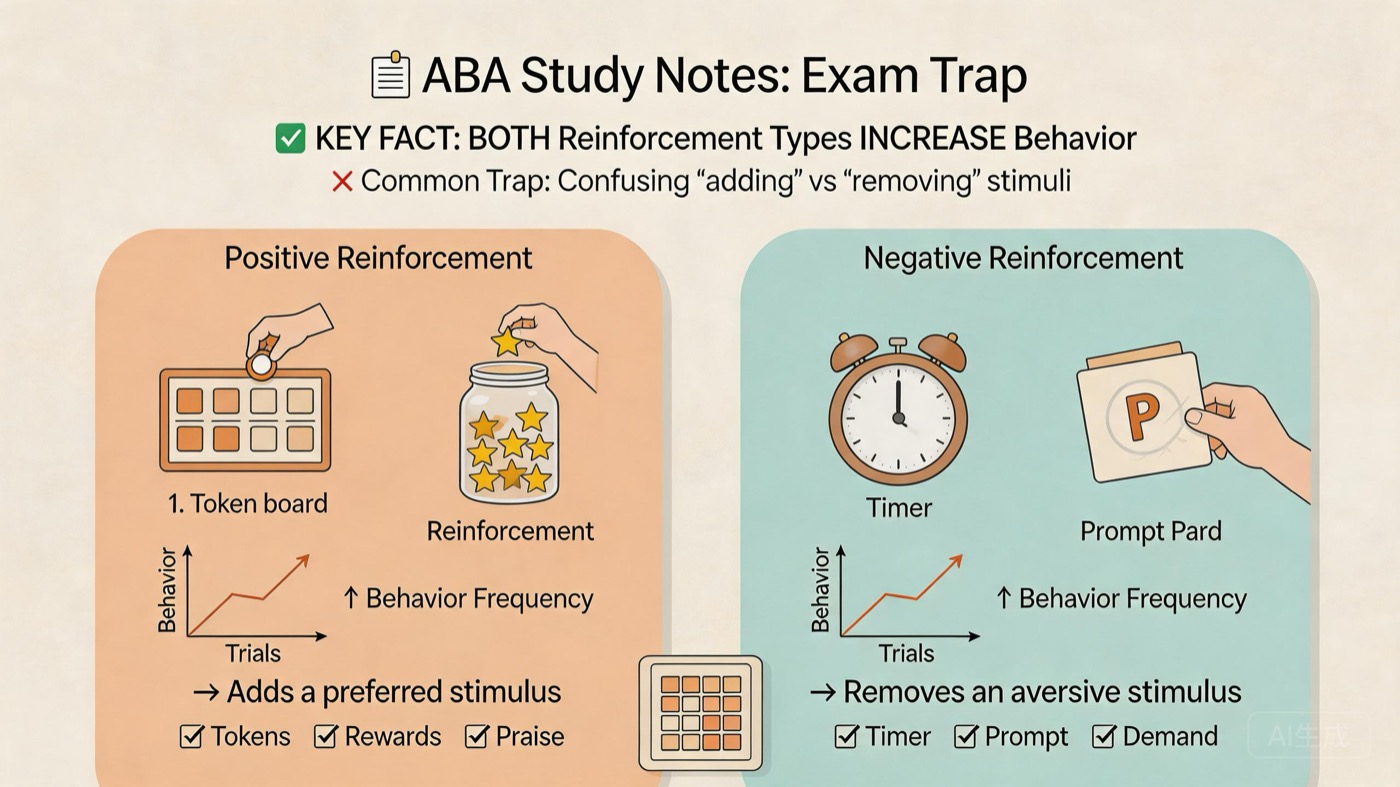
Trap 1: Confusing Positive and Negative Reinforcement
Both reinforcement types increase behavior, but positive reinforcement adds a stimulus, while negative reinforcement removes one. Example: removing a loud noise after a request is negative reinforcement, not punishment. Many students mistakenly think ‘negative’ means punishment. To avoid this trap, always ask: Does the consequence add or remove something? If it adds, it’s positive; if it removes, it’s negative.
Trap 2: Overlooking Motivating Operations
Motivating operations (MOs) alter the value of a reinforcer and the frequency of behavior. Example: Deprivation of attention increases the effectiveness of attention as a reinforcer. Always consider MOs when hypothesizing function; they can change how an antecedent affects behavior. For instance, a child who just ate lunch may not find a candy reinforcer effective, but a hungry child will.
Trap 3: Confusing Extinction with Punishment
Extinction involves withholding the maintaining reinforcer, while punishment involves adding an aversive or removing a positive stimulus. For example, ignoring a child’s tantrum (extinction) is not the same as time-out (punishment). In your notes, clearly differentiate these procedures because the exam often tests the distinction.
For more on avoiding these pitfalls, check out our guide on 4 functions of behavior.
Quick Checklist for Your ABA Study Notes
Before you finalize your notes, run through this checklist to ensure they are exam-ready. This checklist also serves as a quick review before practice tests:
- Define each term in your own words without copying the textbook.
- Include at least one concrete ABA example per concept.
- Identify the behavior function for every example (escape, attention, tangible, automatic).
- Add an exam tip that addresses a common misinterpretation.
- Connect notes to the BCBA task list to ensure coverage of all domains.
- Use active recall: Cover the term and try to recall the definition and example.
- Review notes in spaced intervals: Revisit them after 1 day, 3 days, and 1 week to enhance long-term memory.
Summary: Study Notes ABA – Your Roadmap to BCBA Success
Effective study notes aba are more than summaries; they are active learning tools. By structuring notes with definitions, examples, functions, and exam tips, you build a mental map of ABA principles. Reviewing worked examples helps you apply concepts flexibly, and avoiding common traps keeps your knowledge accurate. Start implementing these strategies today to boost your BCBA exam preparation. For additional resources, explore our BCBA exam prep guide.



