
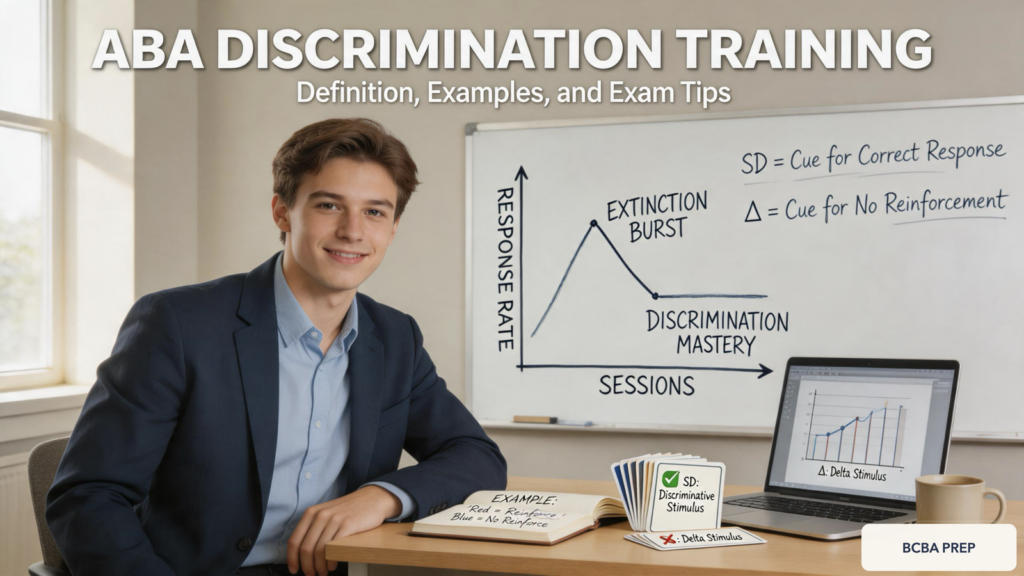
What Is Discrimination Training in ABA?
ABA discrimination training is a procedure that teaches a learner to respond differently to two or more stimuli. The goal is to establish stimulus control: a behavior occurs reliably in the presence of one stimulus (the discriminative stimulus, or SD) but not in the presence of another (the S-Delta). This process relies on differential reinforcement—reinforcing the behavior when the SD is present and withholding reinforcement when the S-Delta is present. Discrimination training is a cornerstone of applied behavior analysis, appearing in everything from early intervention programs for children with autism to organizational behavior management. By learning to discriminate, individuals become more efficient in their environment, responding only when it is likely to be reinforced.
Table of Contents
- What Is Discrimination Training in ABA?
- ABA Discrimination Training Examples with ABC Analysis
- Why Discrimination Training Matters for the BCBA Exam
- Summary: Key Takeaways for the BCBA Exam
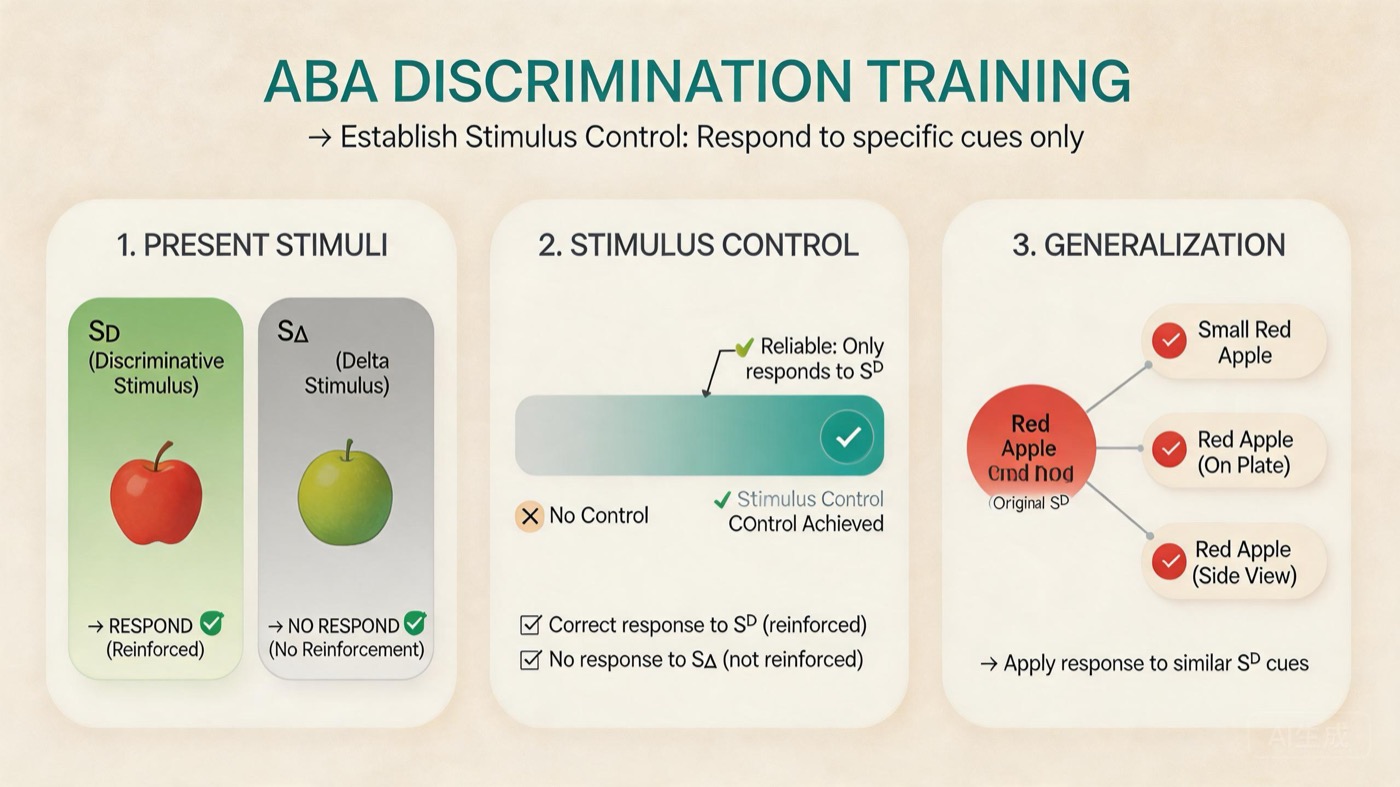
Discriminative Stimulus (SD) vs. S-Delta
The discriminative stimulus (SD) signals that reinforcement is available for a specific behavior. In contrast, the S-Delta signals that reinforcement is not available for that behavior. For example, a green traffic light (SD) signals that pressing the gas pedal will move the car forward; a red light (S-Delta) signals that pressing the gas will not produce forward movement (and may produce a ticket). Over time, the driver learns to press the gas only in the presence of the green light—this is discrimination.
- SD: Antecedent that evokes a behavior due to a history of reinforcement.
- S-Delta: Antecedent that suppresses a behavior due to a history of extinction or non-reinforcement.
- Differential reinforcement is the key mechanism that creates discrimination.
It is important to note that the same stimulus can function as an SD in one context and an S-Delta in another, depending on the behavior and the reinforcement history. For instance, a phone ringing might be an SD for answering if it usually leads to a conversation, but an S-Delta for answering if it leads to a sales pitch. Understanding this flexibility is critical for BCBA exam questions that ask you to identify the current function of a stimulus.
ABA Discrimination Training Examples with ABC Analysis
Here are two practical examples of discrimination training, broken into antecedent (A), behavior (B), and consequence (C).
Example 1: Requesting a Snack with Caregiver Present
A child learns to request a snack only when a caregiver is present. The caregiver’s presence is the SD; the caregiver’s absence is the S-Delta.
- Antecedent: Caregiver present (SD) vs. caregiver absent (S-Delta).
- Behavior: Child says ‘snack’.
- Consequence: When caregiver is present, the child receives the snack (reinforcement). When caregiver is absent, no snack is given (extinction).
- Hypothesized function: Tangible (access to snack).
Over time, the child says ‘snack’ almost exclusively when the caregiver is nearby, demonstrating discrimination.
Example 2: Following a ‘Sit’ Command (Dog Training Analogy)
A dog learns to sit only when given the verbal cue ‘sit’.
- Antecedent: Trainer says ‘sit’ (SD) vs. ‘lie down’ (S-Delta).
- Behavior: Dog sits.
- Consequence: A treat is delivered after ‘sit’ but not after ‘lie down’ (differential reinforcement).
- Hypothesized function: Social positive reinforcement (access to treat).
This analogy illustrates how discrimination training applies across species and settings.
Example 3: Teaching a Child to Identify Colors
Consider teaching a child to point to a red car when asked, “Which one is red?” A red car serves as the SD for pointing, while a blue car (S-Delta) does not. The therapist reinforces pointing only to the red car and provides no reinforcement for pointing to any other color. Over trials, the child reliably points to red when asked, showing stimulus control. This example highlights how discrimination training is used in discrete trial teaching, a common method in ABA programs.
Why Discrimination Training Matters for the BCBA Exam
Discrimination training appears frequently on the BCBA exam under Task List items B-10 (discrimination training) and B-11 (stimulus control). Understanding this concept helps you answer questions about teaching learners to differentiate stimuli, reducing prompt dependency, and designing effective interventions. Moreover, exam items often present a scenario and ask you to identify the SD or S-Delta, or to determine if discrimination training is being implemented correctly. Being able to spot differential reinforcement is key.
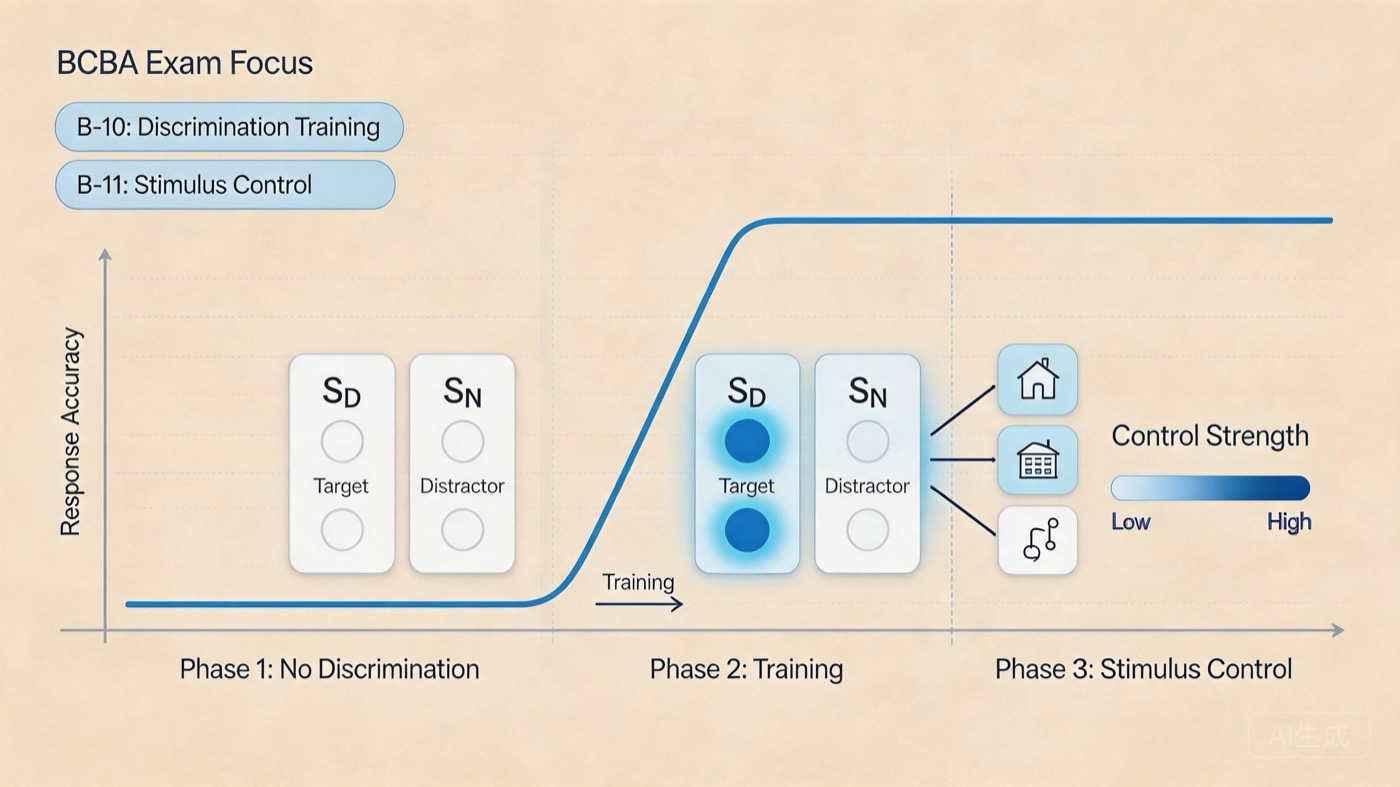
Exam Relevance and Common Traps
Common exam traps include confusing discrimination with generalization, forgetting that discrimination can be taught via errorless procedures, and overlooking the role of conditional discriminations (e.g., matching-to-sample). To avoid these pitfalls, focus on the core elements: SD, S-Delta, and differential reinforcement.
- Confusing generalization vs. discrimination: Generalization occurs when a behavior occurs across multiple stimuli; discrimination restricts it to a specific stimulus.
- Overlooking errorless discrimination training: This approach uses prompts to ensure correct responses from the start, then fades prompts gradually.
- Forgetting the role of conditional discriminations: These involve multiple SDs that depend on the context (e.g., matching colors in a sorting task). Another trap is misidentifying the S-Delta when multiple stimuli are present; for example, in a group setting, the teacher’s voice may be the SD for raising a hand, while other students’ voices are S-Deltas.
Quick Checklist for Discrimination Training
Use this checklist when designing or evaluating a discrimination training procedure:
- Identify the SD and S-Delta clearly.
- Ensure differential reinforcement is in place: reinforce only in the presence of the SD.
- Probe for stimulus control by testing in novel settings or with new stimuli.
- Avoid prompt dependency by fading prompts systematically.
- Plan for generalization across settings, people, and materials after discrimination is mastered.
Mastering discrimination training will boost your exam score and your clinical skills. Many intervention plans rely on building discriminations, especially when teaching academic skills, social skills, and safety skills. For instance, teaching a child to cross the street only when the crosswalk signal is white requires discrimination training.
Summary: Key Takeaways for the BCBA Exam
ABA discrimination training is a fundamental skill that establishes stimulus control. Remember: an SD signals reinforcement is available; an S-Delta signals it is not. Differential reinforcement is the engine of discrimination. For the BCBA exam, focus on identifying the SD and S-Delta in scenarios, understanding the difference between discrimination and generalization, and applying ethical and effective teaching strategies. Review related concepts like stimulus generalization and errorless learning to deepen your understanding. For the latest on the BACB task list, visit the BACB website. Keep practicing with mock exam questions that ask you to identify components of discrimination training—repetition will solidify your knowledge.
Next step for BCBA exam prep
Turn this topic into exam-day practice
Use this topic as a focused review, then test it in exam-style conditions with a free mock before deciding whether five full-length mocks are the right next step.
Start the Free BCBA Mock ExamContinue with Five Full-Length Mocks — $99
Review the included materials and access details before ordering. No pass guarantee is implied.



