
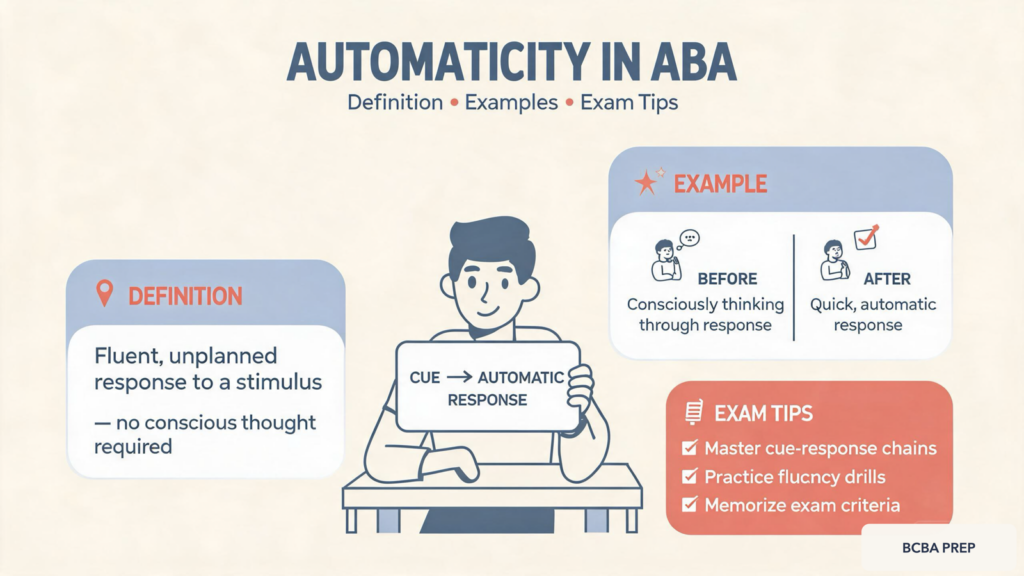
What Is Automaticity in Applied Behavior Analysis?
In everyday language, automaticity means doing something without thinking. But in applied behavior analysis, the definition automaticity refers to a behavior that occurs without conscious deliberation, often because it has been practiced so extensively that it no longer requires attention. This property is observable in both respondent and operant behavior. For example, a driver shifts gears effortlessly after years of practice, and a child with autism may engage in stereotypy automatically because the sensory consequence is reinforcing.
Table of Contents
- What Is Automaticity in Applied Behavior Analysis?
- Why Automaticity Matters on the BCBA Exam
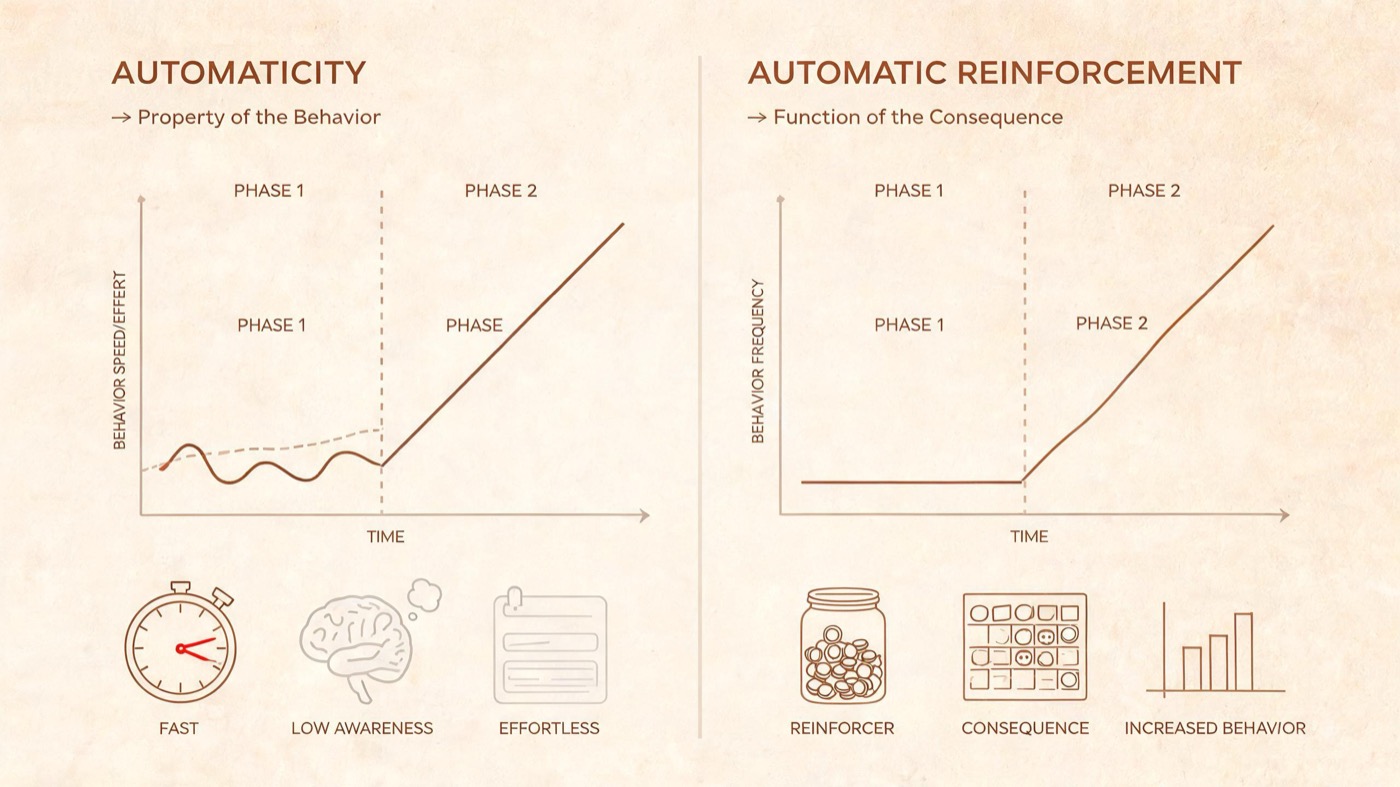
- Automaticity vs. Automatic Reinforcement: Key Distinctions
- Quick Checklist: Is the Behavior Automatic?
- Summary and Exam Tips
- References
From a behavioral perspective, automaticity is not a mental state but a characteristic of the behavior itself. It develops through a history of reinforcement: the behavior has been directly reinforced in the past, or it produces automatic reinforcement independent of the social environment. On the BCBA exam, you may be asked to identify whether a behavior is automatic based on its antecedents and consequences.
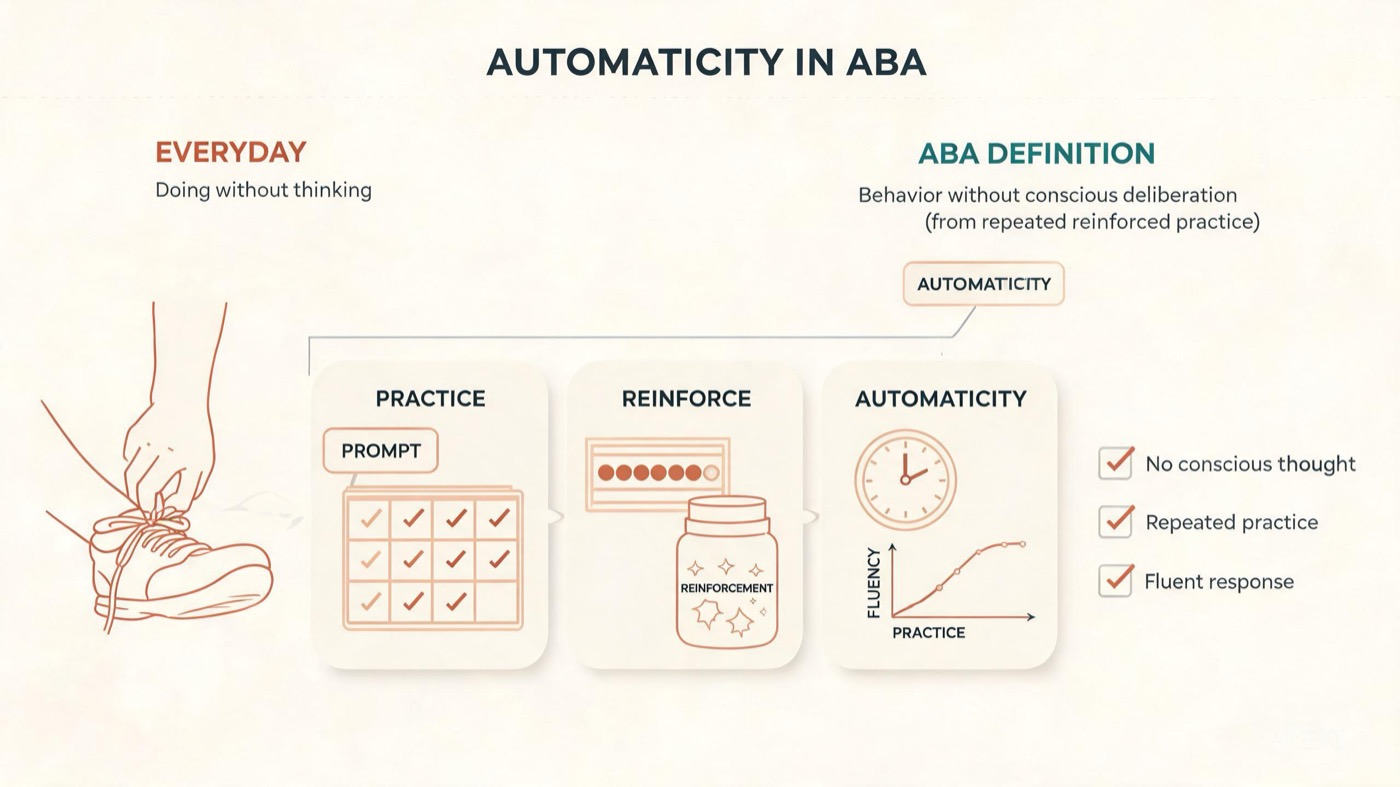
The Behavioral Definition of Automaticity
Operationally, automaticity means the behavior occurs with minimal involvement of mediating verbal or cognitive processes. The three hallmarks are: (1) the behavior is fast and efficient, (2) it occurs without apparent effort, and (3) it is resistant to disruption. In ABA, we focus on the environmental variables that establish and maintain the behavior, not on internal states. A behavior can become automatic through continuous reinforcement followed by intermittent reinforcement, or through repeated pairing with a reinforcer.
Why Automaticity Matters on the BCBA Exam
The BCBA exam tests your ability to analyze behavior in terms of function. Automaticity is relevant because it often involves automatic reinforcement — a function where the consequence is produced directly by the behavior itself. You may encounter questions where you must determine if the function is social positive, social negative, automatic positive, or automatic negative. Understanding automaticity helps you differentiate between these functions.
Exam-Relevant Examples of Automaticity
Here are three worked examples with ABC analysis to help you recognize automaticity on the exam.
- Example 1: Seatbelt buckling. Antecedent: car door opens and driver sits down. Behavior: fastens seatbelt. Consequence: no aversive alarm. Hypothesized function: automatic negative reinforcement (avoidance of the alarm). The behavior occurs automatically because the driver has a long history of reinforcement (no beeping).
- Example 2: Hand-flapping while alone. Antecedent: no demands, child is alone. Behavior: hand-flapping. Consequence: sensory stimulation. Hypothesized function: automatic positive reinforcement (sensory). No social mediation is required.
- Example 3: Therapist data recording. Antecedent: end of a trial. Behavior: therapist records data on a board without looking. Consequence: efficient completion of recording task. Hypothesized function: automatic negative reinforcement (completing the task reduces the aversiveness of unfinished work) and past direct reinforcement for accuracy.
Common Traps When Answering Questions About Automaticity
Many candidates confuse automaticity with automatic reinforcement. Remember: automaticity describes how effortlessly a behavior occurs; automatic reinforcement is a function where the reinforcer is produced by the behavior itself. Another trap is assuming that automatic behaviors are always respondent (reflexive). In fact, many automatic behaviors are operant, maintained by their sensory consequences. Finally, avoid forgetting that automaticity develops through practice and a history of reinforcement — it is not innate.
Automaticity vs. Automatic Reinforcement: Key Distinctions
This distinction is one of the most common sources of confusion. Automaticity is a property of the behavior: it occurs quickly, effortlessly, and with little awareness. Automatic reinforcement is a function of the consequence: the behavior produces its own reinforcer independent of the social environment. For example, a child who hums to himself while working is engaging in an automatic behavior that is maintained by automatic reinforcement (the sound is pleasing). But a habit like nail-biting may also be automatic, even if its function is automatic negative reinforcement (reducing anxiety). Use this comparison to stay clear.
- Automaticity = how the behavior is performed (fluent, unconscious)
- Automatic reinforcement = why the behavior occurs (function: sensory, escape from internal stimuli)
- A behavior can be automatic but maintained by social reinforcement (e.g., greeting a friend without thinking)
- A behavior can be non-automatic but maintained by automatic reinforcement (e.g., first time engaging in a sensory behavior)
Quick Checklist: Is the Behavior Automatic?
Use this checklist when you encounter a scenario on the BCBA exam. If most answers are yes, the behavior likely demonstrates automaticity.
- Does the behavior occur without prompting or deliberation?
- Is the response fast and efficient?
- Has the person practiced the behavior many times?
- Does the person appear to engage in the behavior while doing something else?
- Is the consequence not socially mediated (i.e., it does not require another person)?
- Would disrupting the behavior require significant effort?
Summary and Exam Tips
Automaticity is a core concept that appears on the BCBA exam in questions about function, reinforcement, and behavior maintenance. Remember that automatic behaviors are not inherently respondent; they can be operant and maintained by automatic reinforcement. Practice identifying functions using the ABC format, and watch out for traps that conflate automaticity with automatic reinforcement.
To solidify your understanding, review additional resources on automatic reinforcement and the four functions of behavior. For a deeper dive into behavior analysis as a science, see the goals of behavior analysis. Outbound resources include the BACB Task List and peer-reviewed articles on behavioral automaticity.
References
Next step for BCBA exam prep
Turn this topic into exam-day practice
Use this topic as a focused review, then test it in exam-style conditions with a free mock before deciding whether five full-length mocks are the right next step.
Start the Free BCBA Mock ExamContinue with Five Full-Length Mocks — $99
Review the included materials and access details before ordering. No pass guarantee is implied.



