
PDC-HS ABA is a performance-analysis topic, not a label for a learner or employee. This guide explains what the Performance Diagnostic Checklist–Human Services is designed to examine, how its four domains guide the next question, and how to keep the process respectful and evidence-based.
Table of Contents
- PDC-HS ABA: What the Checklist Is Designed to Assess
- The Four PDC-HS Domains: Turn a “No” Into the Next Question
- How PDC-HS Reasoning Fits an ABA Workflow
- PDC-HS ABA Vignette: From a “No” Response to a Better Question
- Culture, Dignity, Ethics, and Exam Boundaries
- Common PDC-HS Mistakes to Avoid
- Turn PDC-HS Concepts Into BCBA Exam Practice
- Frequently Asked Questions
- Sources and Verification Notes
- Quick Review Checklist
- Take the Free BCBA Mock Exam
The phrase pdc-hs aba usually points to the Performance Diagnostic Checklist–Human Services in a behavior-analysis or BCBA study context. The tool explores environmental variables that may be related to an employee’s performance concern in a human-service setting. It asks what may be affecting task performance; it does not label a person as lazy, unqualified, or the sole cause of a service problem. This is a study and application explainer, not an official BACB form, employment policy, client diagnosis, or substitute for current instrument materials and supervision. Check administration and scoring against current primary sources.
PDC-HS ABA: What the Checklist Is Designed to Assess
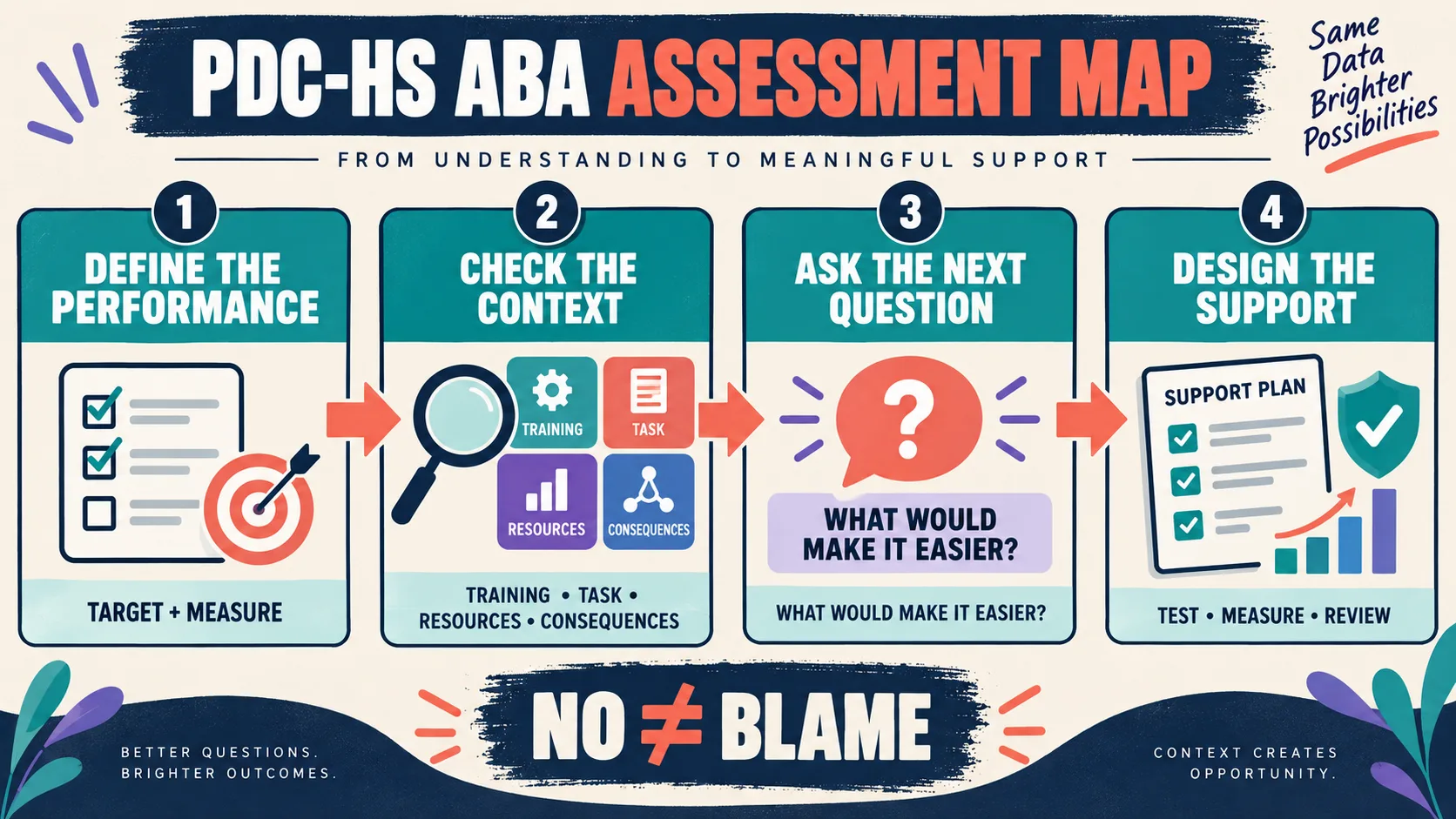
The PDC-HS adapts performance-diagnostic thinking to human-service environments such as clinics, schools, and residential programs. It is commonly described as an indirect, informant-based assessment with a small direct-observation component. Questions are organized across four domains and tied to a specific work task and performance concern.
The practical question is not “What is wrong with this employee?” It is “What conditions make the target task more or less likely to occur correctly, consistently, and efficiently?” That shift changes the assessment from blame to analysis. It can reveal missing training, ambiguous instructions, missing materials, unnecessary effort, or absent feedback.
PDC-HS is also not the same as a functional behavior assessment for a client. An FBA is designed to analyze a learner’s behavior in relation to antecedents, consequences, and other relevant variables. PDC-HS focuses on work performance in a human-service system. The two may use related behavior-analytic reasoning, but they answer different questions and should not be casually substituted for one another.
For BCBA exam purposes, remember the boundary: the instrument helps identify possible environmental variables and intervention directions. It does not make a final employment decision, establish a clinical diagnosis, or guarantee that a suggested intervention will work. The data still need to be interpreted, an appropriate change needs to be selected, and performance needs to be monitored.
The Four PDC-HS Domains: Turn a “No” Into the Next Question
Research descriptions commonly organize the PDC-HS into four domains and 20 questions. A response that suggests a potential barrier should be treated as a prompt for follow-up, not as a verdict. The table below is a study map, not a replacement for the authorized assessment.
| Domain | What it asks you to examine | A productive next question | Boundary to remember |
|---|---|---|---|
| Training | Whether the employee received relevant instruction and has demonstrated the task accurately. | Was the task taught with clear examples, practice, feedback, and a chance to demonstrate competence? | A current error does not prove that training was adequate or inadequate; check records and present performance. |
| Task clarification and prompting | Whether the expected behavior, timing, location, and available prompts are clear. | Could a job aid, checklist, reminder, or clearer task location make the next correct response obvious? | A reminder is support, not evidence that a person lacks motivation or ability. |
| Resources, materials, and processes | Whether the materials, staffing, access, and workflow allow the task to be completed as described. | Are the data sheet, teaching materials, technology, time, and handoff process available when the task occurs? | Do not ask an employee to compensate indefinitely for a broken process or missing resource. |
| Performance consequences, effort, and competition | Whether feedback, outcomes, response effort, competing tasks, and programmed consequences support the target performance. | What happens after accurate performance, and how hard is the task compared with competing priorities? | “No feedback” or high effort is a system clue, not proof of poor character. |
One scoring caution is especially useful for exam questions: not every item is interpreted by mechanically applying the same “No equals problem” rule. The corrected PDC-HS literature explains that some items were worded in the opposite direction in earlier materials. When a question asks about scoring, use the current authorized version and read the item wording carefully rather than relying on a slogan.
How PDC-HS Reasoning Fits an ABA Workflow
A practical workflow begins by defining one observable work performance. “Staff quality is low” is too broad. “The RBT records trial-by-trial data within five minutes of the session ending” is more useful because the behavior, context, and measure are clearer. Then identify reliable informants, review existing records, and decide which claims require direct observation.
Next, examine the four domains without jumping to an intervention. If training is the likely barrier, the next step may involve behavioral skills training, practice, and feedback. If task clarification is the issue, a checklist or prompt may be more appropriate. If materials or process are the issue, moving supplies or fixing a handoff may matter more than another training meeting. If consequences, effort, or competition are involved, feedback, supervisor presence, reinforcement for accurate performance, or task redesign may be considered.
After a change is selected, use a measure that can show whether the problem is improving, such as the percentage of sessions with complete data records, latency to submit the note, or procedural-integrity steps completed. Keep it connected to the target task; a general impression that “things feel better” is less useful than a repeated operational measure.
Finally, review side effects and context. A faster record may be less accurate. A new prompt may improve one task while interrupting another. A performance plan that ignores language access, disability, workload, transportation, scheduling, or cultural expectations may identify the wrong variable. PDC-HS reasoning is strongest when it produces a testable, respectful question about the environment.
PDC-HS ABA Vignette: From a “No” Response to a Better Question
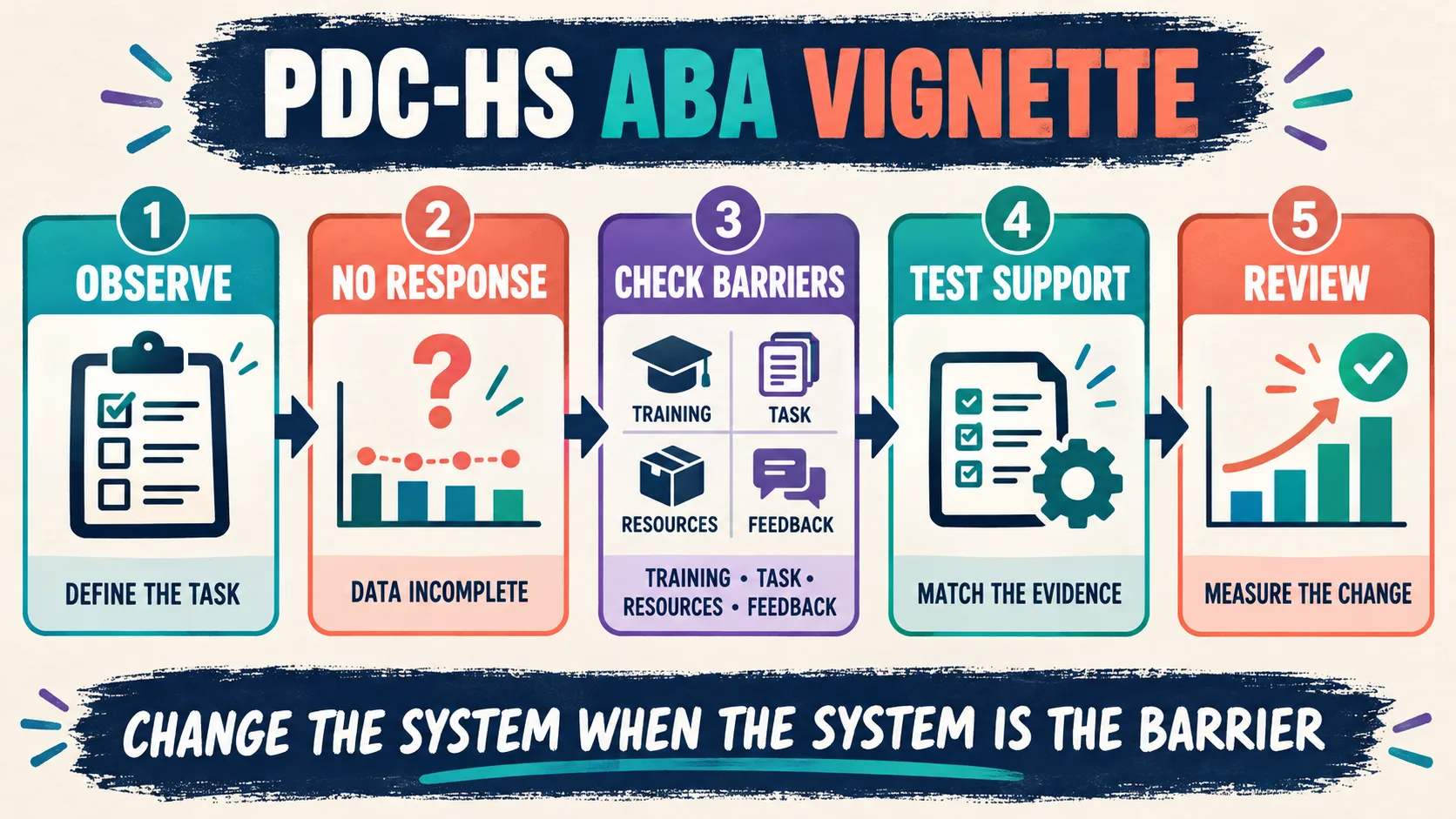
Imagine that a clinic supervisor reports that an RBT often submits incomplete skill-acquisition data. The first reaction might be to schedule remedial training. PDC-HS reasoning slows the decision down. The supervisor defines the task: enter the required data before leaving the client’s session area, then submit the record through the clinic system before the end of the shift.
- Check training. Has the RBT been shown the current data form and practiced the exact entry sequence? Can the RBT demonstrate the task with a sample session?
- Check task clarification and prompting. Are the required fields clearly marked? Is the expectation “before leaving,” “before the end of the shift,” or something else? Is there a usable reminder at the point of performance?
- Check resources and processes. Is the tablet charged? Does the system remain available in the session area? Are materials or session notes delayed by a handoff?
- Check consequences, effort, and competition. Does accurate entry receive timely feedback? Does the final step require a long login while the next client is waiting? Are other end-of-session duties competing with data entry?
- Test one focused support and monitor. Choose a support that matches the evidence, such as a shorter data-entry sequence, a visible job aid, or feedback on complete records. Then measure the target performance again.
Notice what this vignette does not claim. It does not say that the RBT is careless. It does not say that a “No” response proves a single cause. It does not turn a checklist into a disciplinary decision. It uses the assessment to decide what to inspect next and what support might be worth testing.
Culture, Dignity, Ethics, and Exam Boundaries
Performance analysis happens inside a power relationship. A supervisor may control training, scheduling, feedback, access to materials, and the consequences of reporting a barrier. Ask whether the worker can safely report unclear instructions or missing resources. Offer language access and reasonable accommodations when needed, and separate identity, accent, disability, or cultural style from the observable work requirement.
Confidentiality also matters. A study page should not invite readers to publish names, client details, employee records, or identifiable incident narratives. In practice, share only the information necessary for the responsible team to analyze the task and protect the people receiving services. Check the current BACB ethics requirements and applicable employer, privacy, and state rules rather than relying on an old checklist or a social-media summary.
For an exam question, the safest sequence is: define the performance, identify the possible environmental variable, choose a matched intervention direction, monitor the result, and protect dignity and confidentiality. If the stem describes a client’s challenging behavior, pause and ask whether the problem is actually a client behavior targeted by an FBA or an employee performance concern suited to PDC-HS reasoning.
Common PDC-HS Mistakes to Avoid
- Confusing tool and target. PDC-HS examines work performance in a human-service setting; it is not a personality test or a learner assessment.
- Using a vague target. “Bad implementation” cannot guide a useful question until the task, context, and measure are defined.
- Starting with training every time. Training is one domain. Missing materials, unclear prompts, effort, competing duties, or weak feedback may be more relevant.
- Treating a response as a verdict. A potential barrier indicates what to investigate and what support to test; it does not establish blame.
- Ignoring corrected item wording. Read the current version and its scoring guidance, especially when a question reverses the usual direction.
- Skipping measurement after the intervention. A plan without a target measure cannot tell you whether the selected support helped or created a new problem.
Turn PDC-HS Concepts Into BCBA Exam Practice
Use the Free BCBA Mock Exam to practice distinguishing performance analysis from FBA, client assessment, and general supervision questions. For each missed item, write down the target performance, the domain that best matches the evidence, the intervention direction, and the measure you would use to review the change.
Then explain why the other domains were less supported. That last step prevents a common error: choosing an intervention because it sounds helpful rather than because the assessment evidence points toward it. Keep the answer tied to the facts in the stem, and remember that a graph, score, or checklist is evidence for reasoning—not a substitute for the full context.
Frequently Asked Questions
What does PDC-HS stand for in ABA?: PDC-HS stands for Performance Diagnostic Checklist–Human Services. In ABA and organizational behavior-management contexts, it is used to examine environmental variables that may be related to employee performance concerns in human-service settings.
What are the four PDC-HS domains?: The commonly described domains are training; task clarification and prompting; resources, materials, and processes; and performance consequences, effort, and competition. Use the current authorized version for exact items and scoring guidance.
Is PDC-HS the same as an FBA?: No. PDC-HS focuses on human-service work performance, while an FBA is used to analyze a learner’s behavior and its relevant variables. They may share behavior-analytic concepts, but they have different targets and purposes.
Does a “No” response prove that an employee needs training?: No. A potential barrier should lead to a better follow-up question. It may point to training, unclear expectations, missing resources, effort, competing tasks, feedback, or another environmental variable. Match the next step to the evidence.
Sources and Verification Notes
For current professional requirements, review the BACB Ethics Codes, the BCBA Test Content Outline, and the BCBA Handbook. For primary PDC-HS guidance, see the peer-reviewed assessment-administration guidance, the administration study, and the corrected scoring context. This page is an educational guide, not an official BACB instrument or individualized employment or clinical advice.
Bottom line: PDC-HS ABA is most useful when it turns a vague performance concern into a specific, respectful question about training, task clarity, resources, or consequences. Define the task, inspect the environment, match the support to the evidence, measure the result, and keep the person’s dignity in view.
Quick Review Checklist
Use this final checklist to turn pdc-hs aba into exam-ready reasoning. The goal is not to memorize a label in isolation; it is to identify the relevant evidence and explain why the best answer fits the scenario. Key ideas to review:
- State the central definition or decision point for pdc-hs aba in your own words.
- Identify the detail that makes pdc-hs aba different from its closest related ABA term.
- Separate the observable facts in a scenario from assumptions that are not supported by the facts.
- Write one example and one nonexample so you can recognize the concept in a new setting.
Exam application checks:
- Ask what the question is actually requesting before comparing the answer choices.
- Mark the antecedent, response, consequence, or other evidence that supports the selected answer.
- Look for a distractor that describes a related process but does not answer the specific question.
Final self-check:
- Explain how you would verify the interpretation with clear observations or data.
- Change one detail in the scenario and decide whether your answer should change.
- Give a one-sentence rationale that a supervisor or study partner could evaluate.
Take the Free BCBA Mock Exam
When you are ready to apply the idea, use the free practice resource below for additional feedback. Take the Free BCBA Mock Exam



