What Is a Design Baseline in ABA?
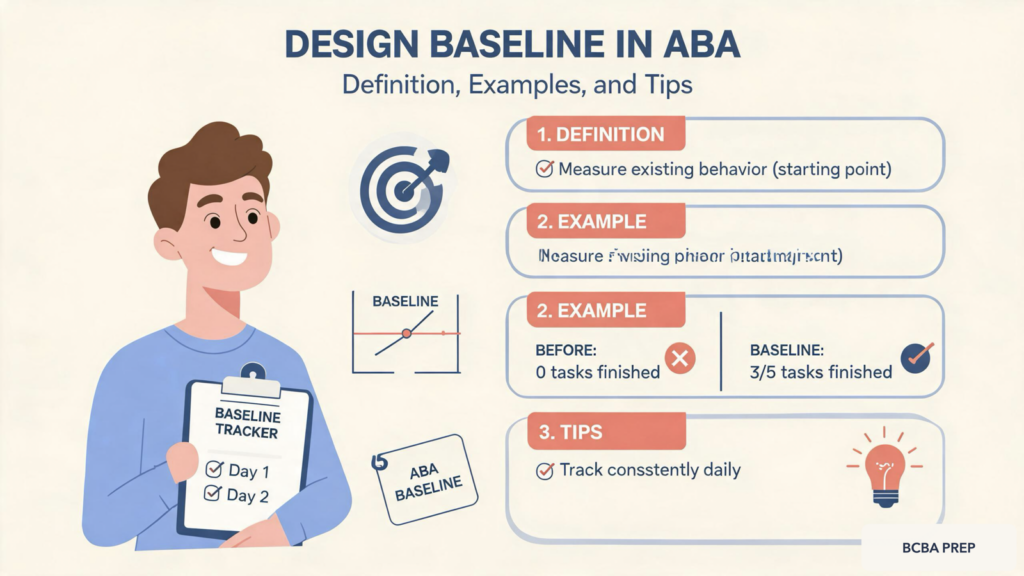
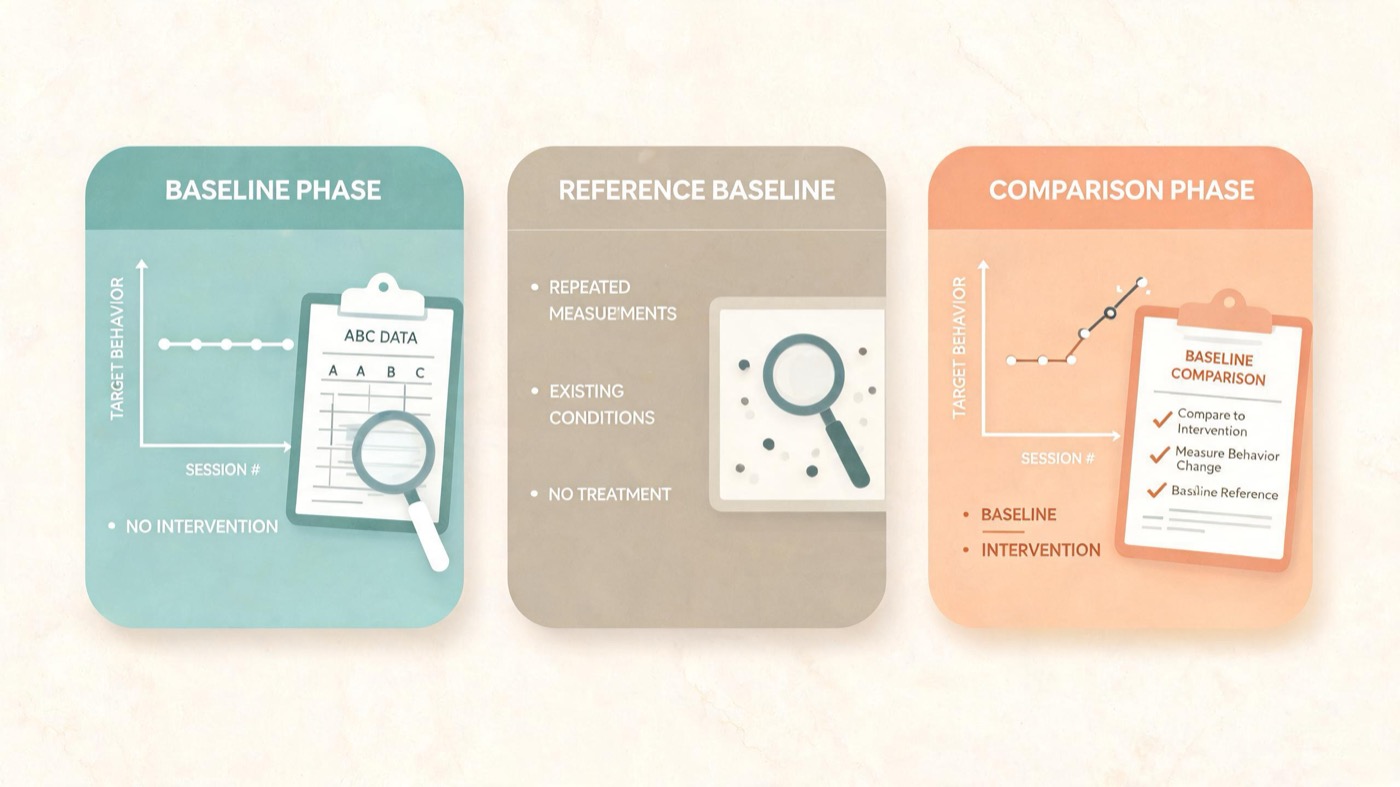
A design baseline is the phase in a single-subject experiment where no intervention is implemented, and the target behavior is measured repeatedly under existing conditions. This phase serves as a reference point against which the effects of an intervention are evaluated. In ABA, the baseline is often labeled as the “A” phase in designs like ABAB or reversal designs.
Table of Contents
- What Is a Design Baseline in ABA?
- Design Baseline in Action: Worked ABA Examples
- Exam Relevance and Common Traps
- Quick Checklist: Design Baseline Essentials
- Summary
- References
The purpose of a baseline is to establish the current level of behavior, allowing the practitioner to predict future behavior if no change is made. Without a stable baseline, it is difficult to attribute any behavior change to the intervention rather than to extraneous variables.
Baseline vs. Treatment Phase
The baseline (A) and treatment (B) phases are the core components of many single-subject designs. During baseline, data are collected under typical conditions; during treatment, the independent variable is introduced. The contrast between these phases demonstrates experimental control.
- Baseline (A): Pre-intervention condition; measures behavior as it occurs naturally.
- Treatment (B): Intervention condition; introduces a change (e.g., reinforcement, prompting).
- Stability criteria: Baseline data should show a stable pattern (low variability, no trend) before introducing the intervention. Typically, at least 3-5 data points are needed to assess stability.
- Prediction and verification: A stable baseline allows prediction of future behavior; if behavior changes only when the intervention is introduced, the effect is verified.
Why Baseline Is Critical for Experimental Control
Baseline data are essential for internal validity. They allow the researcher to determine whether behavior change is due to the intervention or to other factors (e.g., maturation, history). Without a baseline, you cannot rule out alternative explanations.
Baseline also enables replication. In reversal designs, returning to baseline conditions and seeing behavior revert to original levels strengthens the case that the intervention caused the change. This logic is fundamental to ABA research and practice.
Design Baseline in Action: Worked ABA Examples
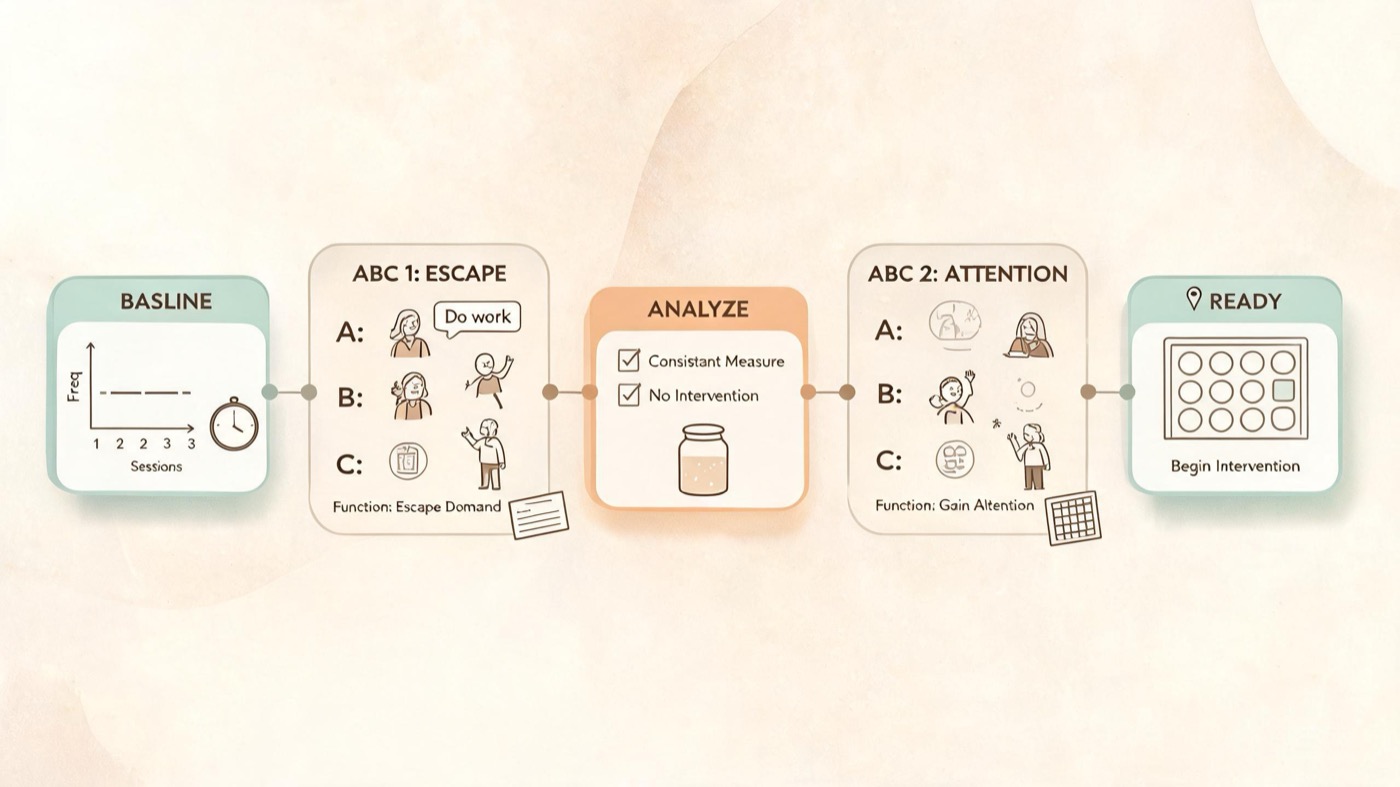
Let’s look at two concrete examples to see how baseline data are collected and interpreted in real-world ABA scenarios. Each example includes an ABC format (Antecedent-Behavior-Consequence) and a hypothesized function.
Example 1: Reducing Aggression in a Preschooler
ABC: Antecedent (teacher gives a demand), Behavior (aggression: hitting, screaming), Consequence (teacher removes the demand). Hypothesized function: Escape from demands.
- Baseline data: During the baseline phase, aggression occurred an average of 8 times per session (range 6-10). Data showed high level and moderate variability.
- Intervention: Functional communication training (FCT) to request a break. After intervention, aggression dropped to 1-2 occurrences per session.
- Interpretation: The decrease from baseline to treatment phases supports the escape function and demonstrates that the intervention was effective.
Example 2: Increasing On-Task Behavior in a Teen
ABC: Antecedent (teacher presents a worksheet), Behavior (on-task: writing, looking at worksheet), Consequence (token delivered for every 5 minutes of on-task). Hypothesized function: Access to tangibles (tokens exchangeable for preferred items).
- Baseline data: On-task behavior was low, averaging 20% of intervals (range 15-25%). The baseline showed a stable, low level.
- Intervention: Token economy with 5-minute intervals. On-task increased to 80-90% of intervals.
- Interpretation: The change from baseline to treatment is clear and immediate, indicating that the token system effectively motivated on-task behavior.
Example 3: Decreasing Self-Injurious Behavior (SIB) in a Child with Autism
ABC: Antecedent (no attention for 2 minutes), Behavior (head-hitting), Consequence (caregiver provides attention). Hypothesized function: Attention-maintained.
- Baseline data: SIB occurred an average of 12 times per hour, with an increasing trend (from 10 to 15 over 5 sessions). Variability was moderate.
- Intervention: Non-contingent reinforcement (NCR) with attention delivered every 30 seconds. SIB decreased to 2 times per hour.
- Interpretation: The baseline trend (increasing) made it easier to see the intervention effect; the introduction of NCR reversed the trend dramatically.
Exam Relevance and Common Traps
The BCBA exam often tests your understanding of baseline concepts. Questions may ask you to identify the baseline phase in a graph, interpret stability, or choose the appropriate design. Knowing common pitfalls can help you avoid losing points.
How the BCBA Exam Tests Baseline Concepts
Typical question formats include:
- Identify the baseline phase on a graph (e.g., which condition is “A”?).
- Interpret stability: Given trend, level, and variability, decide if baseline is stable enough to introduce intervention.
- Select the correct design: Which design requires a baseline? (e.g., reversal, multiple baseline, alternating treatments).
- Evaluate experimental control: Does the data show a functional relation?
Mastering these concepts is essential for the exam and for real-world practice.
Common Traps to Avoid
Here are frequent mistakes candidates make:
- Mistaking baseline for no intervention: Baseline can include existing reinforcement contingencies (e.g., teacher attention). It is simply the condition before the independent variable is introduced.
- Confusing baseline with a control group: In single-subject designs, the baseline serves as the control for that individual; there is no separate control group.
- Assuming baseline must be completely stable: Some variability is acceptable, but a clear pattern (stable or counter-therapeutic trend) is needed. You can intervene if the baseline trend is moving in the wrong direction.
- Forgetting to return to baseline: In reversal designs, a return to baseline conditions is needed to verify the intervention effect.
For more on single-subject experimental designs, check out our detailed guide.
Quick Checklist: Design Baseline Essentials
Use this checklist to review key points before your exam:
Baseline Characteristics
- Pre-intervention measurement: Baseline data are collected before introducing the independent variable.
- Minimum data points: Aim for at least 3-5 data points to assess stability.
- Stability assessment: Evaluate trend (direction), level (mean), and variability (range).
- Prediction: Baseline allows prediction of future behavior if no intervention occurs.
- Verification: Returning to baseline after intervention helps verify that behavior change is due to the independent variable.
Common Exam Topics
- Reversal designs: Baseline-intervention-baseline-intervention (ABAB) to demonstrate experimental control.
- Multiple baseline designs: Baselines are established across behaviors, settings, or participants; intervention is introduced sequentially.
- Alternating treatments design: Baseline is not always required but often included initially.
- Graphing conventions: Baseline data are typically plotted with open circles or a different color; clearly label phases.
Summary
The design baseline is a cornerstone of single-subject research in ABA. It provides the foundation for evaluating intervention effectiveness by offering a clear comparison condition. For the BCBA exam, focus on understanding stability criteria, the role of baseline in experimental control, and common misconceptions. Practice interpreting graphs and identifying baselines in various designs. For additional practice, explore our free BCBA mock exam questions to test your knowledge. As noted by the BACB (2020), “Baseline logic is essential for demonstrating experimental control” (BACB Task List, 5th ed.). Master this concept, and you’ll be well-prepared for exam success.
References
Next step for BCBA exam prep
Turn this topic into exam-day practice
Use this topic as a focused review, then test it in exam-style conditions with a free mock before deciding whether five full-length mocks are the right next step.
Start the Free BCBA Mock ExamContinue with Five Full-Length Mocks — $99
Review the included materials and access details before ordering. No pass guarantee is implied.