
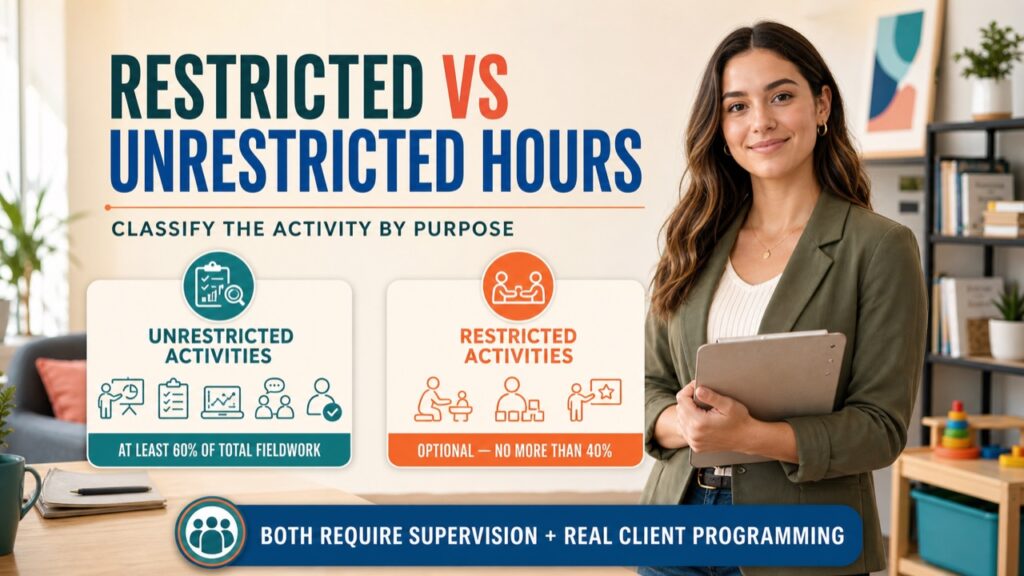
As of July 29, 2026, understanding the difference between restricted vs unrestricted hours is essential for planning BCBA supervised fieldwork correctly. The Behavior Analyst Certification Board (BACB) requires that at least 60% of your total fieldwork hours be unrestricted activities, while restricted activities are optional and cannot exceed 40%. However, many trainees struggle with classifying activities properly. This side-by-side comparison guide defines each category, provides examples, highlights common classification traps, and offers original practice scenarios to sharpen your skills. Always verify requirements with the latest official BACB Handbook for the period under which you are applying. During the 2027 transition, do not combine percentages, forms, or supervisor rules from different requirement periods.
Table of Contents
- Definition of Restricted Activities
- Definition of Unrestricted Activities
- Side-by-Side Comparison Table
- Context-Dependent Classification
- What the Labels Do—and Do Not—Mean
- Common Classification Traps
- What Does NOT Count as Unrestricted Fieldwork?
- Supervision and Documentation Rules
- Study Checklist for Fieldwork Success
- Original Practice Scenarios
- Test Your Knowledge with a Free BCBA Mock Exam
- Additional Resources
Definition of Restricted Activities
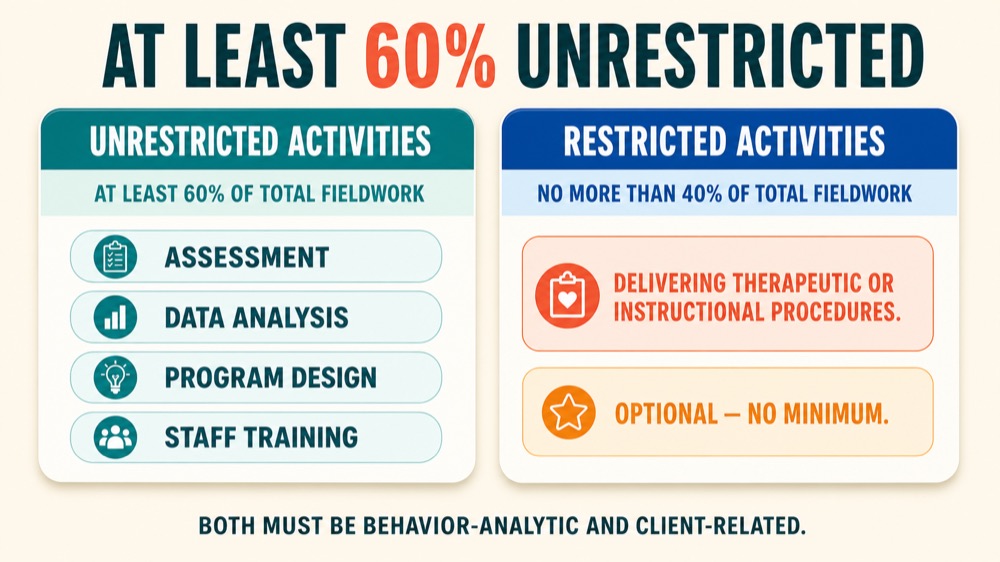
Restricted activities involve the direct delivery of therapeutic or instructional procedures to a client. These are the hands-on implementation tasks that a BCBA oversees but may delegate. Examples include running a discrete trial training session, implementing a token economy, or conducting a social skills group following a written protocol. The key feature is that you are directly providing the intervention to a client, not designing, analyzing, or supervising it. These activities must be behavior analytic, tied to real clients, and appropriate to your training level. The label “restricted” refers only to the proportion cap: you may count up to 40% of your total hours in this category, but there is no minimum restricted hours requirement.
Definition of Unrestricted Activities
Unrestricted activities are behavior-analytic tasks that best represent the assessment, design, analysis, training, and oversight work of a BCBA. These include conducting functional assessments, writing behavior intervention plans, graphing and analyzing data, training staff or caregivers, and supervising RBTs. Unrestricted activities must also be supervised, tied to real clients, and appropriate to your goals. The label “unrestricted” indicates they must comprise at least 60% of your total fieldwork hours, not that they are unlimited in other respects. All other fieldwork rules—supervisory-period hour limits, supervision percentages, observation requirements, contact requirements, and documentation standards—still apply. Unrestricted does not mean unsupervised or unlimited.
Side-by-Side Comparison Table
| Feature | Restricted Activities | Unrestricted Activities |
|---|---|---|
| Definition | Direct delivery of therapeutic or instructional procedures to a client | Behavior-analytic tasks involving assessment, design, analysis, training, or oversight |
| Typical Purpose | Implementing treatment protocols, teaching skills, reducing problem behavior | Analyzing behavior, designing interventions, training others, supervising implementation |
| Examples | DTT, NET, token economy implementation, social skills group, feeding protocol | Functional assessment, BIP writing, data analysis, staff training, supervision of RBTs |
| Proportion | Optional; no minimum; cannot exceed 40% of total | Required; at least 60% of total |
| Common Classification Trap | Assuming all direct client contact is restricted | Assuming all data collection or computer work is unrestricted |
| Documentation Question | “Am I delivering a pre-written protocol directly to the client?” | “Is the primary purpose assessment, design, analysis, training, or oversight?” |
Context-Dependent Classification
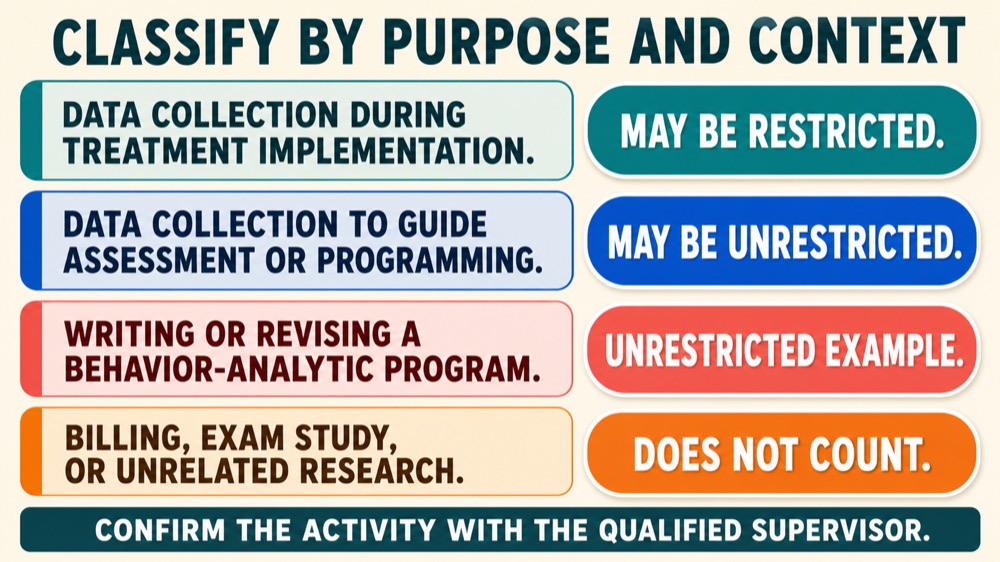
The same observable action can be either restricted or unrestricted depending on its purpose—this is context-dependent classification. For example, collecting trial-by-trial data during a DTT session is restricted because you are in the role of implementer. However, collecting frequency data as part of a functional behavior assessment to design a new intervention is unrestricted, because the purpose is assessment and analysis. Similarly, direct client contact during an intake interview or functional analysis may be unrestricted if you are conducting an assessment. Always ask: “What is the primary purpose of this activity in this moment?” If it is direct delivery of a pre-written protocol, it is likely restricted. If it is assessment, design, analysis, or training, it is likely unrestricted.
What the Labels Do—and Do Not—Mean
Restricted and unrestricted describe the type and purpose of a fieldwork activity; they do not mean prohibited versus permitted. Both categories must satisfy the other fieldwork requirements, occur under qualified supervision, relate to specific programming for real clients, and fit the trainee’s individualized objectives. The labels also do not turn on whether work is paid, difficult, completed on a computer, performed at the service site, or done face to face. Direct client contact can occur during an unrestricted assessment, intake, or programming activity. Conversely, work completed away from a client can remain restricted when it is inseparable from delivering an established therapeutic or instructional procedure. Classification should be based on what the trainee is responsible for accomplishing and why the activity is being performed, with the qualified supervisor confirming that the activity is appropriate.
- Ask about purpose: Is the trainee delivering an established procedure, or conducting assessment, design, analysis, training, or oversight?
- Ask about responsibility: Is the trainee making behavior-analytic decisions or simply observing another professional?
- Ask about the client connection: Does the work support actual programming for a real client served within the supervisory relationship?
- Ask about the full rule set: Would the hour still meet supervision, documentation, and supervisory-period requirements?
Common Classification Traps
- Trap: Classifying from client contact alone. Unrestricted activities can involve client contact, including assessment, functional analysis, and programming meetings. Focus on the activity’s purpose.
- Trap: Classifying from the words “data collection.” Data recorded while routinely delivering treatment may be restricted, whereas data collected for assessment or analysis may be unrestricted.
- Trap: Reading unrestricted as exempt from limits. These hours still count toward total supervisory-period limits, and all supervision, observation, and documentation rules continue to apply.
- Trap: Treating 40% as a target. It is a maximum, not a required share. Restricted hours may range from zero to no more than 40% of the total.
- Trap: Counting RBT work entirely as restricted. Truth: Only direct implementation counts as restricted. If you also train others or analyze data as an RBT (under supervision), those could be unrestricted.
- Trap: Classifying from a single verb. “Observe,” “write,” or “collect” is not enough information. Identify the responsibility, purpose, client connection, and supervisor-approved objective.
What Does NOT Count as Unrestricted Fieldwork?
Some activities do not qualify as fieldwork at all, so calling them unrestricted cannot make them count. The key boundary is whether the work is behavior analytic, connected to specific programming for a real client, appropriate to the trainee’s goals, and accepted within the qualified supervisory relationship. Common excluded or nonqualifying examples include:
- Exam study or test prep
- Billing, scheduling, or administrative tasks
- Reading books or articles unrelated to current clients
- Attending conferences or webinars (unless directly tied to client services and approved by supervisor)
- Listening to podcasts
- Hypothetical case analyses
- University homework or class projects (unless they involve real clients and are supervised)
These experiences may still have educational or employment value, but that value is separate from BACB fieldwork eligibility. A conference session, podcast, hypothetical assignment, or general article does not become unrestricted merely because it discusses ABA. Literature review can qualify when it is relevant to a current client’s programming and is part of the supervised fieldwork plan; unrelated reading cannot. When the purpose or client connection is ambiguous, document the proposed activity and resolve it with the supervisor before accruing or reporting the hour.
Supervision and Documentation Rules
Under the requirements in effect in 2026, both categories occur within supervised fieldwork overseen by a qualified supervisor. Each calendar-month supervisory period requires at least four supervisor-trainee contacts for Supervised Fieldwork or six for Concentrated Supervised Fieldwork, at least one observation of the trainee working with a client, and supervision equal to at least 5% or 10% of that month’s hours, respectively. Total fieldwork must fall within the applicable 20-to-130-hour monthly range. The BACB allows the trainee and supervisor to maintain their own ongoing documentation system, but it must capture required session, supervision, observation, and activity information and support the Monthly and Final Fieldwork Verification Forms. Both parties must retain the required records. These specifics change for some applicants in 2027, so use one requirement period consistently rather than combining percentages, forms, contacts, observations, or hour limits from different versions.
Study Checklist for Fieldwork Success
- ☐ Understand the 60/40 rule: ≥60% unrestricted, ≤40% restricted.
- ☐ Classify each activity by its primary purpose, not just the action.
- ☐ Get supervisor approval for each activity before logging it.
- ☐ Keep a detailed log with purpose notes for each entry.
- ☐ Do not count excluded activities (study, admin, etc.).
- ☐ Ensure a qualified supervisor observes you working with a client during every supervisory period under the 2026 requirements.
- ☐ Verify your supervisor is qualified (active BCBA with no restrictions).
- ☐ Check the current BCBA handbook for any updates.
- ☐ For the 2027 transition, use only the requirements for your specific application period.
Original Practice Scenarios
Use these original scenarios to practice identifying the activity’s primary purpose rather than relying on location, job title, software, or client contact. For each one, decide whether the responsibility is direct delivery of a therapeutic or instructional procedure or work representing assessment, design, analysis, training, or oversight. Actual hours still require supervisor approval and all other fieldwork conditions.
- Scenario A: You implement a picture exchange communication system (PECS) training following the phases outlined in your supervisor’s plan. Answer: R—direct implementation of a pre-written protocol.
- Scenario B: You graph the client’s PECS data from the past week and calculate the trend to decide if the phase should change. Answer: U—analysis of data to inform treatment decisions.
- Scenario C: You conduct a functional analysis (FA) by systematically manipulating conditions to identify the function of a client’s aggression. Answer: U—assessment activity.
- Scenario D: You run a differential reinforcement of alternative behavior (DRA) session where you deliver tokens for appropriate behavior following the written plan. Answer: R—direct implementation of an intervention.
- Scenario E: You train a parent to implement a bedtime routine using behavioral skills training (BST). Answer: U—training others.
- Scenario F: After assessing an implementer’s performance on a current client program, you design and deliver behavioral skills training under your supervisor’s oversight. Answer: U—assessment and training of an implementer tied to real client programming.
Test Your Knowledge with a Free BCBA Mock Exam
After reviewing restricted vs unrestricted hours, use our Free BCBA Mock Exam for additional practice applying behavior-analytic concepts and reviewing feedback. It is an independent study aid, not a representation of current BACB examination items, and this article does not promise that the mock exam contains this exact fieldwork comparison. For actual hour classification and documentation decisions, use the current official requirements and work with your qualified supervisor.
Additional Resources
Because the BACB updates its handbook and future-transition information, verify the version that governs the date you will apply. The following official sources support the definitions, proportions, client-programming boundary, supervision structure, documentation expectations, and transition cautions used in this guide. They should take priority over informal trackers, social posts, and older summaries:
- BCBA Handbook
- Getting It Right: Fieldwork
- FAQs About BACB Supervised Fieldwork Requirements
- 7 FAQs for RBTs Pursuing BCBA or BCaBA Certification
Next step for BCBA exam prep
Turn this topic into exam-day practice
Use this topic as a focused review, then test it in exam-style conditions with a free mock before deciding whether five full-length mocks are the right next step.
Start the Free BCBA Mock ExamContinue with Five Full-Length Mocks — $99
Review the included materials and access details before ordering. No pass guarantee is implied.



