
Understanding the bcba vs psychologist Distinction
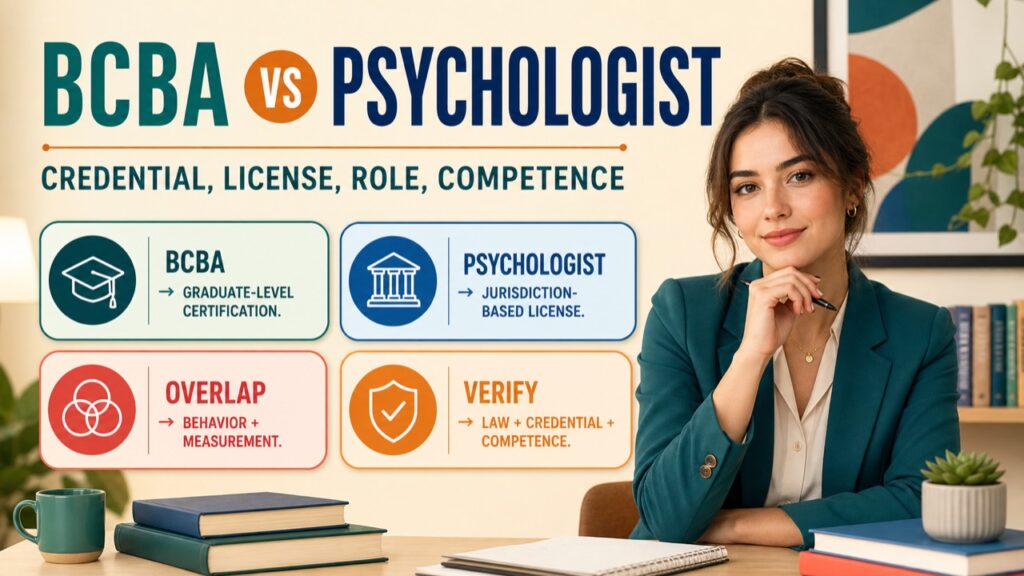
The bcba vs psychologist comparison involves two different kinds of professional label. A Board Certified Behavior Analyst holds a graduate-level certification in behavior analysis. Psychologist licensure, by contrast, is legal authorization attached to a regulated title whose education, categories, permitted services, and restrictions vary by jurisdiction and specialty. Both professions may study behavior, use measurement, evaluate intervention, and contribute to team decisions, yet that overlap does not make their credentials interchangeable. A useful comparison separates five questions: What education was completed? Which certification or license is current? What does local law permit? What role has the employer assigned? Does the individual have scope of competence for this population and service? The answers may differ even for two people who use the same professional title. This guide therefore compares typical technical emphasis and collaboration while avoiding a nationwide claim about every psychologist or every BCBA.
Table of Contents
- Understanding the bcba vs psychologist Distinction
- Training and Credentialing Pathways
- Scope of Practice and Legal Boundaries
- Assessment Methods and Intervention Focus
- Work Settings and Collaborative Roles
- Common Comparison Errors
- Credential and Collaboration Checklist
- Hypothetical Collaboration Example
- Side-by-Side Comparison
- Choosing or Referring Responsibly
- Official BCBA References
BCBA certification alone does not create legal authority to practice psychology or override state law. A BCBA must work within applicable law, actual credentials, and scope of competence. The psychologist title also does not identify one uniform job: specialties may emphasize assessment, intervention, consultation, research, teaching, organizational work, or combinations of these. Readers should verify the license, specialty, and services of the individual professional rather than inferring authority from a broad label.
Training and Credentialing Pathways
BCBA credential: The BCBA is a graduate-level certification awarded by the Behavior Analyst Certification Board. Its eligibility process includes graduate education, behavior-analytic content, supervised fieldwork, and an examination, with maintenance requirements after certification. Because those details change, applicants should use the current official BCBA certification page rather than an old summary. Certification verifies a defined behavior-analysis credential; it is not an academic degree, an employer job description, or automatic legal permission to deliver every possible service. Separate state or other jurisdiction requirements may apply.
Psychologist title and license: Psychologist is a legally regulated professional title, not one national certification with a single pathway. Required education, supervised experience, examinations, license categories, protected activities, and specialty expectations depend on the jurisdiction. The services an individual may offer also depend on the person’s license, training, competence, workplace, and population. Some roles may involve psychological assessment, diagnosis, psychotherapy, consultation, research, teaching, or organizational practice; the title alone does not establish that every one of those services is permitted or offered. Verify the current licensing board record and local rules before drawing a scope conclusion.
Scope of Practice and Legal Boundaries
A BCBA may provide behavior-analytic services such as assessment of behavior-environment relations, measurement, program design, intervention evaluation, staff or caregiver training, and supervision when those activities fit the person’s competence and legal authority. The credential by itself does not authorize the practice of psychology, diagnosis of mental disorders, psychotherapy, or use of tests restricted by law or professional standards. A professional who holds additional licenses or credentials must still distinguish which role and authority support each service.
A psychologist’s permitted work cannot be inferred from the title alone. Depending on jurisdiction, license category, specialty, and competence, services may include forms of psychological assessment, diagnosis, intervention, consultation, or research. The useful comparison is therefore not “which profession can do more?” It is “what service is needed, what law governs it, what credentials does this person hold, and is the service within the person’s demonstrated competence?” Those questions preserve boundaries without ranking either profession.
Assessment Methods and Intervention Focus
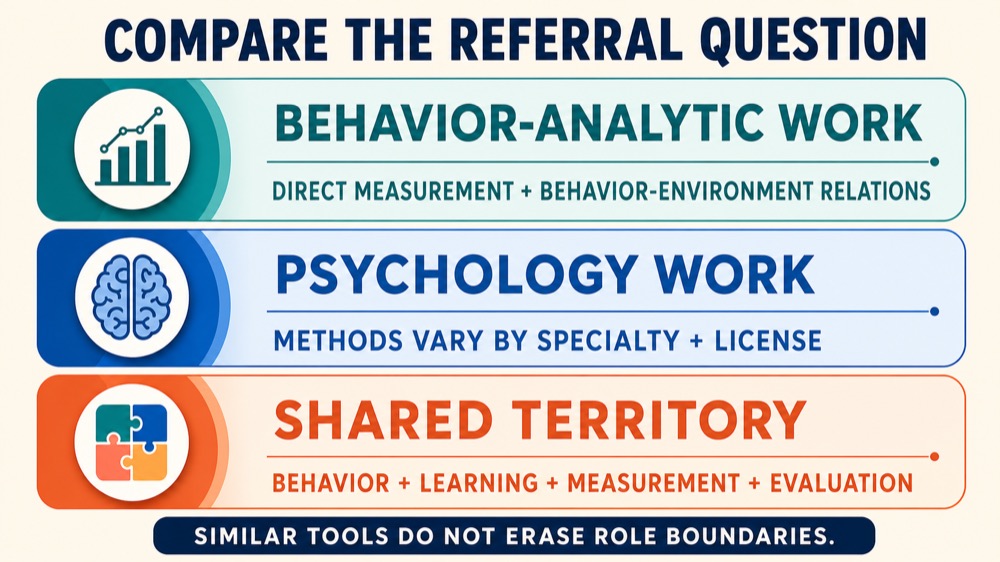
Behavior-analytic work: A BCBA commonly defines socially significant behavior in observable terms, selects direct measures, examines relevant environmental variables, and evaluates whether an intervention changes the target response and meaningful outcomes. Assessment may include record review, interviews, observation, descriptive analysis, skill assessment, preference assessment, or experimental analysis when appropriate and safe. The method should match the referral question; an assessment label does not guarantee a particular design or conclusion. Interventions may address antecedents, skills, consequences, environmental supports, or systems, with repeated measurement used to guide revision.
Psychology work: A psychologist may use interviews, observation, standardized measures, record review, consultation, or other methods permitted by the person’s specialty and license. The purpose may involve learning, cognition, emotion, health, relationships, workplace behavior, diagnostic questions, or other psychological concerns. Intervention methods also vary widely by specialty and competence. There is genuine overlap in measurement, behavior, learning, treatment evaluation, and consultation, but similar-looking tools do not erase professional boundaries. Teams should clarify the question each assessment answers, who is qualified to administer and interpret it, and how results will be used.
Work Settings and Collaborative Roles
Either profession may be found in schools, health systems, community services, universities, government, consultation, or private organizations, but employer titles do not reliably reveal credentials or scope. A BCBA may serve as a clinician, consultant, program designer, supervisor, researcher, or organizational practitioner. Psychologists may work in many specialties, including clinical, counseling, school, health, research, forensic, or industrial-organizational roles, subject to local regulation. Collaboration is most useful when the team names the referral question, assigns responsibilities from verified qualifications, shares only necessary information with authorization, and agrees how competing recommendations will be resolved. Teams should also distinguish consultation from transfer of responsibility: receiving a colleague’s recommendation does not expand one’s legal authority or competence. Each professional remains accountable for the services they personally deliver, document, supervise, or represent to the client.
Common Comparison Errors
- Equating certification with licensure: a certification identifies a credential; a license is legal authorization defined by a jurisdiction.
- Inferring services from a title: verify the person’s license category, specialty, training, competence, and actual offered service.
- Using a nationwide scope statement: protected titles and activities differ across states, provinces, countries, and settings.
- Ranking the professions: “broader” or “better” ignores the referral question and the competence needed for a specific service.
- Reducing psychology to psychotherapy: psychology includes diverse applied, research, academic, and organizational specialties.
- Reducing behavior analysis to one population or setting: the credential describes behavior-analysis competence, not a single diagnosis, workplace, or age group.
- Assuming overlap permits substitution: shared interest in behavior and measurement does not make credentials interchangeable.
Credential and Collaboration Checklist
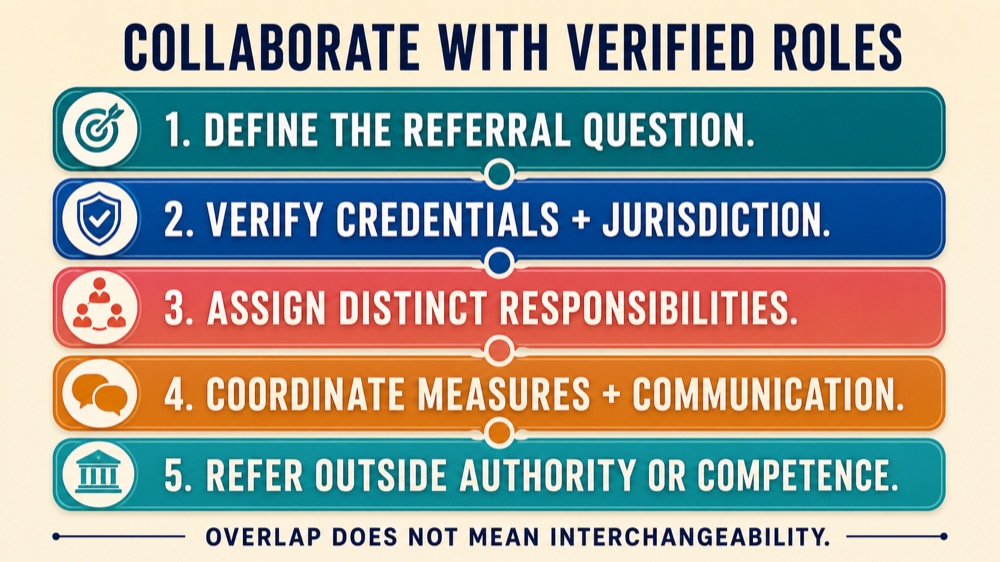
- Confirm the professional’s full credential and current status with the relevant registry or licensing board.
- Identify the jurisdiction and setting that govern the proposed service.
- Ask which license or credential authorizes the specific assessment, intervention, supervision, or consultation.
- Ask how the professional established competence with the population, method, and referral question.
- Clarify whether a test or procedure has separate administration, interpretation, or supervision restrictions.
- Define which team member owns each decision, record, consent process, and follow-up task.
- Request a referral when the needed service falls outside the current professional’s authority or competence.
- Recheck requirements when the professional, client location, delivery format, or service changes.
Hypothetical Collaboration Example
A school team is concerned about a student’s declining participation, incomplete work, and distress during difficult assignments. Before assigning roles, the team checks each professional’s credentials, the school’s policies, family authorization, and local rules. A licensed psychologist with relevant school-based competence may address a psychological referral question using methods permitted within that role. A BCBA with relevant competence may operationally define participation, collect direct classroom data, examine task and environmental variables, and evaluate a behavior-analytic support plan. Neither professional treats an early hypothesis as a proven cause. They coordinate measures, protect confidentiality, explain the limits of each conclusion, and refer when a question falls outside their authority. This is a collaboration model, not a universal division of labor; the exact responsibilities depend on the people, setting, law, and referral questions.
Side-by-Side Comparison
| Question | BCBA | Psychologist |
|---|---|---|
| What is the label? | A graduate-level certification in behavior analysis | A regulated professional title tied to jurisdiction-specific licensure |
| Is it an academic degree? | No; the credential has education requirements but is not itself a degree | No; the title may require specified education, but the license and degree remain distinct |
| Typical technical emphasis | Behavior-environment relations, direct measurement, behavior-change procedures, and evaluation | Varies by specialty and may include assessment, intervention, consultation, research, or organizational work |
| Legal authority | Depends on applicable law and any separate required license | Depends on the jurisdiction, license category, specialty, and restrictions |
| Overlap | Behavior, learning, measurement, intervention evaluation, consultation, and interdisciplinary service | |
| Key verification question | Does this individual hold the current credential, legal authority, and competence for this specific service? | |
Choosing or Referring Responsibly
For a career decision, compare the actual curriculum, supervised experience, credential pathway, local legal environment, populations, and daily work of programs you are considering. For a service referral, begin with the client’s question and verify the professional rather than relying on a title. BCBA and psychologist roles can overlap and collaborate, but they are not interchangeable. Use our Free BCBA Mock Exam for general behavior-analysis practice and feedback; it does not claim to reproduce this exact comparison or any current certification item.



