
The statement replacement behavior strategies must include reinforcement procedures points to a central function-based intervention rule: teaching a replacement response is not enough. The plan must say what consequence will strengthen that response, when the consequence will be delivered, who will deliver it, and how the team will know whether it is working.
Table of Contents
- Replacement Behavior Strategies Must Include Reinforcement Procedures
- Start With Functional Equivalence
- What the Reinforcement Procedure Must Define
- A Four-Step Replacement-Behavior Workflow
- Function-Based Examples
- Schedules, Prompting, and Fading
- Data and Decision Rules
- Common Mistakes
- Quick Checklist
- FAQ
- Quick Review Checklist
- Take the Free BCBA Mock Exam
It means the replacement behavior needs a clear, individualized contingency. A replacement response competes with a behavior that already works for the learner, so the new response must be efficient, functionally relevant, and reinforced consistently. Table of Contents
Replacement Behavior Strategies Must Include Reinforcement Procedures
A replacement behavior is intended to give the learner a safer, more acceptable, or more useful way to obtain the same outcome that previously followed the interfering behavior. If the new response produces no meaningful outcome, it may not compete with the established response. The learner may understand the instruction and still return to the old behavior because the old behavior is faster, easier, more reliable, or more strongly reinforced.
The Vanderbilt IRIS Center’s replacement-behavior guidance describes a functionally equivalent replacement as a positive alternative that serves the same function as the target behavior. It also emphasizes that the replacement should be observable and measurable, provide a strong enough payoff, and be taught with consistent reinforcement. The University of Nebraska replacement-behavior resource similarly includes a reinforcement plan in the teaching workflow and recommends reviewing target and replacement data frequently.
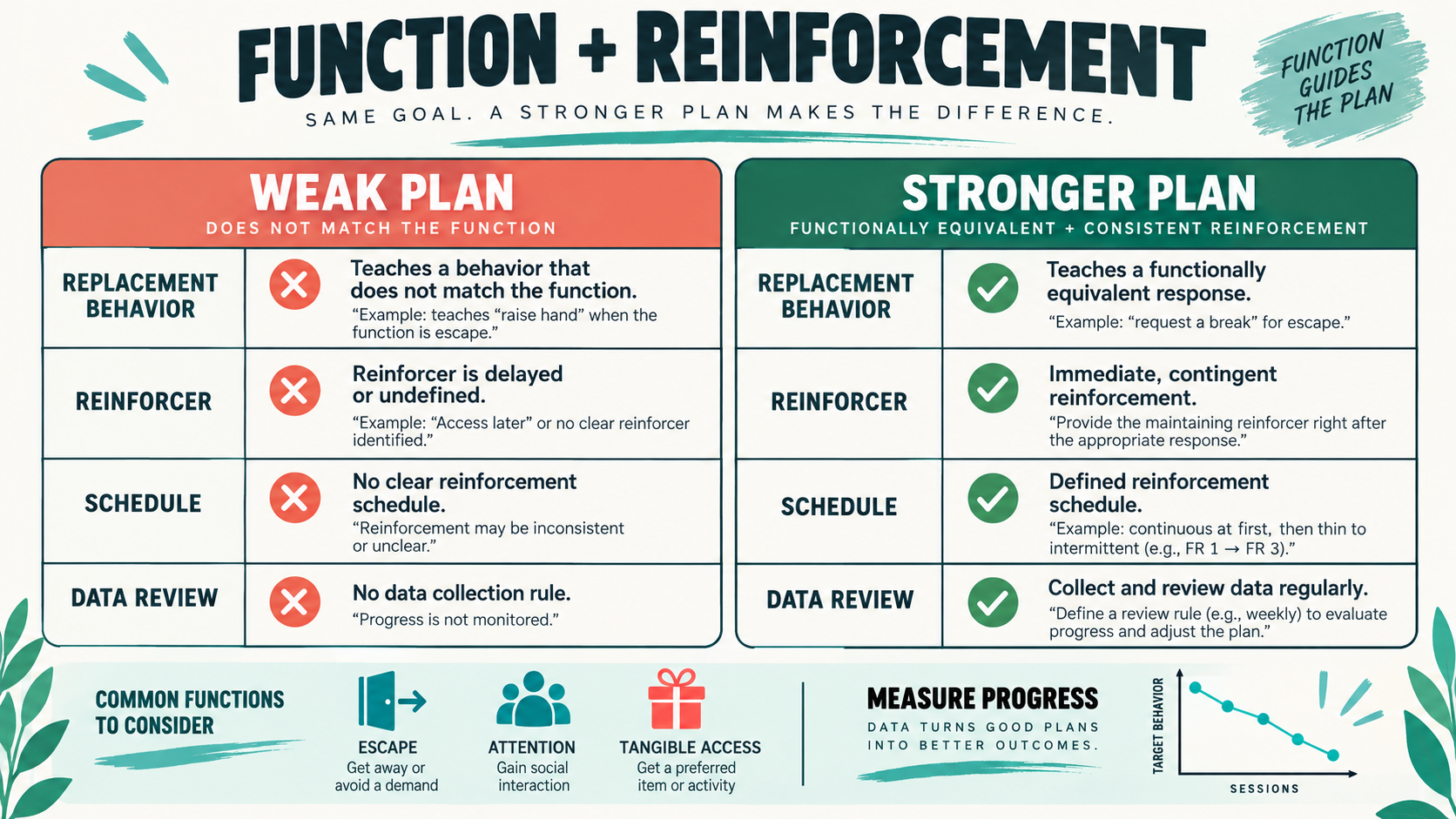
For a BCBA exam question, the safest interpretation is not “reinforce anything that looks appropriate.” Instead, ask whether the plan connects four elements: the target behavior’s function, the replacement response, the reinforcer that matches that function, and a measurable delivery rule.
Start With Functional Equivalence
Functional equivalence means that the replacement behavior allows access to the same type of outcome that maintained the problem behavior. It does not require the replacement response to look like the target response. It requires the consequence to be relevant to the function.
| Hypothesized function | Possible replacement response | Reinforcement procedure to define |
|---|---|---|
| Attention | Raise a hand, tap a help card, or say “excuse me.” | Who responds, how quickly, and what attention is delivered after the request? |
| Escape or break | Request a break or ask for help. | How is the break delivered, for how long, and how does work resume? |
| Tangible or activity | Request the item, activity, or additional time. | What item is available, what request qualifies, and what limits apply? |
| Automatic or sensory | Use an appropriate competing or sensory-regulation response. | How will the plan provide or arrange the relevant sensory consequence safely? |
A replacement can be socially appropriate without being functionally equivalent. For example, “sit quietly” may be a desirable classroom behavior, but it is not automatically an effective replacement for yelling that reliably produces teacher attention. The replacement needs a path to the relevant attention while it is being acquired.
What the Reinforcement Procedure Must Define
The phrase “reinforce the replacement behavior” is incomplete as a written procedure. A strong plan makes the contingency observable enough that trained implementers can use it consistently.
- Response definition: describe exactly what the learner does, including the communication form, prompt level, and criteria for a correct response.
- Reinforcer: identify what consequence is delivered and verify that it is valuable to the learner in the relevant context.
- Contingency: state whether the consequence follows every independent response, a prompted response, a response meeting a quality criterion, or another defined event.
- Timing: specify how soon the reinforcer follows the replacement response. Delay can make the contingency difficult to learn.
- Magnitude and duration: state how much attention, break time, item access, or sensory activity is delivered.
- Schedule: describe the acquisition schedule and the conditions for thinning or changing it.
- Problem-behavior response: specify how staff respond safely and ethically when the target behavior occurs, without accidentally making the replacement less efficient.
- Data rule: define what staff record for independent replacement responses, prompted responses, target behavior, and reinforcer delivery.
Reinforcement is not limited to praise or treats. It can include attention, access to an activity, a break, help, a communication outcome, or a sensory consequence. The correct choice depends on the function and the learner’s preferences. A plan that labels a consequence “reinforcement” without evidence that it increases the replacement response is only a hypothesis.
A Four-Step Replacement-Behavior Workflow
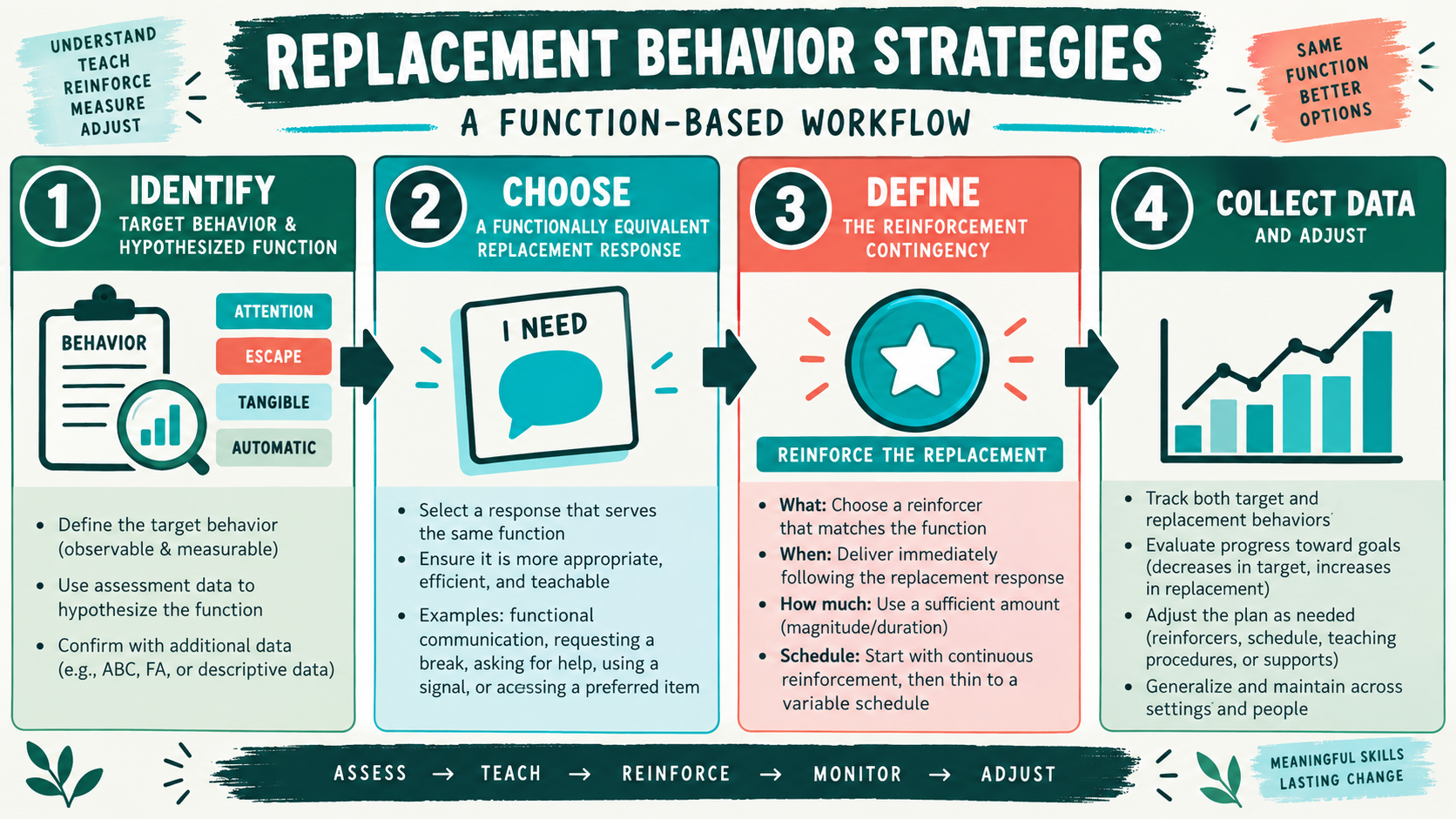
- Identify the function. Use assessment information to determine what the target behavior has produced. Do not select a replacement from appearance alone.
- Choose a feasible equivalent. The response should be observable, measurable, developmentally appropriate, socially valid, and at least as efficient as the problem behavior when it is first taught.
- Write the reinforcement contingency. State the antecedent, replacement response, consequence, timing, schedule, prompts, and safe response to errors or problem behavior.
- Monitor and adjust. Compare independent replacement responding, prompts, target behavior, and contact with reinforcement. Change the plan when the data show that the response is not competing or generalizing.
This sequence prevents a common design error: teaching a communication response first and postponing the reinforcement decision. The reinforcement procedure is part of the replacement strategy from the beginning because the learner needs to experience why the new response works.
Function-Based Examples
Attention-maintained calling out: Teach a learner to raise a hand or use a card to request attention. At first, deliver brief, relevant attention immediately after the independent request. Record independent requests, prompted requests, calling out, and staff response latency. Later, teach a wait response only after the initial request reliably contacts attention.
Escape-maintained refusal: Teach “break” or “help” as a clear communication response. The procedure might provide a short break after an independent request, then use a consistent return-to-task routine. The plan must not make the replacement response so effortful or slow that refusal remains the easier way to escape.
Tangible-maintained grabbing: Teach a request for the item or a visual request for more time. Deliver access according to a defined rule and teach the learner what happens when the item is unavailable. If staff sometimes give the item after grabbing and sometimes after requesting, the contingencies may be unclear and the replacement may not gain strength.
Automatic or sensory behavior: A social reinforcer may not match the function. The team may need to teach a safe competing response or arrange access to an appropriate sensory activity. The plan should be based on assessment, protect dignity, and avoid assuming that all repetitive behavior has the same function.
Schedules, Prompting, and Fading
During acquisition, a dense and predictable schedule can help the learner contact reinforcement for the new response. Continuous reinforcement may be appropriate for early independent responses, but it is not a universal rule or a promise that a particular number of trials will be enough. The team should define mastery using data, not an arbitrary timeline.
As the replacement becomes reliable, the team may thin the schedule gradually, teach delay tolerance, or transfer control to natural consequences. Thinning should not remove the functionally relevant outcome so quickly that the replacement stops competing with the target behavior. The plan should specify when to thin, what performance level is required, and what data indicate that the current schedule is too thin.
Prompting and reinforcement also need to be separated in the record. Reinforcing a prompted request can help build the skill, but the team should measure prompt dependence and systematically fade prompts when appropriate. If staff only reinforce a response after repeated verbal prompts, the learner may not use it independently when the natural situation occurs.
Data and Decision Rules
Collect data on both sides of the intervention. Useful measures can include frequency or rate of the target behavior, frequency or rate of the replacement response, percentage of independent responses, prompt level, latency to reinforcement, and opportunities in which the relevant reinforcer was available.
Write a decision rule before reviewing the graph. For example, the team may continue the current procedure when independent replacement responses increase and target behavior decreases across relevant opportunities. It may revise the plan when the replacement response stays low, when prompts remain high, when the learner contacts reinforcement only in one setting, or when the target behavior continues to produce the same outcome. A graph is not a replacement for a contingency analysis; it is evidence for the next decision.
Check treatment integrity as well. If staff do not deliver the programmed reinforcer after qualifying replacement responses, a low response rate may reflect implementation failure rather than an ineffective replacement. The team should correct training and fidelity problems before concluding that the learner cannot use the skill.
Common Mistakes
- Choosing a polite but nonfunctional response: “Be good” or “stay quiet” may not access the outcome that maintains the target behavior.
- Writing a reinforcement label instead of a procedure: “Use praise” does not say when, how much, or for which response praise occurs.
- Making the replacement harder than the target: a long verbal script may be unrealistic when the target behavior produces a fast outcome.
- Reinforcing inconsistently: unpredictable staff responses can leave the old behavior more efficient than the replacement.
- Thinning too early: removing the relevant consequence before the replacement is fluent can reduce responding.
- Ignoring prompts and errors: a high prompted-response count can hide the fact that independent behavior has not been acquired.
- Using the same reinforcer for every function: attention, escape, tangible, and automatic functions require different analyses.
- Stopping at behavior reduction: reducing the target without teaching and reinforcing a functional alternative can leave the learner without an effective way to meet the need.
Quick Checklist
- Is the target behavior operationally defined?
- Is the hypothesized function supported by assessment information?
- Does the replacement response access the same relevant outcome?
- Can the learner perform it efficiently in the real context?
- Is the reinforcer identified and known to be valuable in that situation?
- Are contingency, timing, magnitude, schedule, prompts, and fading rules written?
- Are safe staff responses to target behavior and errors specified?
- Are independent replacement behavior and target behavior both measured?
- Is treatment integrity checked before changing the clinical conclusion?
- Are decisions based on data, learner dignity, and supervisor review?
FAQ
Why must replacement behavior strategies include reinforcement procedures?: Because a replacement response has to compete with a behavior that already contacts an outcome. A defined reinforcement procedure gives the learner a reason to use the new response and gives staff a consistent way to strengthen it. The procedure should match the function and be individualized.
Does reinforcement always mean giving a reward?: No. Reinforcement means a consequence that increases future responding. It may be attention, a break, help, access to an item or activity, or another function-relevant outcome. Whether something is reinforcing is determined by its effect on behavior, not by its label.
Must the replacement behavior be functionally equivalent?: For a function-based replacement, yes: it should provide an appropriate path to the same relevant outcome. A socially desirable response that does not meet the learner’s need may not compete with the target behavior during acquisition.
Should reinforcement be delivered every time?: A dense schedule may be useful while the response is first acquired, but the schedule should be selected and thinned from data. Do not assume one schedule or one timeline applies to every learner or skill.
What is the best BCBA exam answer?: Look for the option that combines functional equivalence with a clearly defined, contingent reinforcement procedure. Reject answers that teach a replacement without a relevant consequence or that treat reinforcement as generic praise without a delivery rule.
The practical meaning of replacement behavior strategies must include reinforcement procedures is that a plan must teach a response and make that response work. Define the function, choose an efficient alternative, specify the consequence and schedule, measure independent use, and revise from data. For additional BCBA scenario practice, try our free BCBA mock exam. Practice can sharpen discrimination among functional equivalence, differential reinforcement, prompting, and schedule thinning, but it does not replace the current BACB outline, supervision, or individualized clinical judgment. For targeted review, use our replacement behavior strategies must include reinforcement practice questions to apply the concept in exam-style scenarios.
Quick Review Checklist
Use this final checklist to turn replacement behavior strategies must include reinforcement into exam-ready reasoning. The goal is not to memorize a label in isolation; it is to identify the relevant evidence and explain why the best answer fits the scenario. Key ideas to review:
- State the central definition or decision point for replacement behavior strategies must include reinforcement in your own words.
- Identify the detail that makes replacement behavior strategies must include reinforcement different from its closest related ABA term.
- Separate the observable facts in a scenario from assumptions that are not supported by the facts.
- Write one example and one nonexample so you can recognize the concept in a new setting.
Exam application checks:
- Ask what the question is actually requesting before comparing the answer choices.
- Mark the antecedent, response, consequence, or other evidence that supports the selected answer.
- Look for a distractor that describes a related process but does not answer the specific question.
Final self-check:
- Explain how you would verify the interpretation with clear observations or data.
- Change one detail in the scenario and decide whether your answer should change.
- Give a one-sentence rationale that a supervisor or study partner could evaluate.
Take the Free BCBA Mock Exam
When you are ready to apply the idea, use the free practice resource below for additional feedback. Take the Free BCBA Mock Exam



