
When a BCBA exam question asks about safe vs unsafe scenarios ABA, the best answer is usually found by identifying the client’s immediate risk before choosing the most convenient clinical action. A safe answer protects welfare, respects rights and consent, stays within professional competence, and uses the least restrictive effective response. An unsafe answer often sounds fast or helpful but ignores risk, confidentiality, scope, documentation, or the client’s voice.
Table of Contents
- Safe vs Unsafe Scenarios ABA: The Quick Answer
- Five Signals of a Safer Answer
- A Five-Step Decision Path for a BCBA Scenario
- Safe vs Unsafe Scenario Comparison
- Common BCBA Exam Scenario Patterns
- When Immediate Safety Changes the Order
- Unsafe Answer Traps
- Fast Review Checklist
- FAQ
- Take the Free BCBA Mock Exam
The BACB’s Ethics Code for Behavior Analysts provides the governing framework. This article turns that framework into an exam-ready comparison tool. It is study guidance, not legal advice or a substitute for the current Code, supervision, or the rules in the jurisdiction where services are delivered. Table of Contents
Safe vs Unsafe Scenarios ABA: The Quick Answer
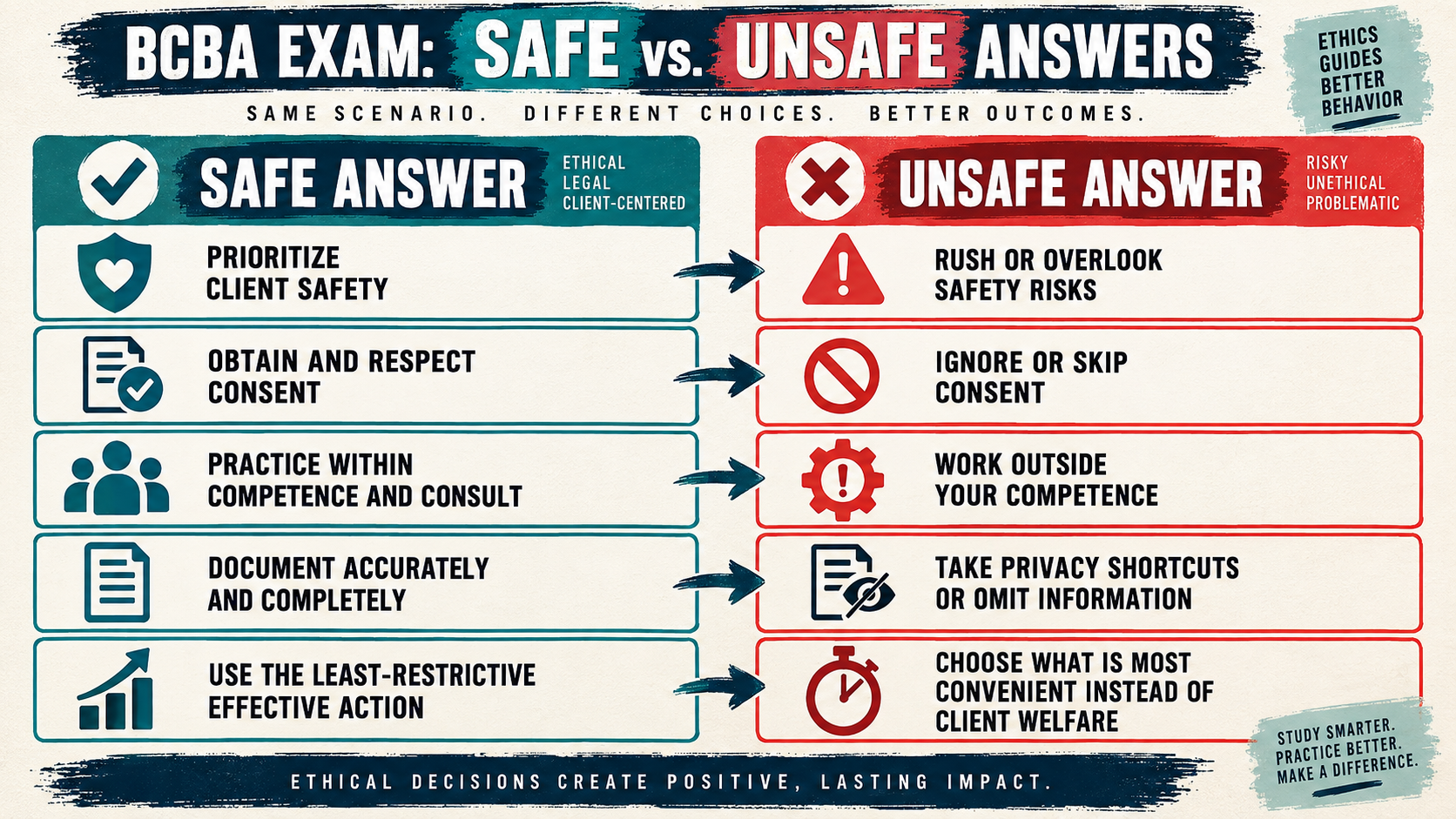
A safe scenario response begins with client welfare, not convenience. The BCBA should identify whether someone faces immediate harm, prevent or reduce that risk, and then address the relevant ethical and clinical requirements. The answer should also preserve dignity and self-determination whenever possible. “Safe” does not mean automatically using the most restrictive intervention; it means selecting an effective response that protects the client while avoiding unnecessary restriction. For exam purposes, compare each option against four questions:
- Does it protect the client and other stakeholders from foreseeable harm?
- Does it respect authorization, consent, assent when appropriate, privacy, and dignity?
- Is the professional working within competence, role, and applicable requirements?
- Does it create a documented, data-informed next step rather than hide or rush the problem?
An option can be well intentioned and still be unsafe. For example, a BCBA who accepts a high-risk case without training may want to help, but proceeding alone can expose the client to ineffective or harmful services. A safer option may involve immediate protective steps, consultation, training, referral, or a coordinated transition.
Five Signals of a Safer Answer
1. It identifies risk before routine procedure. A question may mention a medical concern, dangerous behavior, abuse suspicion, a privacy breach, or an intervention with unexpected side effects. Those details are not decoration. The safest answer responds to the risk instead of continuing the normal session as if nothing changed.
2. It protects client rights and dignity. A strong answer considers informed consent, assent when relevant, privacy, communication needs, cultural responsiveness, and the client’s opportunity to participate in decisions. It does not treat a caregiver, employer, or funder’s convenience as more important than the client’s welfare.
3. It uses competence and consultation appropriately. The Ethics Code includes practicing within a defined role and scope of competence. If the scenario involves a procedure, population, medical issue, or setting outside the BCBA’s training, “try it anyway” is a warning sign. Consultation, supervision, specialized training, or referral is often the safer next step.
4. It preserves accurate information. Safe answers do not alter data, omit an adverse event, hide a limitation, share identifiable details casually, or make a public claim that cannot be supported. Documentation should be factual, timely, and sufficient for the next professional to understand what happened and why the decision was made.
5. It chooses an effective and proportionate action. A safe answer is not simply the harshest answer. The BACB framework emphasizes effective behavior-change interventions and minimizing risk. Look for the option that solves the problem with the least unnecessary restriction while still addressing actual danger.
A Five-Step Decision Path for a BCBA Scenario
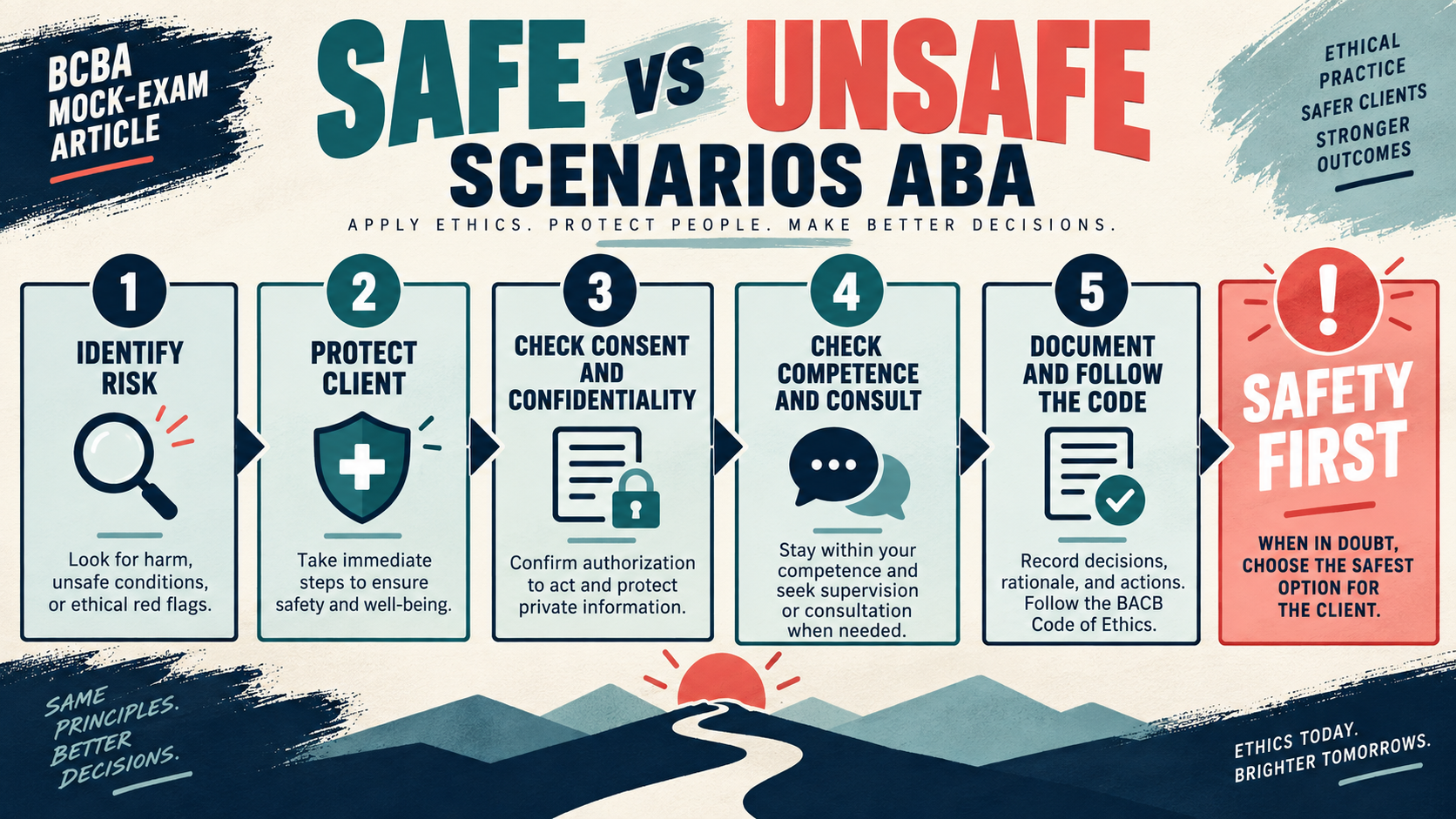
Use the following sequence when answer choices all sound plausible. It helps prevent a common mistake: jumping straight to a policy citation without addressing the person in front of you.
- Identify the risk. Ask what could happen if the current situation continues. Separate a true immediate safety issue from a routine disagreement, inconvenience, or preference.
- Protect the client. Take the prompt action needed to reduce imminent harm. Follow emergency, medical, mandated-reporting, and organizational procedures that apply to the facts. Do not create a new risk while trying to solve the first one.
- Check authorization and privacy. Determine who can consent, what information may be shared, whether assent or stakeholder involvement is relevant, and whether the requested action is within the service agreement.
- Check competence and consultation. If the action requires expertise the BCBA does not have, pause the unsupported procedure and obtain appropriate consultation, training, supervision, or referral. A delay is not automatically unsafe when it prevents unqualified treatment.
- Document, evaluate, and follow the Code. Record the facts, decisions, communication, and follow-up. Use data and the applicable Ethics Code standard to evaluate what happens next. If informal resolution is inadequate or the risk continues, use the appropriate reporting or escalation pathway.
This is a decision framework, not a rigid script. A genuine emergency may require immediate protective action before consent or documentation can be fully addressed. The scenario’s level of risk determines the order, but the principles remain connected.
Safe vs Unsafe Scenario Comparison
The table below shows how exam distractors often differ from the stronger response. The safe column is not a universal legal instruction; it shows the reasoning pattern to look for in a vignette.
| Scenario detail | Safer reasoning | Unsafe signal |
|---|---|---|
| Possible immediate medical or physical danger | Protect the client, obtain appropriate emergency or medical support, and document the event. | Continue the planned protocol to avoid losing session time. |
| Requested intervention is outside the BCBA’s competence | Seek qualified consultation, training, supervision, or referral and use only supported interim steps. | Begin the unfamiliar high-risk procedure after reading a brief summary. |
| Employer asks for altered progress data | Report data accurately, explain the limitation, and document the request and response. | Change or omit information so funding or services appear secure. |
| Unapproved person requests identifiable client details | Verify authorization and share only what is permitted and necessary. | Share the story because the requester seems helpful or influential. |
| Caregiver requests a personal favor that creates a dual role | Recognize the conflict, set a boundary, consider alternatives, and document the decision. | Accept the favor because refusing might feel uncomfortable. |
Common BCBA Exam Scenario Patterns
Safety concern hidden inside a service question: A vignette may ask whether to adjust a program, but the important fact is a new symptom, injury, medication issue, or dangerous escalation. The safer answer addresses health and safety first and coordinates with qualified professionals rather than treating the behavior in isolation.
Competence shortcut: An administrator may pressure the BCBA to accept a case immediately. The fact that services are needed does not create competence. Look for an answer that arranges consultation, training, supervision, or referral while protecting continuity of care.
Consent and assent shortcut: A stakeholder may say that consent is “already understood” or that the client’s refusal is inconvenient. A safer response explains the service, risks, alternatives, and right to withdraw in understandable language. When a client cannot provide legal consent, assent and signs of willingness still matter when appropriate, subject to safety requirements.
Confidentiality shortcut: A request to share a video, progress story, or case detail may be framed as education or marketing. First check authorization, minimum necessary disclosure, identifying information, and applicable privacy rules. Do not assume a good purpose removes confidentiality obligations.
Data-integrity shortcut: If a funder, supervisor, or parent asks for a more favorable graph, the safe answer is accurate reporting and professional communication. Ethical practice can include explaining uncertainty, correcting an error, and documenting the conversation; it does not include manufacturing progress.
When Immediate Safety Changes the Order
Many exam questions use “what should the BCBA do first?” The word first matters. If there is imminent danger, immediate protection may come before a complete meeting, a full written plan, or a routine data review. The BCBA should use the emergency and organizational procedures that fit the facts and involve appropriate medical, legal, or supervisory support.
However, “safety first” does not authorize unlimited action. Once the immediate danger is controlled, return to consent, privacy, competence, documentation, and evaluation. Do not use an emergency as a reason to continue an untested restrictive intervention indefinitely. The safer sequence is protective, proportionate, time-limited when possible, and reviewed with data.
The same distinction helps with mandated reporting and suspected abuse or neglect. The correct next step depends on the facts, state law, organizational policy, and the professional’s role. On the exam, avoid answers that promise a universal timeline or tell the BCBA to conduct an unsupported investigation. Look for immediate protection, factual documentation, and the required reporting or consultation pathway.
Unsafe Answer Traps
- The fastest answer: It solves the schedule problem but skips risk assessment, consent, or consultation.
- The most restrictive answer: It uses punishment, removal, or control without showing that less restrictive effective options were considered.
- The policy-only answer: It names a rule but does not protect the client or address the immediate clinical situation.
- The “ask the caregiver” answer: It treats a stakeholder’s preference as automatic authorization to ignore the client’s rights or safety.
- The “keep it informal” answer: It avoids documentation or escalation even though a serious risk, boundary issue, or data problem remains.
- The “do it yourself” answer: It assumes that general ABA knowledge is enough for a specialized or medically risky procedure.
- The “one principle fits all” answer: It applies confidentiality, assent, least restriction, or reporting language without reading the scenario’s actual risk and authority.
A strong exam strategy is to eliminate choices that create a new risk, hide information, exceed competence, or make convenience the main justification. Then compare the remaining options for effectiveness, proportionality, and documentation.
Fast Review Checklist
- What is the specific risk, and is it immediate?
- Who could be harmed if the BCBA does nothing?
- What protective action is appropriate now?
- What consent, assent, privacy, or authorization issue is present?
- Is the proposed action within the BCBA’s defined role and competence?
- Would consultation, training, supervision, or referral reduce risk?
- Is the response effective without unnecessary restriction?
- What facts, decisions, communication, and follow-up must be documented?
- What data or review will show whether the response worked?
- Which current BACB standard, law, policy, or reporting pathway applies?
FAQ
What is the main difference between a safe and unsafe ABA scenario answer?: A safe answer protects client welfare, respects rights, stays within competence, uses an effective proportionate response, and creates a documented next step. An unsafe answer usually prioritizes speed, convenience, secrecy, or personal confidence over those safeguards.
Does “safe” always mean choosing the least restrictive option?: Not by itself. The response must be effective and must address the actual risk. The exam-friendly principle is the least restrictive effective option, with extra protective action when immediate danger requires it.
What should I do first when a question includes immediate danger?: Identify and reduce the immediate danger using the applicable emergency, medical, organizational, or reporting procedure. Then address consent, competence, documentation, and evaluation. The exact action depends on the facts and jurisdiction.
Why is consultation often the safer answer?: Consultation can prevent a BCBA from applying an unfamiliar or high-risk procedure without adequate competence. It does not mean abandoning the client; it means coordinating qualified support and choosing appropriate interim steps.
How can I practice safe versus unsafe scenarios for the BCBA exam?: For each vignette, underline the risk, identify the affected right or ethical duty, and rank the choices by protection, competence, proportionality, and documentation. Then confirm the reasoning against the current BACB Ethics Code rather than memorizing a slogan. You can reinforce that process with our free BCBA mock exam.
In short, safe vs unsafe scenarios ABA questions test judgment under competing pressures. Protect the client first when danger is real, respect authorization and dignity, work within competence, preserve accurate information, choose the least restrictive effective path, and document what happens next. That sequence gives you a defensible way to separate an ethical answer from a merely convenient one. For targeted review, use our safe vs unsafe scenarios aba practice questions to apply the concept in exam-style scenarios.
Take the Free BCBA Mock Exam
When you are ready to apply the idea, use the free practice resource below for additional feedback. Take the Free BCBA Mock Exam



