
The reaction learned through classical conditioning is called a conditioned response, or CR. It is a learned response that occurs when a conditioned stimulus (CS) is presented after that stimulus has been paired with an unconditioned stimulus (US). The fastest exam shortcut is: if the question asks for the learned reaction elicited by the formerly neutral stimulus, choose conditioned response.
Table of Contents
- Reaction Learned Through Classical Conditioning: The Short Answer
- Classical Conditioning Terms at a Glance
- A Step-by-Step Example
- Why This Is Respondent Conditioning
- Acquisition, Extinction, Generalization, and Discrimination
- How to Read the Question on a BCBA Exam
- Common Answer Choices That Sound Right but Are Wrong
- Quick Identification Checklist
- FAQ
- Take the Free BCBA Mock Exam
The phrase can be confusing because the response may look very similar to the original reflex. What changes is not necessarily the physical form of the reaction. What changes is the stimulus that now evokes it. A response that happened naturally to food, pain, or another unconditioned stimulus can later occur when a previously neutral cue is presented alone. Table of Contents
Reaction Learned Through Classical Conditioning: The Short Answer
The APA Dictionary of Psychology defines a conditioned response as the learned or acquired response to a conditioned stimulus in classical conditioning. In other words, the reaction is not called “conditioned” merely because it is unusual or emotional. It is conditioned because a learning history has made a particular stimulus capable of eliciting it.
Consider Pavlov’s familiar arrangement. Food naturally elicits salivation. Before learning, a bell is neutral and does not reliably elicit salivation. During conditioning, the bell is repeatedly paired with food. After conditioning, the bell alone elicits salivation. The salivation to food is the unconditioned response (UR); the salivation to the bell after pairing is the conditioned response (CR).
The answer remains CR even when the example uses fear, nausea, excitement, muscle tension, or another involuntary reaction. The question is asking what the learned response is called, not whether the response is pleasant or unpleasant.
Classical Conditioning Terms at a Glance
Use the stimulus-response history to identify the term. Do not decide from the response’s appearance alone.
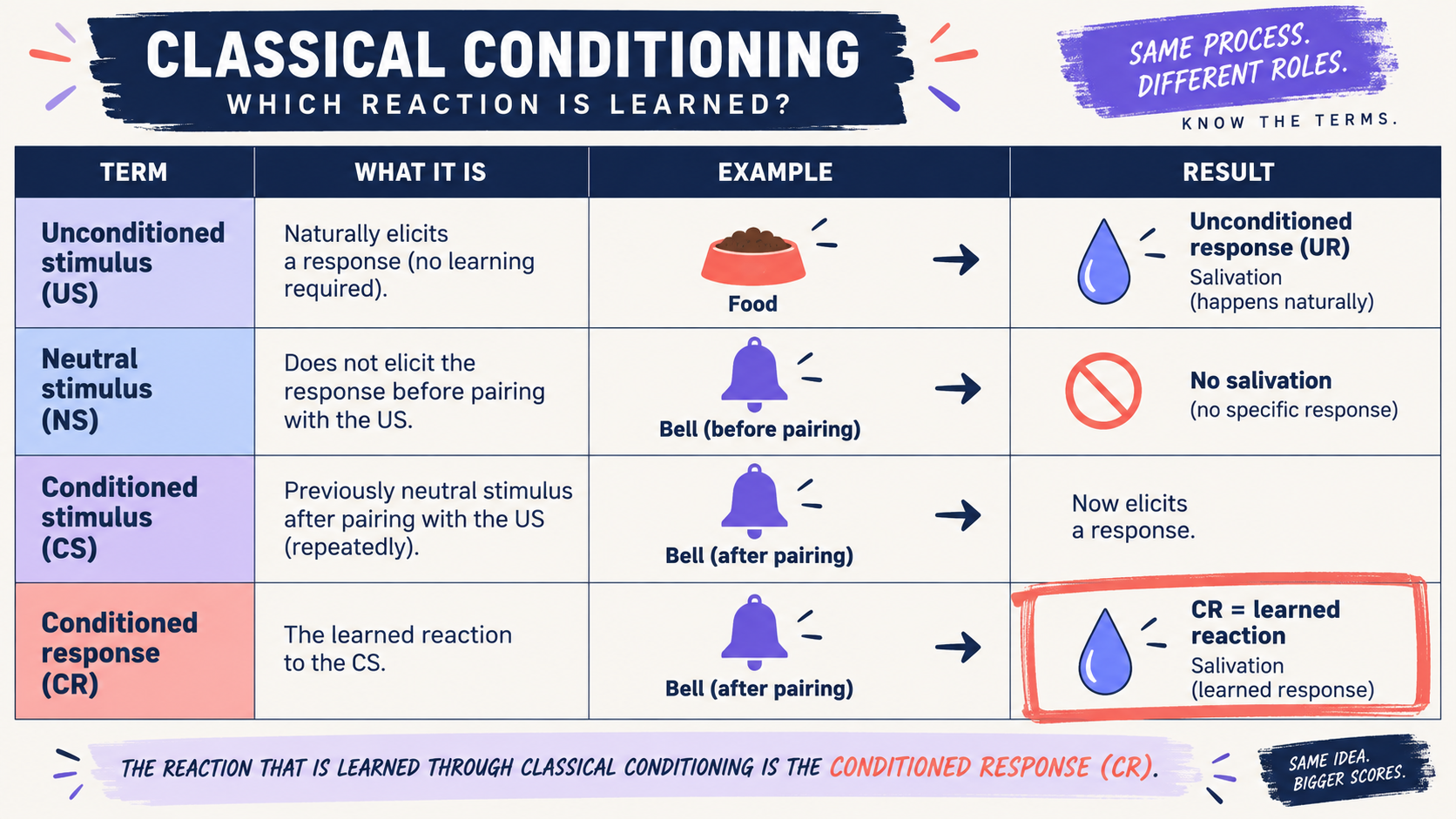
| Term | Meaning | Pavlov example |
|---|---|---|
| Unconditioned stimulus (US) | A stimulus that elicits a response without prior pairing in the procedure. | Food |
| Unconditioned response (UR) | The response elicited by the US before conditioning. | Salivation to food |
| Neutral stimulus (NS) | A stimulus that does not yet reliably elicit the target reflex. | Bell before pairing |
| Conditioned stimulus (CS) | The formerly neutral stimulus after it has acquired eliciting functions through pairing. | Bell after pairing |
| Conditioned response (CR) | The learned reaction elicited by the CS. | Salivation to the bell |
A useful memory line is: US produces UR; pairing changes NS into CS; CS produces CR. The same visible reaction can appear in both the UR and CR columns, but the stimulus producing it tells you which label applies.
A Step-by-Step Example
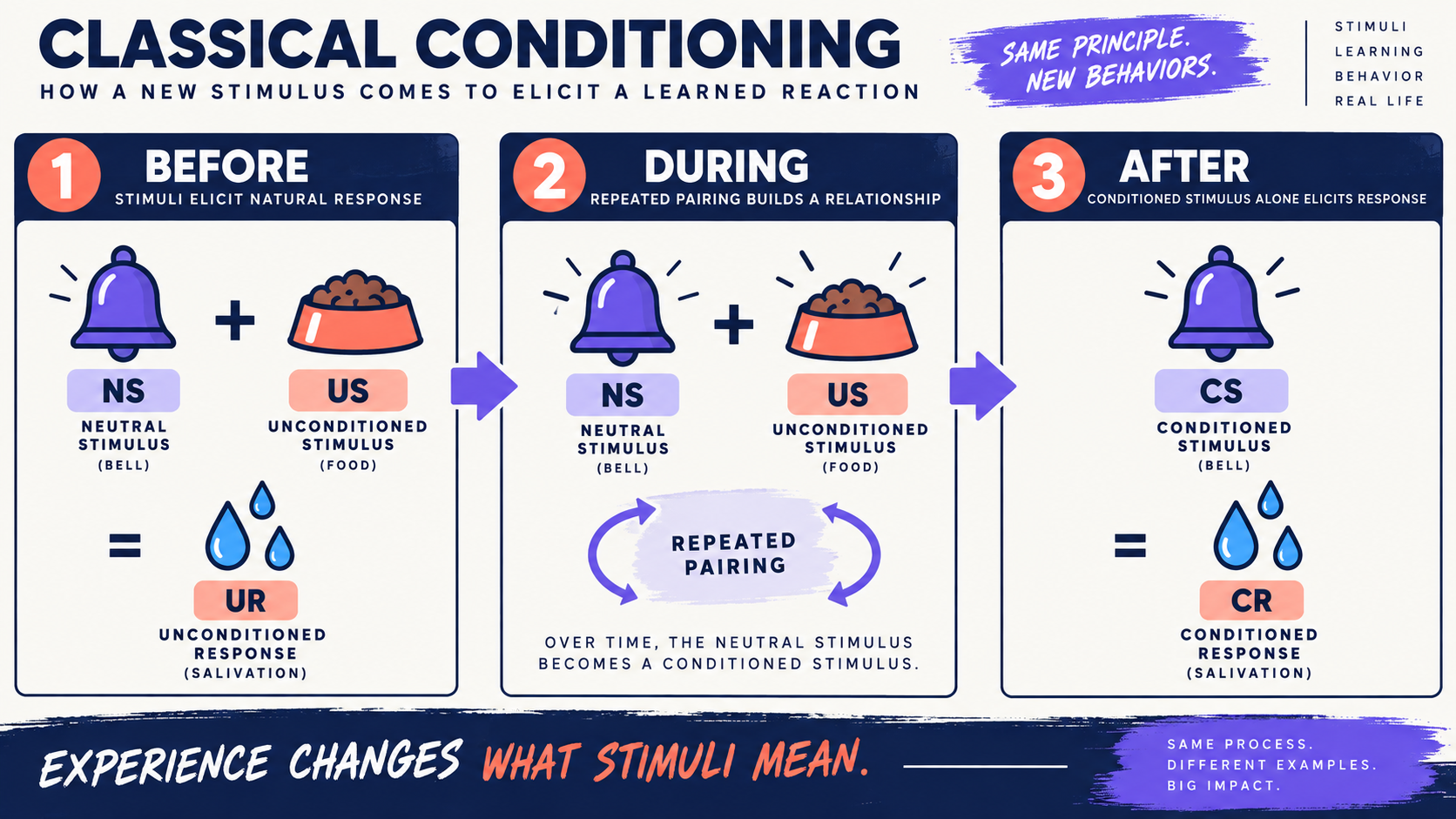
Imagine that a learner hears a particular tone immediately before an unpleasant but harmless air puff. The air puff naturally produces an eye blink. At the beginning, the tone is neutral, the air puff is the US, and the blink to the air puff is the UR.
During acquisition, the tone and air puff are repeatedly paired. The learner’s history now contains a consistent relation between the tone and the biologically significant event. After enough pairings, the tone is presented by itself and the learner blinks. The tone is now the CS, and the blink to the tone is the CR. Notice the important comparison:
- Blink to the air puff: unconditioned response.
- Blink to the tone after pairing: conditioned response.
- Tone after pairing: conditioned stimulus.
- Air puff: unconditioned stimulus.
If the question asks, “Which reaction was learned through classical conditioning?” the answer is the blink that occurs to the tone, not the tone itself. The tone is a stimulus; the blink is the response.
Why This Is Respondent Conditioning
Classical conditioning is also called respondent or Pavlovian conditioning. The target reaction is elicited by a stimulus. The organism does not need to emit the response first in order to produce a consequence. The learning arrangement is based on relations among stimuli and the reactions they evoke.
This is different from an operant example. If a learner raises a hand and the teacher provides attention, and hand raising becomes more likely, the hand raise is an operant behavior selected by its consequence. If a tone is paired with an air puff and later elicits a blink, the blink is a respondent reaction controlled by the stimulus pairing. The word “learned” appears in both examples, but the learning process is different.
The OpenStax explanation of classical conditioning uses the same logic: after repeated pairings, the conditioned stimulus elicits the conditioned response. The APA discussion of instrumental conditioning contrasts this with arrangements in which the response is essential for reinforcement.
Acquisition, Extinction, Generalization, and Discrimination
The core answer is CR, but exam questions often add a process term to test whether you can identify what happened before or after the response was learned.
- Acquisition: the CS-US relation is being established, and the CR develops or becomes stronger.
- Respondent extinction: the CS is repeatedly presented without the US, and the CR decreases over time. Extinction is not the same as erasing the learning history.
- Stimulus generalization: stimuli similar to the CS also elicit similar responses.
- Stimulus discrimination: the organism responds to the CS but not to other similar stimuli that do not signal the US.
- Spontaneous recovery: an extinguished CR may briefly return after a rest period when the CS is presented again.
These are not alternate names for the conditioned response. They describe changes in the conditioning process. If the stem asks for the reaction itself, answer CR. If it asks for the decrease after the CS is presented without the US, answer respondent extinction.
How to Read the Question on a BCBA Exam
For a BCBA-style question, translate the sentence into a small four-part map:
- Find the stimulus that naturally produced the reaction. That is usually the US.
- Find the originally neutral cue that was paired with it.
- Look at what happens when the cue is presented alone after pairing.
- Label the cue CS and the learned reaction CR.
Do not let the stem’s context distract you. A fear response, taste aversion, startle, salivation, or physiological change can be a CR when it is elicited by a CS. The response’s emotional tone does not determine the label; the learning history does.
When studying, use the current BACB BCBA Test Content Outline to understand the exam’s current scope, and use this concept as a discrimination skill. Search results and older study materials may use “classical,” “respondent,” “Pavlovian,” or “conditioned reflex” interchangeably, but the item’s stimulus-response sequence is the evidence you should follow.
Common Answer Choices That Sound Right but Are Wrong
- Conditioned stimulus: this is the cue that elicits the learned reaction, not the reaction itself.
- Unconditioned response: this is the natural reaction to the US before conditioning. The same form of movement can become a CR when a CS elicits it.
- Reinforcement: reinforcement is an operant consequence that changes future behavior. It is not the name of the learned reaction in a respondent pairing.
- Operant response: an operant response is analyzed through its consequences. A CR is analyzed through the stimulus that elicits it after pairing.
- Acquisition: acquisition names the phase or process of learning, not the response produced by the CS.
Quick Identification Checklist
- Is the question describing classical, respondent, or Pavlovian conditioning?
- Which stimulus naturally elicits the reaction? Label it US.
- What reaction occurs to the US before pairing? Label it UR.
- Which cue was neutral before pairing?
- After pairing, which cue is presented alone? Label it CS.
- What reaction occurs to that CS? Label it CR.
- Is the question asking about the response, stimulus, phase, or process?
- Would an operant consequence explain the result better? If yes, do not force a respondent label.
FAQ
What is the reaction learned through classical conditioning?: It is the conditioned response (CR), the learned reaction elicited by a conditioned stimulus after the stimulus has been paired with an unconditioned stimulus. Is a conditioned response always an emotion?: No. Fear and anxiety are common examples, but salivation, blinking, nausea, muscle tension, and other elicited reactions can also become conditioned responses. The defining feature is the stimulus-pairing history.
Can the conditioned response look like the unconditioned response?: Yes. The response may have a similar form, but the labels depend on what elicits it. A blink to an air puff is a UR; a blink to a tone after pairing is a CR.
What is the difference between a conditioned stimulus and conditioned response?: The conditioned stimulus is the formerly neutral cue that acquired an eliciting function. The conditioned response is the learned reaction that occurs when that cue is presented.
What is the quickest way to answer this question on an exam?: Find the reaction that occurs to the formerly neutral cue after pairing. That reaction is the CR. If the question asks what the cue is called, the answer is CS instead.
When a question asks for the reaction learned through classical conditioning, follow the stimulus-response history rather than the emotional wording. A conditioned stimulus elicits a conditioned response; the response is the CR. For additional BCBA scenario practice, try our free BCBA mock exam. Practice can help you distinguish CR, UR, CS, US, and operant consequences, but it does not replace the current BACB outline or supervisor instruction. For targeted review, use our reaction learned through classical conditioning practice questions to apply the concept in exam-style scenarios.
Take the Free BCBA Mock Exam
When you are ready to apply the idea, use the free practice resource below for additional feedback. Take the Free BCBA Mock Exam



