
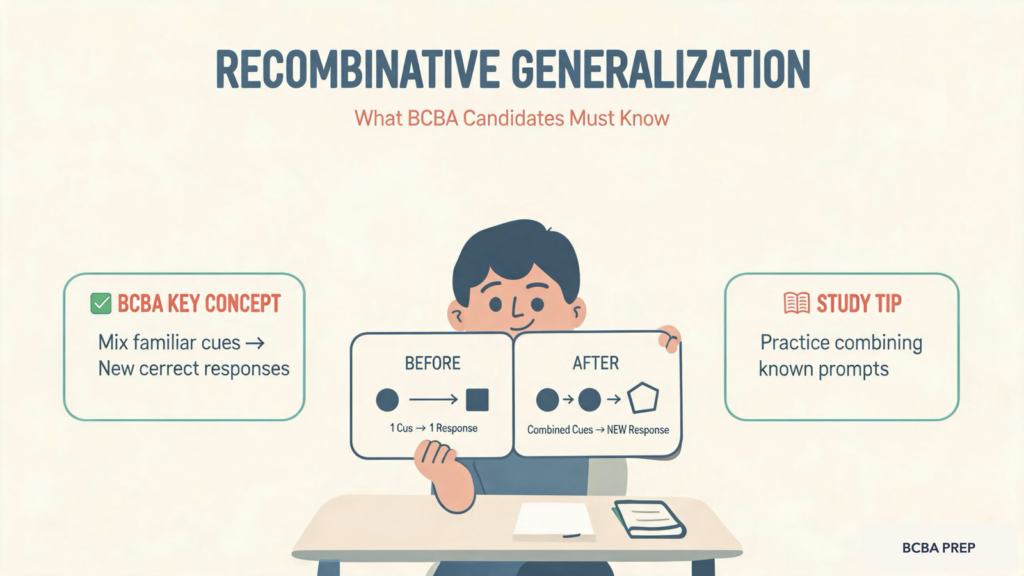
What Is Recombinative Generalization?
Recombinative generalization is a key concept in applied behavior analysis that describes how learners combine previously learned units to produce novel responses without direct teaching. For BCBA candidates, understanding this process is essential because it underlies generative language and complex skill acquisition.
Table of Contents
- What Is Recombinative Generalization?
- ABA Examples of Recombinative Generalization with ABC Analysis
- Exam Relevance and Common Traps
- Quick Study Checklist for Recombinative Generalization
- Summary: Why This Concept Matters for Your BCBA Exam
- References
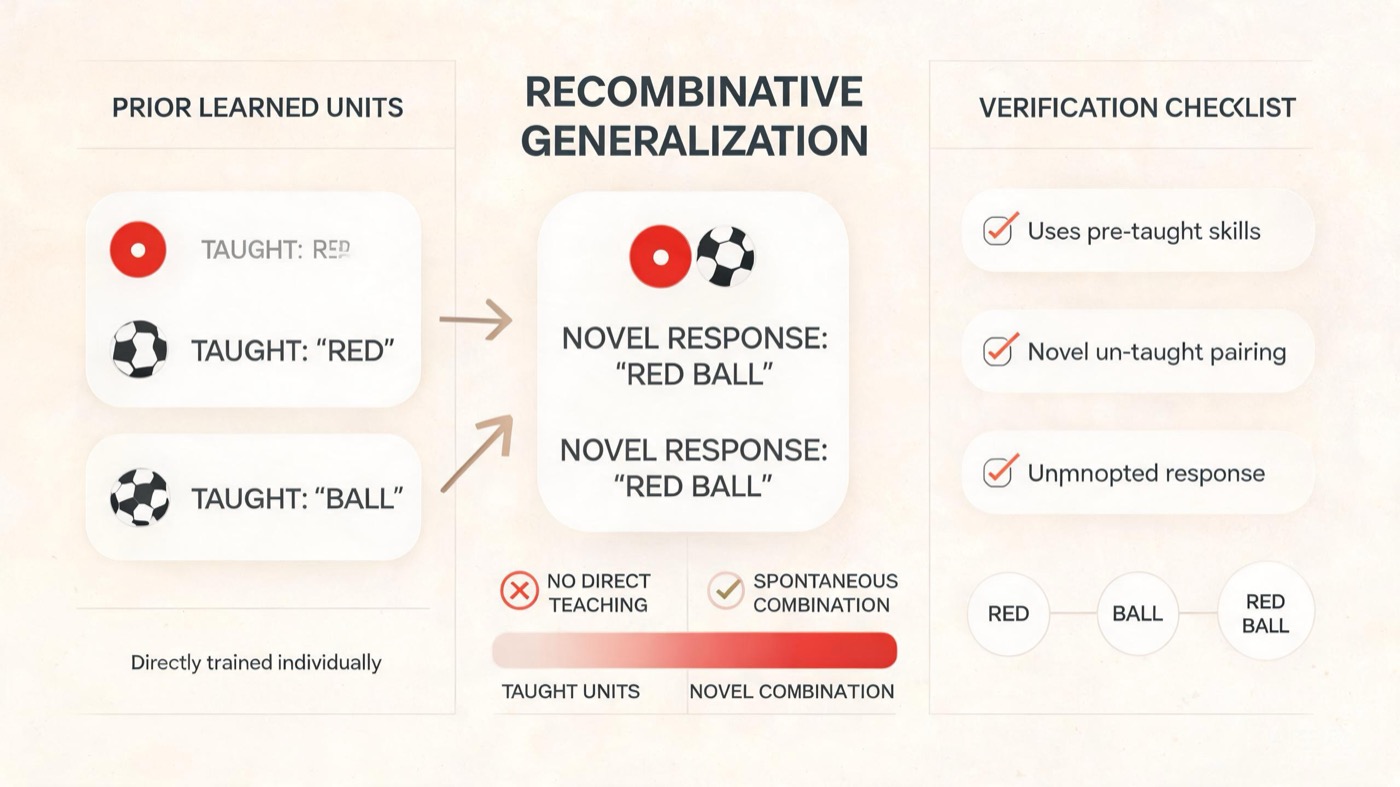
At its core, recombinative generalization involves two or more response classes or stimulus classes being recombined. For example, a child who has learned the sounds ‘ba’ and ‘by’ might spontaneously say ‘baby’ when seeing a picture of an infant. The child did not receive explicit training for the word ‘baby’; instead, they recombined existing units.
Key Components: Response and Stimulus Classes
Recombinative generalization requires prior learning of separate components. These components belong to either response classes (e.g., specific syllables, signs, or motor actions) or stimulus classes (e.g., pictures, objects, or contexts). When a learner encounters a novel stimulus that combines features from two trained classes, they may emit a novel response that is a combination of previously learned responses. This process is often facilitated by matrix training, where stimuli and responses are arranged in a grid to teach component skills and then probe for untrained combinations.
ABA Examples of Recombinative Generalization with ABC Analysis
To prepare for the BCBA exam, you need to recognize recombinative generalization in practice. Below are three concrete examples with an ABC analysis (antecedent, behavior, consequence) and hypothesized function.
Example 1: Combining Syllables to Form Novel Words
- Antecedent: Therapist holds up a picture of a baby and says ‘What is this?’
- Behavior: Child says ‘baby’ (combining previously learned ‘ba’ and ‘by’)
- Consequence: Therapist delivers praise (‘Great saying baby!’)
- Hypothesized function: Social positive reinforcement (attention and praise)
In this scenario, the child had already been taught to say ‘ba’ (e.g., when shown a picture of a bat) and ‘by’ (e.g., waving bye-bye). The novel word ‘baby’ emerges without direct instruction, demonstrating recombinative generalization.
Example 2: Matrix Training for Noun-Verb Combinations
- Antecedent: Therapist presents a card with the word ‘wash’ and a picture of bread
- Behavior: Learner says ‘wash bread’ (combining trained ‘wash apple’ and ‘eat bread’)
- Consequence: Therapist provides a token on the token board
- Hypothesized function: Social positive reinforcement (access to tokens exchangeable for preferred items)
Matrix training systematically teaches all horizontal and vertical combinations (e.g., ‘wash apple’, ‘eat bread’) so that diagonal combinations (e.g., ‘wash bread’) are probed for recombinative generalization. This approach is efficient and commonly tested on the exam.
Example 3: Recombining Signs in ASL
- Antecedent: Learner sees a preferred snack and makes a hungry gesture
- Behavior: Learner signs ‘more eat’ (combining previously learned signs for ‘more’ and ‘eat’)
- Consequence: Caregiver gives access to the snack
- Hypothesized function: Access to tangibles
Note that the learner was not directly taught the phrase ‘more eat’. Instead, they combined two known signs to express a new request. This example highlights how recombinative generalization can occur across modalities (spoken, signed, written).
Exam Relevance and Common Traps
The BCBA exam frequently includes scenario-based questions that ask you to identify the type of generalization or select the best teaching strategy. You might be given a description of a learner who produces a novel response and asked whether it reflects recombinative, response, or stimulus generalization.
How Recombinative Generalization Appears on the Exam
- Questions that describe a learner combining two previously mastered skills (e.g., ‘clap’ and ‘jump’) to produce ‘clap and jump’ without training.
- Items that present matrix training data and ask you to interpret which cells demonstrate recombinative generalization.
- Scenarios where a client uses a novel two-word phrase after learning individual words, and you must identify the generalization type.
Common Distractors to Watch For
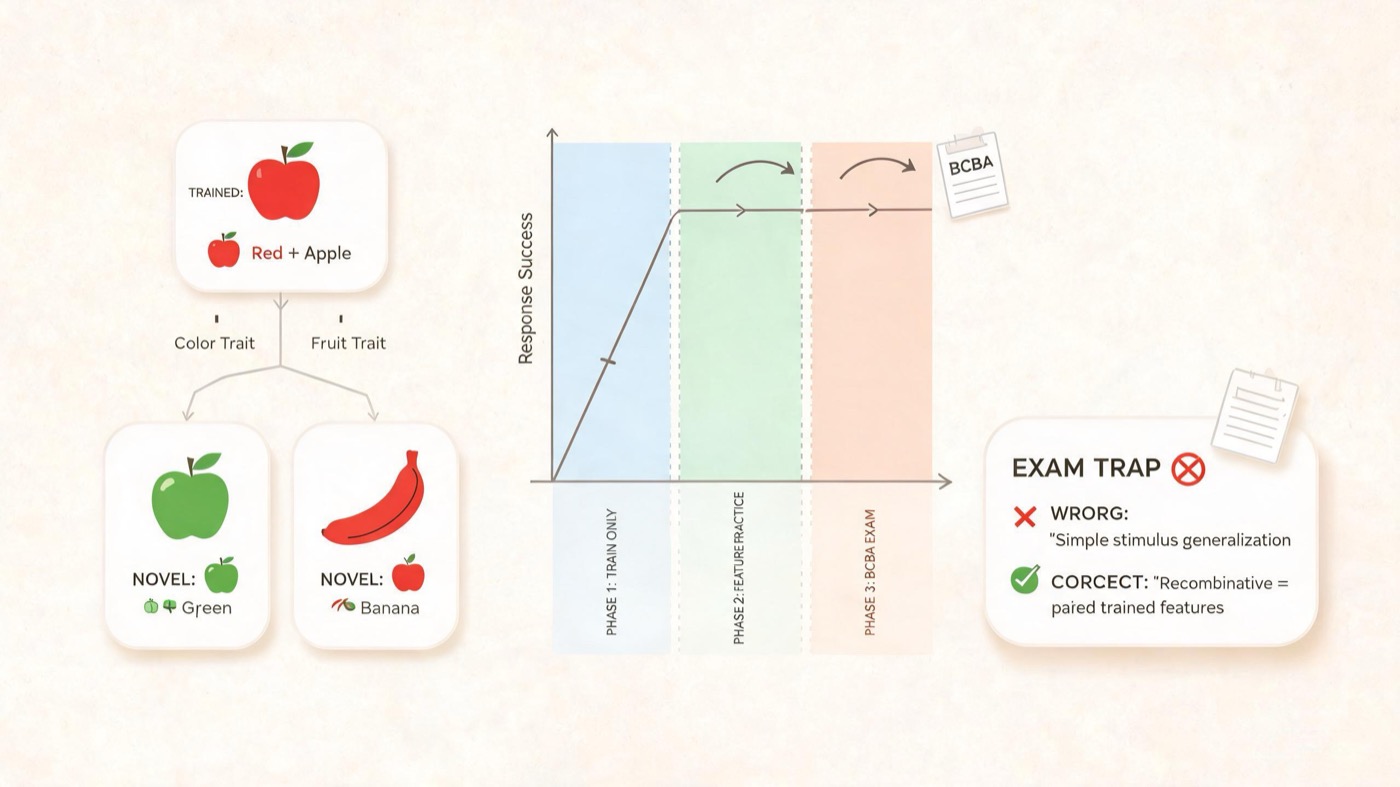
- Confusing with response generalization: Response generalization occurs when the same stimulus evokes a different but functionally similar response (e.g., saying ‘car’ vs. ‘automobile’). Recombinative generalization specifically involves recombining component units.
- Confusing with stimulus generalization: Stimulus generalization occurs when a response occurs in the presence of novel stimuli that share features with the training stimulus. In recombinative generalization, the response itself is novel.
- Assuming any novel behavior is recombinative: Always check whether the learner had prior training on the component parts. Without evidence of component learning, a novel response may be due to other processes like rule-governed behavior or untrained stimulus relations.
For a deeper dive into related generalization concepts, see our guide on stimulus and response generalization.
Quick Study Checklist for Recombinative Generalization
Use this checklist to review before exam day:
- Define recombinative generalization in your own words: combining trained components to produce a novel response.
- Identify the components: What are the response classes and stimulus classes involved?
- Practice ABC examples: For each example, write the antecedent, behavior, consequence, and function.
- Differentiate from other generalizations: Compare with response generalization and stimulus generalization using flashcards or a comparison table.
- Review matrix training: Understand how to set up a matrix and interpret probe data.
- Solve practice scenarios: Use mock exam questions to apply your knowledge.
For more exam-focused practice, try our BCBA mock exam for the 6th edition.
Summary: Why This Concept Matters for Your BCBA Exam
Recombinative generalization is a cornerstone of generative language and efficient teaching. On the BCBA exam, you will need to distinguish it from other forms of generalization and select interventions that promote it. Mastering this concept not only helps you pass the test but also equips you to design effective programming for your future clients. Keep practicing with real-world examples and review the task list items related to generalization and maintenance. Good luck!



