
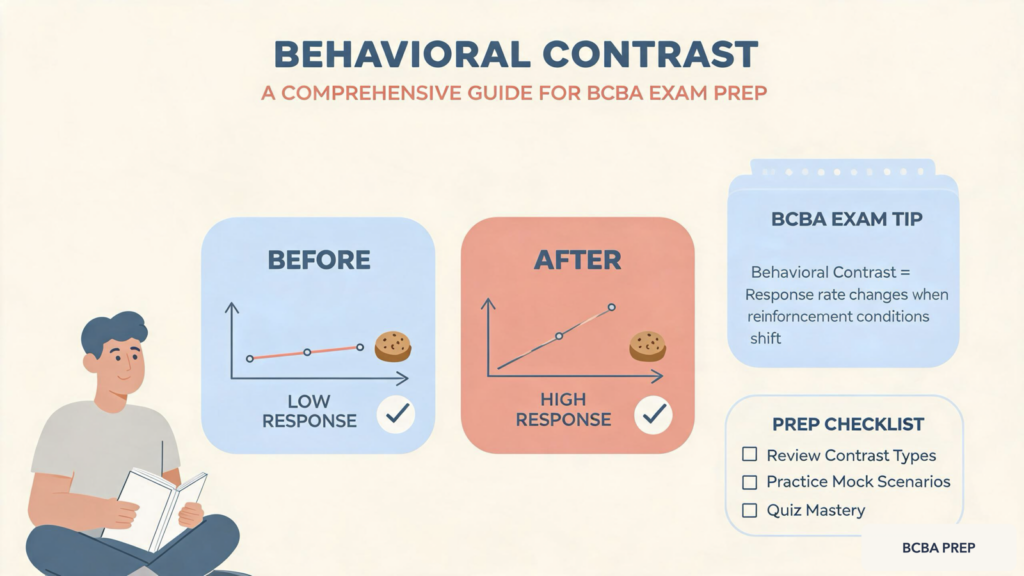
What Is Behavioral Contrast?
Behavioral contrast is a phenomenon in applied behavior analysis where a change in reinforcement in one context leads to a change in behavior in another context, often in the opposite direction. For example, if a child’s aggression is reduced in a clinic using a differential reinforcement of other behavior (DRO) schedule, the aggression might increase at home where no such intervention is in place. This effect is critical for BCBA candidates to understand because it directly impacts treatment integrity and generalization planning.
Table of Contents
- What Is Behavioral Contrast?
- Real ABA Examples of Behavioral Contrast (ABC Analysis)
- Exam Relevance and Common Traps
- Quick Checklist for Behavioral Contrast
- Conclusion and Next Steps
The Standard Definition in ABA
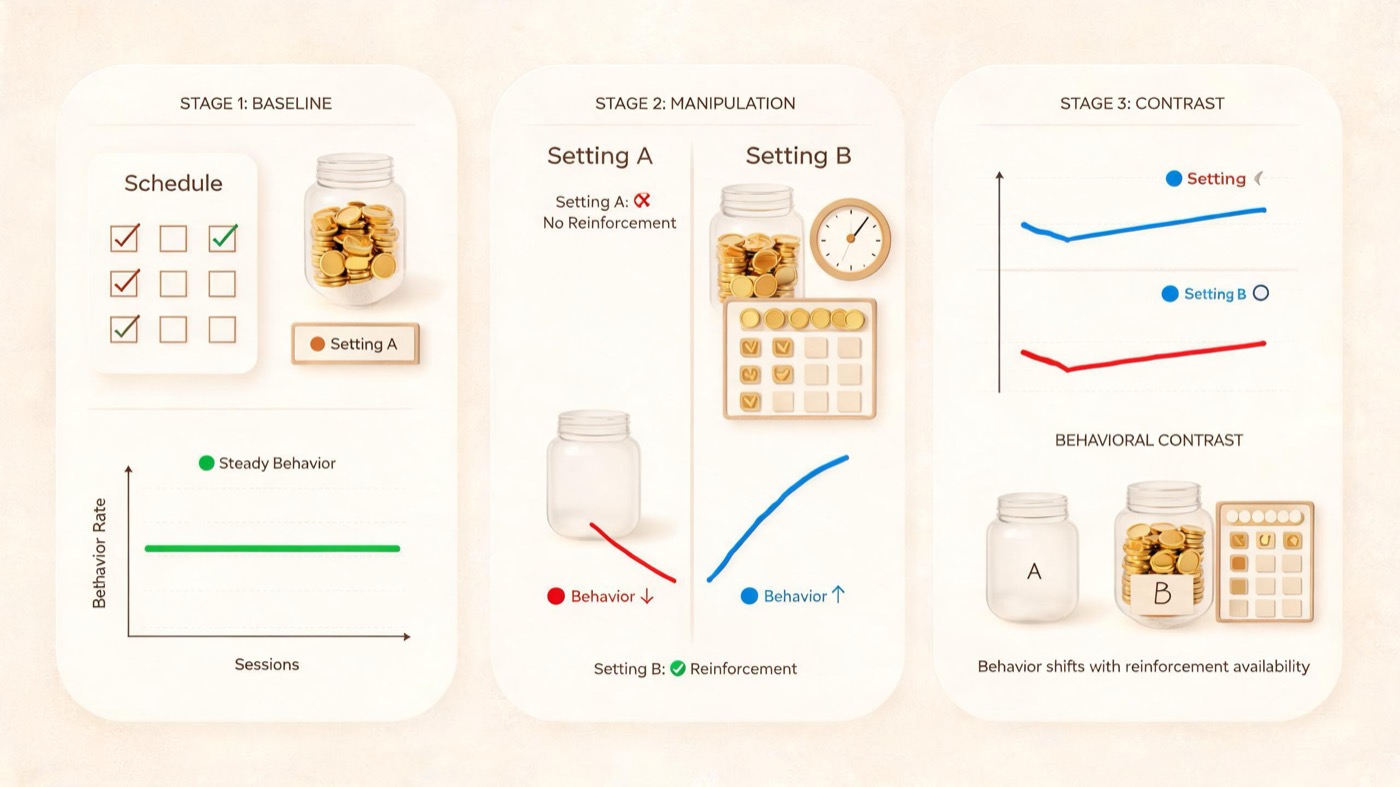
Formally, behavioral contrast refers to the inverse relationship between behavior occurring under two different reinforcement schedules or contexts. It is most commonly observed when using multiple schedules of reinforcement. When the rate of reinforcement changes in one component of a multiple schedule, the response rate in the other component changes in the opposite direction. This contrast effect can be positive (increase in behavior) or negative (decrease in behavior) depending on the context.
How Behavioral Contrast Relates to the BCBA Exam
The BCBA exam frequently tests your ability to identify behavioral contrast in real-world scenarios. Exam questions often present a situation where a behavior decreases in a treatment setting but increases in a non-treatment setting. You must distinguish this from generalization (which involves similar behavior across contexts) and maintenance (behavior persisting over time). Understanding the role of reinforcement changes is key to answering these questions correctly.
Real ABA Examples of Behavioral Contrast (ABC Analysis)
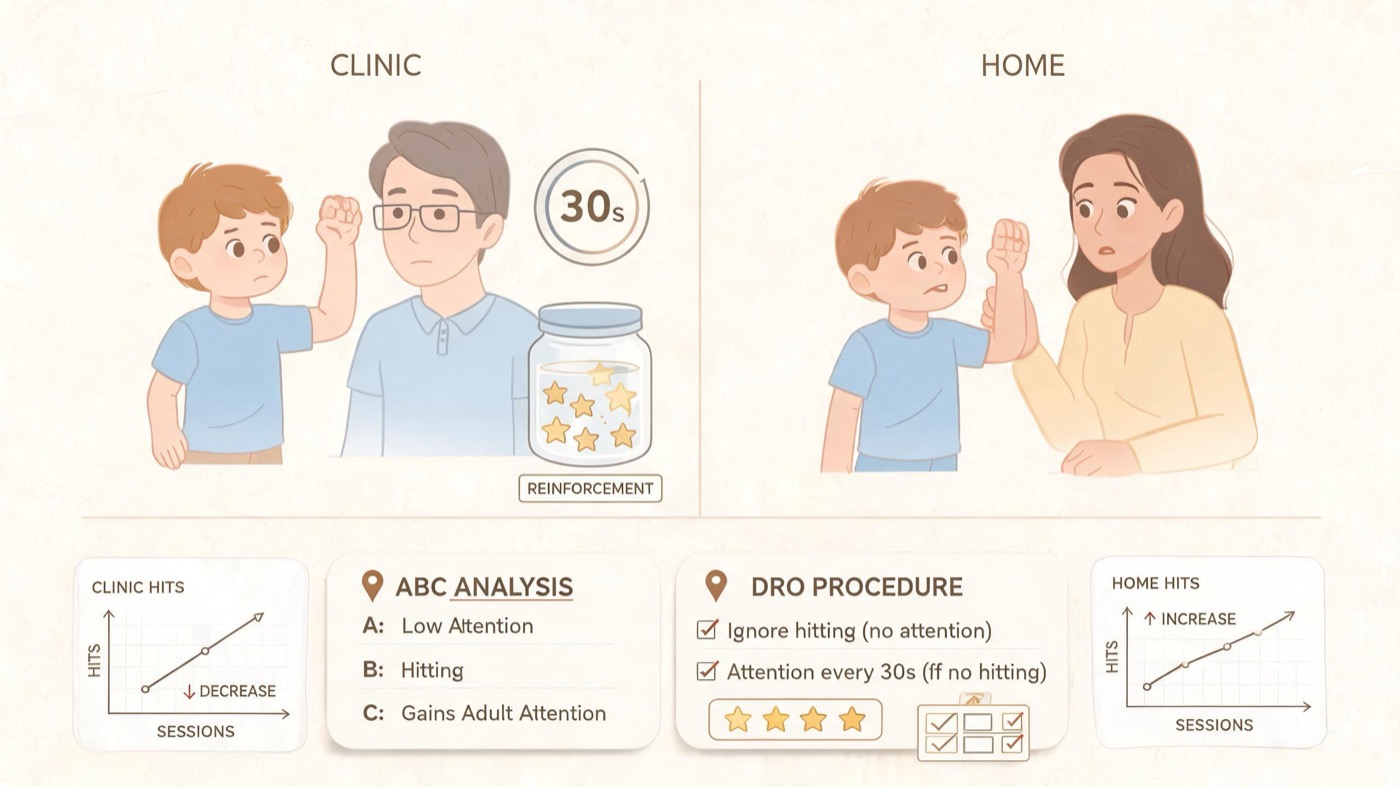
Example 1: Aggression During DRO Implementation
A 5-year-old boy engages in hitting peers to gain adult attention. In the clinic, a DRO procedure is implemented: hitting is ignored, and attention is provided for every 30 seconds without hitting. As a result, hitting decreases in the clinic. However, at home, where no DRO is in place, hitting increases. Using an ABC analysis: Antecedent = demand (e.g., clean up toys); Behavior = hitting; Consequence = attention from parent. The hypothesized function is positive reinforcement (access to attention). The contrast occurs because the DRO in the clinic reduces the reinforcement for hitting, making the home environment relatively richer in reinforcement for that behavior.
Example 2: Self-Stimulatory Behavior in Different Settings
A 9-year-old with autism engages in hand flapping, which provides automatic sensory reinforcement. In the classroom, a DRO schedule delivers a preferred edible for every 2 minutes without hand flapping. Hand flapping decreases in class. On the playground, where no DRO is used, hand flapping increases. Here, the automatic reinforcement remains constant, but the added reinforcement in the classroom makes the playground relatively more reinforcing for hand flapping. This is an example of contrast with automatic reinforcement.
Example 3: Compliance in School vs. Home
A teenager with ADHD complies with homework instructions at school because teachers use a token economy that provides points for compliance. At home, parents use a less structured approach, and compliance drops. The school’s rich reinforcement schedule for compliance makes the home’s relatively lean schedule less effective, leading to a decrease in compliance at home. This illustrates how contrast can affect socially significant behaviors like compliance.
Exam Relevance and Common Traps
How Behavioral Contrast Appears on the BCBA Exam
On the BCBA exam, you will encounter multiple-choice questions that describe a scenario and ask you to identify the phenomenon. Typical presentations include a behavior decreasing in one setting and increasing in another, often in the context of differential reinforcement or a change in schedule. You may also be asked to distinguish behavioral contrast from generalization, maintenance, or side effects of intervention, such as an extinction burst.
Top 3 Traps to Avoid
- Trap 1: Confusing contrast with generalization. Generalization means the behavior occurs in similar but non-trained contexts; contrast means the behavior changes in opposite directions across contexts. Always look for a decrease in one setting and an increase in another.
- Trap 2: Assuming contrast always involves problem behavior. Contrast can occur with any behavior, including adaptive behaviors like compliance or academic performance. The defining feature is the change in reinforcement contingencies, not the behavior type.
- Trap 3: Forgetting that contrast requires a change in reinforcement. Without a change in the reinforcement schedule in at least one context, contrast does not occur. This distinguishes it from other phenomena like contextual variation due to antecedent changes.
Quick Checklist for Behavioral Contrast
Use this checklist to review key points before the exam.
- Define: A change in behavior in one context when reinforcement changes in another context.
- Identify: Look for opposite direction of behavior change across settings (e.g., decrease in clinic, increase at home).
- Analyze: Always note the reinforcement schedules in each context. Has a DRO, DRI, or other differential reinforcement been introduced?
- Distinguish: Contrast is not generalization (same direction) or maintenance (same context over time).
- Apply: When planning interventions, anticipate contrast and program for generality (e.g., teach family members to use similar contingencies).
Conclusion and Next Steps
Behavioral contrast is a fundamental concept in ABA that can complicate treatment outcomes if not anticipated. For BCBA candidates, mastering this topic means being able to identify it in scenario-based questions and understand its implications for treatment integrity and generalization. To deepen your understanding, review the differential reinforcement guide and practice with mock questions. For a broader perspective, consult the BACB task list and research articles. By recognizing contrast early, you can design interventions that minimize its negative effects and promote consistent behavior change across all settings.
Next step for BCBA exam prep
Turn this topic into exam-day practice
Use this topic as a focused review, then test it in exam-style conditions with a free mock before deciding whether five full-length mocks are the right next step.
Start the Free BCBA Mock ExamContinue with Five Full-Length Mocks — $99
Review the included materials and access details before ordering. No pass guarantee is implied.



