
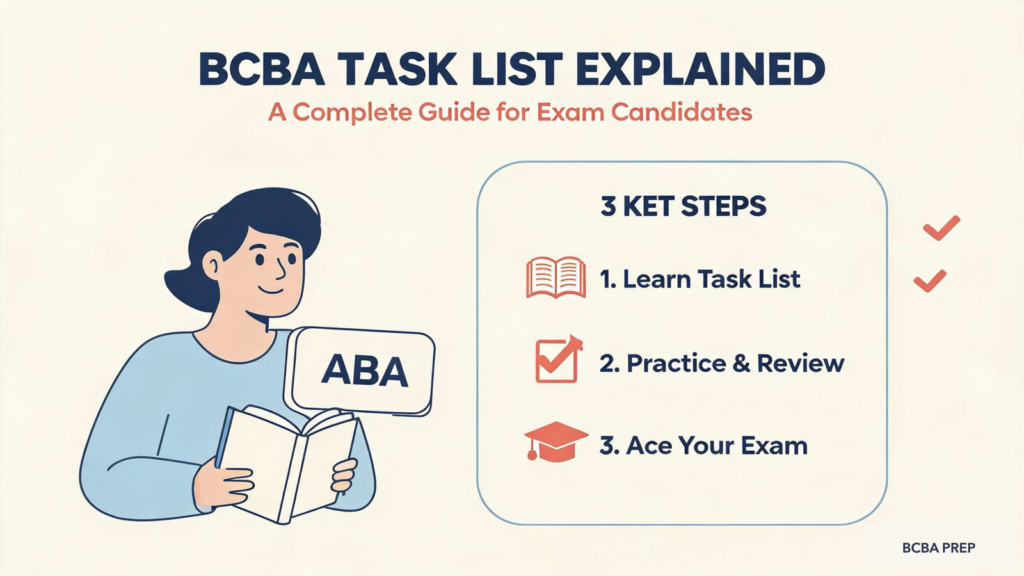
What Is the BACB Task List?
Think of the BCBA Task List as the official blueprint for the BCBA exam. Published by the Behavior Analyst Certification Board (BACB), this document lists every competency a behavior analyst must master. It is your study roadmap. The BACB updates the Task List periodically to reflect current best practices. For exam candidates, knowing this document is essential because every exam question maps back to a specific task item.
Table of Contents
- What Is the BACB Task List?
- Key Domains of the Task List Explained
- Worked ABA Examples to Solidify Concepts
- Exam Relevance and Common Traps
- Quick Checklist for Task List Mastery
- Summary: Your Roadmap to Exam Success
Why the Task List Matters for Your Exam Prep
If you are preparing for the BCBA exam, the Task List helps you prioritize. Instead of guessing what might appear, you can systematically check off each domain. Many candidates who fail their first attempt did not use the Task List as a study guide. Use it to identify weak areas and focus your study time. For a deeper dive, see our BCBA Exam Prep Guide for actionable strategies.
Key Domains of the Task List Explained
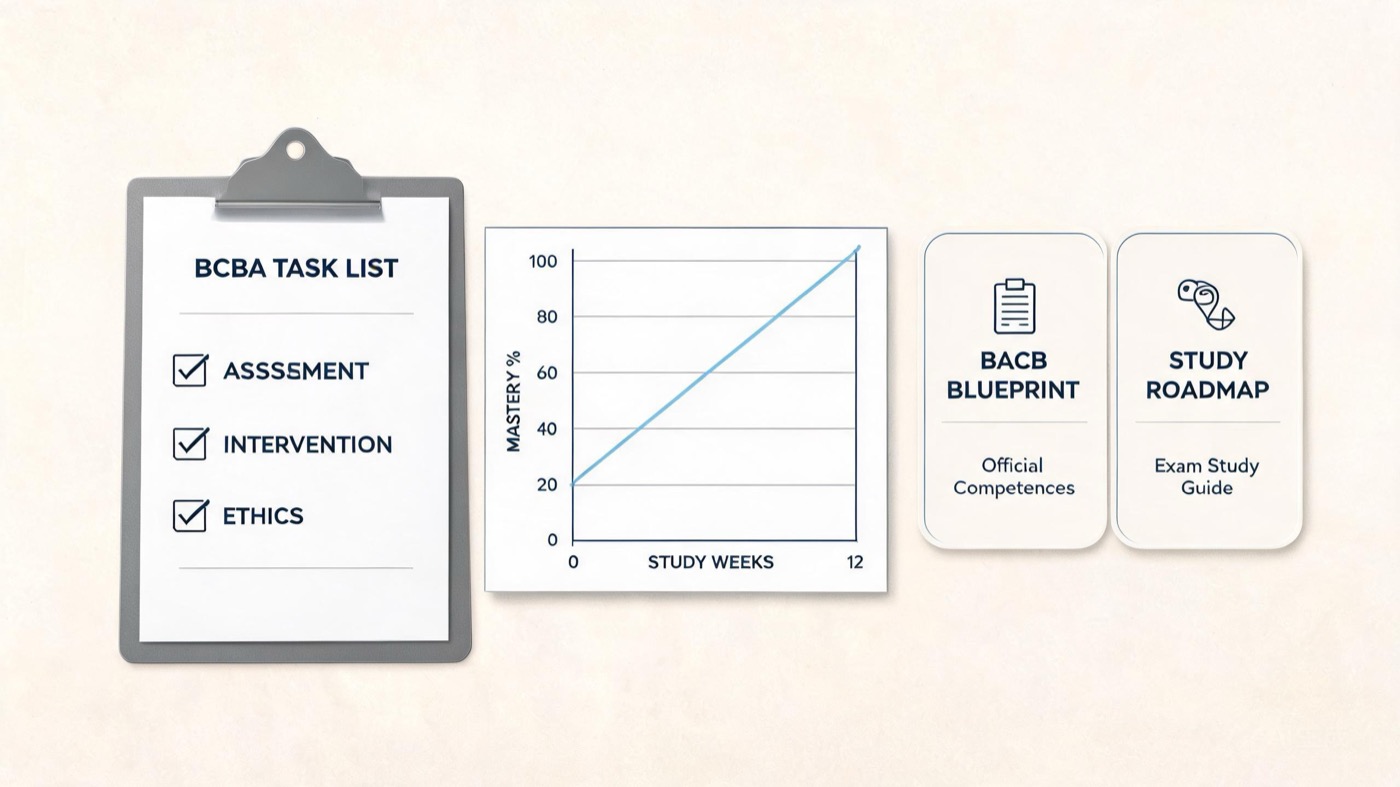
The Task List is organized into four main domains. Each domain contains specific tasks you must be able to perform. Below, we break down each domain with exam-relevant details.
Ethical and Professional Conduct
This domain covers the BACB Ethics Code. You must know how to apply ethical principles in real-world scenarios. For example, when obtaining informed consent, a BCBA must explain procedures, risks, and alternatives in the client’s preferred language. Expect questions that ask you to identify the most ethical course of action.
Assessment and Measurement
Assessment includes measuring behavior, conducting functional behavior assessments (FBAs), and analyzing data. For instance, you might be given ABC data and asked to hypothesize the function of a behavior. Direct observation and preference assessments are common exam topics. Master interpreting graphs and calculating interobserver agreement.
Behavior Intervention and Support
Interventions must be function-based. Common exam questions ask you to select the appropriate reinforcement schedule or punishment procedure. A key pitfall is recommending a consequence that does not match the identified function. Always link the intervention to maintaining consequences.
Systems Support and Supervision
This domain includes supervising RBTs and other staff. You must understand performance management, training procedures, and monitoring treatment integrity. Questions often involve designing a supervision schedule or addressing staff drift from protocols.
Worked ABA Examples to Solidify Concepts
Applying the Task List to real cases helps you remember core concepts. Here are three examples demonstrating the link between assessment and intervention.
Example 1: Reducing Aggression in a Classroom
- Antecedent: Teacher delivers a demand (e.g., ‘complete worksheet’).
- Behavior: Student hits the desk and screams.
- Consequence: Teacher removes the demand.
- Hypothesized function: Escape from task demands.
- Intervention: Teach functional communication (e.g., requesting a break) and provide non-contingent escape every 5 minutes.
Example 2: Increasing On-Task Behavior
- Antecedent: Child is given a math worksheet.
- Behavior: Child writes answers correctly for 2 minutes.
- Consequence: Teacher says ‘Great job!’ and smiles.
- Hypothesized function: Social attention.
- Intervention: Use differential reinforcement of high rates of behavior (DRH) for on-task behavior; provide praise every 3 minutes of focus.
Example 3: Addressing Self-Stimulatory Behavior
- Antecedent: Alone in a quiet room.
- Behavior: Hand flapping for several seconds.
- Consequence: Sensory stimulation.
- Hypothesized function: Automatic reinforcement.
- Intervention: Provide alternative sensory activities (e.g., stress ball or fidget toy) to meet the same sensory need.
Exam Relevance and Common Traps
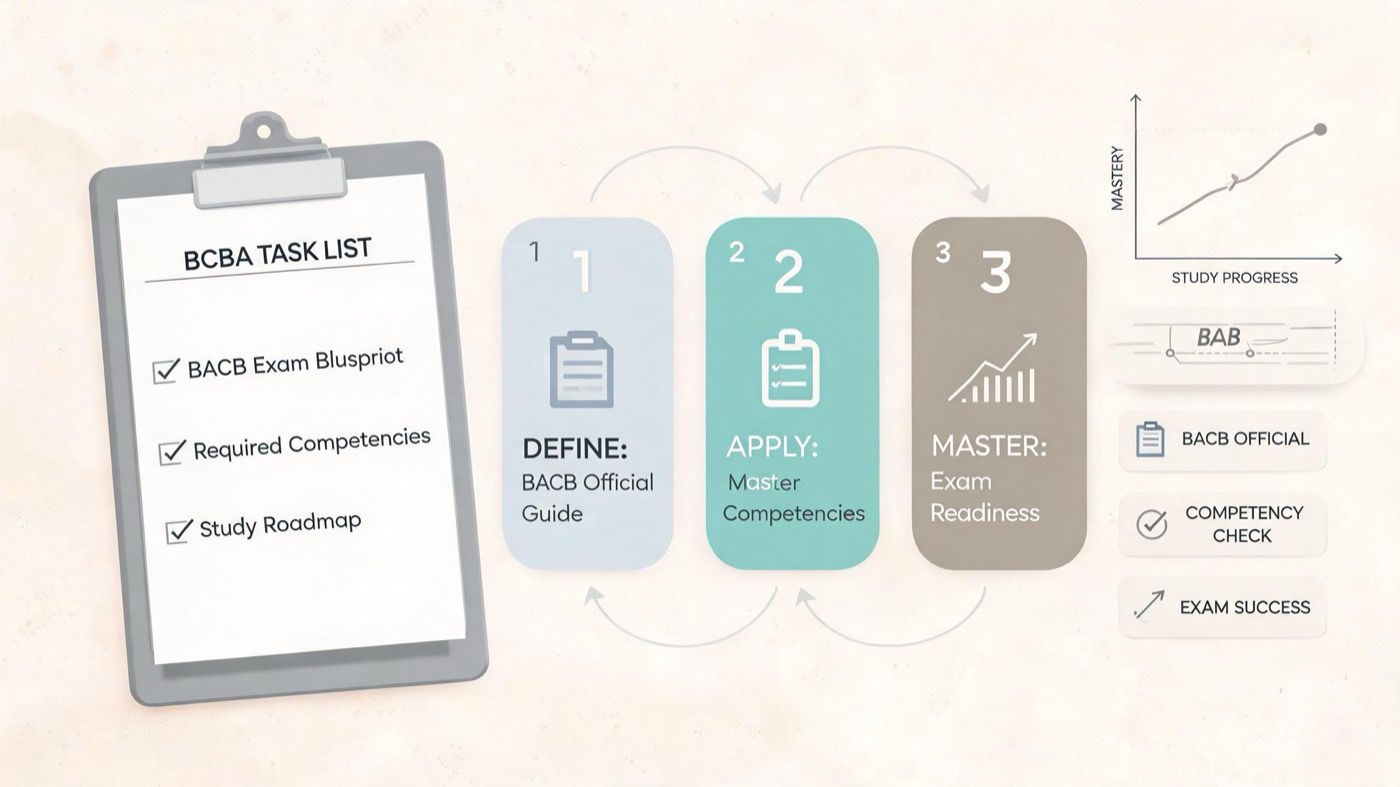
The BCBA exam tests your ability to apply the Task List under time pressure. Many candidates fall into predictable traps. Here are the most common ones and how to avoid them.
Misinterpreting Function-Based Interventions
Trap: Choosing a consequence that does not match the hypothesized function. For example, using time-out (removal from reinforcement) for a behavior maintained by escape — that would actually reinforce the behavior. Strategy: Always ask: ‘What does the behavior achieve for the learner?’ Then select an intervention that teaches a replacement behavior.
Confusing Topography with Function
Trap: Describing the behavior’s form (e.g., ‘hitting’) instead of its purpose. Two children may hit for different reasons. One might hit for attention, another to escape. Strategy: Focus on functional analysis rather than topography when designing interventions.
Overlooking Ethical Safeguards
Trap: Recommending restraint or punishment before trying least intrusive interventions. The BACB Ethics Code requires you to start with reinforcement-based strategies. Strategy: Always consider if a less restrictive option exists before implementing aversive procedures.
For more exam tips, check out our article on BCBA test question strategies.
Quick Checklist for Task List Mastery
Use this checklist to track your progress through the Task List. Check off each item as you feel comfortable with it.
- Ethics: Review the BACB Ethics Code and practice scenarios.
- Measurement: Calculate interobserver agreement and interpret graphs.
- Assessment: Conduct ABC data collection and functional analyses.
- Intervention: Implement differential reinforcement and extinction procedures.
- Supervision: Design a supervision plan and evaluate treatment integrity.
- Systems: Monitor and improve staff performance using behavioral feedback.
Summary: Your Roadmap to Exam Success
The BCBA Task List is your ultimate study roadmap. By breaking down each domain, practicing with real examples, and avoiding common traps, you can approach the exam with confidence. Remember to use this list to guide every study session. For additional practice, try our free BCBA mock exam questions to test your knowledge. Start now and check off each task — one step closer to certification.
Complete BCBA Exam Prep
Turn this topic into exam-day practice
Practice concepts in context with five full-length 6th Edition mock exams, two bonus practice exams, a 6th Edition study guide, and key-term flashcards—all in one $120 USD package.
Get the $120 All-in-One Prep Pack
Review everything included on the product page before ordering. No pass guarantee is implied.



