
The phrase reactive strategies ABA describes planned actions used when interfering or dangerous behavior is already occurring. A reactive strategy is the response that helps people stay safe, reduce escalation, and return to a teachable condition. It is not the whole treatment plan, a synonym for punishment, or a substitute for understanding why the behavior occurs.
Table of Contents
- What Are reactive strategies ABA?
- How Are Proactive and Reactive Strategies Different?
- How Should Function Guide a Reactive Response?
- How Should a BCBA Write the Reactive Section of a BIP?
- What Data Should Be Collected for Reactive Strategies ABA?
- What Are the Ethics and BCBA Exam Boundaries?
- Reactive Strategies ABA FAQ
- Take the Free BCBA Mock Exam
For BCBA exam questions, the best answer usually separates two timelines: what the team changes before behavior occurs and what the team does during an episode. Proactive supports should make the target behavior less likely and teach a useful alternative. Reactive supports should be clear, least intrusive, function-informed, and limited to the immediate situation. This guide explains the distinction, shows how to write a response section in a behavior plan, and identifies the data and ethics checks that keep a reactive plan from becoming a vague list of consequences.
What Are reactive strategies ABA?
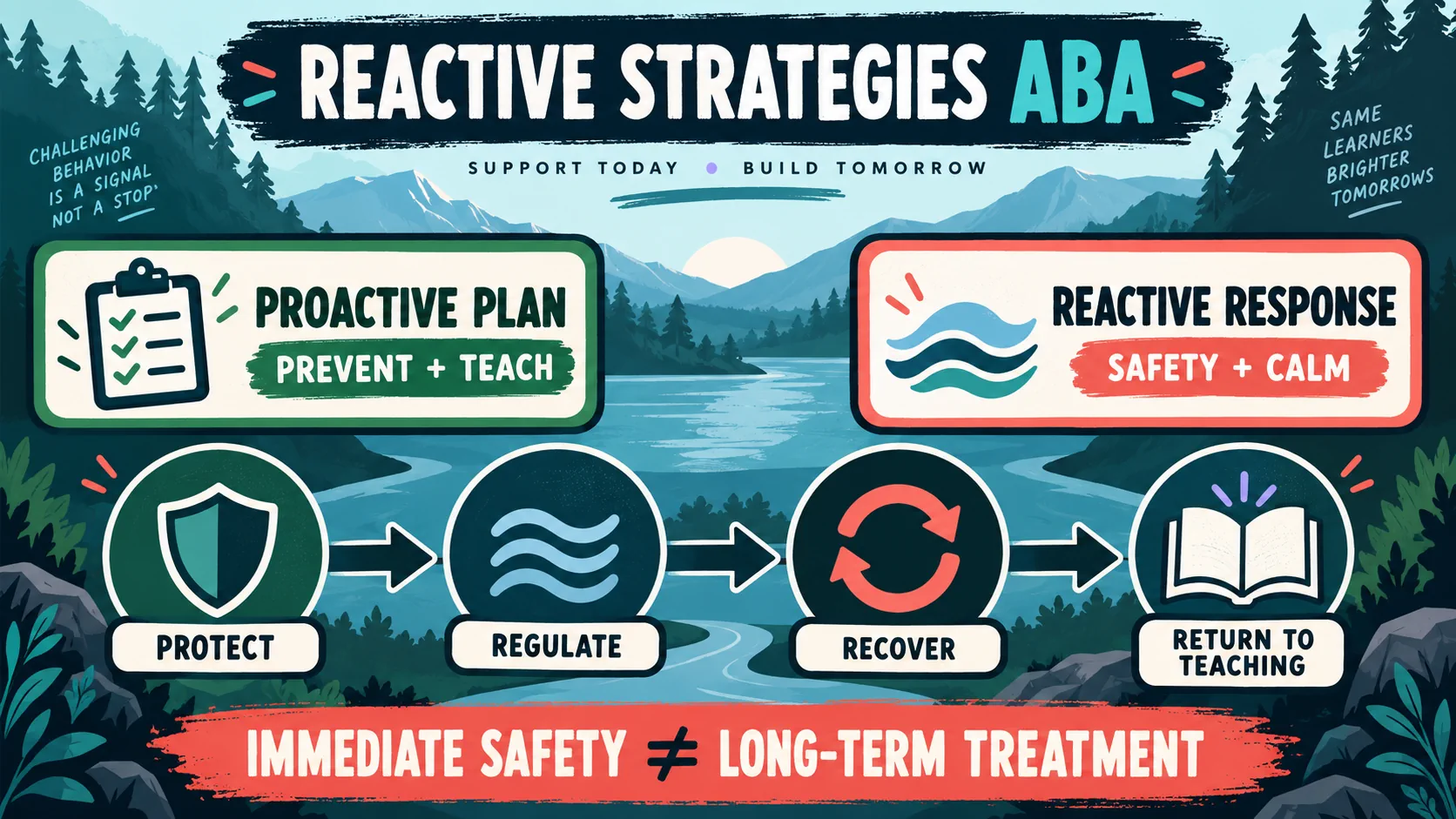
Reactive strategies are preplanned responses to behavior that has begun. The response might involve reducing stimulation, creating space, protecting other people from hazards, prompting a previously taught communication or coping response, pausing a demand according to the written plan, or calling for trained assistance. The specific choice depends on the behavior, its likely function, the setting, the person’s communication and medical needs, and the organization’s safety procedures.
The word planned is important. A reactive strategy should not be invented in the emotional peak of an incident. Staff and caregivers need to know what the behavior looks like, which early signs matter, what they should say or do, which steps are prohibited, when to seek help, and how to document the event. The plan should also state what happens after the person is calm: repair, medical check if needed, access to communication, return to instruction, and review of the data.
- Immediate purpose: reduce risk and support regulation during the episode.
- Limited scope: address what is happening now rather than trying to teach a complex skill in the peak of escalation.
- Function connection: avoid responses that accidentally strengthen the target behavior or remove an effective replacement response.
- Teaching return: once the situation is safe, reconnect the person with communication, choice, reinforcement, and the proactive plan.
Reactive strategies are not automatically restrictive. A neutral prompt, a lower-stimulation space, a brief pause, or moving a fragile object can be less intrusive than a physical procedure. Conversely, a strategy should not be called “mild” just because it is common. The team must consider the actual risk, the person’s experience, the likelihood of escalation, and whether the response is supported by assessment and policy.
How Are Proactive and Reactive Strategies Different?
Proactive strategies occur before the target behavior and change the conditions in which it is likely to happen. They may include functional communication training, visual information, choices, task modification, preference-based reinforcement, noncontingent reinforcement, prompting, and teaching tolerance or coping skills. Their long-term job is to make an effective alternative available and reduce the need for crisis responses.
Reactive strategies occur after the behavior or escalation signal has started. Their first job is safety and their second job is recovery. They may temporarily change the environment or the demand, but they should not replace instruction. A plan built almost entirely from reactive responses can keep a team busy managing episodes while leaving the antecedents, skill deficits, reinforcement history, and environmental barriers unchanged.
| Question | Proactive plan | Reactive plan |
|---|---|---|
| When? | Before or at the earliest predictable cue. | When the defined behavior or escalation signal occurs. |
| Main job | Prevent, teach, arrange reinforcement, and improve fit. | Protect, de-escalate, reduce immediate severity, and restore calm. |
| Typical review | Did the alternative skill become easier and more valuable? | Did risk, duration, intensity, or recovery burden change without harmful side effects? |
| Common error | Using a generic support without matching the function or context. | Treating the reactive response as the intervention and never returning to teaching. |
The two parts should work together. If a reactive response repeatedly ends a difficult task, the team should ask whether escape is being reinforced and whether the plan teaches a safe, efficient break request. If staff repeatedly provide long conversations after aggression, attention may be part of the maintaining pattern. These are hypotheses, not conclusions; the analyst still needs observation, data, and a review of the full context.
How Should Function Guide a Reactive Response?
Function does not mean that every reactive response must deliver the consequence that would have maintained the behavior. It means the team should understand what the behavior may be communicating or producing and avoid making the replacement less efficient. A response that is safe in one case may be unsafe or counterproductive in another.
- Define the target: describe the observable behavior and the threshold that activates the response. “Escalated” is not enough without examples.
- Identify early cues: note changes in voice, pacing, refusal, approach, self-injury, property contact, or other signals that reliably precede greater risk.
- Protect first: use trained, approved environmental and communication steps; remove hazards and create distance when the plan requires it.
- Preserve a replacement: prompt a break, help request, wait response, or other functional communication when the person can use it safely.
- Check the consequence: record what the response changed and whether it may strengthen the target behavior or weaken the replacement.
- Plan recovery: restore dignity, check well-being, document the event, and return to instruction only when the person is ready.
Do not tell an untrained caregiver to improvise a physical hold, restraint, seclusion procedure, or emergency maneuver from an online article. Those actions require applicable law, organizational policy, competency training, medical and risk review, and a plan written by qualified professionals. In an immediate emergency, follow local emergency procedures and seek appropriate help. An exam question that includes imminent danger is testing prioritization and scope, not creative instructions.
How Should a BCBA Write the Reactive Section of a BIP?
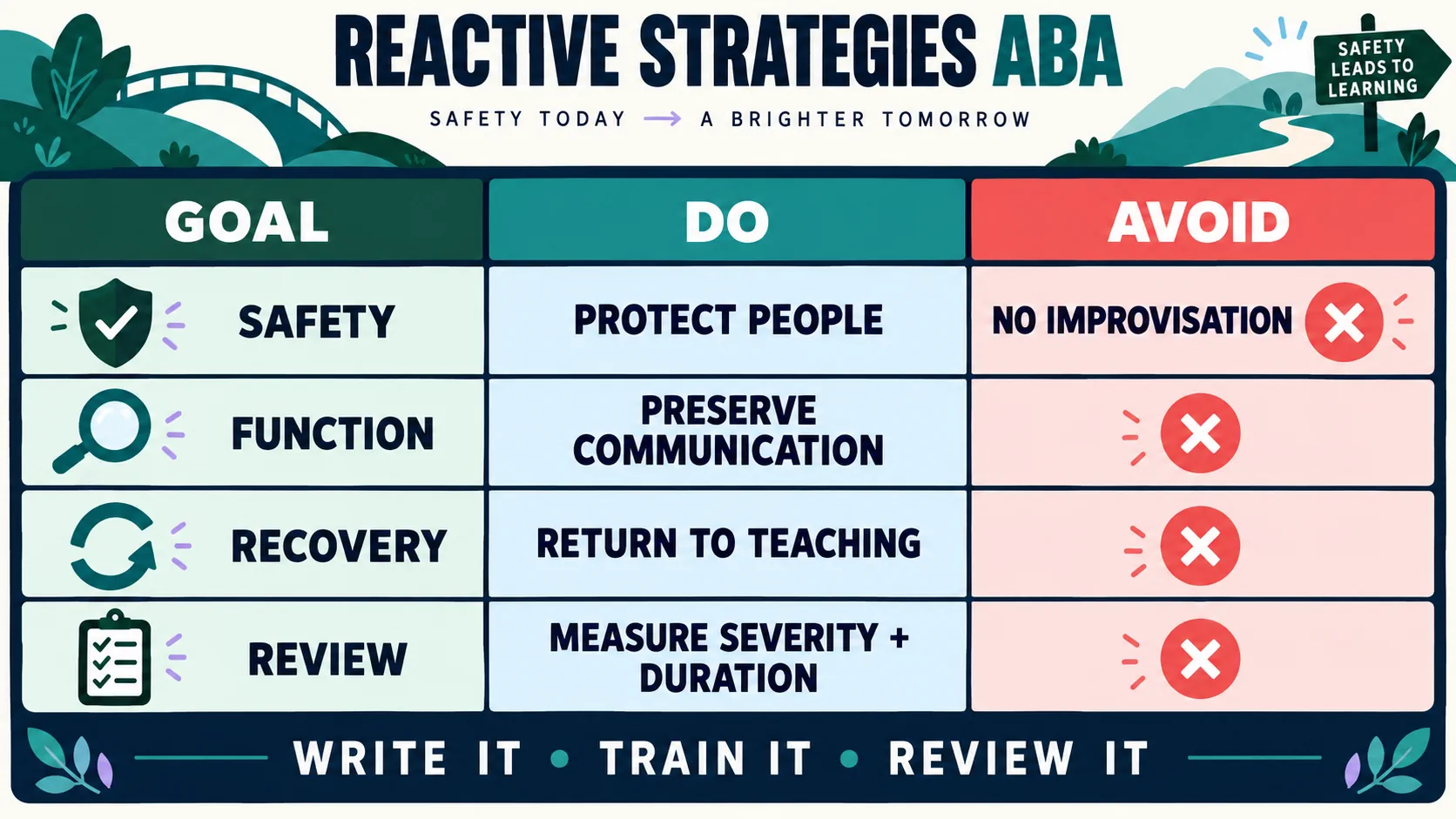
A reactive section should be usable under pressure. It should tell the implementer what to look for, what to do, what not to do, who to contact, and how to record the result. A generic sentence such as “redirect as needed” is not a complete response plan because it does not identify the cue, the action, the safety limit, or the decision rule. One practical writing sequence is:
- Activation definition: list observable behavior and the level of risk that activates each step.
- Response sequence: write the least intrusive approved steps in the order they should be attempted.
- Communication prompt: identify the functional response, prompt level, and available mode such as speech, AAC, gesture, or visual card.
- Environmental action: state how to reduce hazards, crowding, noise, demands, or access to unsafe materials without turning the plan into punishment.
- Escalation boundary: name when trained assistance, a supervisor, a nurse, a caregiver, or emergency services must be contacted.
- Recovery and documentation: specify the calm-down condition, medical check, repair or debrief option, event record, and next review.
Connect the response section to the assessment and the rest of the behavior intervention plan. If the proactive plan teaches a break request, the reactive section should say how staff will recognize and honor that request. If the behavior is maintained by access to attention, the plan should specify how staff respond safely while ensuring that appropriate communication can contact attention efficiently. A BIP is a coordinated system, not a menu of disconnected reactions.
What Data Should Be Collected for Reactive Strategies ABA?
Measure the question the team needs to answer. Frequency alone may hide a change in severity. A lower count with longer, more dangerous episodes is not automatically improvement. Include measures that capture safety, episode severity, recovery, replacement behavior, implementation fidelity, and the conditions that preceded the event.
- Episode frequency and rate: count events across comparable observation periods.
- Duration: record how long the episode or recovery period lasts using clear start and stop rules.
- Severity: use an operational scale tied to observable risk, not a global impression such as “bad day.”
- Injury or property impact: document actual harm and near misses according to policy.
- Latency to recovery: measure time from the last target response to safe participation or another defined recovery criterion.
- Replacement behavior: track independent requests, coping responses, or tolerance skills that make reactive support less necessary.
- Fidelity: check whether the implementer followed the response sequence and whether the plan was feasible in the real setting.
Review the data for side effects. If reactive responses are followed by frequent escape from every demand, the team may need to adjust the demand arrangement and teach a functionally equivalent request. If a response reduces visible behavior but increases distress, avoidance, or loss of communication, the plan needs a broader clinical review. The goal is safer, more autonomous participation—not merely a quieter graph.
What Are the Ethics and BCBA Exam Boundaries?
The current BACB Ethics Code for Behavior Analysts requires assessment-based, evidence-informed intervention, attention to client and stakeholder context, minimization of risk, written procedures, data use, and continual evaluation. It also sets a high bar for restrictive or punishment-based procedures: desired results should not be assumed when less intrusive means have not been evaluated, and ineffective procedures must be modified or discontinued in a timely way.
The BCBA Test Content Outline is useful for organizing exam reasoning. Candidates may need to distinguish assessment from intervention, select and evaluate reinforcement or punishment procedures, plan for unwanted effects and relapse, make data-based decisions about procedural integrity, and collaborate with others. Therefore, an answer that simply says “use a stronger consequence” is usually weaker than an answer that checks function, safety, consent, competence, measurement, and the least intrusive effective option. Common mistakes include:
- Writing only “ignore it” without checking whether attention, escape, or safety is involved.
- Using extinction as a crisis response without considering the risk of escalation or a functional communication alternative.
- Calling redirection a complete plan when no replacement response or recovery step is defined.
- Measuring only the number of incidents and ignoring intensity, duration, injury, and quality of life.
- Putting a procedure in writing that the caregiver or staff member has not been trained and assessed to implement.
- Confusing short-term suppression with durable behavior change and generalization.
Reactive Strategies ABA FAQ
Are reactive strategies the same as punishment?: No. A reactive strategy is any planned response to behavior after it begins. It may be a safety step, a prompt for functional communication, a reduction in stimulation, or a recovery procedure. Some reactive procedures can involve consequences, but the label alone does not establish punishment. Analyze the contingency, risk, purpose, and effect.
Should reactive strategies be used before proactive strategies?: They are used at different times. Proactive supports should be in place before predictable behavior and should receive the main teaching and prevention effort. Reactive steps are available for the moment behavior occurs and should help the person return to safety and learning. Repeated reactive episodes are a signal to review the proactive plan, assessment, and implementation fidelity.
What belongs in a reactive behavior plan?: Include observable activation criteria, an approved response sequence, a functional communication prompt, safety boundaries, escalation contacts, recovery steps, documentation rules, and a review schedule. Use language that a trained implementer can follow under pressure. Do not copy a generic restraint or crisis procedure into a plan without the required training, policy, and authorization.
How do you know a reactive strategy is working?: Look beyond whether the behavior stopped. Review severity, duration, injury or near misses, recovery time, replacement communication, implementation fidelity, and whether proactive supports reduce future episodes. A reactive response may be successful in the short term while the overall plan still needs revision.
Reactive strategies ABA are the safety-and-recovery part of a larger function-based plan. Define the episode, protect people, preserve useful communication, document what happened, and return to proactive teaching as soon as it is safe. For additional scenario practice, use our reactive strategies ABA questions in the free BCBA mock exam and choose the option that is measurable, function-informed, within scope, and least intrusive while still protecting safety.
Take the Free BCBA Mock Exam
When you are ready to apply the idea, use the free practice resource below for additional feedback. Take the Free BCBA Mock Exam



