

An ABA evaluation is a structured assessment used to understand a person’s current skills, communication, routines, strengths, support needs, and meaningful goals before or while behavior-analytic services are planned. It is not a test that a child must pass, a substitute for a medical diagnosis, or a promise that a certain number of therapy hours will be appropriate. A useful evaluation connects multiple sources of information to observable, individualized decisions.
Table of Contents
- What Is an ABA evaluation?
- How Is an ABA Evaluation Different From Other Evaluations?
- What Does an ABA Evaluation Look At?
- How Do Interviews and Observation Fit Together?
- What Tools Might a BCBA Use During an ABA Evaluation?
- How Does the Evaluation Become Goals and a Plan?
- What Should Families Ask About an ABA Evaluation?
- What Are the Ethics and BCBA Exam Boundaries?
- ABA Evaluation FAQ
- Take the Free BCBA Mock Exam
For families, the process can feel unfamiliar because it may include an interview, direct observation, record review, and structured assessment activities. For BCBA candidates, the same topic is a test of assessment boundaries: what question is being asked, what information does each method provide, how should the result be interpreted, and when is referral to another professional needed? This guide explains what an initial evaluation can include, how it becomes a treatment plan, and which ethical and exam distinctions matter.
What Is an ABA evaluation?
An ABA evaluation is a behavior-analytic assessment process that gathers information relevant to behavior change, skill acquisition, participation, communication, and quality of life. The exact scope depends on the referral question, the setting, the person’s age and communication, the available records, payer or program rules, and the qualifications of the professionals involved.
The word evaluation does not identify one universal test. A BCBA might evaluate current performance in daily routines, conduct a functional behavior assessment for a specific target, review caregiver priorities, or use a standardized tool as one part of a broader assessment. The responsible clinician should explain which questions each activity is intended to answer and what the results can and cannot support.
- Purpose: identify strengths, barriers, priorities, and measurable areas for support.
- Evidence: combine interviews, observation, records, direct assessment, and appropriate standardized measures rather than relying on one score.
- Outcome: produce a clear summary, recommendations within scope, and goals that can be monitored in real contexts.
- Limit: do not present a behavior-analytic evaluation as a medical, psychological, speech-language, or school eligibility diagnosis unless the professional is qualified and authorized to provide that evaluation.
How Is an ABA Evaluation Different From Other Evaluations?
Families may hear several professional terms that sound interchangeable. They are not always interchangeable. The key distinction is the question each evaluation is designed to answer and the professional authority behind the conclusion. A BCBA can collaborate with medical, educational, and allied-health professionals without taking over their roles.
| Type of process | Main question | Typical contribution |
|---|---|---|
| ABA evaluation | What skills, behaviors, supports, and goals should be examined in daily life? | Behavioral observation, functional hypotheses, skill baselines, priorities, and measurable planning information. |
| Diagnostic evaluation | Does the person meet criteria for a medical or psychological diagnosis? | Diagnosis and differential considerations by a qualified diagnosing professional. |
| School evaluation | What educational supports or eligibility decisions are needed in the school system? | Educational performance, access, accommodations, and school-based planning. |
| Functional behavior assessment | What environmental variables may be related to a defined behavior? | Operational definitions, ABC information, functional hypotheses, and intervention-planning evidence. |
These processes can inform one another, but one does not automatically replace another. A diagnosis does not tell a team which behavior to measure or which communication response to teach. A school evaluation does not automatically describe what happens at home. An FBA may be one component of a broader ABA evaluation when the referral question involves behavior that interferes with safety, learning, or participation.
What Does an ABA Evaluation Look At?
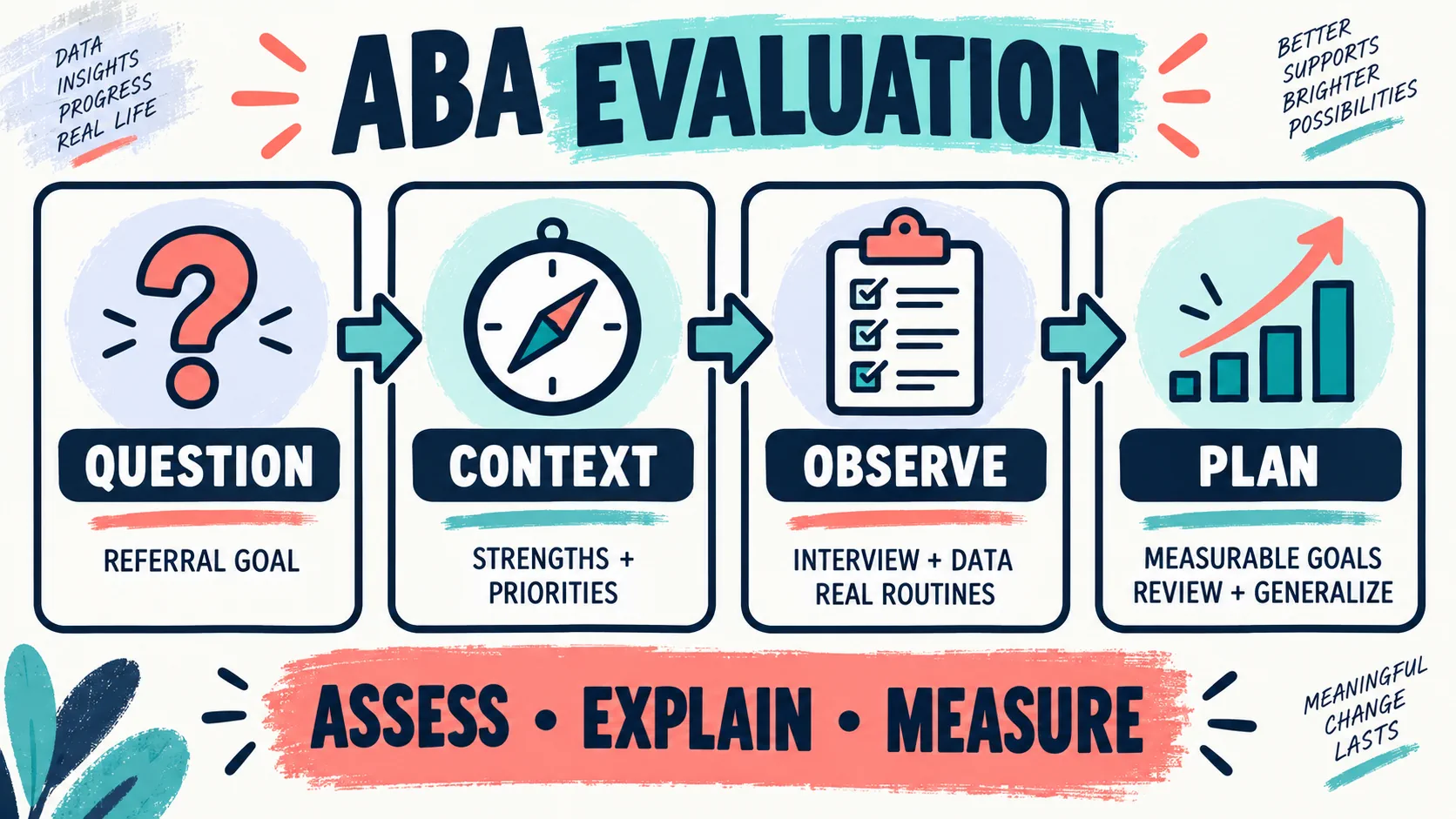
The evaluation should be individualized instead of treating a checklist as a complete picture of a person. The assessor may consider communication in the person’s preferred or accessible mode, independent living, learning readiness, play or leisure, social participation, self-advocacy, safety, adaptive routines, and behaviors that affect access to valued activities. The emphasis should be on meaningful outcomes, not on making a person appear typical for its own sake. Common information domains include:
- Strengths and preferences: activities, people, materials, topics, sensory conditions, and routines that support participation.
- Communication: how the person requests, rejects, comments, asks for help, indicates a break, and understands relevant cues, including AAC or other nonspoken modes.
- Daily routines: eating, dressing, hygiene, transitions, sleep-related routines, school or work participation, and community access when these are within scope.
- Skill performance: what the person does independently, what requires a prompt, how performance changes across settings, and whether the skill generalizes.
- Behavioral context: what happens before and after a defined behavior, what the behavior may accomplish, and whether medical or environmental variables could matter.
- Stakeholder priorities: the person’s preferences and goals, caregiver concerns, team priorities, cultural context, and the practical resources available to implement support.
A strong evaluation records what was observed and under what conditions. If a person does not demonstrate a skill during a short appointment, that does not prove the skill is absent. Fatigue, unfamiliar people, communication mismatch, pain, motivation, task history, and setting can change performance. The report should state limits and avoid presenting a single session as a complete description.
How Do Interviews and Observation Fit Together?
Interview information provides history and context that may not be visible during a brief observation. A caregiver, teacher, or the learner may describe routines, communication signals, prior interventions, medical changes, cultural expectations, and situations that are difficult or successful. These reports are valuable, but they remain one source of information. They should be compared with direct observation and documented records when decisions depend on the pattern.
Direct observation shows how behavior and skills occur in a particular context. The evaluator might observe a natural routine, arrange a brief task, or use structured opportunities to sample a skill. The observation should be explained in advance: what will be observed, how privacy will be protected, how the person can pause or decline, and how the data will be used.
- Start with the referral question: decide whether the priority is skill assessment, behavior assessment, treatment planning, service fit, or another defined question.
- Collect history without overclaiming: record reports and records as context, then identify what still needs direct verification.
- Observe representative situations: sample the routines, materials, people, and demands relevant to the question rather than creating an artificial performance contest.
- Define the response: describe what counts, what does not count, and which dimension matters—frequency, duration, latency, accuracy, independence, or opportunity-based performance.
- Compare sources: explain agreement, disagreement, missing data, and setting differences instead of averaging away important differences.
- Invite interpretation: review the summary with the person and stakeholders, correct factual errors, and identify priorities before finalizing goals.
When information conflicts, the answer is not automatically to trust the professional or the report with the most confident wording. Ask what was measured, under what conditions, and whether the measurement actually represents the decision. A parent report that a skill occurs at home and an observation that it did not occur in a clinic may both be accurate because the contexts differ.
What Tools Might a BCBA Use During an ABA Evaluation?
Tools are selected to answer a question; they are not the question. A BCBA may use direct data sheets, ABC recording, structured probes, preference information, adaptive or skill assessments, rating scales, caregiver interviews, and review of prior records. A named instrument can organize information, but its score should not be interpreted outside its purpose, training requirements, validity evidence, or the person’s context.
For example, a skill assessment may show that a learner performs a communication response with a model but not independently. That result can support a baseline and prompt-fading decision, but it does not by itself explain why a challenging behavior occurs. An FBA may be needed for the second question. Similarly, a rating scale can identify a concern for follow-up, but a rating is not direct observation and does not prove a functional relation.
- Use an operational definition when the evaluation depends on counting behavior.
- Record the opportunity or observation time when converting counts to percentages or rates.
- Document prompt levels and error-correction rules when measuring independence.
- Separate screening, descriptive assessment, and experimental functional analysis.
- Refer medical, diagnostic, speech-language, occupational, legal, or educational questions to the appropriately qualified professional.
Assessment results should be understandable to the people who will use them. Explain technical terms, share accessible formats, and identify what would change the recommendation. The goal is not to produce a dense report; it is to support an accurate and respectful decision.
How Does the Evaluation Become Goals and a Plan?
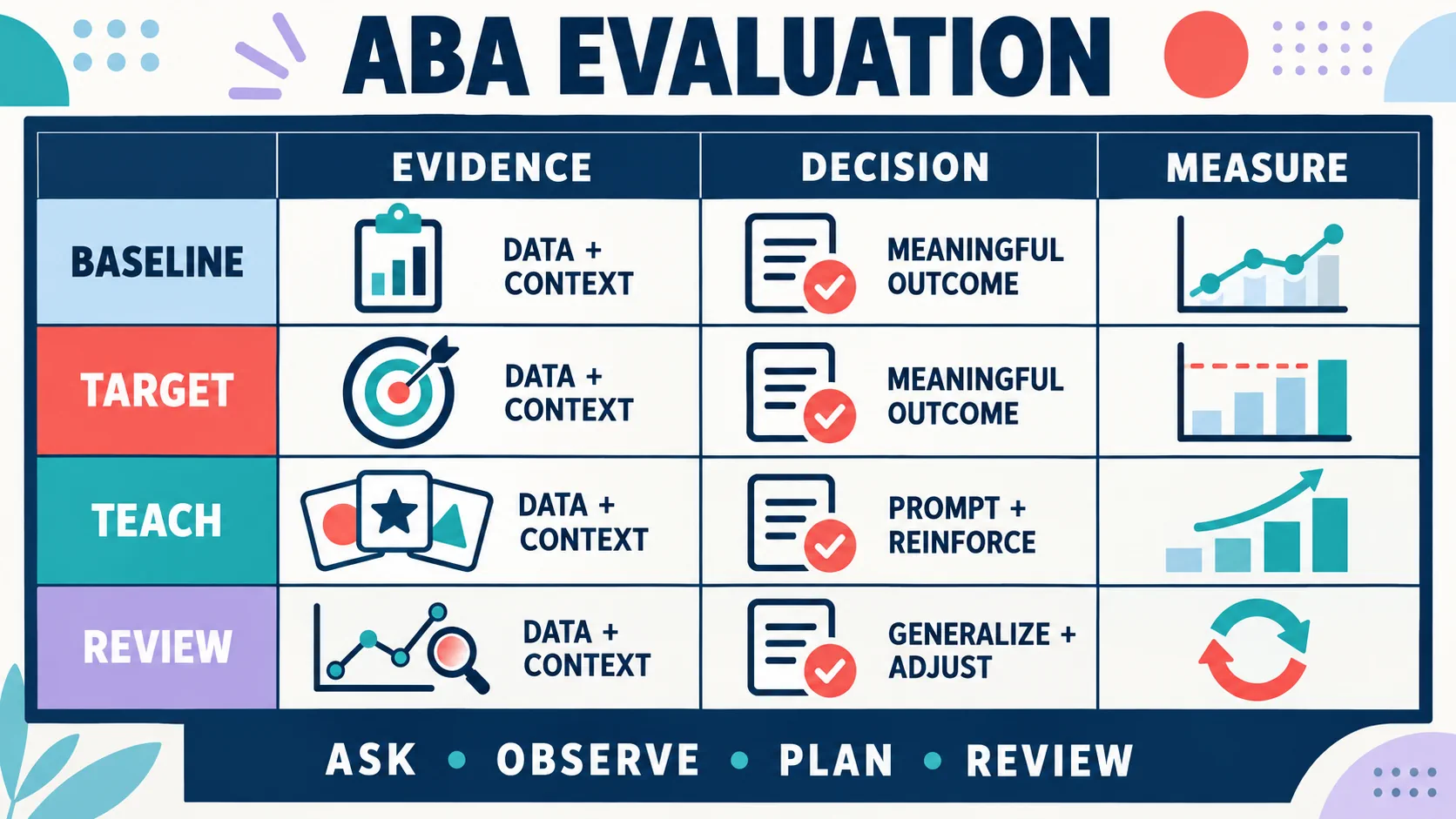
The evaluation becomes useful when it leads to a transparent decision chain: current performance, meaningful priority, observable goal, teaching arrangement, measurement system, review date, and generalization plan. A goal should describe a response that matters in the person’s life and can be observed consistently. “Improve communication” may be a priority, but it needs a defined response and context before progress can be evaluated. A practical goal-writing sequence is:
- Choose the outcome: identify access, independence, communication, safety, participation, or another socially meaningful result.
- Define the response: state the observable action, the relevant opportunity, and the level of independence expected.
- Set a baseline: document current performance, prompt level, context, and measurement conditions.
- Plan instruction: select antecedent arrangements, prompting, reinforcement, error correction, and fading that fit the learner and setting.
- Plan transfer: identify people, materials, routines, settings, and communication partners needed for generalization and maintenance.
- Review with the learner and stakeholders: confirm that the goal is acceptable, feasible, and connected to quality of life.
Suppose an evaluation shows that a learner can request a break with a visual card during one-to-one instruction but not during a noisy transition. A useful plan would not simply label the learner “noncompliant.” It would examine the transition context, teach and reinforce the communication response there, adjust the environment when possible, and measure independent requests and successful transitions across settings. Read the broader assessment in ABA guide for the assessment-versus-intervention distinction, and connect behavior-specific findings to the functional behavior assessment process when the referral question is about a behavior’s environmental function.
What Should Families Ask About an ABA Evaluation?
Families and adult learners are collaborators, not passive recipients of a score. Before the appointment, gather relevant records if you choose to share them and write down routines, strengths, communication preferences, successful supports, concerns, and priorities. You do not need to create a perfect performance for the evaluator. Honest, representative information is more useful than a rehearsed demonstration.
- What question is this evaluation designed to answer?
- Which parts involve interview, direct observation, standardized tools, or functional assessment?
- How will communication preferences, assent, privacy, and breaks be supported?
- What will the report say about strengths, limitations, missing information, and next steps?
- How will goals be selected, measured, reviewed, and generalized to daily life?
- Which questions require a medical, diagnostic, school, speech-language, or occupational referral?
- Who will implement the plan, what training will they receive, and how can concerns be raised?
A useful answer should be specific without promising certainty. A provider may explain the assessment process, but no online article can determine whether a particular person needs services, what diagnosis applies, or which treatment intensity is appropriate. Those decisions require individualized assessment and the rules that apply in the person’s jurisdiction, program, and funding context.
What Are the Ethics and BCBA Exam Boundaries?
The BACB Ethics Code for Behavior Analysts emphasizes assessment procedures that are behaviorally coherent, evidence-informed, responsive to client and stakeholder context, and designed to maximize benefit while minimizing risk. It also addresses medical needs, documentation, informed consent, assent, competence, and continual evaluation. A strong answer therefore asks whether the assessment is appropriate for the question and whether the result is being used within the professional’s competence.
The BCBA Test Content Outline supports the same reasoning pattern. On an exam, do not select a tool just because it is familiar. Identify the target, choose a method that measures the relevant dimension, consider validity and reliability, interpret the result within context, and use data to guide the next decision. If the stem includes possible medical variables, consent concerns, or a question outside the analyst’s scope, the best answer may include consultation or referral. Common exam errors include:
- Confusing a diagnostic evaluation with a behavior-analytic assessment.
- Treating a standardized score as a complete description of current behavior.
- Inferring function from the topography of behavior alone.
- Selecting an intervention before defining the behavior and reviewing assessment data.
- Ignoring assent, stakeholder priorities, cultural context, or communication access.
- Continuing an ineffective plan without reviewing data and making a timely change.
ABA Evaluation FAQ
Is an ABA evaluation the same as an autism diagnosis?: No. An ABA evaluation examines behavior-analytic questions such as skills, communication, routines, environmental variables, and measurable support needs. An autism or other medical diagnosis is a separate diagnostic process completed by an appropriately qualified professional.
How long does an ABA evaluation take?: There is no universal time. The scope, setting, referral question, records, communication needs, observation opportunities, payer rules, and report requirements all affect the process. A responsible provider should explain what will happen, what information is still missing, and when the findings will be reviewed.
Will a child fail an ABA evaluation?: No. The purpose is to understand current performance and priorities, not to grade a child. A person’s performance can change with fatigue, unfamiliar people, task history, communication access, pain, or context. The evaluator should report those conditions and avoid treating one brief observation as the whole person.
What happens after an ABA evaluation?: The team may summarize strengths and needs, propose measurable goals, recommend teaching and measurement procedures, identify needed referrals, and discuss service fit. The plan should be reviewed with the person and stakeholders, implemented by trained people, and changed when data or lived experience show that it is not effective or acceptable.
ABA evaluation is best understood as a question-to-evidence-to-plan process. Ask what the evaluation is meant to answer, how information was collected, what the limits are, and how the findings will improve meaningful participation. For more practice with assessment scenarios, try our ABA evaluation questions in the free BCBA mock exam and choose the answer that is individualized, measurable, ethical, and within professional scope.
Take the Free BCBA Mock Exam
When you are ready to apply the idea, use the free practice resource below for additional feedback. Take the Free BCBA Mock Exam



