
The search phrase scripting ABA can mean two different things, and that distinction matters. In one use, scripting describes repeated or memorized language that a learner says in a particular context. In another, script training is an instructional procedure in which a practitioner teaches a planned phrase or conversation sequence and then gradually transfers control to natural cues. The shared word does not mean that the two processes have the same function or should receive the same intervention.
Table of Contents
- What Does scripting ABA Mean?
- How Should a BCBA Analyze the Function of Scripting?
- How Does Script Training and Script Fading Work?
- What Data Should Be Collected for Scripting in ABA?
- What Are the BCBA Exam Traps About Scripting?
- Scripting in ABA FAQ
- Take the Free BCBA Mock Exam
For a BCBA candidate, the reliable starting point is functional assessment. A repeated phrase is a response form, not a diagnosis and not a function. It may help a person communicate, regulate, participate, remember a sequence, or engage in behavior that is maintained by its own sensory or social consequences. This guide separates the meanings, shows how to gather useful context, explains script fading, and identifies the measurement and ethics traps that appear in exam-style scenarios.
What Does scripting ABA Mean?
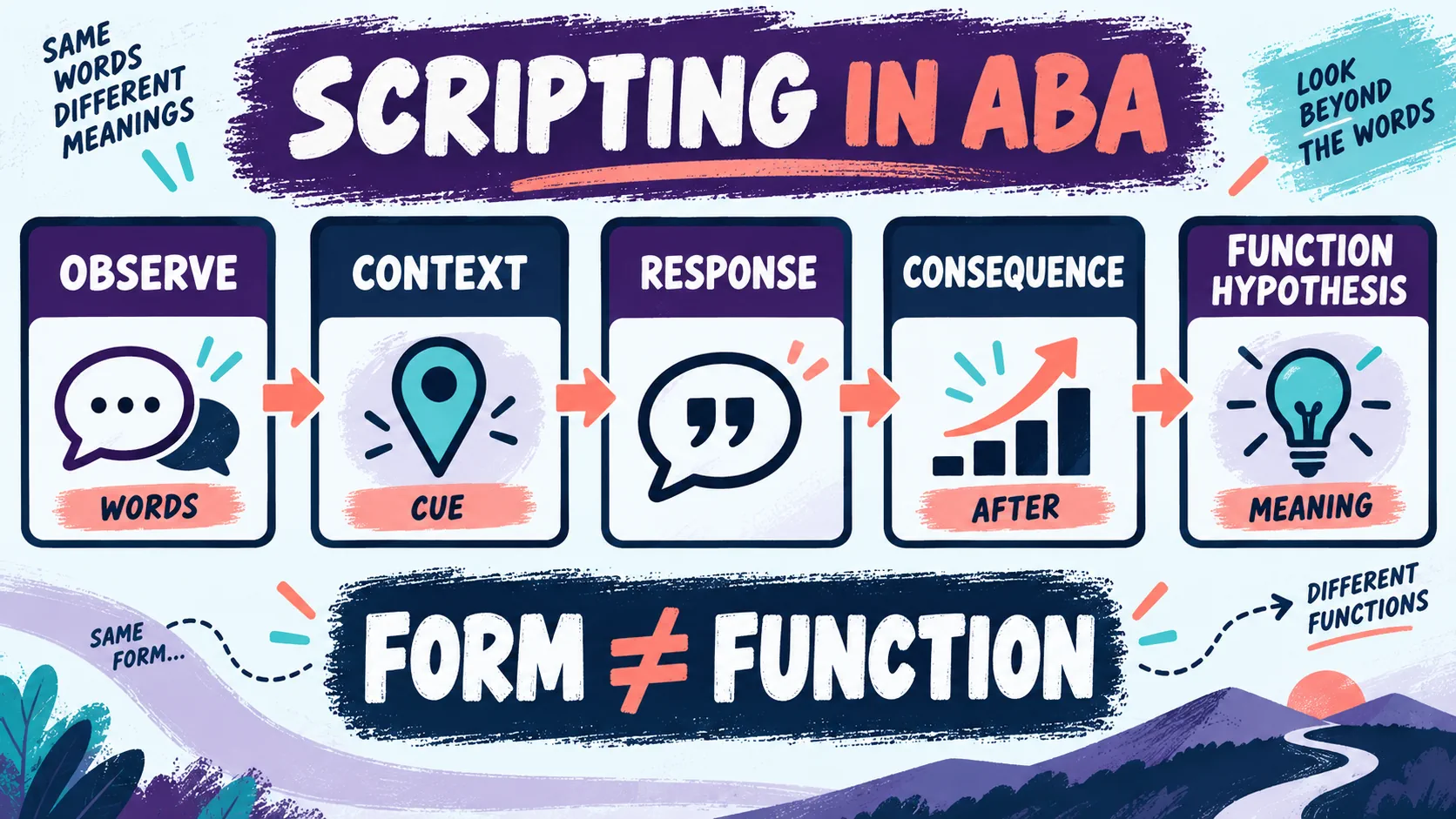
In clinical and educational conversations, scripting often refers to the use of a previously heard or practiced phrase, dialogue, lyric, or sequence of words. The phrase may be repeated exactly, altered slightly, or used in a new situation. The source could be a conversation, a video, a book, a classroom routine, or an earlier teaching interaction. The important point is that the topography alone does not tell the analyst why it occurs.
There is also a technical teaching use. A clinician may write a short language script, model it, prompt the learner to use it during a social opportunity, and fade the script so that the natural activity or conversation becomes the relevant source of control. A study of script training, for example, reported increases in both scripted and unscripted peer communication and observed generalization across toys, settings, and peers. That finding supports a teaching question—how can planned language help create more flexible communication? It does not justify treating every repeated phrase as a skill deficit. Keep these boundaries clear:
- Scripting is not a diagnosis. The word does not establish autism, a language disorder, or any other condition.
- Scripting is not automatically problem behavior. A behavior becomes a treatment target only when the team has a meaningful, evidence-based reason to change it.
- Scripting is not automatically echolalia. There can be overlap, but immediate or delayed repetition and a learned conversational script are not interchangeable labels.
- Scripting is not automatically nonfunctional. Repetition may convey a request, signal a topic, support participation, or serve a self-directed function.
When a reader wants the broader verbal-behavior vocabulary, our scripting ABA concepts within the verbal behavior BCBA exam guide can provide context for analyzing verbal stimuli, motivating operations, and consequences. A separate guide on communicative echolalia is useful when the case specifically describes echoed language and possible interactional meaning.
How Should a BCBA Analyze the Function of Scripting?
Begin with an operational description that another observer could recognize. Record the exact words or an objective description of the response, when it occurs, how long it lasts, and what happens immediately before and after it. Avoid starting with “the learner is scripting for attention” or “the learner is escaping.” Those are hypotheses that must be supported by patterns in the environment. A useful observation sequence asks four questions:
- What changed before the phrase? Note a demand, transition, question, social approach, denied item, change in routine, access to a preferred activity, or quiet period.
- What is the response form? Describe the words, volume, timing, flexibility, and whether the learner directs the phrase toward another person or uses it privately.
- What follows it? Record attention, a break, access to an item, a change in the task, social interaction, automatic continuation, or no obvious environmental consequence.
- What does the learner do next? A later request, approach, escape, play action, or return to the task can clarify what the phrase may be accomplishing.
| Observation question | What to record | Why it matters |
|---|---|---|
| When is the script evoked? | Antecedent, routine, people present, task demand, and time of day. | A pattern can suggest a relevant motivating operation or discriminative stimulus. |
| Is the response flexible? | Changes in wording, topic, speaker, materials, and response to a partner. | Flexibility and variation help distinguish a memorized sequence from a broader conversational repertoire. |
| What follows? | Attention, tangible access, escape, interaction, sensory continuation, or no clear change. | The consequence pattern guides the next assessment question; it does not prove a function by itself. |
| What is the stakeholder goal? | Communication, participation, safety, autonomy, access, or reduced disruption in a specific routine. | A socially meaningful goal prevents an analyst from targeting harmless variation merely because it looks unusual. |
Do not confuse a correlation with a functional relation. If a phrase often appears before adults talk with the learner, attention may be relevant, but direct tests and repeated measurement are still needed. If the learner uses a script during independent play, the team should investigate whether it is enjoyable, regulating, rehearsing an interaction, or associated with another event. A respectful assessment can treat the phrase as information about the learner’s communication system rather than as noise to suppress.
How Does Script Training and Script Fading Work?
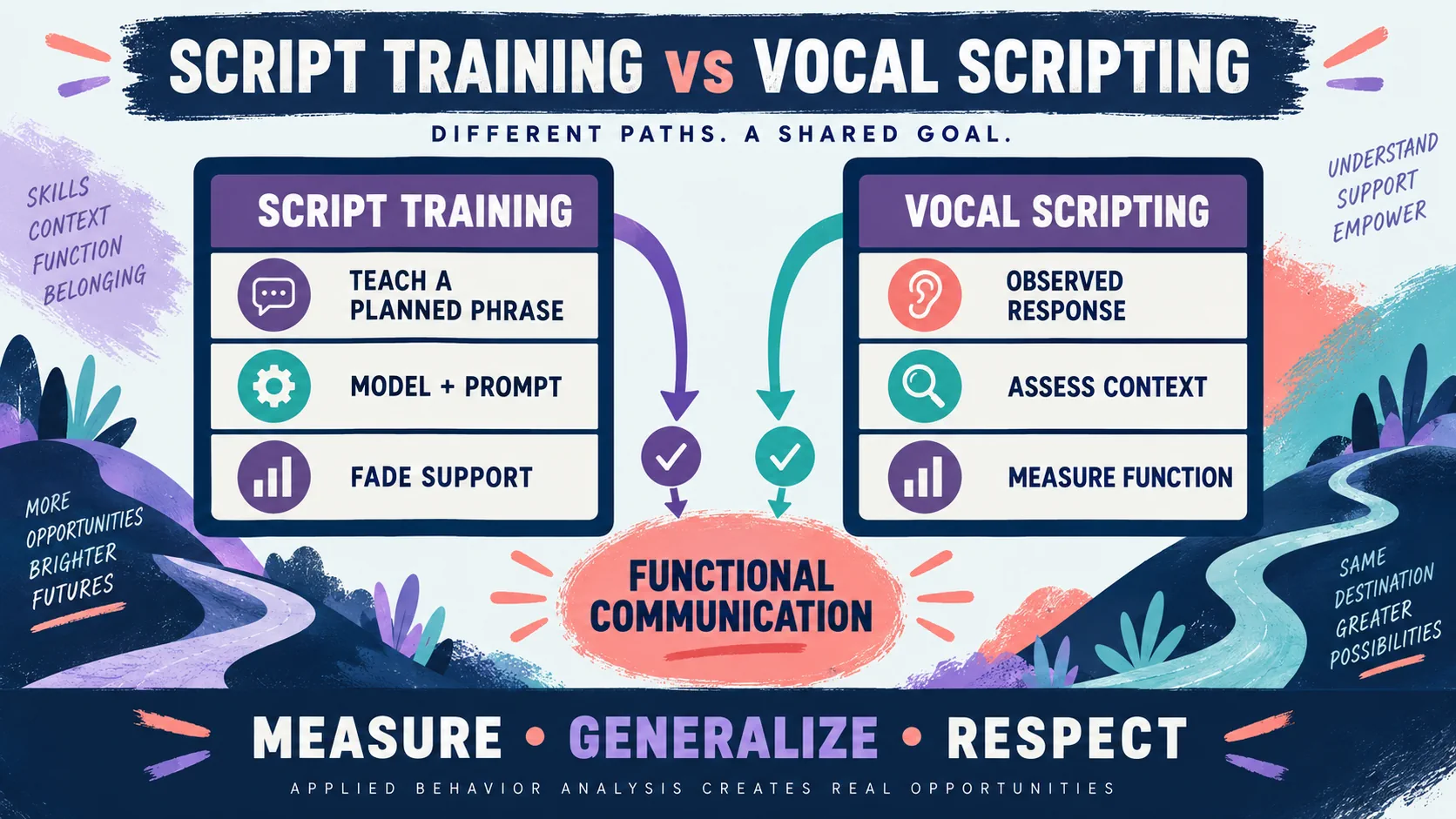
Script training is different from trying to eliminate vocal scripting. It is an instructional arrangement for making a useful language response more likely during a defined social opportunity. A script may be written, spoken, visual, or delivered through an approved communication system. The exact format depends on the learner’s communication mode, preferences, access needs, and goals. A practical script-fading sequence usually includes these decisions:
- Define the social response: specify whether the target is an initiation, a question, a response, a topic change, a request for help, or another observable action.
- Choose a meaningful opportunity: use an activity, partner, item, or topic that matters to the learner rather than rehearsing an empty exchange.
- Teach the initial script: model or prompt the phrase with the least intrusive effective support and make the response understandable to the communication partner.
- Reinforce participation and variation: arrange a natural or agreed consequence for the social exchange; do not require a perfect accent, speed, or scripted wording when the message is clear.
- Fade systematically: remove a word, delay a prompt, reduce a visual cue, or vary the opening while monitoring independent and novel responses.
- Test generalization: sample new people, places, materials, topics, and times. A response that appears only with the original script has not yet demonstrated broad transfer.
The BCBA should not assume that fading must proceed at one fixed speed. If the learner loses access to meaningful communication when a prompt is removed, the team may need to restore a support, simplify the change, or use a different teaching arrangement. The data should determine the next step. Coordinate with speech-language professionals and the learner’s support network when communication form, motor access, language development, or AAC is part of the case.
Script training can be helpful without making scripted language the only acceptable language. A strong program expands options: the learner may use a practiced phrase, a spontaneous variation, an AAC message, a gesture, or another effective response. The clinical question is whether the person can access the goal with dignity and increasing control, not whether every response looks neurotypical.
What Data Should Be Collected for Scripting in ABA?
Choose a measurement system that matches the decision. If the goal is to increase independent social initiations, record opportunities and independent initiations. If the question is whether a script is transferring to a new partner, sample across partners. If a team is considering a reduction procedure, first define the behavior, identify possible benefits of the response, and monitor replacement communication and quality-of-life indicators.
- Frequency or rate: useful when the number of responses in a defined observation period is meaningful and the observation time is comparable.
- Duration: useful when an episode’s length affects participation, but define when the episode starts and stops.
- Latency: useful for measuring time from a natural cue or social opportunity to an initiation or response.
- Opportunity-based percentage: useful for independent, prompted, or incorrect responses across clearly defined opportunities.
- Generalization probes: use planned samples with new partners, settings, materials, topics, or routines.
- Social-validity information: ask the learner and stakeholders whether the goal is meaningful, feasible, acceptable, and helpful; do not use satisfaction as a substitute for outcome data.
For example, “scripting decreased” is not enough to show improvement. The learner might instead be silent, distressed, or dependent on prompts. A stronger review pairs the target measure with functional communication, participation, independent variation, and stakeholder-priority data. If the learner’s script is a useful request or a self-regulation strategy, the plan should protect access to that function while teaching additional options where needed.
What Are the BCBA Exam Traps About Scripting?
The current BACB materials do not create a special universal “scripting protocol.” The BCBA Test Content Outline requires candidates to reason about assessment, behavior-change procedures, prompting, modeling, generalization, data-based decisions, client-informed goals, and collaboration. The BCBA Handbook is the current source for examination and certification information. Apply those broader competencies to the case rather than memorizing a single answer for every repeated phrase. Common exam traps include:
- Choosing an intervention from topography alone: the same words can have different antecedents and consequences.
- Calling the behavior attention-maintained without a pattern: an observer must collect and interpret relevant data.
- Reducing a communication response without a replacement: the plan should preserve or expand an effective way to communicate.
- Confusing script training with vocal scripting: one is a teaching procedure; the other describes an observed response pattern.
- Declaring generalization after one familiar trial: vary the people, setting, materials, and cues that matter to the goal.
- Ignoring assent, preferences, or stakeholder priorities: intervention selection should be client-informed, culturally responsive, and contextually feasible.
Ethically, the analyst should explain the purpose of the goal, use competent procedures, monitor unwanted effects, and involve the people affected by the service. The BACB Ethics Code for Behavior Analysts is the controlling source for professional responsibilities; this article is a study aid, not a substitute for the current Code or case-specific supervision.
Scripting in ABA FAQ
Is scripting always a problem behavior?: No. A repeated phrase may be communicative, enjoyable, regulating, socially connecting, or unrelated to a current environmental consequence. Treat it as a response to assess, not as a problem by definition. A treatment target should be justified by a meaningful goal and supported by data.
Is scripting the same as echolalia?: Not necessarily. Echolalia commonly describes echoed language, while scripting may describe a memorized or repeated language sequence used across contexts. The terms can overlap in a particular case, but the observer should document the actual response, source, timing, flexibility, and possible function instead of relying on a label.
What is script fading in ABA?: Script fading is a procedure for gradually reducing a planned language prompt while monitoring independent and novel communication. The fading step might remove words, delay a cue, reduce a visual support, or vary the context. The sequence and mastery rule should be individualized and adjusted when the data show loss of useful communication.
How should a BCBA write a scripting goal?: Describe the response, opportunity, communication partner or context, level of prompting, measurement, and criterion. “Will stop scripting” is not an adequate goal because it does not define a socially meaningful outcome. A stronger goal might measure independent responses to a peer’s topic change across several partners, while also protecting the learner’s ability to communicate and regulate.
Scripting in ABA is best understood through context, function, flexibility, and the learner’s own priorities. Separate observed vocal scripting from script-training procedures, measure what the person and team actually need to know, and use fading only when it expands meaningful communication. To practice the same kind of scenario-based discrimination, try our scripting ABA practice in the free BCBA mock exam and look for the answer that is function-based, measurable, respectful, and supported by the facts in the question.
Take the Free BCBA Mock Exam
When you are ready to apply the idea, use the free practice resource below for additional feedback. Take the Free BCBA Mock Exam



