

Quick answer: Pinpointing ABA is the process of turning a broad concern or desired outcome into a precise, observable, and measurable behavior or result. Instead of recording that a learner is “uncooperative,” a BCBA might define how many task directions the learner follows within 10 seconds, under which conditions, and with what level of prompting. The goal is not to make a person sound like a number. It is to make the target clear enough that the learner, caregiver, technician, and supervisor can recognize the same event and make better decisions from the data.
Table of Contents
- What Is Pinpointing ABA?
- Why Does Pinpointing ABA Improve Measurement?
- What Is the Difference Between Behavior and Result Pinpoints?
- How Do You Write a Pinpointing ABA Statement?
- What Are Pinpointing ABA Examples?
- How Is Pinpointing Different From an Operational Definition?
- What Data Should You Collect After Pinpointing?
- What Are Common BCBA Exam Traps?
- FAQ
- Quick Review Checklist
- Take the Free BCBA Mock Exam
Pinpointing is closely related to operational definition, but the concepts are not interchangeable in every context. An operational definition describes what counts as a behavior. A pinpointing process also asks which behavior or result matters, how it connects to a meaningful outcome, and how the team will know whether the intervention is working. That makes pinpointing useful for clinical ABA, supervision, and organizational behavior management (OBM), as well as for BCBA exam questions about measurement and assessment.
What Is Pinpointing ABA?
In pinpointing ABA work, the analyst narrows an imprecise label into a target that can be observed and measured. “Improve communication” is a valuable direction, but it is not yet a pinpoint. “During snack, independently selects the picture for ‘more’ within 5 seconds after the item is visible” is closer because it identifies a response, a context, a time window, and a measurement opportunity.
There are two related uses of the word. In clinical behavior analysis, pinpointing often means identifying the exact form of a target behavior so that different observers can record it consistently. In OBM and performance improvement, a behavior pinpoint describes the observable action that should change, while a result pinpoint describes the important outcome produced by that action. A useful plan may track both rather than assuming that a favorable result proves the desired behavior occurred.
The distinction matters for BCBA exam reasoning. The BACB’s BCBA Test Content Outline places measurement, behavior assessment, and intervention selection in separate but connected domains. A candidate should be able to identify what behavior is being measured, select a defensible measurement system, and evaluate whether the intervention produced a meaningful change. Pinpointing is one practical bridge between those decisions.
| Starting statement | Pinpointed behavior | Possible measure |
|---|---|---|
| The learner is off task. | Leaves the assigned seat for more than 5 seconds during independent work. | Frequency, duration, or percentage of intervals, selected to fit the question. |
| Staff need better performance. | Delivers the programmed prompt within 3 seconds after the defined cue. | Percentage of opportunities with a fidelity checklist. |
| The learner should be more independent. | Completes each step of the morning routine without an adult prompt. | Independent steps, prompt level, and task-completion percentage. |
Why Does Pinpointing ABA Improve Measurement?
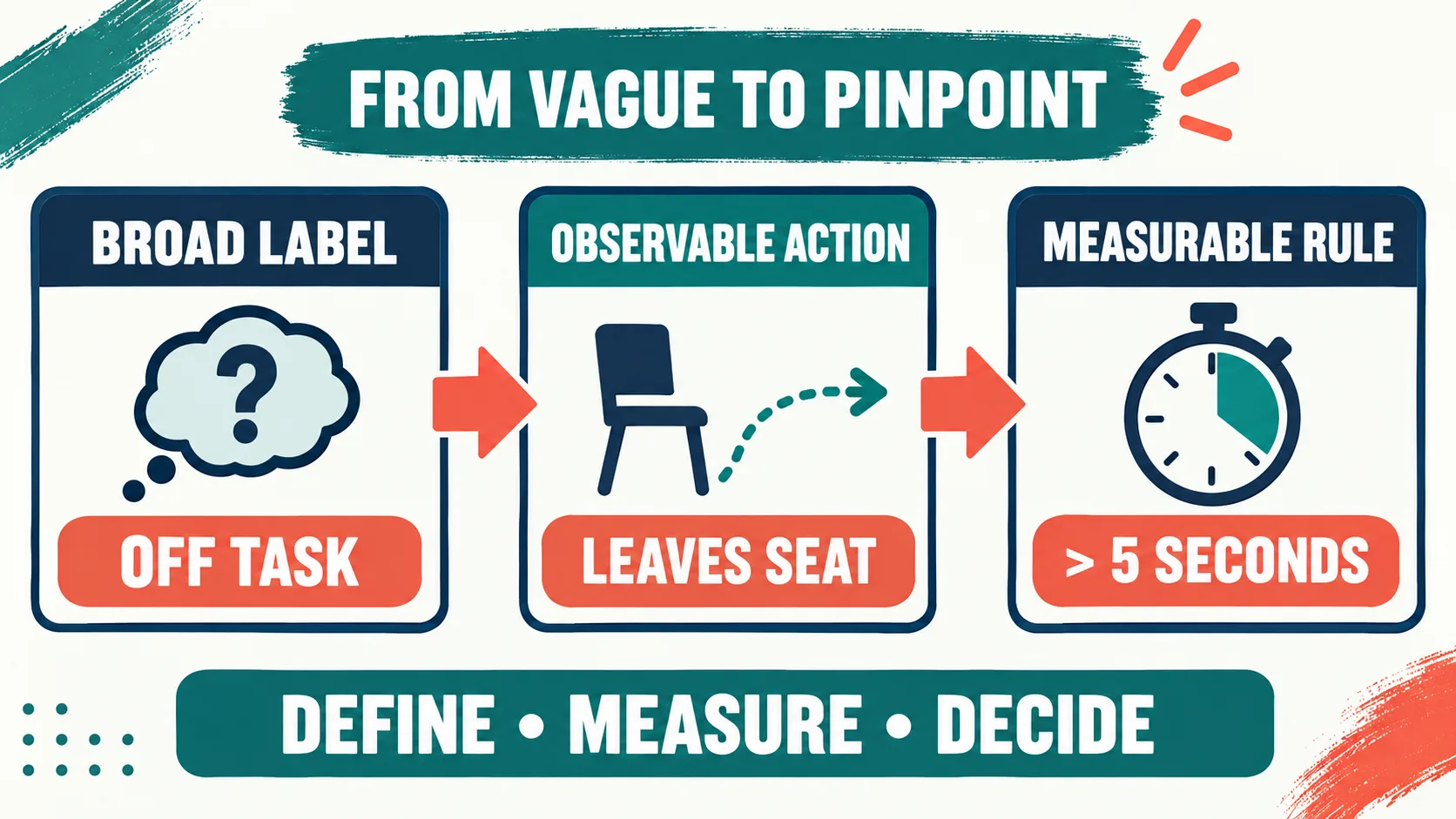
Vague labels create disagreement before the first data point is recorded. One observer may call a learner “engaged” when the learner is looking toward the worksheet; another may require writing; a third may count asking for help. Their percentages can look precise while representing different events. Pinpointing makes the observation rule explicit so that data reflect the same response class across people and sessions.
Pinpointing also protects the team from choosing a convenient but irrelevant measure. If the meaningful concern is whether a learner can request assistance, counting all vocalizations may produce a large data set without answering the question. A pinpoint can specify the functional response, the situation in which help is needed, and the degree of independence expected. The measurement system then follows the target rather than the other way around.
For workplace or supervision questions, the same logic applies. “Improve documentation” is a result-oriented request. A behavior pinpoint might be “records the session start time, target response, prompt level, and next-step decision before closing the note.” A result pinpoint might be “the percentage of notes that pass the agreed documentation review.” If the result changes but the target behavior does not, the team should investigate other variables instead of claiming that the intervention taught the desired action.
What Is the Difference Between Behavior and Result Pinpoints?
A behavior pinpoint is an action that can be seen, heard, or otherwise measured through a defined response form. Examples include delivering a prompt, arranging a choice, recording a response within a specified interval, or asking a learner which communication mode is preferred. A result pinpoint is a product or outcome that follows, such as completed work, accurate data entry, fewer missed opportunities, or improved access to a routine.
The two levels should not be confused. “The student earns 80% on the quiz” is a result, not a description of the teaching behavior that produced it. “The technician presents the discriminative stimulus, waits 5 seconds, and records the first response without adding an unplanned prompt” is a behavior description. Both might be worth tracking, but they answer different questions and can change at different rates.
When a BCBA writes a performance-improvement plan, connect the pair carefully. Ask: What result matters to the learner, family, client, or organization? Which observable actions are plausibly related to that result? What environmental conditions make the action more or less likely? What direct measure will show whether the action is occurring? This chain is more informative than assigning a personality label to a person who is struggling.
How Do You Write a Pinpointing ABA Statement?
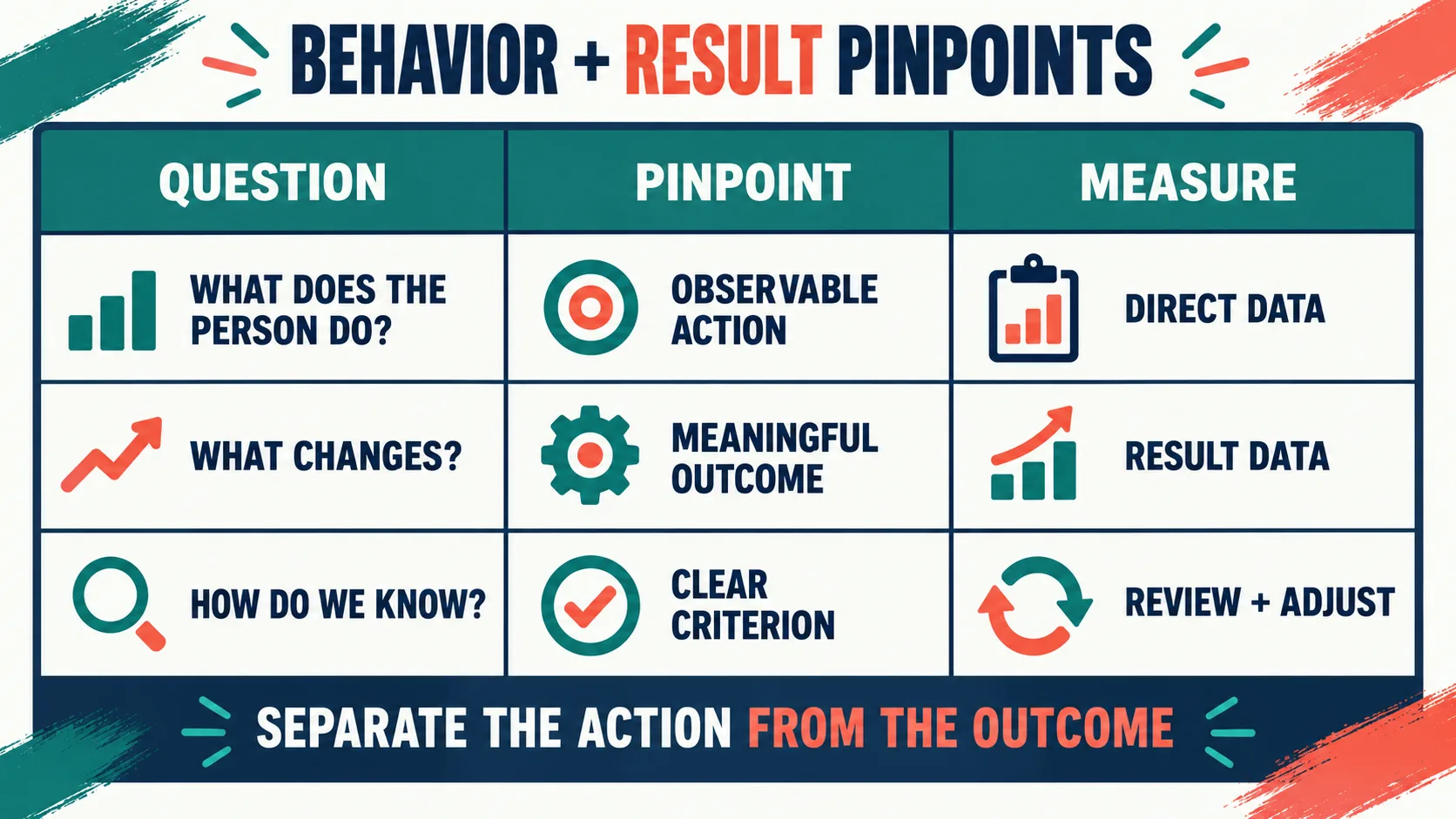
A practical statement should be specific without becoming so complicated that observers cannot use it during real work. The following sequence keeps the definition connected to the reason for measurement:
- Name the meaningful outcome or concern. Start with the problem the team is trying to solve, such as safe transitions, functional communication, accurate implementation, or participation in a valued routine. Confirm that the goal matters to the learner and stakeholders.
- Ask what a person would actually do. Replace labels such as “defiant,” “motivated,” or “professional” with an action, product, or observable interaction. If a private event is relevant, describe the public behavior or communication that will be measured rather than pretending to observe the private event directly.
- Specify the conditions. State when the behavior has an opportunity to occur. Include the instruction, material, setting, person, or event that matters. A response may be correct in a one-to-one teaching trial and absent during a group routine, so the context cannot be an afterthought.
- Set the response boundary. Define what counts and what does not count. Include a start and stop rule when duration matters, a latency window when speed matters, or a criterion for an independent response when prompts are possible.
- Select a measure that matches the dimension. Use count or rate for discrete events, duration for how long a response lasts, latency for time to begin, and percentage only when the denominator is clearly defined. Choose interval recording cautiously because it estimates occurrence rather than giving the same information as continuous measurement.
- Plan the quality check. Decide how observers will practice the definition, how disagreements will be reviewed, and whether procedural integrity or interobserver agreement is needed. A precise sentence is not enough if the team applies it inconsistently.
- Revisit social validity and function. Ask whether the target improves meaningful participation, communication, safety, or autonomy. If the definition encourages a superficial performance that does not help the person, revise the target before increasing its score.
What Are Pinpointing ABA Examples?
Example 1: Replacing “tantrum” with observable responses: “Tantrum” may combine crying, dropping, yelling, pushing materials, and leaving the area. Those responses can have different functions and require different safety decisions. A team could create separate pinpoints: vocal crying above an agreed audible threshold, dropping the body below the seat height for at least 3 seconds, and pushing instructional materials more than 15 centimeters. The team can then examine which response is changing and whether a functionally appropriate communication response is increasing.
Example 2: Defining functional communication: “Uses communication” is too broad for a treatment decision. A more useful pinpoint might be: “When an item is visible but unavailable, independently selects the ‘help’ or ‘break’ icon within 5 seconds of the opportunity, before engaging in the defined problem response.” Record opportunities, independent selections, prompted selections, and the consequence delivered. This makes it possible to evaluate both acquisition and whether the communication response works in the routine that matters.
Example 3: Improving staff implementation: “Staff use reinforcement correctly” needs a response rule. A behavior pinpoint could require the staff member to deliver the programmed consequence within 2 seconds after the learner’s defined target response, use the planned magnitude, and record the trial. A fidelity checklist can score each component separately. If the learner’s progress is slow, the BCBA can see whether the issue is the teaching procedure, the reinforcer, the timing, or an unmeasured contextual variable.
How Is Pinpointing Different From an Operational Definition?
An operational definition is a tool within a broader measurement and decision process. It describes the form or boundary of a response so an observer can identify it. Pinpointing asks an additional question: which behavior or result deserves attention, and how will it be linked to a meaningful objective? A pinpoint may contain an operational definition, a context, a criterion, and a plan for measurement, but the exact format depends on the setting.
For a refresher on observable form, compare the site’s topography in ABA guide. For broader target selection, the existing target behavior guide is a separate resource. Keep the content boundaries clear: topography describes what a response looks like, an operational definition establishes response rules, and pinpointing connects a measurable target to a decision or outcome.
What Data Should You Collect After Pinpointing?
Record the minimum information needed to answer the clinical or performance question, while preserving the context needed for interpretation. Depending on the target, this may include opportunities, independent and prompted responses, frequency, rate, duration, latency, setting, communication partner, materials, prompt level, and consequence. If the target is a staff behavior, record the relevant opportunity and whether each step of the procedure occurred.
Review the data for level, trend, and variability rather than reacting to a single score. If a result improves only when a particular supervisor is present, the environment may be controlling performance. If accuracy improves while prompts become more intrusive, the apparent gain may not represent independence. If observers disagree about what counts, improve training and the definition before drawing a conclusion. The BACB Ethics Code’s section on collecting and using data emphasizes selecting and implementing data procedures correctly and using the results to make decisions, not collecting numbers for their own sake.
What Are Common BCBA Exam Traps?
- Using a label as a definition: “Noncompliant,” “lazy,” and “inattentive” describe interpretations, not response boundaries.
- Confusing a result with a behavior: A completed worksheet may be a product; it does not automatically reveal which teaching actions produced it.
- Choosing percentage without a denominator: State whether the denominator is opportunities, trials, intervals, or tasks completed.
- Changing the target and the measurement together: If the definition or recording system changes, mark the change and interpret the graph accordingly.
- Ignoring function and social validity: A highly measurable response is not automatically a meaningful or ethical treatment target.
- Calling prompted performance independent: Record the prompt level and define what “independent” means before collecting mastery data.
FAQ
Is pinpointing only used in OBM?: No. The word is especially common in performance-improvement and OBM literature, but the underlying practice of narrowing a concern into observable, measurable behavior is also useful in clinical ABA, education, supervision, and BCBA exam questions. Always read the context to determine whether the question is asking about a behavior pinpoint, a result pinpoint, or an operational definition.
Can a pinpoint include a result?: Yes. A plan can track a behavior pinpoint and a result pinpoint together. Keep them labeled separately so the team does not infer that an outcome score proves a specific action occurred.
How detailed should the statement be?: Detailed enough that trained observers can identify the same event and the team can choose a defensible measure, but concise enough to use in the setting. If the statement requires a paragraph of interpretation every time someone records a response, simplify the boundary or create examples and nonexamples.
Bottom line: Pinpointing ABA is disciplined problem definition. Start with a meaningful outcome, identify the observable behavior or product that matters, specify the conditions and response boundary, select a matching measurement system, and check whether the target improves real participation or performance. When you are ready to test these distinctions in scenario-based items, use the free BCBA mock exam. For targeted review, use our pinpointing aba practice questions to apply the concept in exam-style scenarios.
Quick Review Checklist
Use this final checklist to turn pinpointing aba into exam-ready reasoning. The goal is not to memorize a label in isolation; it is to identify the relevant evidence and explain why the best answer fits the scenario. Key ideas to review:
- State the central definition or decision point for pinpointing aba in your own words.
- Identify the detail that makes pinpointing aba different from its closest related ABA term.
- Separate the observable facts in a scenario from assumptions that are not supported by the facts.
- Write one example and one nonexample so you can recognize the concept in a new setting.
Exam application checks:
- Ask what the question is actually requesting before comparing the answer choices.
- Mark the antecedent, response, consequence, or other evidence that supports the selected answer.
- Look for a distractor that describes a related process but does not answer the specific question.
Final self-check:
- Explain how you would verify the interpretation with clear observations or data.
- Change one detail in the scenario and decide whether your answer should change.
- Give a one-sentence rationale that a supervisor or study partner could evaluate.
Take the Free BCBA Mock Exam
When you are ready to apply the idea, use the free practice resource below for additional feedback. Take the Free BCBA Mock Exam



