
Turn this topic into exam-day practice
Use a short free mock to apply what you reviewed, then continue with full-length practice if you need more repetitions.
Take the Free BCBA Mock Exam Practice with Five Full-Length Mocks — $99
Target Behavior ABA: What is a Target Behavior? The Foundation of ABA
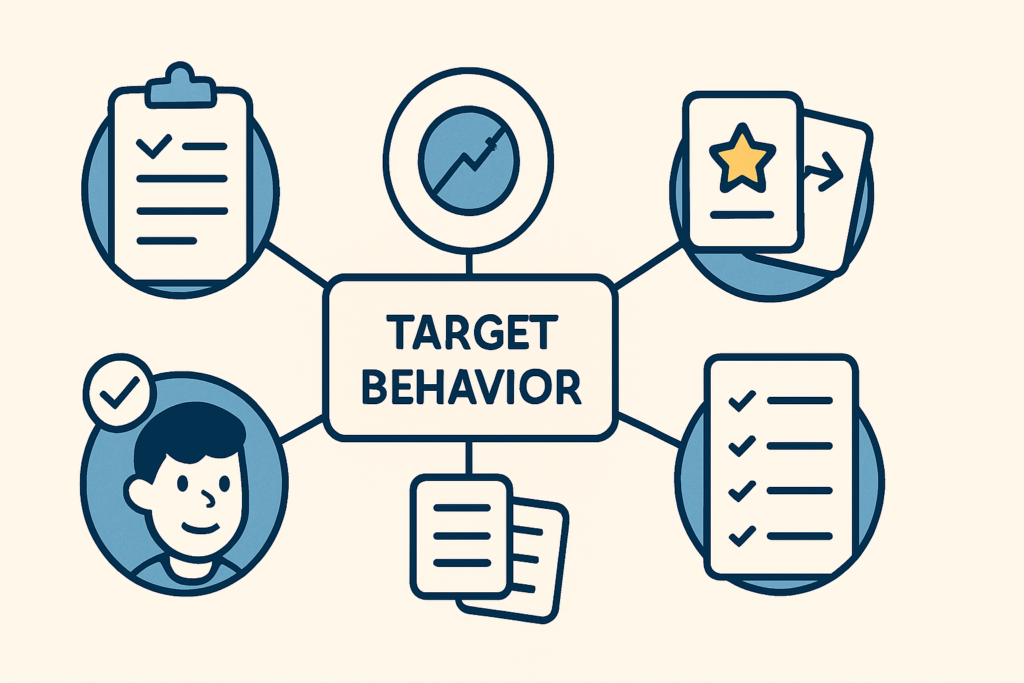
A target behavior is the specific action or response that becomes the focus of assessment, measurement, and intervention in applied behavior analysis. This concept serves as the cornerstone of ABA’s scientific approach, providing the measurable unit that allows practitioners to evaluate change objectively.
Table of Contents
- Target Behavior ABA: What is a Target Behavior? The Foundation of ABA
- Target Behavior in Action: From Assessment to Hypothesis
- Target Behavior on the BCBA® Exam: What to Expect
- Quick Checklist for Defining and Selecting Target Behaviors
- Summary: Precision, Ethics, and Effective Practice
Without a clearly defined target behavior, data collection lacks meaning and interventions cannot be properly evaluated. The precision required in defining these behaviors reflects ABA’s commitment to empirical validation and accountable practice.
Beyond Labels: Crafting an Operational Definition
An operational definition transforms vague descriptions into measurable observations. It must meet two critical criteria: observability and measurability. This means anyone reading the definition should be able to identify the behavior’s occurrence without interpretation.
Poor definitions often include mentalistic terms or subjective judgments. For example, ‘being aggressive’ is vague, while ‘making forceful contact with another person’s body using hands or feet’ provides clear parameters.
- Observable: The behavior can be seen or heard directly
- Measurable: You can count, time, or otherwise quantify occurrences
- Clear boundaries: Includes what the behavior IS and IS NOT
- Action-oriented: Describes movements rather than internal states
Ethical Selection: Prioritizing What Matters Most
Choosing which behaviors to target involves more than clinical judgment—it requires ethical consideration of client welfare and social significance. The BACB Ethics Code emphasizes selecting behaviors that improve quality of life.
Several factors guide ethical selection. Client safety always takes precedence, followed by behaviors that enable greater independence. Consider whether the behavior interferes with learning or social relationships, and whether reducing it would decrease reliance on negative reinforcement.
Collaborative goal-setting with clients and caregivers ensures interventions align with personal values and cultural contexts. This approach respects client dignity while maintaining professional standards.
Target Behavior in Action: From Assessment to Hypothesis
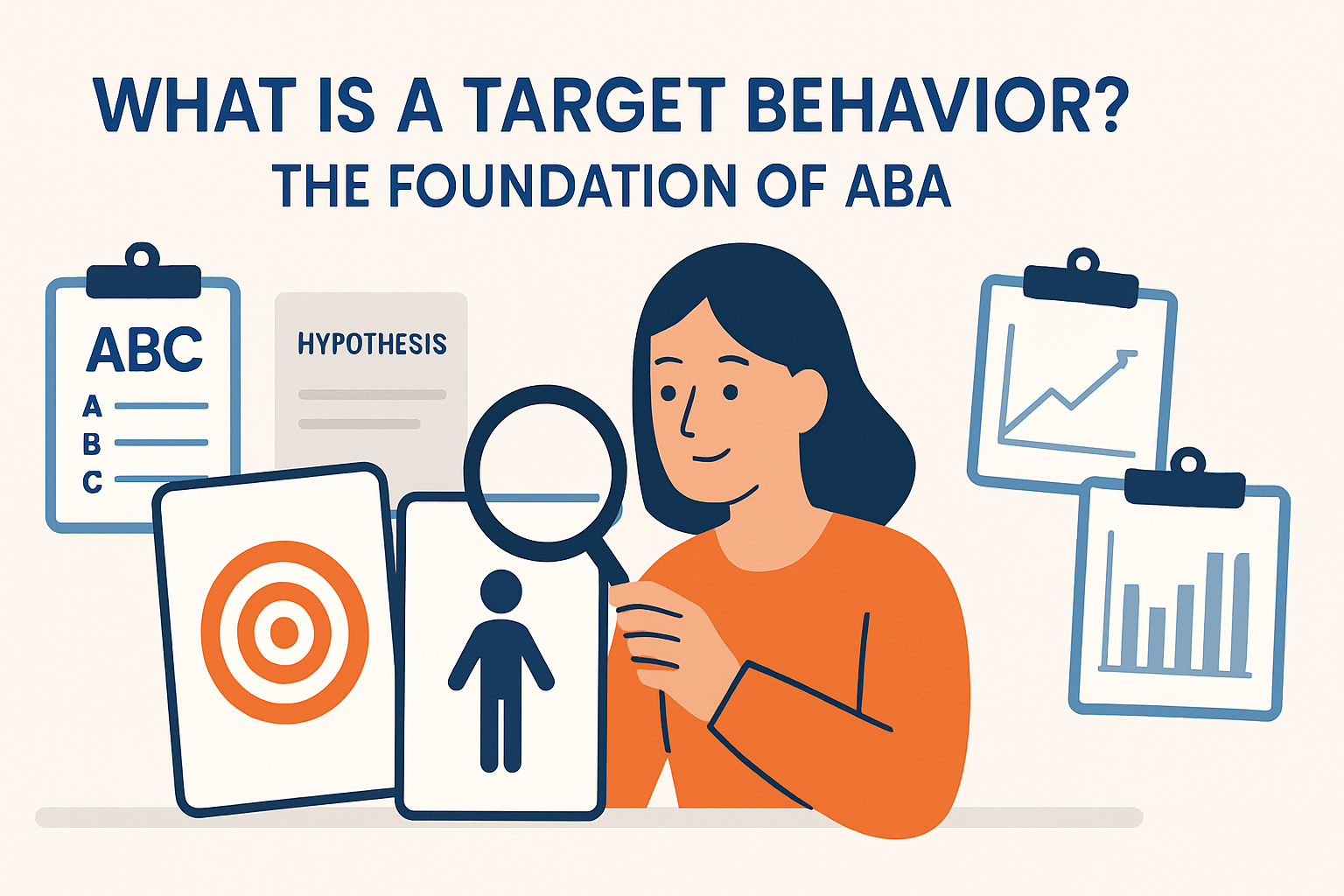
Well-defined target behaviors enable systematic assessment and functional analysis. By examining behavior within the ABC framework (Antecedent-Behavior-Consequence), practitioners can develop data-driven hypotheses about why behaviors occur.
These examples demonstrate how operational definitions guide assessment and inform intervention planning. Each case shows the connection between precise measurement and functional understanding.
Example 1: Elopement in a School Setting
Operational definition: ‘Any instance where the student’s feet move more than 3 feet away from the designated work area without adult permission during instructional time.’ This excludes walking to the pencil sharpener when given permission.
Sample ABC data reveals patterns: Antecedent = difficult math worksheet presented, Behavior = elopement, Consequence = worksheet removed. This suggests a possible escape function from academic demands.
The data collection allows practitioners to test hypotheses systematically. If elopement consistently follows difficult tasks and results in task removal, the functional assessment supports an escape-maintained behavior hypothesis.
Example 2: Vocal Stereotypy During Group Time
Operational definition: ‘Any instance of non-contextual vocalizations lasting 2 seconds or longer, including humming, repetitive vowel sounds, or scripted phrases unrelated to the current activity.’ This excludes appropriate responses to questions.
ABC data shows: Antecedent = quiet independent work, Behavior = vocal stereotypy, Consequence = no observable social reaction. The pattern suggests automatic reinforcement as the maintaining variable.
This understanding guides intervention selection. Rather than addressing social functions, practitioners might focus on providing alternative sources of sensory stimulation or teaching appropriate vocal alternatives.
Target Behavior on the BCBA® Exam: What to Expect
Exam questions frequently test your ability to identify appropriate operational definitions and select target behaviors ethically. Understanding these concepts is essential for Task List sections C-1 (defining behavior) and C-2 (measuring behavior).
The exam evaluates both technical knowledge and ethical application. You’ll need to distinguish between topographical definitions (what the behavior looks like) and functional definitions (what the behavior achieves).
Key Terms and Task List Alignment
Several related concepts appear regularly on the exam. Understanding their relationships strengthens your analytical skills and prepares you for complex scenario questions.
- Behavior: The activity of living organisms that can be observed and measured
- Response class: A group of behaviors that produce the same effect on the environment
- Environment: All physical and social events that affect behavior
- Stimulus: Any event that can potentially influence behavior
- Measurement: The process of applying quantitative labels to behavior
These concepts connect directly to Task List requirements and form the foundation of behavioral assessment.
Common Exam Traps and How to Avoid Them
Multiple-choice questions often include plausible but incorrect answers. Recognizing these patterns helps you select the best response under exam conditions.
- Vague definitions: Avoid answers containing terms like ‘frustrated,’ ‘anxious,’ or ‘disrespectful’
- Topography-function confusion: Remember that different behaviors can serve the same function
- Convenience over benefit: Reject options prioritizing staff ease over client improvement
- Measurement errors: Watch for definitions that can’t be reliably measured
- Cultural bias: Be alert to definitions reflecting cultural norms rather than objective criteria
Practice identifying these traps with mock exam questions to build your test-taking skills.
Quick Checklist for Defining and Selecting Target Behaviors
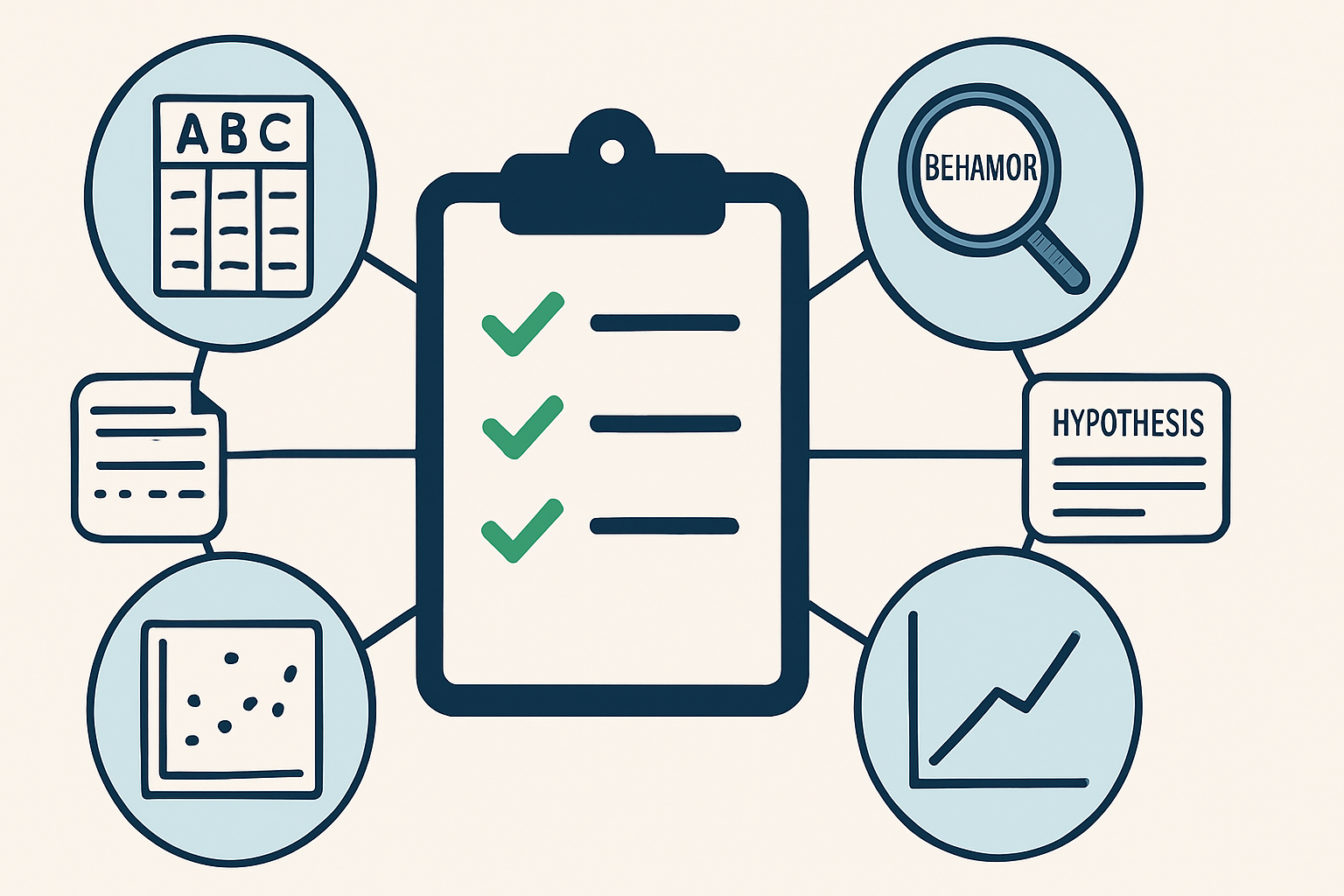
Use this practical tool to evaluate your target behavior definitions and selection decisions. Each item reflects best practices in ABA assessment and intervention planning.
- Observability check: Can two independent observers agree on occurrences?
- Measurability verification: Can you count, time, or otherwise quantify it?
- Social significance: Does changing this behavior improve quality of life?
- Client collaboration: Have you involved the client/caregiver in selection?
- Safety priority: Does this behavior pose immediate physical risk?
- Learning impact: Does it interfere with skill acquisition?
- Function consideration: Have you assessed the maintaining variables?
- Cultural appropriateness: Does the definition respect cultural context?
This checklist aligns with ethical guidelines and ensures comprehensive assessment.
Summary: Precision, Ethics, and Effective Practice
Target behavior definition represents the intersection of scientific rigor and ethical practice in ABA. Precise operational definitions enable reliable measurement, while ethical selection ensures interventions promote meaningful change.
The process begins with creating definitions that are both observable and measurable. This technical precision supports data-driven decision making throughout assessment and intervention. Ethical considerations then guide which behaviors warrant intervention based on their impact on client welfare and social functioning.
For BCBA exam preparation, focus on distinguishing appropriate definitions from vague descriptions. Practice applying ethical selection criteria to scenario questions, and remember that the best answers prioritize client benefit over professional convenience. Mastery of these concepts supports both exam success and effective clinical practice.
Additional resources on behavioral assessment can be found in the BACB Task List and peer-reviewed journals on applied behavior analysis.
Next step for BCBA exam prep
Turn this topic into exam-day practice
Use this topic as a focused review, then test it in exam-style conditions with a free mock before deciding whether five full-length mocks are the right next step.
Start the Free BCBA Mock ExamContinue with Five Full-Length Mocks — $99
Review the included materials and access details before ordering. No pass guarantee is implied.



