

Quick answer: The need for assessment of maintaining variables in OBM begins with a simple risk: a performance problem can have several different causes. An employee may lack a skill, lack a resource, receive unclear feedback, encounter a consequence that favors the wrong response, or face too much effort for the available payoff. If an intervention is chosen before those variables are assessed, a team may train someone who already knows the task or add incentives to a problem caused by missing materials.
Table of Contents
- What Are Maintaining Variables in OBM?
- The Need for Assessment of Maintaining Variables in OBM
- How Does an OBM Assessment Find Maintaining Variables?
- Which Assessment Methods Can Be Used in OBM?
- What Should You Measure in an OBM Assessment?
- Examples of Maintaining Variables in OBM
- What Are the Limits and Ethical Boundaries?
- FAQ
- Quick Review Checklist
- Take the Free BCBA Mock Exam
Organizational behavior management (OBM) applies behavior-analytic principles to workplace performance. Assessment does not mean blaming the employee or delaying action forever. It means defining the performance, identifying plausible environmental variables, collecting enough direct and informant data, and selecting a change that addresses the strongest hypothesis. This is useful BCBA exam logic because the question is not merely “What procedure sounds helpful?” It is “What evidence supports this procedure?”
What Are Maintaining Variables in OBM?
A maintaining variable is an environmental event or arrangement that helps keep a pattern of behavior occurring. In clinical ABA, analysts may examine what follows a response and what establishes its value. In OBM, the same functional reasoning can be applied to workplace behavior such as completing documentation, following a safety step, giving feedback, or submitting a report on time.
“The employee is careless” is not a maintaining-variable analysis. It is a broad judgment. A stronger starting point is observable: “The technician completes the checklist on 2 of 5 shifts, and the form is stored in a different location on each shift.” That description creates questions about access, task clarity, effort, competing priorities, and consequences. The data may show that the problem is not a lack of motivation at all.
The original discussion by Austin, Carr, and Agnew argued that formal assessment of maintaining variables deserved more attention in OBM. Their work connected functional-assessment logic from ABA with organizational performance analysis. The practical lesson is not to copy a clinical functional analysis into every workplace. It is to preserve the habit of testing the variables that may be supporting the performance pattern.
| Assessment question | Evidence to collect | Possible next decision |
|---|---|---|
| Can the person perform the task? | Direct observation, work sample, or skills check. | Teach or practice the missing response. |
| Is the task possible in the setting? | Access to tools, time, materials, and clear instructions. | Repair the environment or workflow. |
| What follows the performance? | Feedback, reinforcement, delay, correction, or competing outcomes. | Change the consequence or make it more reliable. |
The Need for Assessment of Maintaining Variables in OBM
The need for assessment of maintaining variables in OBM is strongest when a proposed intervention is based on an assumption rather than evidence. A manager may request training because performance is low, even though the employee has never received the current procedure. A supervisor may add praise even though the real barrier is a broken system. A dashboard may display a score without showing whether staff have the time or materials to change it.
Assessment improves the match between problem and solution. It can also prevent side effects. If a quota increases speed but reduces accuracy, the intervention may strengthen the wrong response dimension. If a feedback system compares employees publicly, it may create avoidance or reporting problems. A function-based assessment asks what the current arrangement selects, not simply what behavior is easiest to criticize.
How Does an OBM Assessment Find Maintaining Variables?
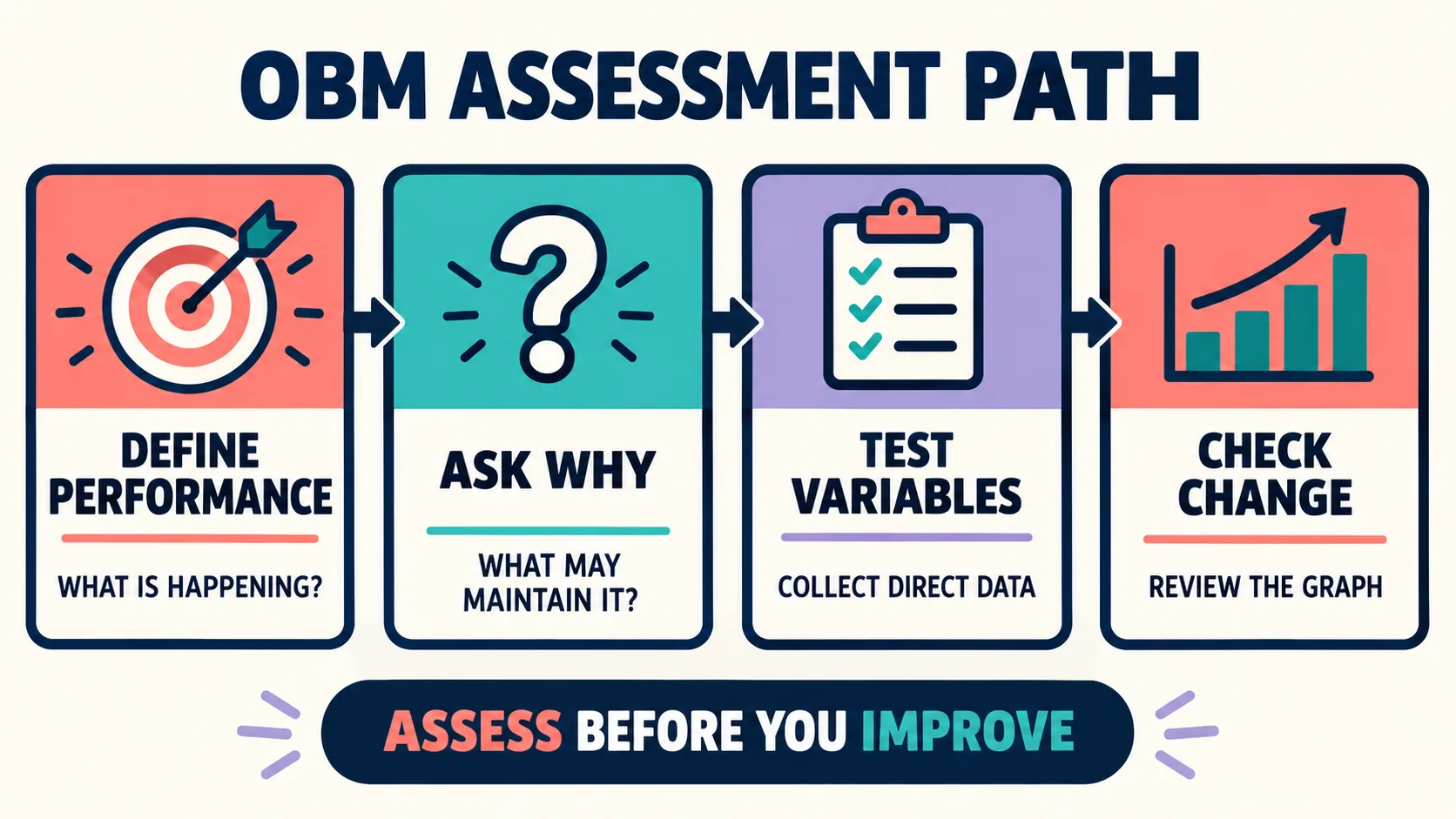
A practical assessment can be organized as a sequence. The depth of the assessment should match the risk, urgency, complexity, and decision being made:
- Define the performance. State who should do what, under which conditions, how often, and to what quality standard. “Improve documentation” is too broad; “enter the session note before leaving the clinic, with all required fields complete” is more measurable.
- Define the discrepancy. Compare current performance with a meaningful criterion. Check whether the criterion is valid, attainable, and socially important rather than treating any difference from a manager’s preference as a problem.
- Check skill and knowledge. Ask the person to demonstrate the task or review a work sample. A written answer that the worker knows the rule is not enough if the actual response cannot be performed under real conditions.
- Map the environment. Inspect instructions, materials, time, equipment, staffing, competing tasks, and the sequence of consequences. Interview data can generate hypotheses, but direct observation helps determine whether those conditions are present.
- Record what follows performance. Note feedback, access to preferred outcomes, delays, corrections, escape from effort, and whether the consequence is delivered consistently. Do not label an event as reinforcement until the behavior changes or the arrangement is otherwise supported as functionally relevant.
- Rank hypotheses. Select the variables most plausible and most changeable. Separate a cause that can be addressed from a background fact that is merely correlated with the performance.
- Test the smallest useful change. Use a pilot, component comparison, or repeated measurement when the decision warrants it. Protect confidentiality and avoid creating a high-stakes experiment without appropriate approval and safeguards.
- Review the outcome. Graph the target performance, quality, side effects, and maintenance. If the data do not improve, return to the assessment instead of escalating the same intervention automatically.
Which Assessment Methods Can Be Used in OBM?
Informant assessment is often an efficient first step. Interviews and questionnaires can ask what staff know, what resources they have, what feedback they receive, and what makes the response difficult. Informant data are useful for generating hypotheses, but they can be affected by memory, perspective, and social desirability. Treat them as evidence to check, not as proof that one variable maintains the behavior.
Descriptive assessment observes the behavior in the natural work setting. An analyst can record the antecedent, the performance, and what follows it, along with task difficulty, time, materials, and other relevant context. A descriptive pattern may suggest a maintaining variable, but conditional association does not automatically demonstrate a causal relation.
Experimental or component analysis provides stronger evidence when it is feasible, safe, and authorized. The analyst changes one relevant feature while measuring the performance and other outcomes. In OBM, the arrangement may involve feedback, task clarification, resources, response effort, or consequences. The design must respect workplace rights, confidentiality, informed participation where required, and the limits of the analyst’s role.
What Should You Measure in an OBM Assessment?
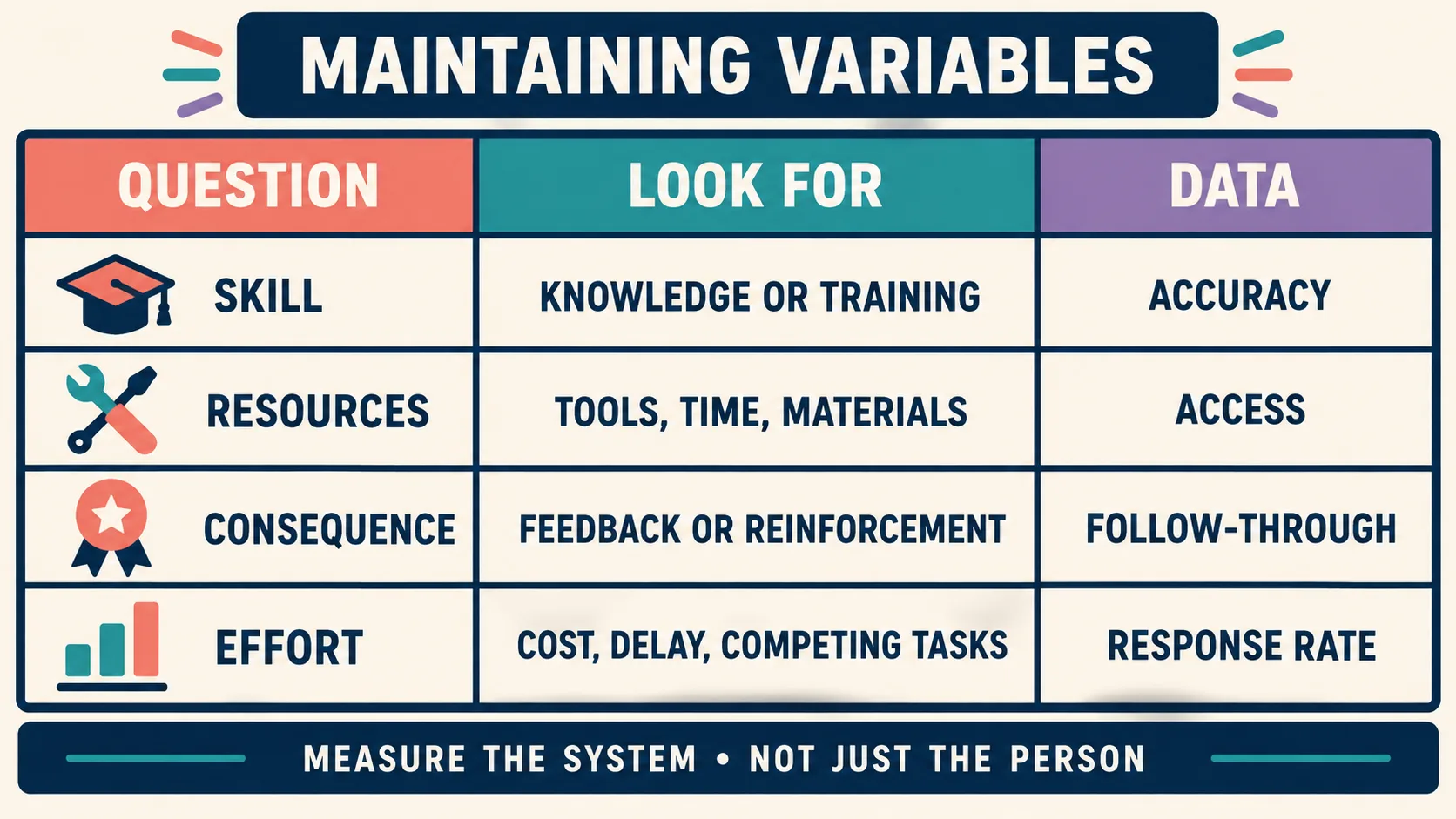
Measure the performance that matters, not only an easy proxy. If the goal is accurate documentation, count complete and correct records rather than just the number submitted. If the goal is safety, include the target safety response and relevant quality or incident measures. If the goal is supervision, measure the defined feedback behavior and the recipient’s meaningful outcome.
Also record exposure. A raw count can be misleading when workers have different numbers of opportunities, shift lengths, caseloads, or task assignments. Rate, percentage of opportunities, latency, duration, quality scoring, and direct work samples may answer different questions. Keep the denominator and scoring rule visible so a later graph does not hide a change in opportunity.
Use treatment-integrity or implementation measures when a new procedure is introduced. If feedback was scheduled but not delivered, a weak outcome may reflect implementation failure rather than a false hypothesis. Measure social validity as well: whether the goal is important, the procedure is acceptable, and the outcome is useful to the people affected.
Examples of Maintaining Variables in OBM
Training hypothesis: A staff member misses a data-entry step because the procedure changed and no one demonstrated the new sequence. A performance-based training package with instruction, modeling, rehearsal, and feedback may be appropriate. The assessment should still check whether the form is available and whether the step can be completed during the shift.
Resource hypothesis: A team rarely completes a safety check because the required equipment is stored in a locked room far from the work area. More reminders may not solve the problem. Moving the materials, clarifying access, or changing the workflow may be the relevant intervention.
Consequence hypothesis: A supervisor asks for incident reports but responds only when a report is late. The delay may produce more attention than timely completion. A reliable, meaningful consequence for accurate and timely reporting could change the pattern, but the analyst should monitor accuracy so speed is not reinforced at its expense.
Effort hypothesis: A desired response requires several screens and duplicate entries while a competing task can be completed in one step. Reducing response effort, simplifying the sequence, or changing the competing contingency may be more direct than another motivational speech.
What Are the Limits and Ethical Boundaries?
Maintaining-variable assessment is not permission to manipulate employees covertly or to treat a workplace like a laboratory without safeguards. Use the least intrusive assessment that can answer the question, protect private information, explain the purpose and expected impact, and involve the appropriate decision makers. Do not use a performance score to justify discrimination, retaliation, or an intervention outside the analyst’s competence.
The BCBA Test Content Outline connects assessment, measurement, data interpretation, and intervention decisions. The BACB Ethics Code also requires behavior analysts to use appropriate procedures and make decisions from relevant data. In an exam scenario, the best answer is usually the one that defines the performance, gathers objective information, considers context, and selects an evidence-matched action before escalating.
FAQ
Does every OBM problem require a functional analysis?: No. Start with the least intensive assessment that can answer the decision. Informant and descriptive methods may be enough for a low-risk workflow change, while a complex or high-stakes problem may need a stronger design and additional authorization.
Is a lack of motivation a maintaining variable?: “Lack of motivation” is usually a hypothesis, not a complete explanation. Specify the observable performance and examine access, effort, skill, feedback, consequences, and competing outcomes. Then use data to determine which variables are functionally relevant.
How is OBM assessment different from clinical FBA?: Both use functional reasoning, but the setting, target, stakeholders, and risks differ. OBM commonly addresses employee or system performance, resources, workflow, and organizational consequences. Use the assessment model that fits the setting and your competence rather than copying a clinical protocol without adaptation.
Bottom line: The need for assessment of maintaining variables in OBM is the need to match a change to evidence. Define the performance, check skill and context, observe what follows the response, rank hypotheses, test a focused change, and review both improvement and side effects. For broader OBM concepts, read the site’s organizational behavior management guide, then practice applying the reasoning with the free BCBA mock exam. For targeted review, use our the need for assessment of maintaining practice questions to apply the concept in exam-style scenarios.
Quick Review Checklist
Use this final checklist to turn the need for assessment of maintaining into exam-ready reasoning. The goal is not to memorize a label in isolation; it is to identify the relevant evidence and explain why the best answer fits the scenario. Key ideas to review:
- State the central definition or decision point for the need for assessment of maintaining in your own words.
- Identify the detail that makes the need for assessment of maintaining different from its closest related ABA term.
- Separate the observable facts in a scenario from assumptions that are not supported by the facts.
- Write one example and one nonexample so you can recognize the concept in a new setting.
Exam application checks:
- Ask what the question is actually requesting before comparing the answer choices.
- Mark the antecedent, response, consequence, or other evidence that supports the selected answer.
- Look for a distractor that describes a related process but does not answer the specific question.
Final self-check:
- Explain how you would verify the interpretation with clear observations or data.
- Change one detail in the scenario and decide whether your answer should change.
- Give a one-sentence rationale that a supervisor or study partner could evaluate.
Take the Free BCBA Mock Exam
When you are ready to apply the idea, use the free practice resource below for additional feedback. Take the Free BCBA Mock Exam



