
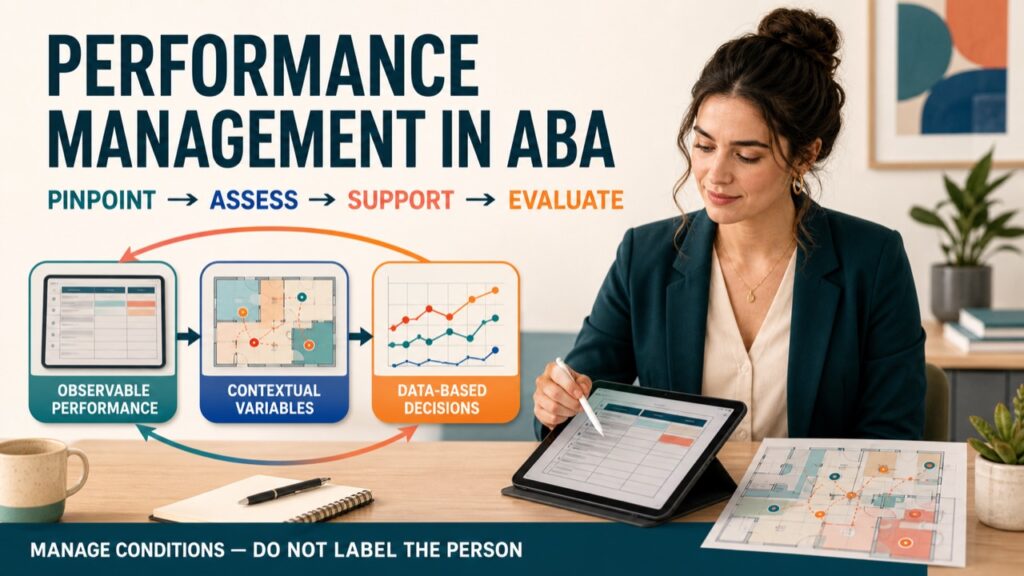
Performance management in ABA is a continuous, data-based process for improving socially significant employee or supervisee performance. Within organizational behavior management, the process includes defining an observable employee behavior, measuring representative performance, assessing relevant environmental variables, selecting contextually appropriate procedures, and evaluating whether performance and valued organizational outcomes change. It is an applied decision process, not a single intervention.
Table of Contents
- What Is Performance Management in ABA?
- Distinguishing Performance Management From Common Misconceptions
- The Role of Training and Ongoing Support
- Function-Based Performance Management Workflow
- Performance Diagnostics and Procedural Integrity
- Cultural Responsiveness and Contextual Fit
- Key Takeaways for Supervision
- Authoritative Sources
The current BCBA Test Content Outline (6th ed.) places related competencies in Domain I. Task I.5 concerns empirically validated and culturally responsive performance-management procedures; I.6 concerns a function-based approach to assessing and improving supervisee behavior; and I.7 concerns data-based decisions about supervisory efficacy. Those tasks support the framework in this guide without implying how often any particular term will appear on an examination.
What Is Performance Management in ABA?
At the performer level, a supervisor first pinpoints what a person must do rather than rating a trait such as attitude or professionalism. Appropriate targets might include recording data according to the written definition, implementing each critical treatment step, completing a required permanent product, or communicating specified information. The supervisor also identifies why that behavior matters, such as procedural accuracy, timely access to information, safety, or continuity of service.
After baseline measurement, performance diagnostics examine whether the performer has the necessary skill and whether instructions, materials, workflow, consequences, response effort, or competing demands support the target. The resulting procedure might include task clarification, instruction, modeling, practice, performance feedback, goal setting, reinforcement, or a process change. These are possible components rather than a required bundle. Measurement is needed to evaluate the selected package and, when the design permits, the contribution of individual components.
Distinguishing Performance Management From Common Misconceptions
Several boundaries prevent the term from becoming a vague label for ordinary management. The distinguishing feature is a repeated measurement-and-decision cycle focused on behavior in context. A supervisor should not infer a cause from a personality description or select a favorite tool before assessing conditions that affect performance.
- Continuous process versus delayed rating: A periodic review may summarize past work, whereas performance management uses repeated observations to guide current support and evaluate change.
- Behavior versus person label: A useful target specifies an action and its conditions. Labels such as careless, resistant, or unmotivated do not identify what to measure or change.
- Performer behavior versus client programming: The immediate target is an employee or supervisee action, even when improved staff performance is expected to support client services.
- Performer level versus system level: Behavioral systems analysis examines wider workflows and organizational alignment. Performance management may reveal a system barrier, but the two scopes are not interchangeable.
- Assessment versus default intervention: More training, feedback, or incentives should follow evidence of a relevant deficit or contingency, not managerial habit.
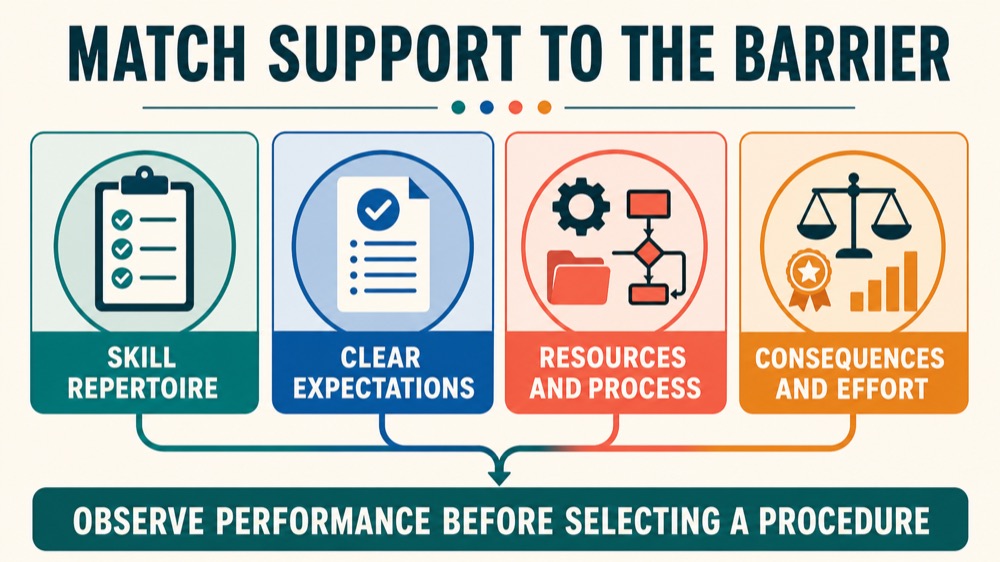
This boundary is especially important when performance is low despite demonstrated skill. Ambiguous instructions, unavailable materials, inefficient software, delayed consequences, excessive effort, or competing priorities may be more relevant than another training session. A function-based assessment keeps the supervisor focused on modifiable conditions and avoids attributing performance to an assumed inner trait.
The Role of Training and Ongoing Support
Initial competency-based training establishes a repertoire through instruction, modeling, rehearsal or workplace practice, and corrective feedback. Ongoing performance support asks a different question: does the trained behavior occur accurately under ordinary job conditions and continue over time? The evidence-based review by Novak and colleagues treats preservice training and continued coaching, observation, and feedback as related parts of staff support rather than assuming that initial training is sufficient.
Performance feedback provides information about observed behavior or its products. Its behavioral effect must be demonstrated. Depending on its content, timing, history, and surrounding contingencies, feedback may clarify a rule, prompt a response, or participate in a consequence relation. The label reinforcement is appropriate only when a consequence increases the future probability of the relevant behavior. Praise, a graph, or a corrective statement should therefore be evaluated by its measured effect instead of its helpful intent.
Selection and delivery also depend on context. Observation may be live or based on an appropriate permanent product; coaching may occur at different intervals based on performance, feasibility, privacy, and risk. The supervisor chooses a defensible arrangement, documents it, and changes it when data show that the current support is ineffective or unnecessarily burdensome.
Function-Based Performance Management Workflow
A practical workflow moves from definition to assessment, intervention, and evaluation. The order helps prevent premature solutions, but the details should be adapted to the setting, the performer, the significance of the outcome, and available resources. Each step should leave a record that another reviewer can understand.
- Operationally define the performer behavior and valued outcome. Use pinpointing to specify topographies (e.g., “writes a session note with all required fields”) and the outcome (e.g., “note approved by supervisor within 48 hours”).
- Establish representative measurement. Collect baseline data under typical conditions using direct observation, permanent products, or validated self-monitoring.
- Assess skill/training. Can the staff member perform the behavior if asked? If not, provide training first. If yes, move to other variables.
- Assess antecedents and information. Are expectations clear? Are there written protocols or job aids? Are prompts available?
- Assess resources and processes. Does the staff member have time, materials, and system support? Is the process efficient?
- Assess performance consequences. What happens after the behavior currently? Is there immediate feedback? Does the supervisor provide attention only when errors occur?
- Assess response effort and competing demands. Is the required behavior time-consuming relative to other tasks? Are there easier alternatives that are reinforced?
- Select a feasible procedure from the assessment and evidence. Choose interventions that address identified variables. For example, if consequences are lacking, introduce performance feedback plus goal setting. If response effort is high, reduce steps or provide checklists.
- Monitor procedural integrity and performance continuously. Ensure the intervention is implemented as designed. Track the targeted outcome measure.
- Revise from data. If performance does not improve, reassess and adjust. Use an experimental design (e.g., multiple baseline across staff) to evaluate effectiveness.
Consider a hypothetical note-completion problem. A supervisor defines the target as submitting a note through the approved system by the organization’s stated deadline with every required field complete. Direct review of permanent products shows missed deadlines and omitted fields. Interviews and observation then suggest that the written criterion is hard to find, the mobile workflow frequently times out, and feedback arrives days after completion.
The resulting package might place the criterion at the point of performance, repair or simplify system access, and provide descriptive feedback from the permanent product. The supervisor measures timely, complete notes and records whether each support component was delivered. If performance changes after the package, the data support evaluating the package under those conditions; they do not by themselves establish which component produced the change. The next decision follows replicated measurement, feasibility, staff input, and any planned component analysis.
Performance Diagnostics and Procedural Integrity
Performance diagnostics organize questions about training and skill, antecedents and information, equipment and processes, consequences, effort, and competing demands. A checklist can structure inquiry, but indirect answers should be checked against direct observation or permanent products when feasible. The assessment narrows plausible variables; it does not prove a behavioral function merely because one box was selected.
Procedural integrity is the extent to which the selected support is delivered as designed. Measure it separately from the target performance. When staff behavior remains unchanged, low integrity may make the outcome difficult to interpret, while adequate integrity may point toward a weak hypothesis, an ineffective component, insufficient contextual fit, or an insensitive measure. A data-based decision can modify the procedure, improve implementation, collect better measurement, or return to assessment.
Cultural Responsiveness and Contextual Fit
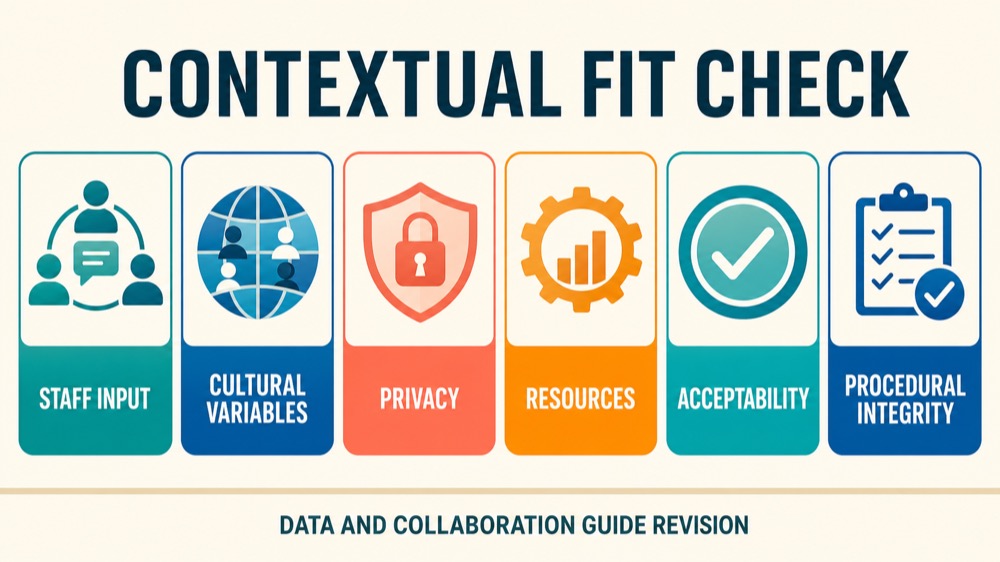
Culturally responsive performance management requires collaboration about goals, measurement, feedback, and acceptable support. Contextual fit concerns whether a procedure matches the performer’s skills and preferences, the workplace’s resources and workflow, the significance of the outcome, and relevant cultural variables. These considerations belong in assessment and evaluation rather than being added after a package has been selected.
- Cultural responsiveness. Understand how the supervisee’s cultural background may influence their preference for feedback, reinforcement type, or communication style. Avoid assuming that one approach works for everyone.
- Collaboration. Involve staff in pinpointing behaviors and selecting interventions. This increases buy-in and acceptability.
- Privacy. Collect, store, and share only the performance information needed for the purpose, following applicable law, contracts, consent requirements, and organizational policy. Choose private feedback arrangements when public display could identify or stigmatize a performer.
- Acceptability and staff input. Ask supervisees about their preferred feedback format (e.g., written, verbal, graph) and schedule. Use social validity measures to ensure interventions are acceptable.
- Resources. Consider the time and cost of data collection and intervention. A PM system that requires excessive paperwork may be abandoned.
These factors are integral to ethical and effective PM. Ignoring them can lead to resistance, low procedural integrity, and negative side effects.
Key Takeaways for Supervision
Sound performance management keeps the target observable, the assessment function based, the procedure linked to evidence and context, and the decision tied to both performance and implementation data. It also separates initial skill acquisition from ongoing workplace support and treats staff input, cultural variables, privacy, feasibility, and social validity as substantive design variables.
Use our Free BCBA Mock Exam for original questions and answer feedback that exercise data-based professional reasoning without claiming to reproduce this exact topic or secure examination content. For a deeper assessment-focused companion, review the function-based performance diagnostics guide.
Authoritative Sources
- BACB BCBA Test Content Outline (6th ed.)
- Evidence-Based Performance Management
- Performance Management in Human Services
Next step for BCBA exam prep
Turn this topic into exam-day practice
Use this topic as a focused review, then test it in exam-style conditions with a free mock before deciding whether five full-length mocks are the right next step.
Start the Free BCBA Mock ExamContinue with Five Full-Length Mocks — $99
Review the included materials and access details before ordering. No pass guarantee is implied.



