
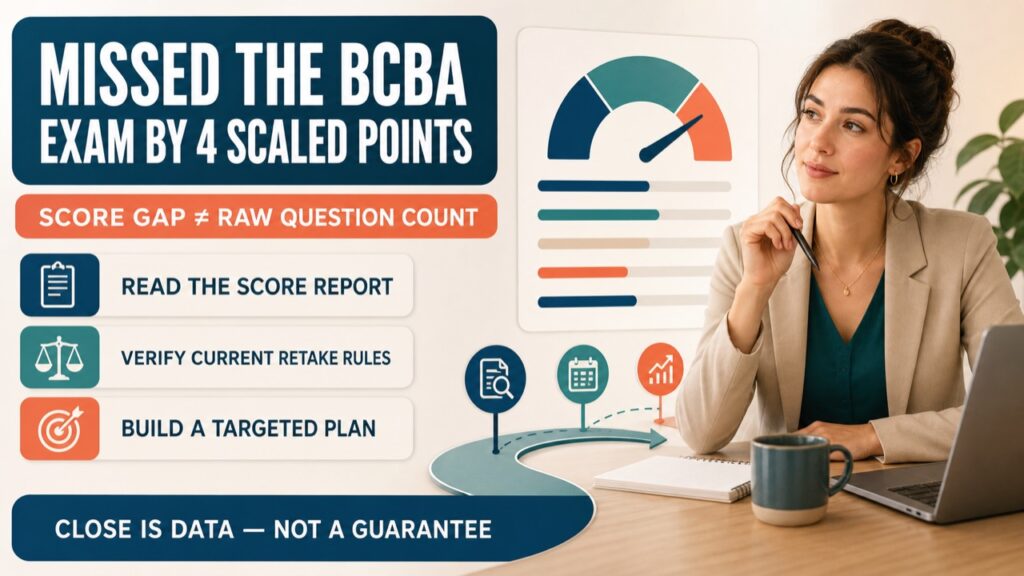
Understanding the 4-Point Scaled Score
If your result shows that you missed the BCBA examination passing standard by four scaled points, the number is meaningful as an outcome but not as an item count. The BACB explains that a scaled score is created by mathematically transforming performance so results from different examination forms can be compared against the same passing standard. Because forms are equated for difficulty, the size of a scaled-score gap does not disclose how many responses would have changed the result.
Table of Contents
- Understanding the 4-Point Scaled Score
- Using Your Score Report Effectively
- BACB Retake Policies and Procedures
- Your Reset and Retake Plan
- Key Actions to Take Now
- Signs You Are Ready to Retake
- Maintaining Momentum without Overwhelm
The BACB also explains in its current Examination Information that it does not report a candidate’s raw number correct or overall percentage correct. That means there is no defensible calculation from a four-point gap to a particular number of items. Treat the score as a pass/fail result plus directional study information, not as a reconstruction of the secure examination or proof that one isolated mistake determined the outcome.
This distinction matters for planning. A close-looking scaled result can invite either panic or overconfidence, yet neither reaction identifies what to study. The useful next step is to preserve the official report, read the content-area information carefully, and combine it with fresh evidence from original practice questions. Your plan should respond to patterns you can observe rather than to an assumed raw-score story that the report does not provide.
Using Your Score Report Effectively
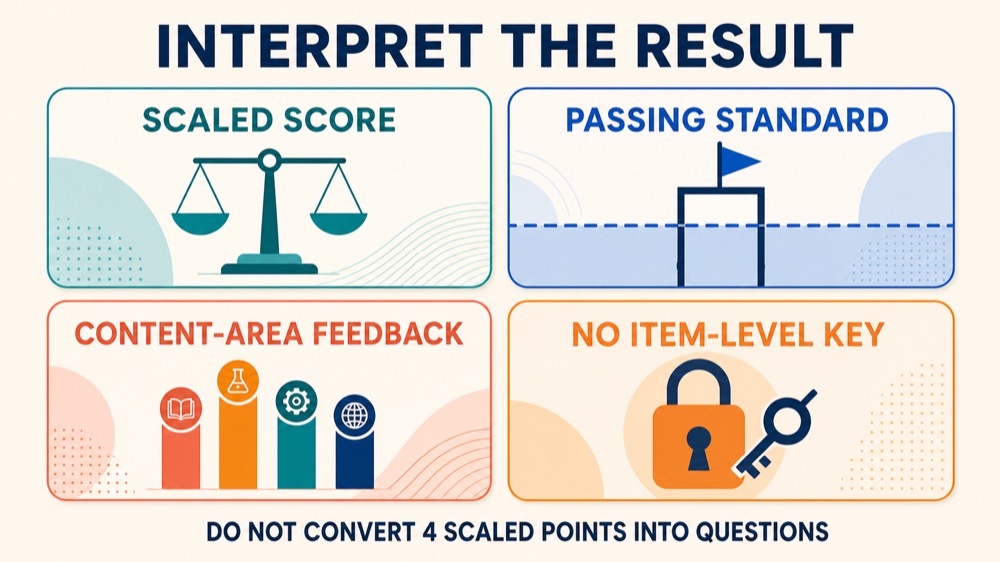
For an unsuccessful BCBA attempt, the official score report includes the percentage answered correctly and the total number of questions within each primary content area. That content-area performance is more useful than guessing about individual missed items, but it still has limits. BACB cautions that the number of questions in an area is relatively small and may not predict your complete understanding of that area. Read the report as directional evidence, not a diagnostic profile.
Start by placing the report beside the current BCBA Test Content Outline (6th ed.). Mark broader domains that deserve attention, then examine your own performance on original, independently written practice items. A lower report percentage can justify extra review, while a higher percentage does not justify dropping that domain. BACB specifically advises candidates preparing again to study all content rather than relying only on the areas that appeared weak.
- Which concepts can you define precisely without relying on recognition?
- Which scenario questions do you miss for the same conceptual reason?
- Which errors come from reading the stem too quickly or overlooking a qualifier?
- Which domains remain accurate when questions are mixed and timed?
These questions turn broad report data into observable study decisions. Record the rule you applied, why the selected answer fits, and why each alternative fails. Do not record or reconstruct secure examination content. The goal is to identify repeatable reasoning errors using lawful practice material, then verify that those errors decrease across new examples rather than disappear only on memorized questions.
BACB Retake Policies and Procedures
Knowing the current administrative sequence keeps the study plan separate from the scheduling process. The BCBA Handbook, updated June 2026, says the Examination Retake Application becomes available in the BACB portal within 48 hours after a failed attempt. It also says candidates receive an examination authorization email within 48 hours after submitting that application, with instructions for scheduling a new appointment.
The same handbook states that candidates must observe a 30-day wait after the previous attempt. It permits no more than eight total attempts during the two-year authorization period that follows initial application approval. Check the dates and status displayed in your own portal before paying or scheduling, and recheck the current handbook because fees and procedures may change after this article’s review date.
An examination appeal is a separate, narrow process. The current BACB Administrative Appeals page identifies examination-condition irregularities, such as disruptive conditions or significant technical problems, and currently requires a written request within seven days of the appointment. It also states that examination results and specific questions or answers may not be appealed. If an irregularity occurred, preserve contemporaneous documentation and follow the official instructions; the numerical closeness of the result does not change those stated boundaries.
Your Reset and Retake Plan
Begin with an administrative reset: save the score report, confirm the portal’s application and authorization dates, and note the earliest eligible testing date without treating it as a required appointment. The waiting period creates a minimum boundary, not a personalized readiness decision. Choose a later date when your learning data support it, while staying inside the authorization window shown in your account.
Next, build an error log from original practice material. For every missed or uncertain item, label the underlying concept, the reasoning step that failed, and the evidence that would support the correct choice. Separate knowledge gaps from discrimination errors, overgeneralized rules, missed qualifiers, and pacing problems. Revisit the concept with a new example, then test it again in a mixed set so improvement is not based on remembering the earlier answer.
Use short focused study blocks for identified gaps, but regularly return to cumulative mixed practice across the full outline. Timed work should evaluate both accuracy and decision quality: can you identify the relevant relation, reject tempting alternatives, and complete the set without a late-session collapse? An hour total is only a record of exposure. Stronger evidence is stable performance across unfamiliar sets, clear explanations, appropriate pacing, and fewer repetitions of the same error pattern.
Key Actions to Take Now
- Download the score report and record the percentages and item totals shown for every primary content area.
- Open the BACB portal, locate the Examination Retake Application when available, and verify the authorization dates displayed for your account.
- Respect the current 30-day retake interval and choose an appointment only after checking both official eligibility and your learning data.
- Map directional report feedback to the current Test Content Outline while keeping every domain in cumulative review.
- Build an error log that distinguishes concept gaps, faulty rules, missed qualifiers, and time-management errors.
- Use new, original questions to test whether corrected reasoning transfers beyond a familiar practice item.
- Alternate focused repair sessions with timed mixed sets so weaker material improves without stronger material drifting.
Signs You Are Ready to Retake
- Your accuracy remains reasonably stable across multiple unfamiliar, mixed practice sets rather than peaking on one familiar form.
- You can state the controlling concept and explain why the correct option fits the scenario.
- You can reject each distractor for a specific reason instead of relying on a vague feeling or memorized wording.
- Your error log shows that repeated conceptual and reading errors are declining across new examples.
- Your pacing leaves enough time to read qualifiers and review flagged items without rushing the final portion.
- Your stronger domains remain maintained while targeted domains show improvement.
- You understand the administrative difference among the scaled score, passing standard, and examination authorization.
Maintaining Momentum without Overwhelm
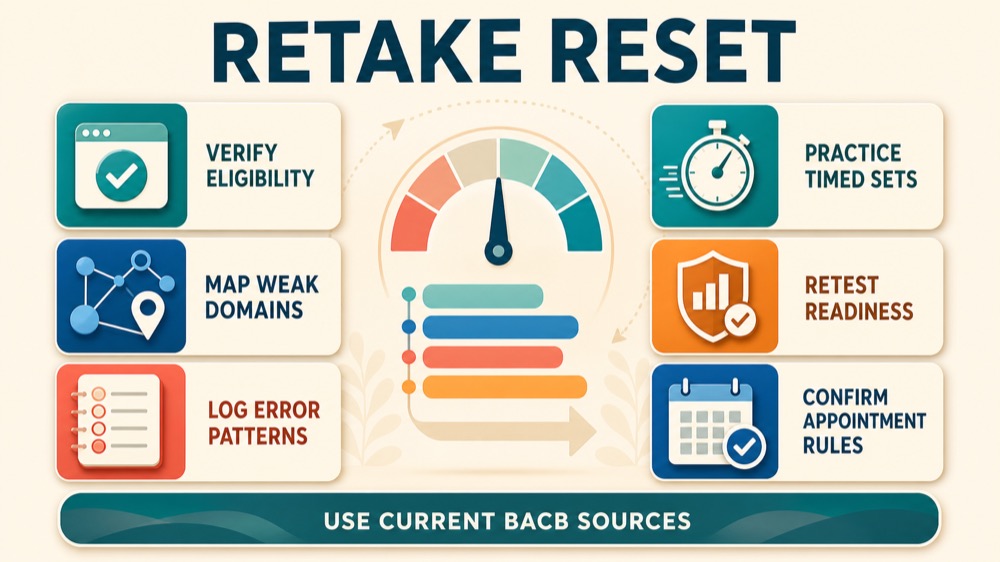
Disappointment after a narrow-looking result is understandable, but the scaled gap alone does not diagnose what happened. Give yourself enough distance to review the report accurately, then move from reaction to measurement. A simple weekly plan can name the domains to review, the practice sets to complete, the errors to revisit, and the evidence you will use to decide whether the plan is working.
Keep the plan flexible when the data change. If a concept improves in focused drills but fails in mixed scenarios, practice discrimination and transfer rather than repeating the same notes. If accuracy stays high but pacing deteriorates, adjust set length and review habits. If a previously strong domain begins to slip, restore cumulative practice. These are actionable observations; the four-point label by itself is not.
Use current BACB documents for policy and outline questions, and use lawful study materials for skill building. A study partner can help by asking you to explain decisions, but no one should solicit, share, or reconstruct secure examination content. Your comeback plan is strongest when it is grounded in official administrative information, original practice, observable learning patterns, and a balanced review of the complete outline.
A useful review cycle has four parts: sample, analyze, repair, and verify. First, complete a new mixed set under realistic timing. Next, classify both incorrect answers and low-confidence correct answers. Repair the underlying rule with definitions, examples, and nonexamples. Finally, verify the change on different questions after enough time has passed to reduce simple recall. Repeat the cycle until your data show broader, durable improvement rather than a one-session spike.
Before scheduling, conduct a final administrative check as well as a learning check. Confirm that the retake application is approved, the appointment falls within your active authorization, your identification will meet testing-center requirements, and the current handbook has not changed. Then review your practice evidence for stable reasoning, pacing, and domain coverage. These checks cannot predict a result, but they can prevent avoidable administrative errors and make the retake decision more deliberate.
For additional original practice and answer feedback, use the Free BCBA Mock Exam. Add the results to your error log, explain each decision in your own words, and compare performance across more than one practice set. It is a study data point rather than a promise about your next result, and it does not reproduce secure BACB examination items.
Next step for BCBA exam prep
Turn this topic into exam-day practice
Use this topic as a focused review, then test it in exam-style conditions with a free mock before deciding whether five full-length mocks are the right next step.
Start the Free BCBA Mock ExamContinue with Five Full-Length Mocks — $99
Review the included materials and access details before ordering. No pass guarantee is implied.



