
Quick answer: The phrase ABA intervention autism usually points to behavior-analytic support designed around an autistic person’s goals, environment, communication, and daily participation. An intervention may teach functional communication, play, learning, self-care, safety, or other skills; it may also reduce behavior that interferes with health, learning, or access. The important question is not whether one branded method works for everyone. It is whether the team can explain the goal, the teaching arrangement, the data, the child’s voice, and how the plan will be reviewed.
Table of Contents
- What Does ABA Intervention Autism Mean in Practice?
- What Goals Can ABA Intervention Address?
- How Is an ABA Intervention Plan Built?
- How Is an ABA Intervention Chosen?
- Which ABA-Based Intervention Formats Are Common?
- What Does the Evidence Say About ABA Intervention for Autism?
- How Do Data and Generalization Shape the Plan?
- How Should Child Voice and Ethics Shape Intervention?
- How Does ABA Work With Other Autism Supports?
- How Do ABA Intervention Autism Approaches Compare?
- What Questions Should Families Ask Before Starting?
- What Are Red Flags in an ABA Intervention Plan?
- ABA Intervention Autism FAQ
- Is ABA intervention a cure for autism?
- How many hours of ABA intervention are required?
- Which ABA method is best for autism?
- Can ABA be used with speech or occupational therapy?
- Key Takeaway
- Take the Free BCBA Mock Exam
ABA intervention is not a diagnosis, a cure, or a fixed number of therapy hours. The Centers for Disease Control and Prevention places ABA among several behavioral, developmental, educational, social-relational, and other approaches used in autism support. Families can consider ABA alongside speech-language therapy, occupational therapy, educational services, medical care, and developmental approaches. This guide explains how to evaluate an intervention without turning a broad search phrase into a universal prescription.
What Does ABA Intervention Autism Mean in Practice?
In practical terms, an ABA intervention changes an environment, teaching arrangement, consequence, or support so that a meaningful response becomes easier to learn or use. A clinician may examine what happens before a behavior, what the person does, what happens afterward, and which skills or supports would improve participation. The plan should describe observable actions rather than a vague demand to “act normally” or “be less autistic.”
A respectful intervention asks what the person needs to communicate, participate, regulate, learn, and stay safe. It does not assume that every repetitive movement, refusal, difference in eye contact, or unusual interest is a problem to eliminate. A target deserves scrutiny when it is selected mainly for appearance or adult convenience instead of health, autonomy, access, communication, or the person’s own priorities.
The team may include a BCBA, BCaBA, RBT or behavior technician, caregiver, teacher, speech-language pathologist, occupational therapist, physician, or other professional. Credentials and responsibilities vary. A person delivering direct teaching is not automatically the person who independently diagnoses, designs the entire plan, or changes clinical procedures.
What Goals Can ABA Intervention Address?
Goals should be meaningful in the person’s actual life and measurable enough for the team to tell whether support is helping. Examples may include:
- Requesting help, a break, an item, or a change through speech, signs, gestures, writing, or an augmentative and alternative communication system.
- Participating in play, conversation, shared activities, routines, or community events in a way that respects the person’s communication and preferences.
- Completing daily-living steps such as dressing, eating, hygiene, organizing materials, or preparing for sleep.
- Learning to navigate transitions, waiting, changes in plans, sensory needs, or unfamiliar environments with useful supports.
- Replacing dangerous behavior with a functionally related communication or safety response.
- Maintaining a skill and using it with different people, materials, places, and levels of support.
A strong goal identifies the response, the context, the level of independence, and the reason it matters. “Uses a communication response to request a break during a difficult routine” is more useful than “improves compliance.” The family and learner should be able to ask why the goal was selected, what success looks like, how much prompting is expected, and what will happen if the goal is not meaningful or the procedure causes distress.
How Is an ABA Intervention Plan Built?
Good intervention planning is a cycle. The team gathers information from the learner and people who know the learner, observes relevant situations, defines a target or skill, records a baseline, selects a teaching arrangement, and decides what data will answer the question. The team then reviews the response and keeps, changes, fades, or stops the procedure based on evidence and client welfare.
Assessment is not the same as a medical diagnosis. A behavior-analytic assessment can describe patterns, skills, environmental variables, and support needs within the professional’s scope. Hearing, sleep, pain, medication, nutrition, language, motor, and mental-health questions may need other qualified professionals. A sound ABA plan makes room for those referrals and does not treat every difficulty as a behavior problem.
How Is an ABA Intervention Chosen?
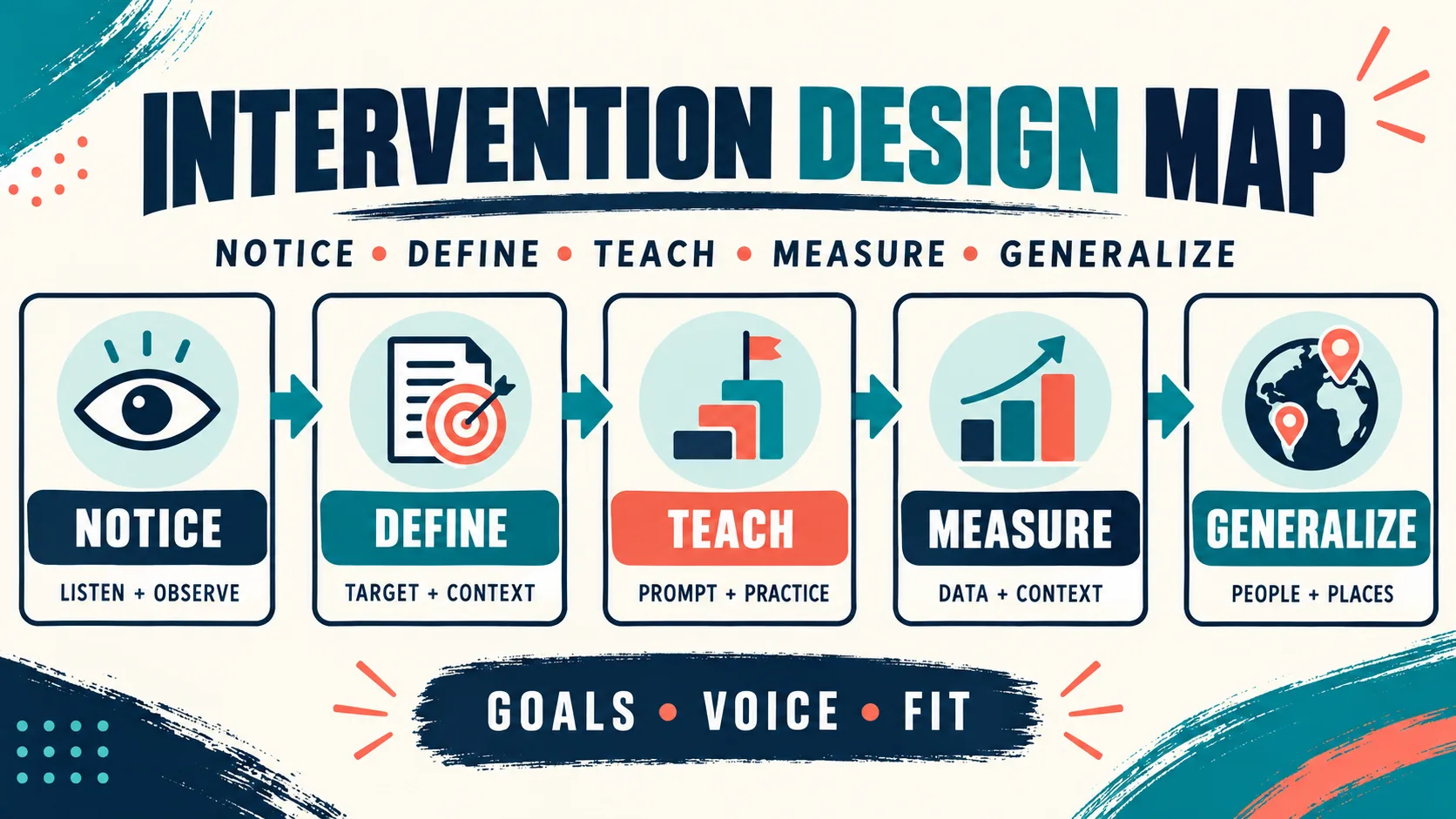
Start with the question the intervention is meant to answer. If a person cannot request help, the team may prioritize functional communication. If a routine is unsafe, the plan may analyze the context and teach a safer alternative. If a skill appears only in therapy, the team may plan generalization across people and settings. The method follows the goal; the goal should not be invented merely to justify a favorite method.
Choice should also account for the person’s age, communication, learning history, health, sensory profile, cultural context, family capacity, school schedule, and preferences. The same teaching arrangement may be useful in one context and a poor fit in another. The plan should include a way to notice distress, refusal, fatigue, pain, and unintended effects before they become a crisis.
Which ABA-Based Intervention Formats Are Common?
Labels often overlap, and a program may combine more than one approach. The table is a comparison prompt, not a recommendation or a treatment prescription.
| Format or approach | What it may emphasize | Questions to ask |
|---|---|---|
| Discrete Trial Teaching | Small, clearly arranged teaching opportunities with defined responses and feedback | How will skills move from structured practice into ordinary routines? |
| Naturalistic teaching or PRT | Learning opportunities embedded in motivating activities and natural contexts | How are interests, communication, choice, and generalization built in? |
| Comprehensive early intervention | Multiple developmental or adaptive goals coordinated over time | Which goals are essential now, and how will intensity be reviewed? |
| Functional communication or caregiver-mediated work | Teaching communication and practical responses across daily routines | What training, tools, and support will make the strategy usable at home? |
The National Institute of Child Health and Human Development describes several behavioral approaches, including positive behavior support, pivotal response training, early intensive behavioral intervention, and discrete trial teaching. That overview does not mean every approach is appropriate for every person. Ask the clinician to connect the selected format to the individualized goal and the data that will show whether it is helping.
What Does the Evidence Say About ABA Intervention for Autism?
Evidence questions are more useful than a simple “works” or “does not work” label. Ask which outcome was measured, for whom, under what conditions, over what period, and whether the outcome mattered to the learner and family. A study may show improvement on a skill measure without answering whether the person felt safe, had more choice, generalized the skill, or experienced an unintended cost.
The CDC treatment and intervention overview explains that behavioral approaches focus on what happens before and after behavior, use measurement, and can be delivered in health, education, home, or community settings. The NICHD behavioral-management resource describes common ABA-related formats and also notes that other behavioral therapies may be effective. Those points support individualized decision-making; they do not justify a guaranteed outcome or a universal schedule.
Evidence reviews also use terms such as comprehensive treatment model, focused intervention practice, naturalistic intervention, and family involvement. A family can ask the provider which category best describes the plan, which findings support it, and what limits the evidence has. If a clinic uses “evidence-based” as a slogan but cannot explain the target, measurement, or review process, ask for more detail.
How Do Data and Generalization Shape the Plan?
Data should answer a decision question. Depending on the goal, the team may measure frequency, duration, latency, accuracy, opportunities, prompt level, independence, or the use of a skill across settings. The measure should be defined clearly enough that different trained people could record the response in a reasonably consistent way.
Generalization means the learner can use a skill with different people, materials, places, or cues. Maintenance means the skill continues over time after teaching support changes. A plan that produces a strong clinic graph but no meaningful use at home, school, work, or in the community may need a different teaching arrangement. Ask when the team will probe generalization, how the family will see the results, and what will happen if the skill does not transfer. When reviewing a progress update, look for the connection between the target and the decision:
- What response was defined, and in what context was it observed?
- How much prompting or other support was needed?
- What changed in the learner’s daily participation, not only on the graph?
- Was the skill checked with another person, material, place, or routine?
- What will the team keep, change, fade, or investigate next?
How Should Child Voice and Ethics Shape Intervention?
Ethical intervention protects dignity, privacy, safety, communication, and meaningful choice. The BACB Ethics Code for Behavior Analysts provides the professional framework; the exact rules for a specific service also depend on the credential, state, employer, payer, and setting.
Assent can be expressed through words, gestures, movement, body language, device use, or other behavior. A child or adult may not control every clinical decision, but the team should notice signs of willingness, discomfort, fatigue, and refusal. A break request should be taught and honored according to the safety plan. If a procedure repeatedly produces distress, the correct next step is review and consultation—not simply labeling the response noncompliance.
Goals should not be selected only to make a person look more typical. Ask whether the target improves access, communication, health, autonomy, safety, relationships, or participation. A good plan can explain how it avoids unnecessary suppression of harmless self-regulation and how it incorporates the learner’s and family’s priorities.
How Does ABA Work With Other Autism Supports?
ABA does not replace every other service. Speech-language therapy may address communication, an occupational therapist may address occupational performance or sensory-related participation, a school team may address educational access, and medical professionals may evaluate health factors. The ABA team should obtain appropriate consent, clarify roles, and communicate in a way that does not create contradictory demands.
Families can read the site’s pediatric ABA guide for setting and team questions, and the ABA for toddlers guide for the narrower early-childhood topic. This page stays focused on intervention design and evidence rather than repeating those service-selection guides.
How Do ABA Intervention Autism Approaches Compare?
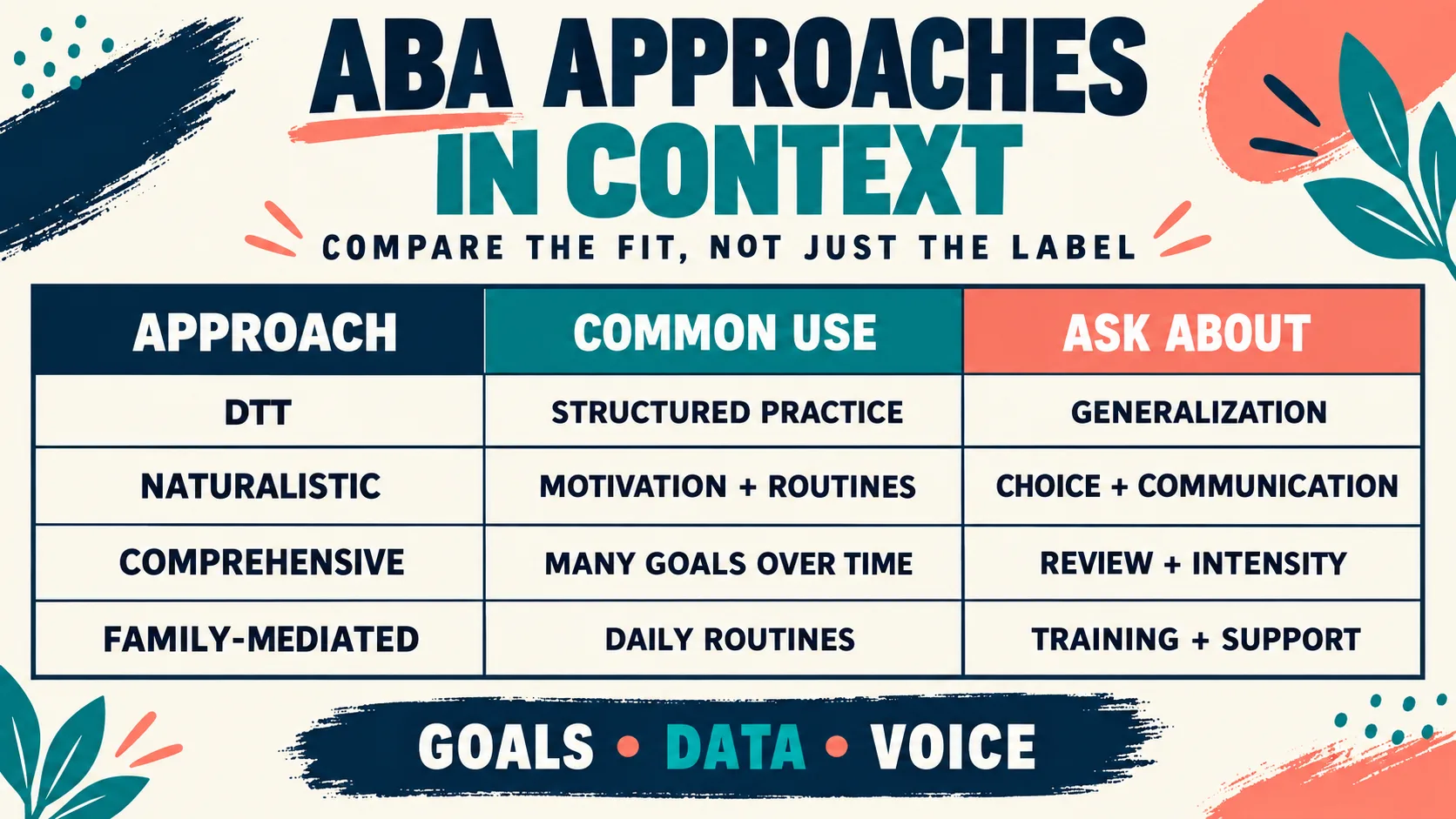
Use this matrix to compare the logic of a plan, not to rank one label above another. The same person may need a structured teaching opportunity for one skill, naturalistic practice for another, and caregiver coaching to make the response useful outside therapy. A qualified clinician should be able to explain why the selected arrangement fits the target and how it will be adjusted.
What Questions Should Families Ask Before Starting?
- What meaningful skill or participation problem is this intervention meant to address?
- How did the learner, family, and relevant professionals contribute to goal selection?
- Who assessed the situation, who supervises the plan, and who can change a procedure?
- What data will be collected, how will the family see them, and when will the team review them?
- How will the plan support communication, breaks, assent, privacy, and safety?
- How will the team test generalization and maintenance across people and settings?
- How will ABA coordinate with speech, occupational, medical, educational, and community supports?
- What would cause the team to pause, modify, fade, or stop an intervention?
What Are Red Flags in an ABA Intervention Plan?
Be cautious when a provider promises a cure, guarantees a result, treats one number of hours as correct for every person, refuses to explain who makes clinical decisions, or cannot show how data affect the plan. A generic curriculum may be a useful teaching resource, but it is not automatically an individualized intervention. A provider should also be able to discuss risks, alternatives, coordination, and what happens when the learner’s response changes.
Red flags do not mean a family must diagnose the provider from one conversation. They mean the plan deserves clarification, a second opinion, or a pause before commitment. Keep written questions, request plain-language explanations, and use the appropriate clinical, payer, school, state, or emergency channel for the issue involved.
ABA Intervention Autism FAQ
Is ABA intervention a cure for autism?
No. ABA is a set of behavior-analytic approaches that may support selected skills, participation, communication, learning, or safety. It should not be presented as a cure or as a way to erase an autistic identity. Outcomes depend on the person, goals, context, implementation, and other supports.
How many hours of ABA intervention are required?
There is no universal number that can be responsibly prescribed from a keyword. A schedule should follow individualized goals, assessment, health and safety needs, family capacity, school or work demands, clinical reasoning, and authorization rules. Ask how the recommendation will be reviewed and what evidence would support fading or changing it.
Which ABA method is best for autism?
There is no single best method for every person or goal. The relevant comparison is whether the teaching arrangement is effective, humane, meaningful, feasible, and generalizes. Ask the team to explain why a particular format fits the target and how the learner’s preferences and communication will influence implementation.
Can ABA be used with speech or occupational therapy?
Many people receive more than one type of support. Coordination should be consent-based and role-aware, with each professional working within competence and communicating about goals that affect shared routines. Families can ask who is responsible for each decision and how conflicting recommendations will be handled.
Key Takeaway
ABA intervention autism is best understood as an individualized design problem: identify a meaningful goal, select a defensible teaching arrangement, measure what happens, protect the learner’s voice, test generalization, and revise when the plan is not helping. For a structured review of the measurement, reinforcement, ethics, and supervision concepts behind ABA, use the site’s free BCBA mock exam. For targeted review, use our aba intervention autism practice questions to apply the concept in exam-style scenarios.
Take the Free BCBA Mock Exam
If you want a low-pressure way to check your recall, use the free practice resource below. Take the Free BCBA Mock Exam



